
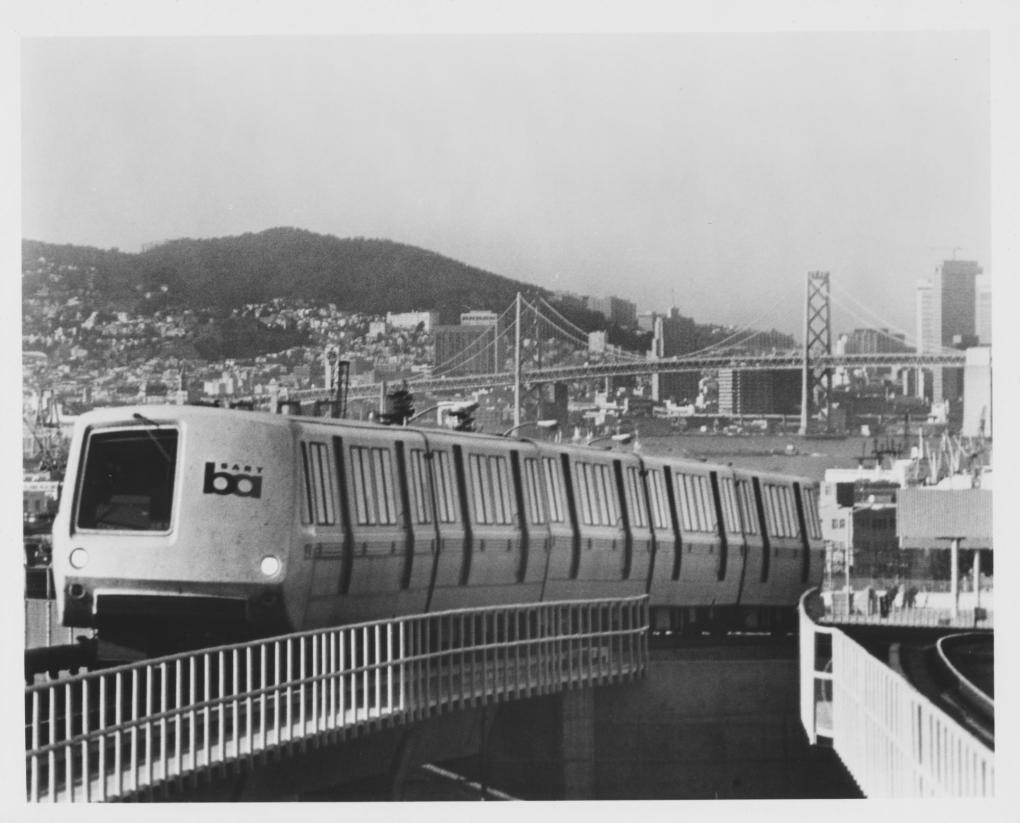
Check out our special 50 Years of BART section with historical documents, photos and videos at bart.gov/50years
BART's vision is to support a sustainable and prosperous Bay Area by connecting communities with seamless mobility.
BART's mission is to provide safe, reliable, clean, quality transit service for riders.
Mileage
131.4 total: The S-Line from Berryessa/North San José to Fremont, 15.1 miles; A-line from Fremont to Lake Merritt, 23.8 miles; the BART to Oakland International Airport (OAK) elevated guideway structure, 3.2 miles; the M, W and Y-line from Oakland West to Millbrae, 27 miles; the R-line from Richmond to MacArthur, 10.2 miles; the C-line from Pittsburg/Bay Point to Rockridge, 29.3 miles; the BART to Antioch extension from Pittsburg/Bay Point to Antioch, 9.1 miles and the L-line Dublin/Pleasanton to Bay Fair, 13.7 miles. Systemwide, there are 33.5 miles of aerial track; 65.1 miles of track at grade and 32.8 miles of subway track.
Stations
50 stations comprise 19 surface, 15 elevated and 16 subway stations. Four of these are a combination of BART and MUNI Metro stations in downtown San Francisco (Embarcadero, Montgomery St, Powell St, and Civic Center). One station is a combination of BART and Caltrain in Millbrae. One is a combination of BART and VTA Light Rail in Milpitas. For an overview of each station, visit the Stations section.
Track gauge
5'6" wide compared to 4'8.5" for standard. The BART to Antioch extension DMU trains run on standard gauge rail.
Trains
Legacy Gen 1 cars (A,B,C).
They use 1000-volt DC electricity from third rail power for propulsion. One 150 hp motor per axle, four motors per car. Aluminum body, air conditioning, tinted windows.
BART’s legacy fleet was composed of:
- 59 A2 cars and 380 B2 cars from Rohr. Year in service was 1972. Rehabbed in 1997 and 2002 and eligible for retirement in 2018 and 2022.
- 150 C1 cars from Alstom. Year in service was 1988. Never rehabilitated, eligible for retirement in 2015 and 2018.
- 80 C2 cars from Morrison-Knudsen. Year in service was 1994. Never rehabilitated, eligible for retirement in 2018 and 2021.
A-Car: 75' long with cab, 10'6 high, 10'6 wide, headroom 6'9"
B-Car: 70' long, 10'6 high, 10'6 wide, headroom 6'9"
C-Car: 70' long, 10'6 high, 10'6 wide, headroom 6'9"
- On September 11, 2023, BART began to run only Gen2 cars for the base schedule.
Gen 2 cars (D,E).
BART has ordered 775 cars from Bombardier, later bought by Alstom. They use 1000-volt DC electricity from third rail power for propulsion. Each car has two trucks. One 194 HP motor per axle, two axles per truck. Aluminum body, air conditioning, tinted windows, length over coupler faces -70ft. Nominal width at Carbody ( at closed door panels) – 126 in (130in). Nominal height from top of rail to rooftop 12ft 8-1/8 in. Nominal height from top of rail to floor 3ft 3 in.
The BART to Antioch extension trains are Diesel Multiple Unit (DMU). They are fueled by renewable diesel, an advanced biofuel produced from bio-based sources such as vegetable oil.
Number of cars
BART had 669 legacy revenue vehicles comprised of 59 A2 cars, 389 B2 cars, 150 C1 cars and 80 C2 cars in the fleet. Car seating capacity - 72 in both the Rohr-built A- and B-Cars, and 64 in C-Cars and C2-Cars.
BART has ordered 775 Fleet of the Future cars. The first Fleet of the Future train carried passengers in January 2018. The size of BART's fleet will be dynamic while new trains are put into service and old trains are retired.
BART has 8 DMU train cars which each have a seating capacity of 104.
Speed
70 mph maximum; 35 mph average, including 20-second station stops. For BART to Antioch DMU trains, the maximum speed is 75 mph; 60 mph average.
Operations Control Center (OCC)
The current Operations Control Center (OCC) replaced the old "central control room," which made history when the system first opened in 1972, with what was considered the largest monitor display board of its kind in the country. The OCC functions as the nerve center of BART's system, performing supervisory control of train operations and remote control of electrification, ventilation and emergency response systems. The display boards use computer imaging and video projection to display the entire system, combining information into two: one for track and train positions and the other for maintenance information and electrification. Stations and wayside - Network of control devices and track circuits controlling train speeds, stops and safe spacing. Backup train protection system - Sequential Occupancy Release System (SORS): 52 mini-computers in 26 stations.
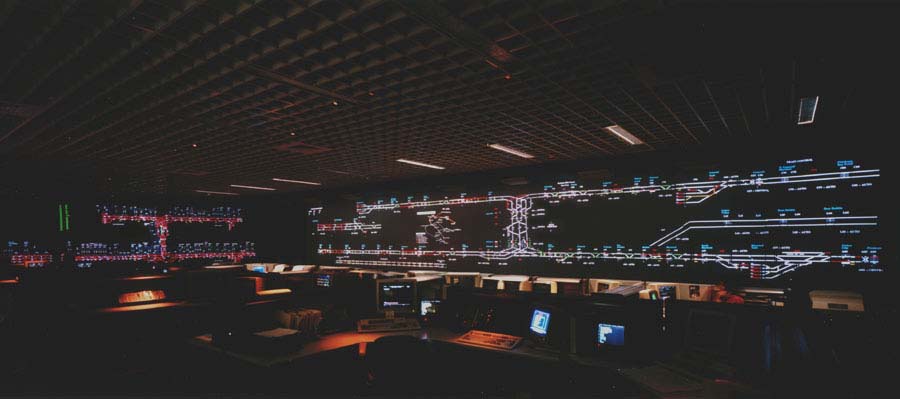
A centralized control center is needed to operate the BART to Antioch DMU system independent of BART operations. It is located in the maintenance annex north of State Route 4 near the Antioch Station. A dispatch, control and monitoring desk at the Central Control Facility is used to communicate with transit operations and maintenance personnel. The facility is also linked to the Operations Control Center to allow synchronization of operations at the DMU Transfer Platform.
Automatic Fare Collection (AFC)
Station Equipment
300 ticket vending machines, 579 faregates, and 168 addfare machines supplied by Cubic Transportation Systems, Inc. Ticket vending machines in the free area of BART stations accept cash as well as debit/credit cards. Addfare machines are located in the paid area of the stations, and are intended for use by customers who need to add value to exit the system. Addfare machines accept cash, credit and debit. In some stations, Addfare machines also serve for parking validation/payment. Additionally, there are over 80 bill-to-bill change machines located throughout the BART system. These machines break $10 and $20 bills into $5 denominations, for use in the ticket vending machines and addfare machines.
Fares
Clipper
The Clipper fare payment system is a Bay Area regional project managed the Metropolitan Transportation Commission. Clipper provides Bay Area transit customers a single fare payment medium for all their transit trips, through use of electronic "smart card" technology and pay by phone options.BART Tickets
BART stopped selling paper tickets in 2020 and stopped accepting paper tickets on November 30th, 2023.The BART magnetic ticket, with its blue and black stripes and simple white arrows pointing straight, has become an iconic piece of ephemera in the San Francisco Bay Area.
BART had offered:
A blue ticket for adults.
A green ticket for seniors 65 and older.
A red BART ticket for disabled individuals and youth ages 5 through 18.
A “BARTPlus” ticket, which was terminated in 2015 and would later be replaced by Clipper Card.
Fares
BART fares are based on how far you travel. To check fares visit the Fare Calculator. Fares are paid for with a Clipper card, which is the Bay Area’s all-in-one transit card administered by the Metropolitan Transportation Commission. Clipper is reusable, reloadable, and regionally accepted on other transit systems. Children 4 and under ride free, children 5 through 18, senior citizens (age 65 and over), persons with disabilities, and low income residents are eligible for discounts. Visit the Ticket section for more information.
Proof of eligibility is required for discount tickets and Clipper cards and therefore are not available at station vending machines. Discount Clipper cards can be obtained by mail or in person at multiple locations across the Bay Area.
Reports
Reports related to finances and BART's budget, ridership data, Customer Satisfaction Surveys, system performance can be found in our Reports section.
Cost of the Original BART System
| Total Cost of Original BART System | $1,619,000,000
|
| Sources of Funding: | |
| 1962 General Obligation Bond Referendum | $792,000,000 |
| California Toll Bridge Authority | $176,000,000 |
| Proceeds of Sales Tax Revenue | $150,000,000 |
| Earnings from Temporary Investments | $111,000,000 |
| Transit Development | $24,000,000 |
| Miscellaneous Income | $51,000,000 |
| Federal Capital Grants | $330,000,000 |
Costs of BART Extensions Program
| Phase I Extensions Programs | Cost | Year Opened/Opening |
| Colma Station (CSX) | $179,907,000 | 1996 |
| Pittsburg/Bay Point (PAX) | $480,000,000 | 1996 |
| Dublin/Pleasanton (DPX) | $584,790,000 | 1997 |
| San Francisco Airport (SFO) | $1,564,200,000 | 2003 |
| Warm Springs (WSX) | $767,000,000 | 2017 |
| Other Extensions | Cost | Year Opened |
| West Dublin Station | $106,500,000 | 2011 |
| Oakland Airport Connector (OAC) | $484,165,000 | 2014 |
| East Contra Costa (BART to Antioch) | $524,941,000 | 2018 |
| Silicon Valley Berryessa (SVBX)** | $2,421,300,000 | 2020 |
| **SVBX is fully funded by Santa Clara Valley Transportation Authority |