
Update - Sept. 16, 2024: The Earthquake Safety Program has been completed.
On This Page:
A Vital Transportation System
More Earthquakes Predicted
Transbay Tube Retrofit
Program Purpose and Benefits
Vulnerability Study
System Elements
Duration and Funding
Citizens' Oversight Committee
A Vital Transportation System
BART is one of the Bay Area's most vital transportation links. Before the arrival of the COVID-19 pandemic BART carried about 400,000 riders every weekday; and during the peak of the commute across the San Francisco Bay, BART carried as many travelers as the San Francisco-Oakland Bay Bridge. Ridership fell dramatically during the pandemic but it has started to grow as more riders return to their offices and use BART to attend public events. The BART system represents a public investment currently valued at nearly $15 billion, with immeasurable importance to the local and regional economy.
Major Earthquakes Predicted
BART's success in maintaining continuous service directly after the 1989 Loma Prieta earthquake reconfirmed the system's importance as a transportation "lifeline." However, Loma Prieta may not be the biggest test of BART's ability to withstand seismic impact. A U.S. Geological Survey statistical analysis has predicted a high probability of one or more major earthquakes hitting the Bay Area within the next 30 years. Unlike Loma Prieta, which was centered more than 50 miles south of San Francisco, future earthquakes could be close to or directly under the BART system.
Transbay Tube Retrofit
The Transbay Tube is BART’s most critical asset. Although the tube is structurally sound, in a very large and very rare earthquake, the outer shell and concrete liner could crack. To address concerns of flooding, BART embarked on a massive project to retrofit the tube that involved the installation of an inner steel shell and new pumping system. Read more about this project.
Program Purpose and Benefits
Because of the likelihood BART will be subject to a major earthquake, and to safeguard the public's significant investment in the system, BART initiated the Earthquake Safety Program. The program upgraded vulnerable portions of the original BART system to ensure safety for the public and BART employees. Portions of the original system with the highest traffic were upgraded not only for life safety but also to ensure that they can return to operation shortly after a major earthquake. The upgrades were accomplished using the latest seismic standards to improve the structural integrity of BART facilities.
Vulnerability Study
One of the first and most critical undertakings of the Earthquake Safety Program was a systemwide Vulnerability Study, an assessment of how system components would perform during a major earthquake.
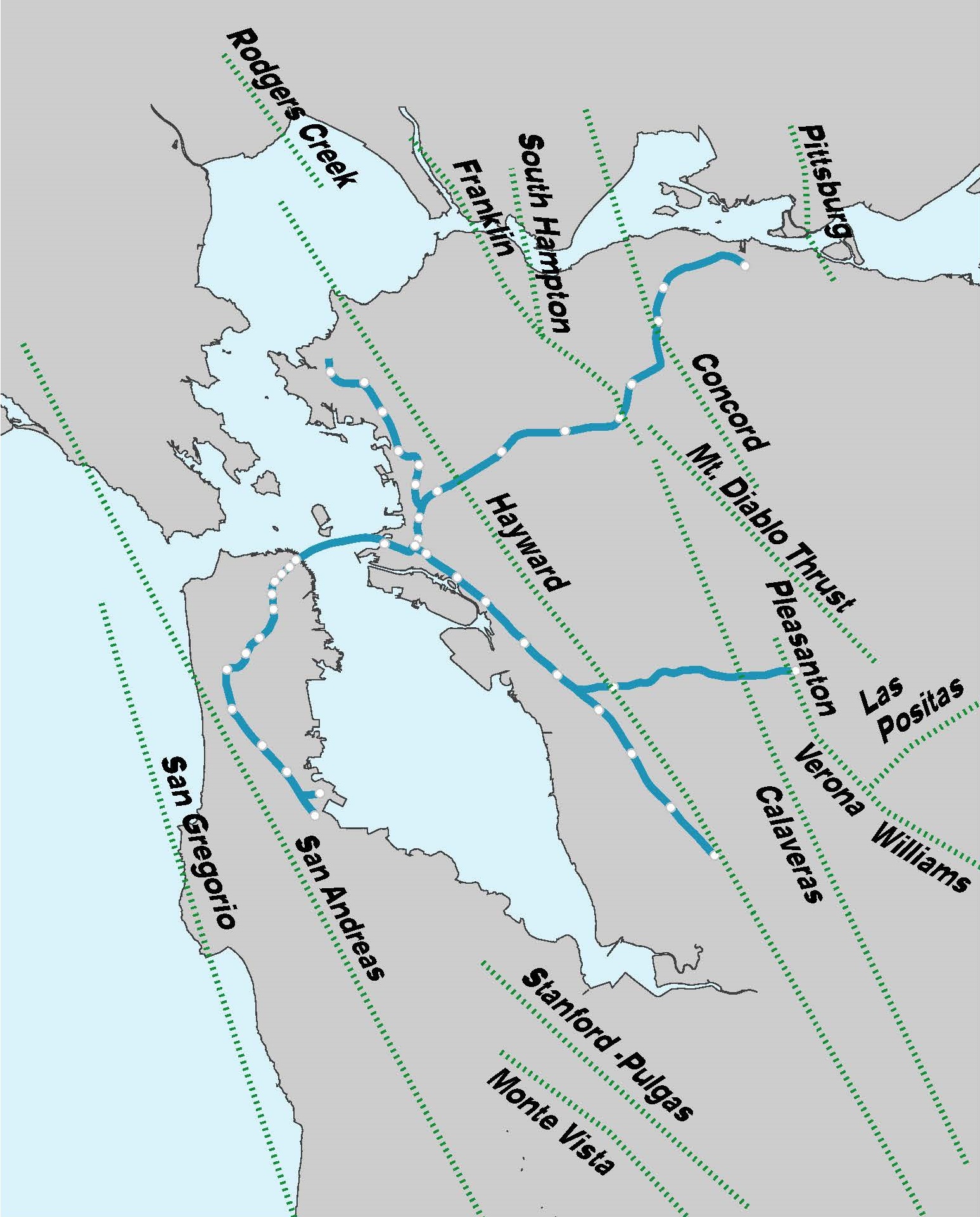
Bay Area faults in the BART service area
System Elements
The Earthquake Safety Program addresses the original BART system completed between 1972 and 1976, with a service area spanning three counties -- Alameda, Contra Costa and San Francisco. System extensions, built mostly during the 1990s, employed more stringent and up-to-date seismic criteria than the original system, and thus do not require upgrades. The original BART system includes the following elements:
- 74 miles of track
- 34 stations (11 elevated, 14 subway and 9 at-grade)
- The Transbay Tube
- The BART Caldecott Tunnel
- Train maintenance yards
- Terminal, operations and administration facilities
- Power, mechanical, train control and communications equipment
Duration and Funding
The Earthquake Safety Program was completed in 2024. Its budget was $1.457 billion. The funding sources included:
- $980 million from General Obligation Bonds (Regional Measure AA)
- $116 million from California Department of Transportation Local Seismic Safety Retrofit Program
- $93 million from Regional Measure 2 (RM2), State Transportation Improvement Program (STIP), Prop 1B
- $60 million from investment return
- $194 million from Measure RR
- $11.5 million from Transportation Congestion Relief Program (TCRP)
- $3 million from FEMA Pre-Disaster Mitigation Program
Citizens' Oversight Committee
On November 2, 2004, Bay Area voters passed Regional Measure AA, which authorized BART to issue bonds for $980 million to make earthquake safety improvements to BART facilities in Alameda, Contra Costa and San Francisco counties. The measure also required BART to establish a Citizens’ Oversight Committee to monitor the progress and effective use of funding.