
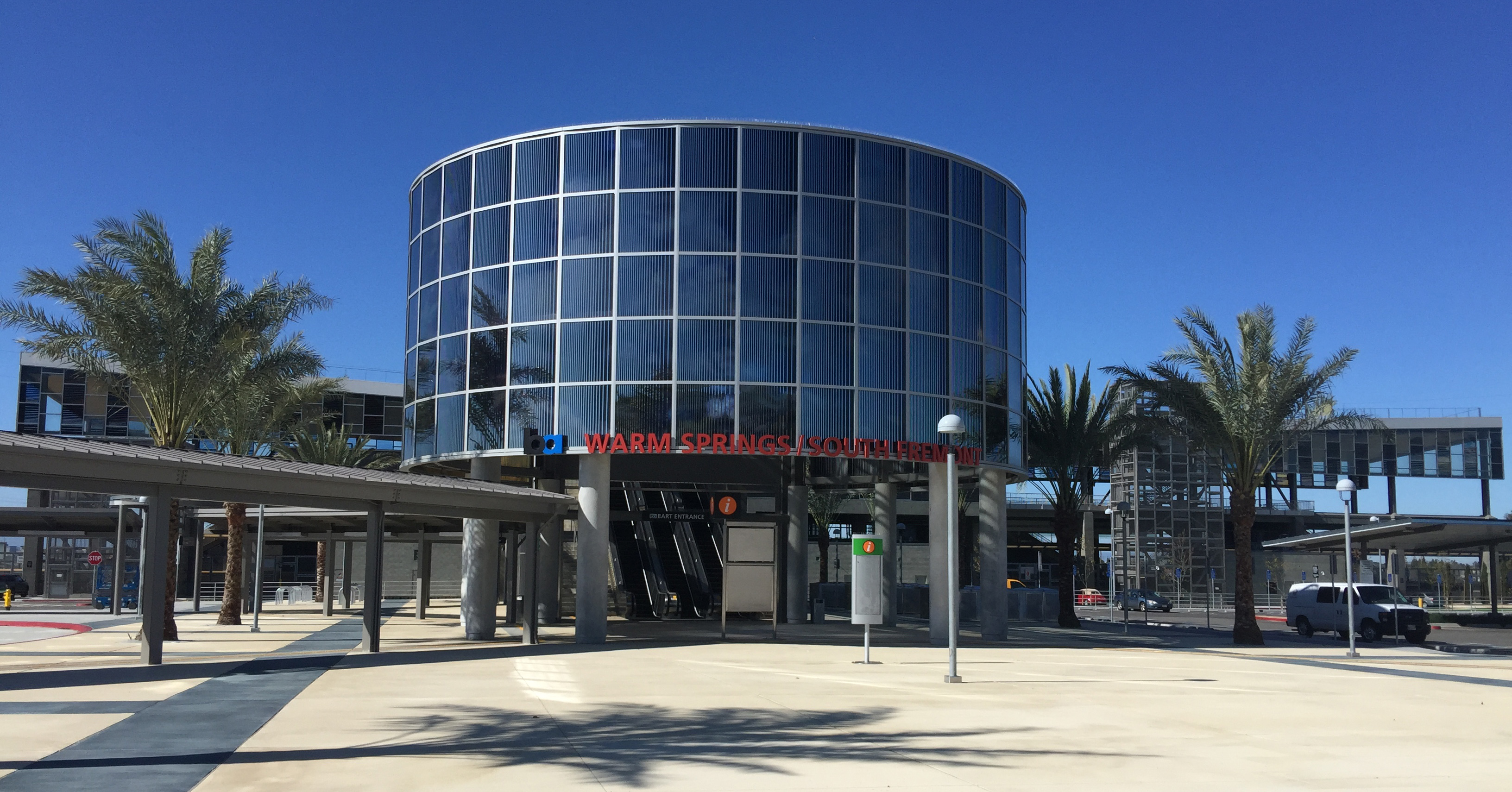
Warm Springs / South Fremont Station Rotunda
The Warm Springs Extension Project is a multi-station extension of BART service to the Warm Springs District of Fremont. The project has completed the Warm Springs/South Fremont Station, which opened for revenue service on March 25, 2017. The next phase of the project will design and construct the Irvington Station, which will be located approximately midway between the existing Fremont and Warm Springs/South Fremont stations.
The Warm Springs Extension Project includes:
- Warm Springs/South Fremont Station (completed)
- Irvington Station
Irvington BART Station
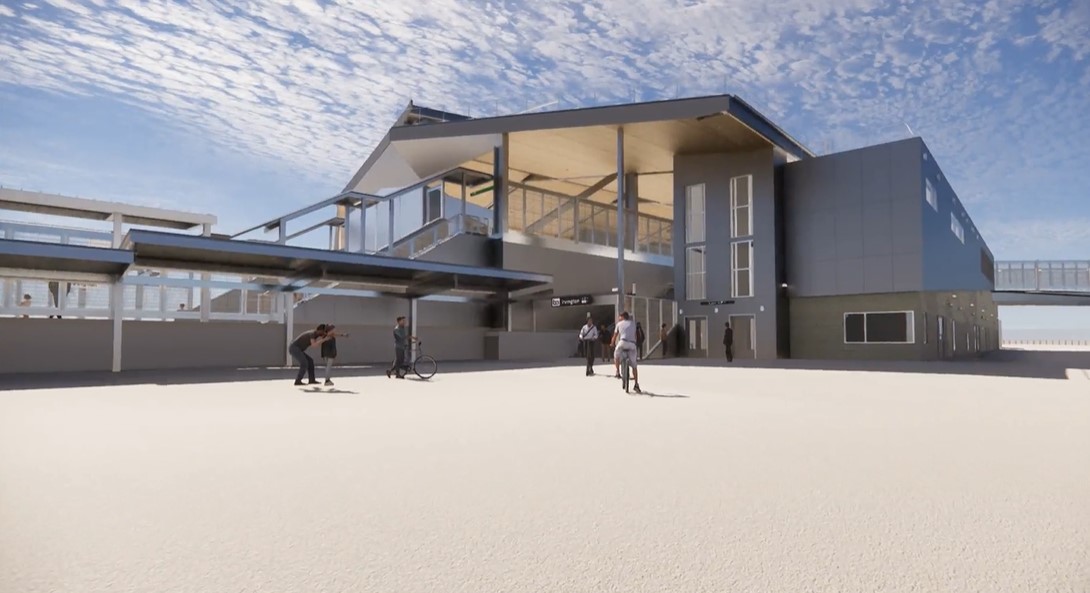
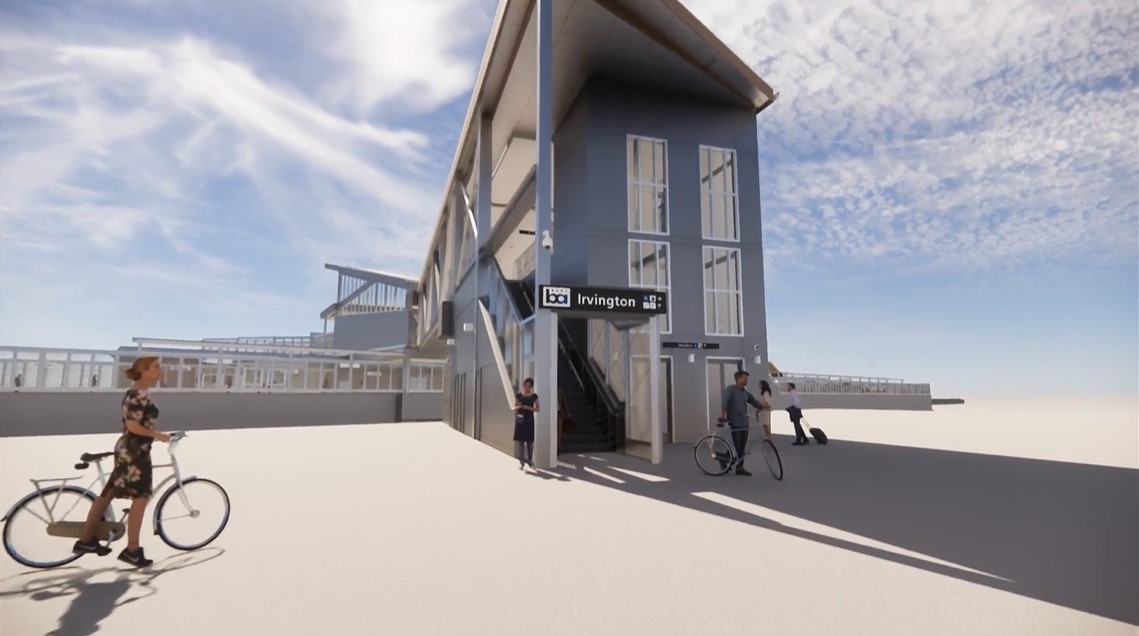
Click on an image above to access video walkthroughs of the Irvington Station Eastern Plaza and Western Plaza entrances. Precise timing and phasing of project construction is subject to funding availability to be secured by the City of Fremont.
The future Irvington BART Station is currently in design and will be located approximately halfway between the existing Fremont and Warm Springs/South Fremont stations. The City of Fremont has secured $120 million in funding for the station through Alameda County Transportation Commission's Measure BB, which was approved by voters in 2014, and an additional $2 million in funding through the Metropolitan Transportation Commission Regional Measure 2.
In November 2017, the City of Fremont provided BART a Letter of Intent stating the City is responsible for taking the lead to secure funding for station construction that is in excess of the amount provided by Alameda County Transportation Commission. In 2021, the cost estimate for the Irvington Station was $282 million. The project has $122 million secured. Federal capital grant programs could be pursued to help close this gap, provided the project obtained required NEPA clearance. BART has recommended the City of Fremont seek a revised cost estimate conducted by an independent third party and an updated ridership forecast reflecting current economic conditions prior to pursuing any additional funding.
Planning and environmental work led by the City of Fremont was completed in Summer 2019, and the preliminary engineering work led by BART was completed in Summer 2020. The project is now in the final design phase. Click here to learn more.
For more information, visit the City of Fremont's website or visit the Warm Springs Extension news section.
Irvington Station Art Design Development Presentation Now Available - Click here for more information
Irvington Station Final Design: Architecture & Art - Click here for more information
Geotechnical Investigations & Surveying to Begin for Irvington Station November 2019 - Click here for more information
Quick Links
Attachment 1 -The Metropolitan Transportation Commission's adopted Cap and Trade Funding Framework.
Attachment 2 - November 2017 Letter of Intent from the City of Fremont.
Irvington Station Final Design: Architecture & Art - Click to learn more.
BART Board Adopts Addendum to the Warm Springs Extension Project FSEIR and Modifications to the Irvington Station - Click to learn more.
Irvington Station Update: Preliminary Engineering Completed, Final Design for Irvington Station to Begin Summer 2020 - Click to learn more.
BART Warm Springs Extension Named Project of the Year by the California Transportation Foundation - Click for more information on the award!
BART Warm Springs / South Fremont Station Recognized as a CODAWorx 2018 Top 100 Design Project
Watch the Warm Springs / South Fremont Station Video - Click to view the video of the Warm Springs / South Fremont Station.
Solar Power at the Warm Springs / South Fremont Station - Click for more information on solar power at the Warm Springs / South Fremont Station.
Construction Updates & Videos - Visit our Construction Updates Section for updates.
Warm Springs Extension Virtual Tours - Take a quad copter ride down the Warm Springs Extension project alignment and around the new Warm Springs / South Fremont Station!
Read our contractor success story - Mosaic Global Transportation
Project Overview
The Warm Springs Extension (WSX) added 5.4-miles of new tracks from the existing Fremont Station south to a new station in the Warm Springs District of the City of Fremont. A second station will be added as an infill station and located approximately midway between the Fremont and Warm Springs/South Fremont stations in the Irvington District. $120 million in funding for the Irvington Station is included in Alameda County Transportation Commission's (ACTC) Measure BB passed by voters in 2014.
The WSX project alignment crosses over Walnut Avenue; under Stevenson Boulevard, Fremont Central Park and the Union Pacific Railroad track in a subway; over Paseo Padre Parkway; under Washington Boulevard; under Auto Mall Parkway; and over South Grimmer Boulevard. Get a detailed description and images of the Warm Springs Extension Alignment.
The Warm Springs/South Fremont Station features an at-grade island platform with an overhead concourse, intermodal access to Valley Transit Authority (VTA) and Alameda-Contra Costa Transit (AC Transit) buses, as well as taxi and passenger drop off areas, all via Warm Springs Boulevard. The new station also provides approximately 2,000 parking spaces, including 42 EV charging stations.
As with all BART stations, the Warm Springs/South Fremont Station is fully accessible to pedestrians and bicyclists and includes bike lockers, elevators, escalators, Braille signs, and a tactile sight path to aid riders with disabilities.
In keeping with the Federal Transit Administration (FTA) guidelines to incorporate art into mass transit projects, BART commissioned artwork from professional artists for the new Warm Springs/South Fremont Station and for the concrete seating areas at the existing Fremont Station. Learn more about the Warm Springs Art Program.
Project Background
 In 1992, the BART Board of Directors certified the Final Environmental Impact Report (EIR) and adopted the two-station extension; however, the project was not constructed because sufficient funds were not available. In 2006, the project completed an environmental review under the National Environmental Policy Act (NEPA). This was in addition to the California Environmental Quality Act (CEQA) clearance that was completed in 2003. View the history of the Warm Springs Extension environmental process and a chronology of the Warm Springs Extension project.
In 2007, BART devised an implementation strategy whereby the project would be constructed via two large contracts: The Fremont Central Park Subway Contract and the Line, Track, Station, and Systems Contract. This approach succeeded in minimizing overall escalation costs and the special needs associated with the disruption to Fremont Central Park.
Fremont Central Park Subway Contract
The Fremont Central Park Subway Contract (Subway) included a mile-long subway beneath Fremont Central Park, an embankment for the BART trackway, two ventilation structures, and relocation of recreational facilities within Fremont Central Park. The contract work area extended from just south of Walnut Avenue, through Stevenson Boulevard and Fremont Central Park, including a portion of Lake Elizabeth, and to the east side of the Union Pacific Railroad (UPRR) freight tracks just north of Paseo Padre Parkway. The BART Board awarded the Subway contract to the Shimmick/Skanska Joint Venture on May 28, 2009, for the low bid of $137 million, and the contract was completed on schedule and under budget.
Line, Track, Station, and Systems Contract
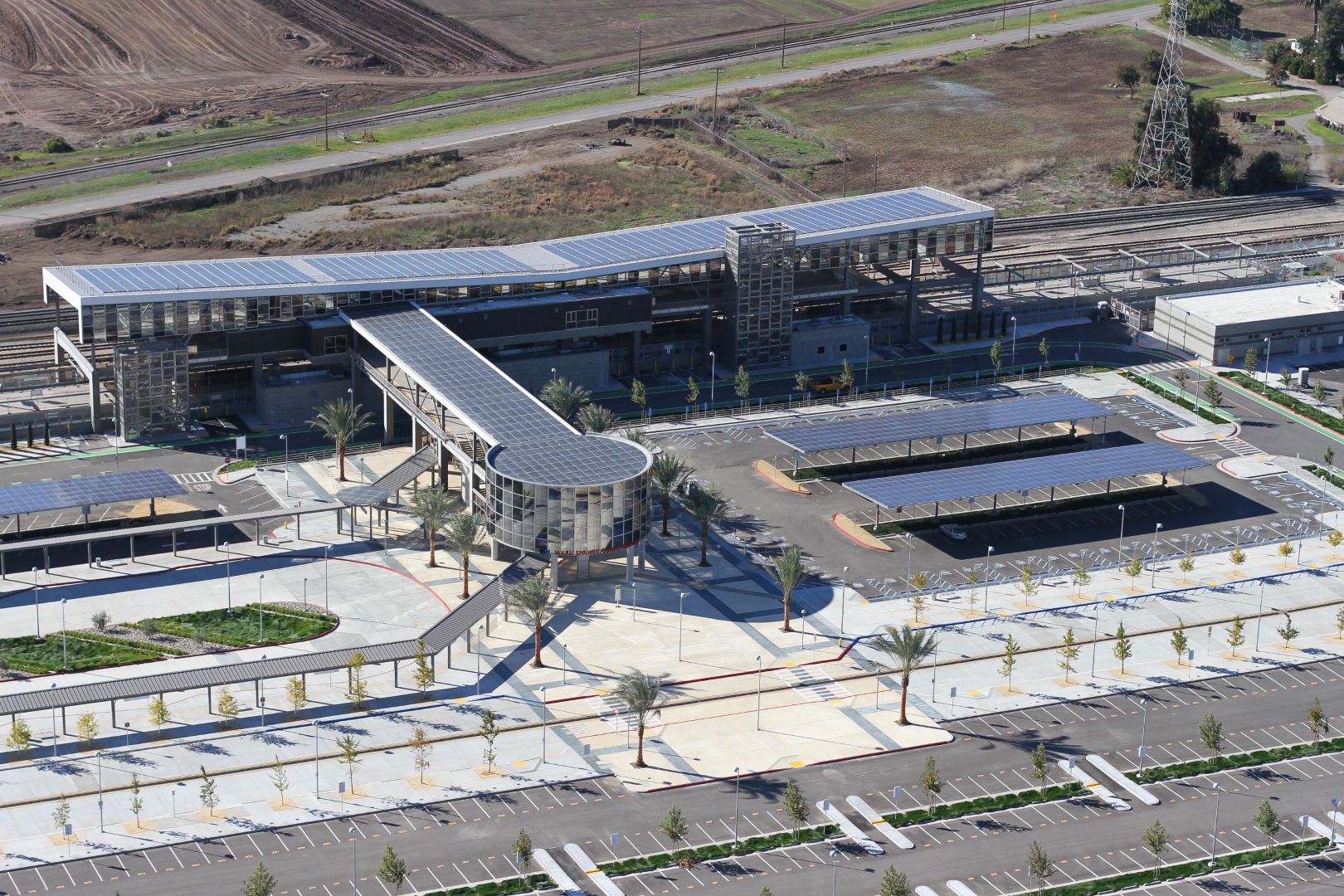 The Line, Track, Station, and Systems (LTSS) Contract was a design-build contract intended to perform the final design as well as construct the remaining parts of the Warm Springs Extension, including the trackway, systems, tie-in at the Fremont Station, and the new Warm Springs/South Fremont Station and parking lot. This contract also included certain provisions to facilitate both the further extension of BART into Santa Clara County (by VTA) and the construction of an intermediate station in the Irvington District.
The Warm Springs/South Fremont Station, including the surrounding site, was carefully designed to promote both multimodal and disabled access as well as to accommodate potential future transit-oriented development. The station meets not only BART's Facility Design Standards, but also the expectations of the BART Bicycle Task Force, the BART Disability Task Force, and the accessibility requirements of the State Architect. Furthermore, the site development is well integrated within the surrounding infrastructure, both existing and planned. The conceptual and preliminary design of the station itself was the work of Robin Chiang & Company of San Francisco, architectural sub-consultant of BART's General Engineering Consultant, Parsons Brinckerhoff, Inc. The open and gracefully geometric design, coupled with ample landscaping and a public art component, is intended to capture both the spirit and energy of BART, as well as the history and culture of the Warm Springs District of Fremont. This design concept was completed and detailed by the Design-Build contractor's architect, HNTB, as part of the execution of the LTSS contract.
The Warm Springs/South Fremont Station opened for passenger service on March 25, 2017, significantly under budget.
Tail Track Building Demolition Contract
This contract removed or modified various existing structures along Warm Springs Court in preparation for construction of the BART trackway south of the Warm Springs / South Fremont Station. In October 2011, the contract was awarded to Parc Services of Livermore, CA, for $1.06 million. The contract was completed on schedule in October 2012.
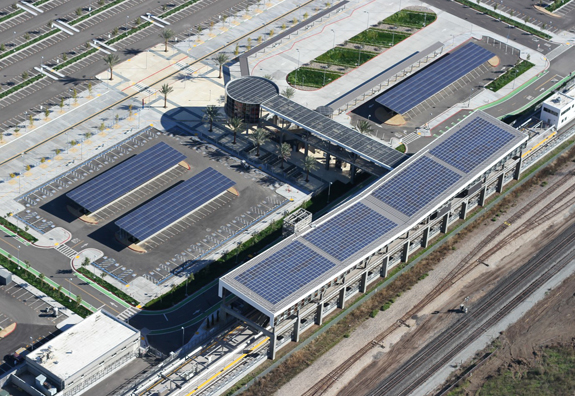 Solar Power at the Warm Springs / South Fremont Station
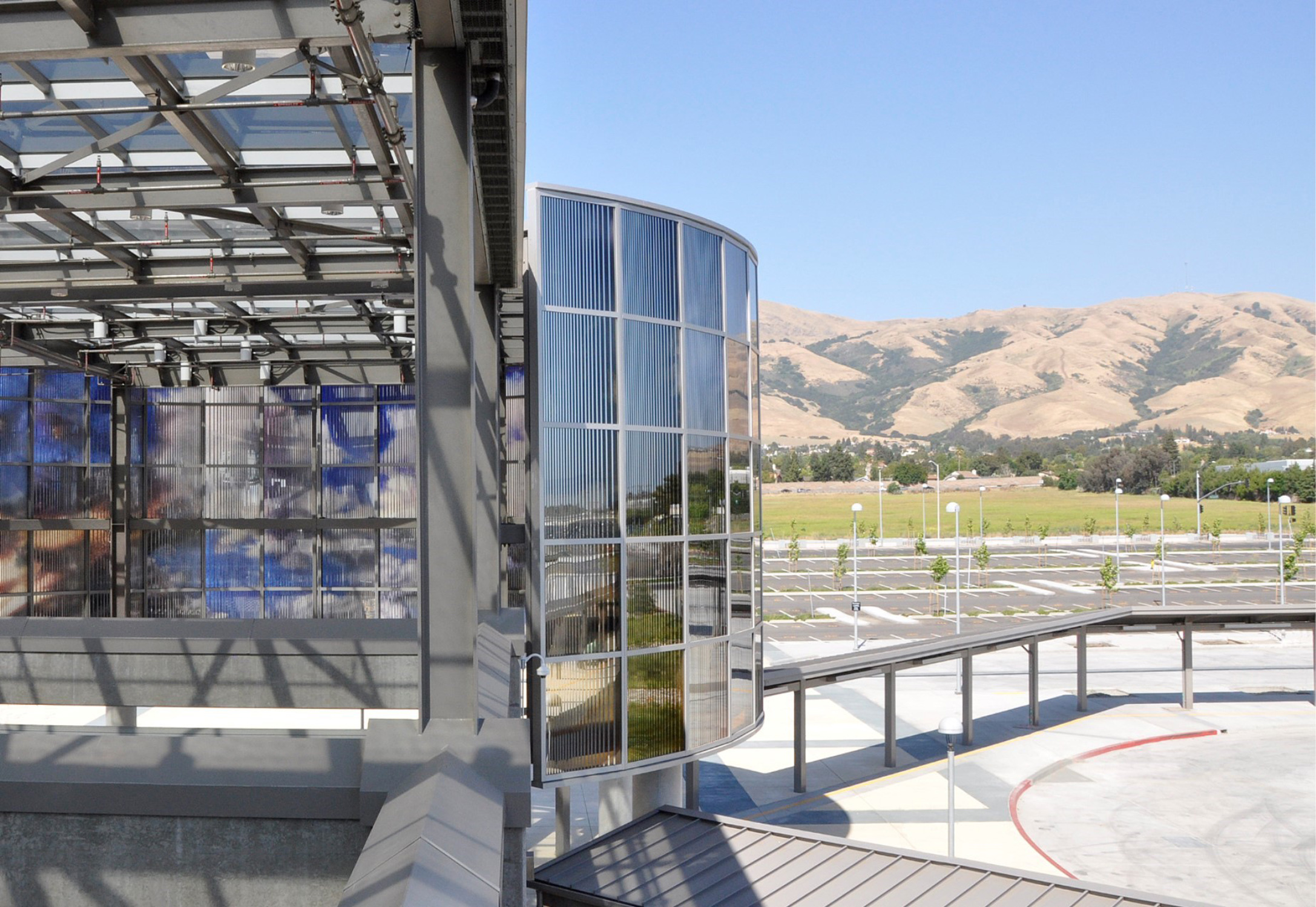
The Warm Springs / South Fremont Station has nearly 2,000 solar panels installed on the station roof and on parking lot canopies. These were installed and will operate for at least the next 20 years under a “power purchase agreement” between BART and SolarCity. The panels went into operation on September 29, 2016 and have the capacity to generate 512 kilowatts (kW) of power, which is more than enough to serve all the daytime electricity needs for the Warm Springs / South Fremont Station. For comparison, the average California home with rooftop solar has about 5 kW of capacity.
Partners and Funding
The total project budget for the Warm Springs Extension was approximately $890 million. The various funding partners and their share in the total project are as follows:
- $215 million Alameda County Transportation Improvement Authority (ACTIA), Measure B Tier 1
- $100 million State of California Traffic Congestion Relief Program
- $176 million Metropolitan Transportation Commission (MTC) Regional Measure 2 Bridge Tolls
- $118 million MTC Regional Measure 1 Bridge Tolls
- $69 million State of California Transportation Improvement Program (STIP)
- $2 million Alameda County Congestion Management Agency (CMA)
- $40 million MTC Proposition 1B - 50% BART (Revenue Based), 50% MTC (Population Based)
- $92 million MTC Proposition 1B State & Local Partnership Program (SLPP)
- $24 million BART Agency Contribution
- $54 million San Francisco International Airport (SFO) Extension Surplus Revenue
The WSX project, exclusive of the Irvington Station and rail vehicles, was completed for approximately $750 million.
Warm Springs Extension Construction Schedule
Major construction on the Warm Springs Extension began in August of 2009 with the commencement of the Fremont Central Park Subway Contract. The Subway Contract was completed in April 2013. Major construction of the design-build Line, Track, Station and Systems (LTSS) contract, which began in October of 2011, was completed in the summer of 2016. The Warm Springs Extension opened for revenue (passenger) service on March 25, 2017, following a period of rigorous testing and CPUC approval.
Other Related Projects
West Access Bridge & Plaza Project
In February 2022, the west pedestrian/bicycle bridge was opened connecting the Warm Springs / South Fremont Station to the City of Fremont's Innovation District. For more information on this project, visit the City of Fremont's project webpage.
Washington Boulevard and Paseo Padre Parkway Railroad Grade Separation Project – Update
In May 2010 the City of Fremont completed the Washington Boulevard and Paseo Padre Parkway Railroad Grade Separation Project. The grade separation at Paseo Padre Parkway included an overpass for future BART trains, and was constructed by the City of Fremont via an agreement with BART to avoid future disruption during construction of the Warm Springs Extension. The Grade Separation project eliminated six railroad grade crossings, relocated interfering utilities and made the railroad corridor to the southeast of Fremont Central Park compatible with the WSX project alignment.
BART Silicon Valley Project
This project is intended to extend BART service southward from Warm Springs to Milpitas, San Jose and Santa Clara. This project is sponsored by the Santa Clara County Valley Transportation Authority (VTA), which is responsible for its implementation under an agreement with BART. For more information on this project please visit www.vta.org/bart.
Updated October 2022