
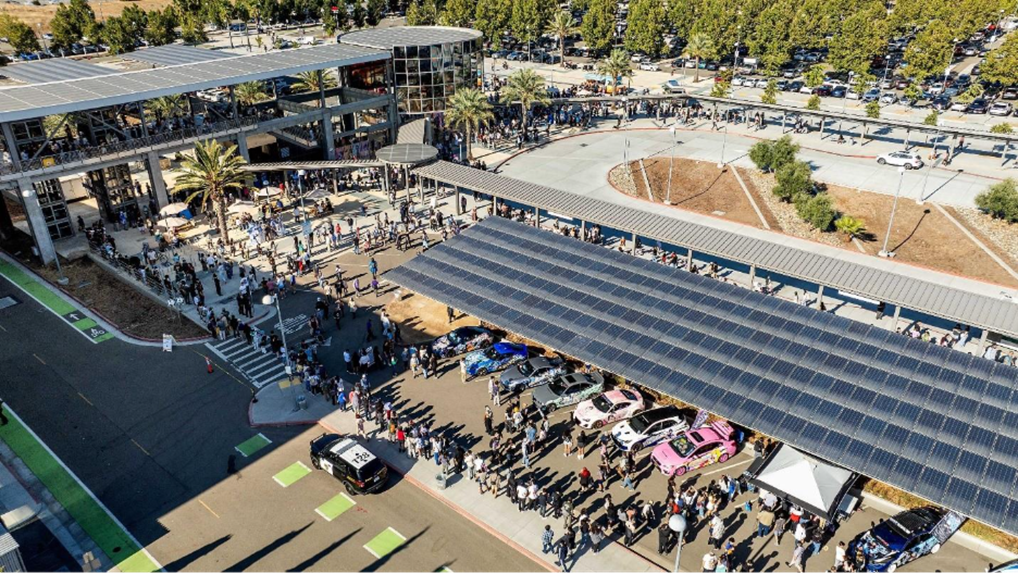
Solar panels on the roof and in parking lot of Warm Springs / South Fremont Station.
Sustainability at BART is both what BART does and how BART does it
What BART does
BART carries approximately 181,000 passengers on a typical weekday (as of calendar year 2025). BART’s daily riders save nearly 34,000 gallons of gas and directly reduce CO2e emissions by over 660,000 pounds per weekday.
By providing accessible transit, BART helps people rely less on cars for their daily needs and encourages dense, mixed-use development. The compact, walkable communities made possible by BART support healthy lifestyles and reduce transportation costs for its riders.
How BART does it
BART is committed to advancing regional sustainability by providing safe, affordable, equitable, and environmentally friendly transit to move people to jobs, recreation, and services. BART incorporates cost-effective sustainability through fulfillment of the goals found in the Sustainability Policy.
BART’s Sustainability Program
Specific focus areas of BART’s Sustainability Program include:
- Energy Use: As one of the biggest consumers of electric power in Northern California, it’s important that BART identifies savings where possible.
- Energy Procurement: BART procures its own electricity, the majority of which is used for the traction power system that runs its electric train fleet, to source clean, renewable energy.
- Green Building and Infrastructure: BART uses guidance for building construction and operations as identified by organizations like the US Green Building Council and the Institute for Sustainable Infrastructure.
- Electric Vehicle Charging: BART supports transportation electrification, including the transition to electric vehicles (EV). Projects to install EV chargers at BART stations with parking serve riders and surrounding communities. Additionally, EV chargers at BART’s support facilities promote the transition of its fleet of non-revenue vehicles, like service trucks, from gas-powered to EV in addition to supporting BART employees who drive EVs.
- Stormwater Pollution Prevention: BART strives to minimize potable water use and prevent stormwater pollution.
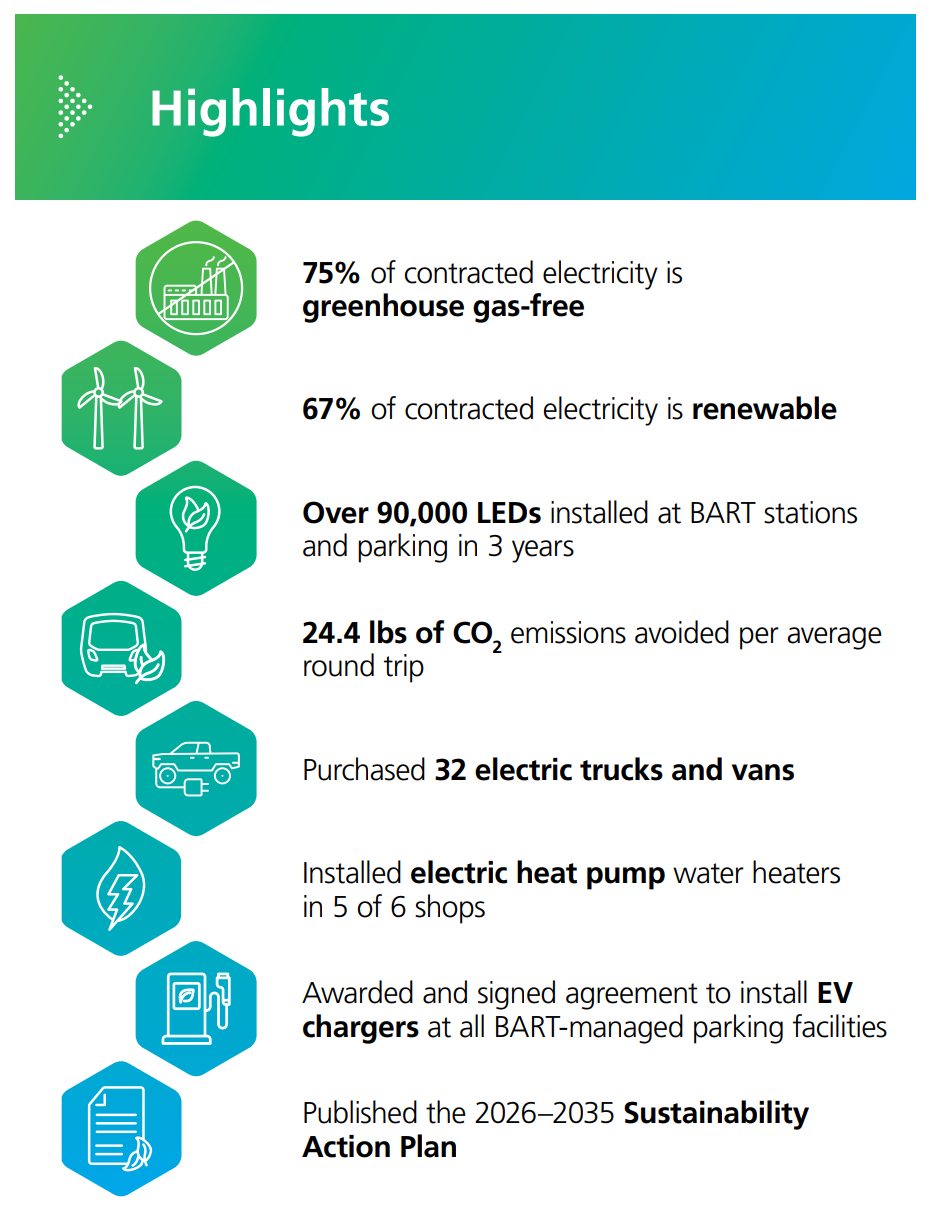
Key documents for BART’s Sustainability Program efforts, like the annual Sustainability Report, are found at the Policies, Plans and Reports. Highlights from the most current report are shown below.
Did you know that BART riders get the equivalent of 101 miles per gallon?
On average BART is over three times more efficient than a typical car driven alone (on a passenger-mile per gallon basis of comparison).
- [1] = number of passenger miles travelled on BART (2024) = 844,765,603 miles
- [2] = amount of traction power energy used by BART trains (2024) = 1,100,578,666 MJ
- [3] = amount of MJ per gallon of gasoline = 126.9 MJ/gallon of gas
- [4] = energy adjustment factor for deadhead and layover miles = .964
- BART miles per gallon of gas equivalent = [1] / [2] * [3] / [4] = 101 miles per gallon equivalent
- Average car fuel efficiency: 24 miles per gallon (based on most recent 20 years of average fuel economy from the US Environmental Protection Agency’s Automotive Trends Report)
Questions or feedback?
Please send an email to [email protected].