
Traffic is a nightmare when bad weather hits the Bay Area. Turning to transit is a great option to avoid driving in unsafe road conditions.
Weather can also impact BART service and cause delays.
Even with these impacts, BART remains a much safer option to driving during bad weather.
When the rails are slippery from frost
BART will temporarily run trains at slower speeds in areas where the temperature dips below 36 degrees Fahrenheit causing frost and ice. But it is a temporary condition as once a few trains run over the area, it heats up the rail enough to return to normal speeds.
BART no longer runs trains at reduced speed during the rain, except for a few select locations near the end of the lines. BART crews updated the train car braking profile software and made slight changes to train speeds at specific locations with a longitudinal slope and where data showed cars were experiencing high rates of wheel flats. These two changes reduced wheel flats and allowed BART to run trains at normal speeds during the rain. Wheel flat spots occur when wheels slide on rails, instead of spinning.
When it is hot
BART uses sensors on its tracks to measure rail temperature. When the rail temperature reaches 115 degrees Fahrenheit, BART slows the speed of trains in that area to reduce possible heat-related train derailments caused by sun kinks in the rail. A sun kink is when extreme heat bends or distorts the track.
BART rail is heat-treated prior to installation, which allows for thermal expansion of the rail; however, when there are sharp rises in ambient temperatures, the thermal forces exerted on the rail increase, making it possible for the rail to expand beyond its designed temperature.
Train speeds are reduced in targeted parts of the system as a precautionary measure to give Train Operators more time to react to any observed abnormal rail conditions.
BART crews also do more inspections in areas prone to heat impacts during heat waves.
Running trains at reduced speeds causes delays of at least 8 minutes in impacted areas.
Extreme wind
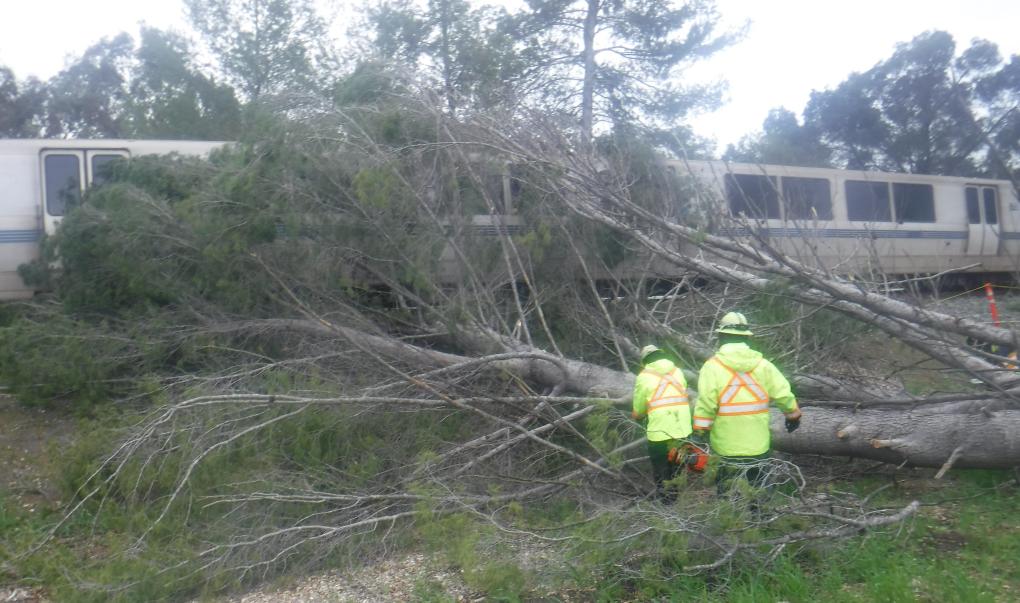
BART runs normal service during wind gusts unless something is obstructing our tracks, such as a downed tree.
BART has a preventative maintenance program to protect the system from trees that could be knocked down into the trackway during severe weather. Trees are removed or cut back before winter storms arrive in the Bay Area.
BART cars were built for wind velocity up to 94 MPH. Our nonstandard wide gauge track provides more stability in high winds for our lightweight aluminum cars. All the heavy equipment is mounted under the floor of the train, giving our cars a low center of gravity.
Power outages
Power outages typically do not impact train service because BART has flexibility to pull power from other sections of our traction power supply system, ensuring continuous train operation. The exception to this can occur when there is a power outage impacting a train dispatch yard. For example, if lightning strikes near a yard causes a power failure, our ability to safely dispatch trains could be impacted.
During power outage incidents, critical systems such as tunnel fans are protected by a combination of fixed and portable generators.
Additionally, all BART stations have emergency backup lighting systems. Escalators at stations impacted by a local power outage may be taken out of service. Elevators should remain operational. BART will close a station if it doesn’t have adequate lighting for safe service. BART will also deploy power generators to stations if needed. Fare gates automatically open when there is no power.