
Podcast: BART managers take to the trains to hear directly from riders
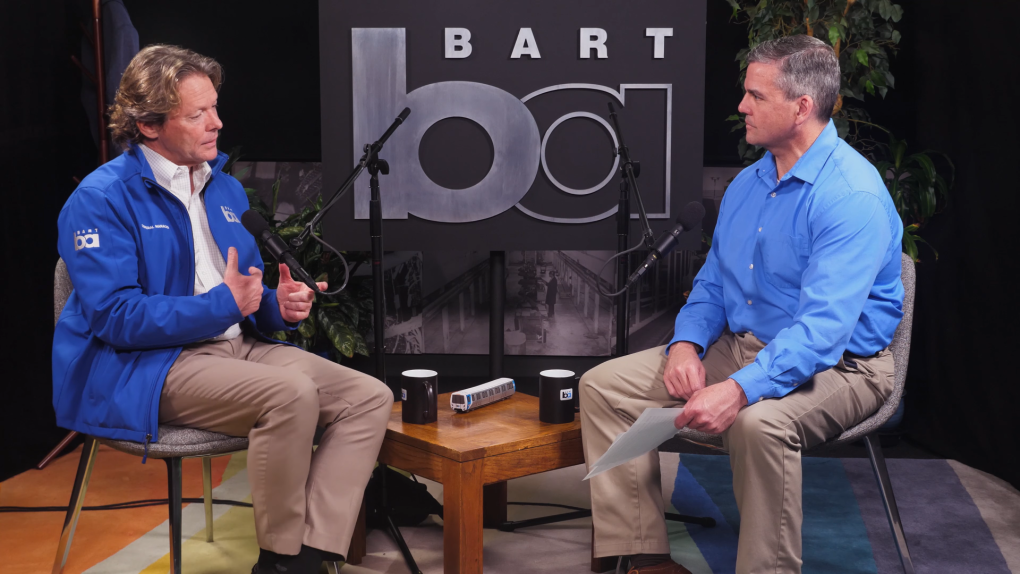
INTRO: It’s a criticism that’s been around for as long as there has been public transit: “If the people running these systems actually rode the trains, things would be different.” BART is responding to that thought with a program that is making sure dozens of the agency’s top leaders on a consistent basis are riding the system they manage. Welcome to “Hidden Tracks: Stories from BART.” I’m Chris Filippi with the BART Communications Department and on this episode of Hidden Tracks I’m joined by the man who launched the Managers Riding Trains program, BART General Manager Bob Powers.
(Transcript Below)
FILIPPI: When you’re out doing Managers Riding Trains, do you get compliments on your hair?
POWERS: (laughs) It’s normally all over the place, Chris, I don’t.
FILIPPI: And I’m now joined by BART General Manager Bob Powers, thanks for joining us on Hidden Tracks.
POWERS: My Pleasure, my pleasure.
FILIPPI: So, Bob, you're an engineer by trade. A really interesting story even coming here. Worked in Baltimore and Seattle, then came to BART in 2012, as I understand, as an Assistant General Manager of planning, moved up the ranks, became GM in 2019. Talk about the challenges of leading such a complex organization that so many people in the Bay Area count on.
POWERS: Yeah, I think, you know, as my progression at BART, over the I think I've been here 12 or 13 years now. It has been quite interesting in that as the Assistant General Manager for planning, development and construction, you were responsible for a certain set of portfolios. And then I fleet it up to the Deputy GM and that portfolio grew, and now you're the GM and it's everything at BART. And so, you know, you represent BART at every meeting that you're at. One way or the other. You're responsible for all the decisions that are getting made at BART one way or the other. And, I just have found that, as that progression has happened, the importance of the executive team and the team that you work with and just that family atmosphere to get us through.
I've just enjoyed it every day, every day coming into work. I've enjoyed it. Even the days that are a little rough around the edges, you know, coming in the next day is not difficult. Right? It isn't, and it's because just what I feel that BART means to the Bay Area and how important it is, and I just enjoy working with the people at BART. I fundamentally do.
FILIPPI: That's really huge. To have that team that that you can count on and that you have, confidence in. I think a lot of people imagine what would it be like to be the boss? You know, we all kind of have a vision in our mind. But once you get into that position, sometimes it's a little different than you imagine has anything surprised you about the General Manager’s role?
POWERS: I don't know if it's surprise me, but you know, you're responsible. You know, everything kind of lands up in the corner office, right? Which is fine. But I have found maybe by trial and experimentation how important it is to get re-grounded. And re-grounded is, you know, there's a lot of discussions going on whether they're technical or political or social, but get back grounded into what we're our core mission, Chris, is safe, clean, reliable transportation. And so when all this other drama is going around that we're involved in, you know, getting back out, talking to the Train Operators, talking to the Station Agents, getting out in the system. I mean, resets me and brings my drama level down. I'm like, okay, this is what we're supposed to be doing.
FILIPPI: That’s why you’re here. You get away from that noise to get back to what matters for folks. And that really ties into Managers Riding Trains, which you launched back in January of 2024. Tell me about that idea. How did it come about?
POWERS: It was something I had been thinking about, about how important it is for our managers to be out there in the system, and getting grounded in what, you know, what their work is. If you're a planner or if you're a financial analyst, if you're the head of procurement, you know, that's great, but you're doing it for a reason, right? And the reason is what we do provide safe, clean, reliable transportation. What better way to kind of reinforce that is to get our managers out riding trains, and to see how we're doing.
FILIPPI: I grew up in the Bay Area riding BART. Since I've been at BART, I think riding the trains is so important because if I'm going to talk about our service, I need to live the service. I need to experience it. Do you feel that same way for the managers that they really need, It's different to talk about it as opposed to, okay, here's what the riders are actually experiencing today and candidly, some days can be better than others.
POWERS: Totally. I couldn't agree more, Chris. You have to experience what our riders experience if we are in fact going to improve the rider experience, right? I mean, that's what we're all about. And so, what better way to do that than to know firsthand what their experience. If you were to ask me, you know, the current challenges with the new fare gates, right? I wouldn't be able to answer that but for me, being out the system, I go out there, I stand at these fair gate arrays, and I watch what's going on, how the customers are interacting with the fare gates and where we need to kind of sand down the edges. I wouldn't be able to have that discussion with the Station Agents or the our front line employees unless I'm out there in the system, I wouldn't have known that data set sitting up on the 10th floor. Just wouldn’t.
FILIPPI: So, tell us how the program works because I'm thinking it's really important to have that structure to actually get it on calendars and then follow up on it and make sure it's happening consistently.
POWERS: Yeah. So, Managers Riding Trains, I first started, you know, what did we want out of Managers Riding Trains? There are different benefits of it and certainly the one is, you know, folks getting out in the system and knowing BART and being able to understand the rider’s experience but there's other benefits to it. To maximize those benefits, which we can certainly talk about.
So, we have five lines of service. We have 130 miles; we have 50 stations. What I wanted to do was to saturate the system with eyes and ears and a presence. And so we looked at five lines, the entire system in the am and the pm, peak hour inbound in the mornings and outbound in the afternoons. It started with, I think it started at about, I don't even know what 12 or 13 teams of two and I paired them up, so, like you and me. This is one of the jackets that we wear.
FILIPPI: I see that, that looks good.
POWERS: And the point of the jacket was to, when you and I are out in the trains, walking the system and riding trains that people notice, you know, you're two BART employees walk in the trains. So, we needed to be visible that, hey, there's two BART people walking the train right now. We broke the system up into zones, and we tried to set it into zones. We have the data in the analysis that you and I in a certain zone could ride the entire zone and back within the two hours, 2.5 hours. So, we broke it up and we put it in teams of two, and we've tried to pair people up. I know each other pretty well. We said like, you know, right through the hallway. I could yell and you could hear me right, to yell to you, not at you.
FILIPPI: (laughs)
POWERS: But how important it was to pair people up that were unknown to each other, right and how that has another complementary benefit. You put somebody from fire life safety together with somebody from, accounts payable. Right? And then all of a sudden your family gets tighter over time, right? And so it's grown. It's doubled in the last, I don't know, six months or so. That program has doubled and so right now we have 50 teams of two ride in the system. Happens to be on Tuesdays. Pairing up with each other, riding the systems, walking the trains, talking to our riders. And it has proven a just the most, a seriously high return on the investment of folks being out in the system during their day to day. You know, their core business hours at BART. I could list off five, six, seven benefits that, one, you know, some of them that I knew consciously going into what we'd get, but some that just were, you know, just happened to be benefits after the fact. You know, it's just organically, right?
FILIPPI: What kind of benefits?
POWERS: Yeah, I'll tell you that one of the biggest benefits, certainly planned benefits, was to be complimentary presents to our Progressive Policing Bureau out there. And, you know, if we see folks that are in need of services or folks that shouldn't be in the BART system, you know, just be an added presence to our Progressive Policing Bureau was out there to do that. And obviously one that was planned was to be out there talking to the riders, you know, what's working for them, what's not working for them. Right?
But there are other benefits that, you know, we have been out there when our when our folks are out there. And if you and I are out there, we are riding the train. My zone, my train. I get on at Lake Merritt, and I ride supposed to be down to I think it's Bay Fair, but I've added one. I've gone down to Hayward just because I wanted to grab Hayward into what I do. And, you know, it's evolved so that it's not just talking to the riders being a presence, but if you're riding with me and you'll learn from me the way I do it, I make sure the lights are up, especially now with the time change. I look at the stations, I see how the stations are operating. I study the fare gate operations on it. So, it's this complimentary set of perspectives that are not necessarily project deliver or engineering. Right? These are folks that are generally not a bunch of engineers out there watching the fare gates so it's just a different perspective,
One of the things that you don't think about, Chris, you come down on the platform, and we don't have a map of the system, right? Because you and I know the system like the back of our hand, right? But for our riders, every station, every glass case or plastic case that is down there should have a map in the system or some type of information for our riders. And so, and the stations are the first place that a rider gets introduced to BART, right?
You walk down on 19th, every one of those cases should have something in it, right? And a vacant case is a bad impression of BART for our riders, it's these little things, right? And, and I think those little things are just kind of these just a side benefit of the managers being out there and we've just improved the rider experience.
FILIPPI: Yeah. Looking for those sorts of things like the lighting at a station or an empty kiosk or something like that, that could easily go by the wayside. And, you know, people who may work at the station don't even, like, notice it after a certain amount of time, because they're just so used to it. But having that extra set of eyes out there, that just seems like a really, a very easy way to get some easy wins.
POWERS: Yeah, totally. The analogy I use is folks that are drafting up a memo to send to the governor's office, right? I'll grab somebody who's got nothing to do. I'll grab you, right? I'll grab somebody for Communication. External Affairs. Nothing to do with the memo. Just as an outside QAQC does this read, right? And that's exactly what's happened with Managers Riding Trains.
FILIPPI: I think it's a big deal to be out there and be visible. But you even touched on it, the job of the people doing Managers Riding Trains isn't just to be out there, it's to interact.
POWERS: Interact, talk to the riders and you build up, you know, folks, I'll tell you I'm out there and you can tell. You walk the trains, I get in the last car train pulls into the station, eight car train, ten car train. I'm at the end of the platform and this is the, there's directions I've given to everybody and you start at the end car and you walk through to the front of the train. As the train is moving, you jump off at stations, get on the next one.
You make eye contact with the riders and if they're too busy during their whatever they're doing or if they want to say hello and how's everything going and where they're going. If I am up on the platform and if I see somebody that may not be sure they're on the right platform and I say, you guys good, everybody know where you're going. Everything. And they just are, so, like, oh, you're with BART. Oh, yeah. We want you want to go here. And they're just so appreciative that somebody in a blue jacket or in a in the BART uniform is out there. That's in addition to our front line employees that are out that do an excellent job.
FILIPPI: Yeah, and I was going to ask about that too. I'm really interested in what the riders are telling you. As an example. I mean, we've had some service interruptions of late. When you go out on a Tuesday after one of those days, are they unloading on you or are they coming up like, what is that experience like?
POWERS: Yeah, they are. It reinforces Chris, you know, the term unloading maybe it's accurate. But my perspective is when they come and talk to me after we've had a service challenge, a service disruption, it reinforces to me and every other manager riding on the trains just how important BART is, right? And that we cannot be, these service we have to minimize those and do away with them because we're impacting the quality of the ride and you hear it, right? Somebody is trying to get home. Somebody is trying to pick up their kids from daycare, or they're trying to get to their next appointment and we're not able to run a line of service because of a power disruption.
It just reinforces how important we are and how we have to drive down these disruptions. And you're right, they are vocal and they should be vocal. They should hold us accountable.
FILIPPI: When that sort of thing happens, we make a big deal about our public outreach, and rightly so. Talking to the public, talking to the press, being very present on social media. But that one-on-one interaction with riders, especially riders who are counting on us for several days a week, as you mentioned, to get to a job, to get to a doctor's appointment, to get to their classes, to talk with those folks directly, just feel so important to me.
POWERS: It is. And I hear, I hear often, I hear if it happens, it happens but what they're more interested and they're not, certainly they want us to minimize those, those instances, Chris, but what they really want to do is to get real time information about the impacts and what their options are. You know, when is the next train going to be coming, should they transfer? So, they're very interested in, this real time information that we put out to them so that they can have the options and the choices to make.
FILIPPI: Give me a sense for that rider feedback. Obviously, you're hearing from them directly what kind of gains, is that kind of feedback leading to? What kind of improvements are we seeing because of what you're hearing on these on these Manager Riding Trains trips?
POWERS: Yeah, the big one, the most recent one that was challenging for BART was that when we have these service disruptions, oftentimes our app doesn't reflect what's going on in the system. If I take a line out for certain duration, two hours, three hours because of a power, what should happen in a perfect world, is that our real time information? Right? When Chris goes on to his, it should show that line being out of service. But there's been a disconnect on that. It's been since fixed, but that was primarily pointed out to me by our riders like, Powers we get it, but you know, you got to get your software and your real time information up and running so that people know and can make decisions. And there was no excuse. We had no excuse on why our real time information that we put out wasn't consistent with the service that we put out. They should be synced up at all times.
FILIPPI: What's the most memorable experience you've had with Managers Riding Trains?
POWERS: You know, one of the biggest takeaways for me is how, this effort is being perceived by our front-line employees, the men and women with SEIU (Service Employees International Union), ATU (Amalgamated Transit Union), AFSCME (American Federation of State, County, and Municipal Employees), the OA (BART Police Officers Association, BPOA), the MA (BART Police Managers Association, BPMA), they're out there. I talked to them, and they are so appreciative that we're out there.
Pick a station, you and I go to Fruitvale Station this afternoon that station is spotless, and it's SEIU that's maintaining that station and all the stations that are out there and so, I'll talk to the workers that are out there. I'm like, this station looks awesome, the platform, it's spotless. I call it theNnew BART, right? The new fare gates, safety and security, cleanliness, on-time performance. I could go on and on, but we're killing it on those. You know, those three legs of that stool and talking to our front-line employees and getting their feedback. It is just I guess that's probably one of the highlights that and it happens every time I'm out in the system.
FILIPPI: Yeah, as I understand it's become known as Blue Jacket Tuesday. So, I mean, but that really speaks to you're being noticed and it's not just a one off and I think especially in your position, anybody who leads a large organization, it's so easy to become out of touch and to not talk to folks that are on the front lines, dealing with the customers every day. I would think that's a really important thing for you to stay grounded but to also hear that real experience.
POWERS: And they know they have day-to-day, hour-after-hour, what's working and what isn't working, right? So, listening to the frontline employees translates to improving the rider experience. You know, listening to the riders translates to improving the rider experience. So, you couple those two together and we are making headway. So, rider experience is all time high right now, right? Our crimes in the system are way down. I don't know if it's at an all-time low, I mean considerably down. On-time performance is looking good and I'm not, by any stretch, disrespecting that we've got to do away with these service disruptions that's unequivocal. They happen. We got to deal with them. We got to do better there. But, if I could pull those out, we're doing pretty good. So, I just kind of pull them out and minimize them and eliminate them.
FILIPPI: It's probably the core question. There's so much going right with BART but given service disruptions, perhaps some riders are like, can I count on you? I need to get to work on time. What do you tell a rider like that?
POWERS: They can count on us, Chris. We are 94, 93% passenger on time. Again, our cleanliness numbers, our safety numbers we're rocking it there. We are taking drastic steps. I would say, you know, and minimizing and reducing these service disruptions.
When I talk to our frontline employees and I do service awards, and I'm in a group of 50 of, I make no qualms about it is our Achilles heel, right? We're doing so good. Steps forward with the New BAT, four or five steps forward and then this disruption and I'm back three steps, right? And then I got to regain ground. We would be so much further along without these disruptions. So, we're really focused on minimizing those.
FILIPPI: How big of a deal is it to have so many managers in blue jackets out there, especially if it's been like a tough day recently. But just being out there and facing the public in terms of the credibility of BART. Maybe things didn't go exactly how we want it, but we're here to face the music. We're here to face our riders directly. How big is that in terms of our credibility in the Bay Area?
POWERS: It is at the core of our credibility. And I think at the core of the BART family, you know, to the Bay Area is our commitment to transparency. If and when something, you know, challenging in the system happens, we're very forward leaning. We're taking it head on and trying to course correct on that situation, remedy it and put us in a position not to happen again. We don't hide from it. You know, if something were to happen, we’re out there in the system talking to our riders, it happened, right? It's unacceptable. We're trying not to let it happen again. But we're not hiding from it, I'll tell you that. Not under my watch.
FILIPI: Are riders asking you about our future kind of in the big sense, beyond the service. Like, hey, we've heard about this fiscal cliff. We know transit in general faces some real challenges going forward. Do you hear that from riders?
POWERS: I do, I hear that quite often. Again, it translates back to how important BART is to the region. And, they are they're concerned about BART's fiscal position and about, you know, where BART's going. We had a pretty good discussion with the BART Board yesterday about, you know, our upcoming budget process. So, and then I would say the riders are very sophisticated and they quite understand, Chris, that in the Bay Area public transit is a system, right? These are not standalone transit agencies, and we're all interconnected and we're all, working very well together right now. But as BART goes, the other operators go and so that that sophistication, they're tracking on and so there's concern about if BART's having challenges fiscally, you know, what does it mean to many, many people who take BART connect to another system, right? Whether it's Muni, AC Transit, Caltrain? So, if BART’s got challenges, what does it mean to those connections, and those complementary agencies?
FILIPPI: Are folks asking you about Tap and Ride? This is a real improvement for the BART experience, a recent improvement. It allows folks to tap in, tap out on BART with a credit card. Big convenience, especially for travelers. Are you getting feedback on that?
POWERS: Feedback has been overwhelming. Overwhelmingly positive, Chris. As I'm out in the system watching and learning. I knew about folks coming in paying with their credit card. If you and I go to say we go to London, that's what we would do, right? Pull out your credit card. It's, you know, SOP, right? Standard Operating Procedures in world class transit operations, which BART is world class. And so now we are just pull out your credit card tap and off you go. But you don't think about it until you're out there watching the interaction with the riders.
I was out at Embarcadero not too long ago and talking to folks that were coming in, and they're like, they had Clipper cards, but they hadn't loaded their Clipper cards. And they're like, I'll deal with that tonight when they get home, they pulled out their credit card and tapped and off they went. They made their train. They made their connection, right? The Station Agents are talking to riders that are at the Clipper vending machines. They're like, hey, you can just, you know, pull out your credit card and tap, and they're like, what? Yeah, we can do that. You're like, yeah, and off they go and it really has it's running around, you know, 10 or 11% of all trips taken on BART right now are Tap and Ride. And we've had very few, drama sets associated with that. BART was first in to go to this Tap and Ride. But December 10th, December 10th every other operator in the Bay Area that's on the Clipper system, which is the vast majority, if not all of them, you will be able to use your credit card and Tap and Ride starting December 10th and just what a difference that's going to make, right?
And then we transition into Clipper Two. We have the Super Bowl coming in town. We have the World Cup soccer games coming in town. Just a fundamental change in the rider experience.
FILIPPI: So, Next Generation of Clipper is coming up. Clipper Two is going to bring a lot of improvements for folks too. You talked about being a network and more than BART. That's what Clipper Two is all about. That's going to be a huge improvement for riders. Allows discounts between different agencies.
POWERS: It is. The discounts from one system to the other system, riding out in in all 27 operators and what it's going to allow us to do after it gets up and running, in December, we will be able to work with MTC (Metropolitan Transportation Commission) on these, all these folks that want these passes, right?
You want you come in to say go into Barcelona, right? But get yourself if you're not, get yourself a pass for a three day, you know, ride transit anywhere in three days a pass, let's do something like that at the airport, right? They could go on BART, wherever they want to go, you know. And you know, these passes and the Clipper Two allows all this creative thinking to, manifest itself in improving the rider experience and that all starts, you know, December 10th.
FILIPPI: You mentioned some of the big events coming up to Super Bowl, FIFA World Cup. These are events that are so large, it's even more than just the event. There are all these surrounding events that bring people into the community. What an amazing opportunity to showcase all the improvements at BART.
POWERS: Yeah, not only at BART but at public transit in the Bay Area. But, you know, I bleed BART blood. BART blue blood. You're wearing BART blue. But yeah, we're very proud. I am so proud of the New BART and when folks are out in the system. The other piece, Chris, since you brought this up that I hear people, when I'm out in the system or just out going from, I generally don't even go to a meeting that's not BARTable, folks that are getting reintroduced to BART, that hadn't taken BART in a while or that have take BART once in a while to a dinner or an event like that, they're like, man, you guys are rocking it. It's just you know, it's a very proud feeling that folks are feeling like that, and I think with these events that are coming in, you know, worldwide events, people coming from all over the world staying for days and weeks, they're really going to enjoy the public transit in the Bay Area.
FILIPPI: So, we've talked about all these lighter subjects. Let's get serious.
POWERS: All right.
FILIPPI: So, how long have you been a Deadhead?
POWERS: A long time, a long time. I'll tell you, Chris, it's crazy because I get into it so much that I don't listen to anything else.
FILIPPI: Really?
POWERS: Yeah, it's gets a little crazy, you know? And I have all these playlists on my Spotify on different Dead shows that, you know, and I share them around a little bit with people. But I get into this groove, I'm like, man, I haven't listened to anything else in a long time and I'm like, I better, you know, do a little variety. Yeah. But, you know, I listen to a lot of Dead. I sometimes I say kiddingly, you know, that concept is a forcefield around me, and nobody can penetrate it, you know?
FILIPPI: Is there a Dead concert that you've been to that stands out in your mind?
POWERS: No, the ones that I gravitate toward, any Dead concert is good, it'll change how you look at life. But the ones that I listen to a lot, you know, certainly 1972 was a good year, 1977 was a good year, but any year's a good year for a Dead show.
I was listening to one from ‘84 last night. You know, when I put, like, four or five songs and I fell asleep to it, you know, and so.
FILIPPI: OK? Cool, there it is.
Thank you for listening to ‘Hidden Tracks stories from BART.’ You can listen to our podcast on SoundCloud, iTunes, Google Play, You Tube, Spotify, and of course on our website at BART.gov/podcasts.