
Search Results
Bus Bridge and Red Line Cancellation Alert: Major trackway rebuilding work near Richmond Station on four non-consecutive weekends
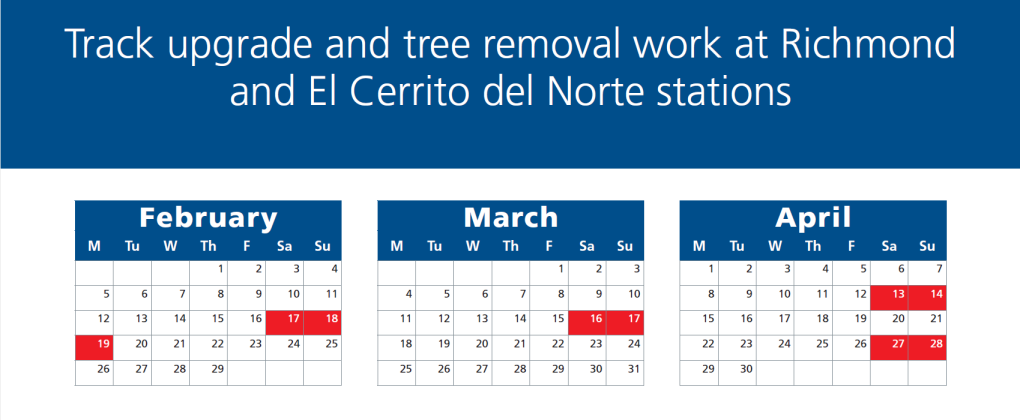
Update 4/15/24: The final bus bridge that had been scheduled between Richmond and El Cerrito del Norte the weekend of April 27-28 has been cancelled. Instead, our team will do trackway replacement work on the Yellow Line between Rockridge and Lafayette stations the weekend of 4/27-28. Get more details on this project here: https://www.bart.gov/news/articles/2024/news20240313
BART’s next major track improvement project will focus on replacing track equipment near Richmond Station. On four non-consecutive weekends in February, March, and April workers will replace an interlocking near Richmond Station. Interlockings allow BART to safely move trains from line to line and are an essential part of the system. Work will also be done to address vegetation that could impact service.
The weekend dates for this project are February 17-19 (Presidents’ Day Weekend), 3/16-17, 4/13-14, and 4/27-28.
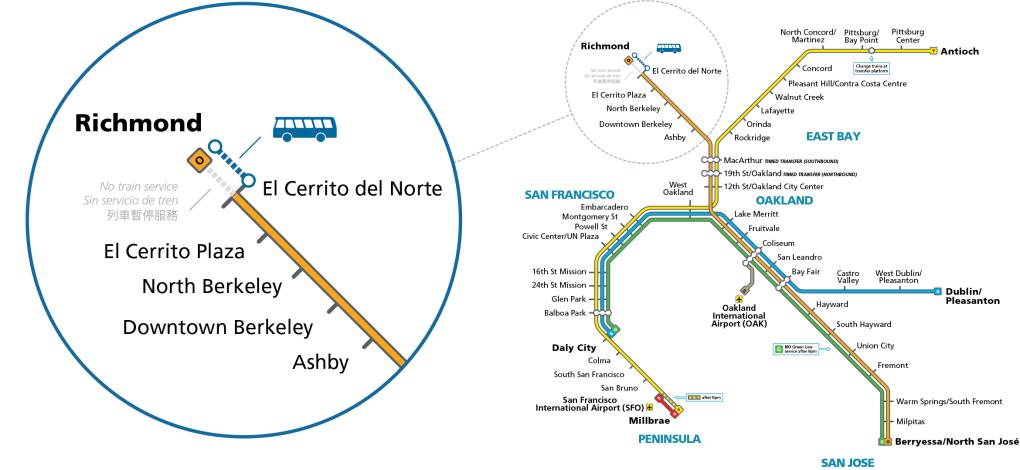
- Free buses will replace train service between Richmond and El Cerrito del Norte stations on all four weekends.
- The Red Line (Richmond-Millbrae) will be cancelled thus reducing service frequency and transbay options during these weekends. Transbay riders in the East Bay who would normally take the Red Line should instead board an Orange Line (Richmond-Berryessa) train and transfer to a Yellow Line train to San Francisco at MacArthur Station. This is scheduled to be a timed transfer to reduce wait times.
- Millbrae riders will be served by a shuttle train between SFO and Millbrae that is timed with the Yellow line train for an easy transfer at SFO.
- Riders can expect delays of up to 20 minutes in the work area on shutdown weekends.
- Richmond Station will not have train service but will still be open for Amtrak passengers and passengers traveling through the station. Riders will be able to board the bus bridge at Richmond.
Cyclists might find it faster to ride their bike along Nevin Ave in Richmond and the Ohlone Greenway to avoid the bus bridge and reduced frequency on the Richmond line.
You can keep up with the latest updates for trackway repair projects that impact service by going to our Alerts and Advisories page. BART’s Trip Planner has been improved to show the full customer journey including bus bridges.
BART wants to thank AC Transit for providing buses for BART riders during this track closure. Bay Area transit agencies are improving regional coordination to keep the Bay Area moving.
The equipment being replaced is decades old and has outlived its design life. Riders will enjoy a smoother, safer, more reliable, and quieter ride once the projects are complete.
This upcoming work is part of BART’s overall effort to improve the safety and reliability of the 131-mile, 50 station system. You can learn more about the progress of this work by reading the 2023 Measure RR Annual Report published by the independent Measure RR Bond Oversight Committee.
This article was originally posted on January 22, 2024.
This 1,200-pound gear makes escalators run. Fixing it is no simple task.
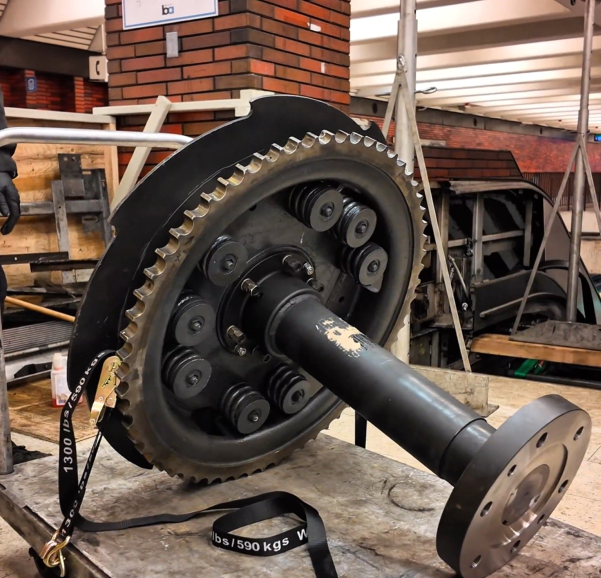
Half of the 1,200-pound bull gear ready for installation at 12th St. Oakland Station.
The sun has just risen in a wash of pink and purple over BART’s Oakland Shops, and four men dressed in blue are standing around a giant gear.
It looks like a bicycle gear with its interlocked steel circles rimmed with teeth. But this gear is big. Very big.
Known as a bull gear, this 1,200-pound steel beast can be found in all of BART’s 175 escalators. Like its namesake, its job is to pull heavy loads, in this case, moving the belt of an escalator used by thousands of BART passengers each day.
The bull gear in question belongs in an escalator that carries riders from the concourse at 12th St. Station to the platform. Many of the escalator’s components, including the bull gear, are nearly as old as the BART system.
Recently, the gear’s bearings were starting to wear, meaning the ride was not as smooth as it should be. So BART’s Elevator/Escalators Maintenance team sprung into action, taking the escalator out of service so the gear could be removed, renovated, and reinstalled in a matter of weeks. Like the gear, it was a big job.
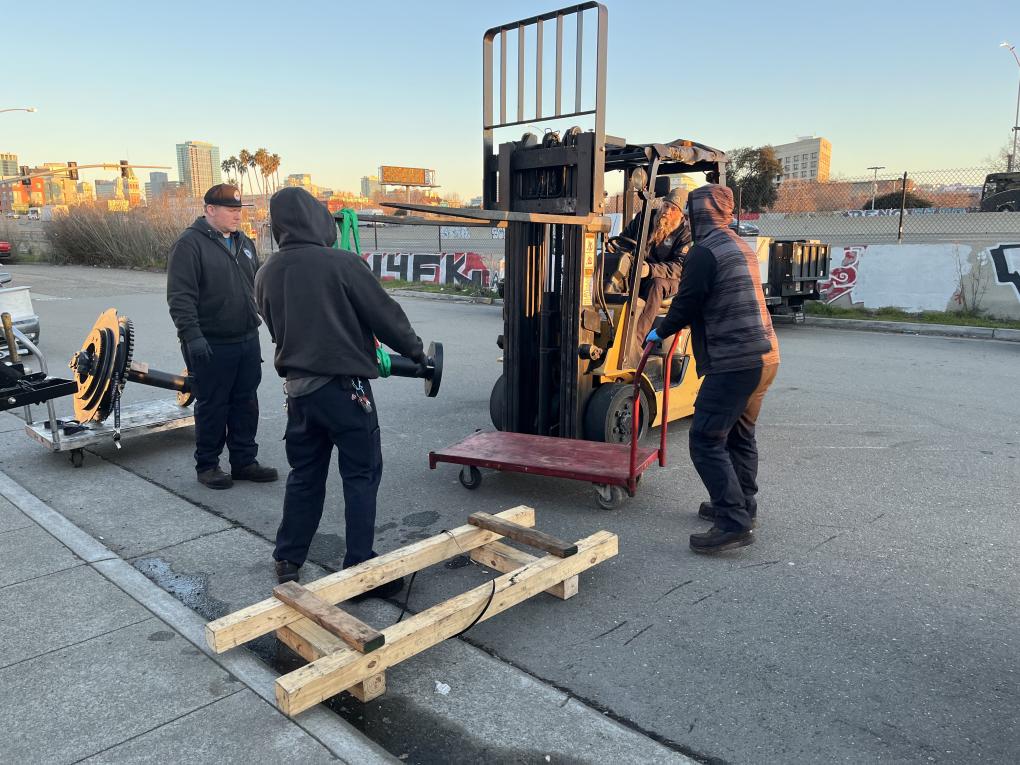
Escalator techs Mehdi Nategh and Brian McMurtrie and escalator tech trainees Austin Eagleston and Luis Gonzalez separate the bull gear with a forklift and load it onto a cart at BART's Oakland Shops.
When this bull gear wore out, rather than ordering a new gear with a price tag in the tens of thousands, the maintenance team saw an opportunity to save money in BART’s operating budget by refurbishing it with new bearings and bolts. The renovated part should provide a smooth and safe ride for years to come.
“We are mitigating problems as they arise,” said Eric Stockton, Section Manager of Elevator/Escalator Maintenance. “Customer service is our number one focus at BART, and escalators play a big role in that.”
So how do you fix a bull gear? Unfortunately, you can’t tinker with it while it’s installed in an escalator. That means Eric’s team has to take the escalator apart, then use a chain fall (a gear system used to raise and lower loads) to lift the bull gear onto a flatbed cart.
These gears are too large to fit in BART’s elevators, so the gear must be wrenched in half with a forklift to split it into two, more manageable pieces. Then up the escalator into the light of day, onto the back of a truck, and off to the parts repair shop for a makeover.
On this particular morning at the Oakland Shops, the four men standing over the refurbished 12th St. Bull gear were tasked with getting it back into its escalator home. That meant, repeating all the steps above but in reverse.
By 8am, the men were off to 12th St., one truck carrying the cloven gear, another carrying their tools. You can watch some of the reinstallation process in the above video.
It took about a month to get the bull gear in place and the parts attached to get the escalator back in service. It’s worth the hard work, said Mehdi Nategh, the team lead who’s been working on escalators for almost thirty years.
“These bull gears can last more than twenty years,” he said.
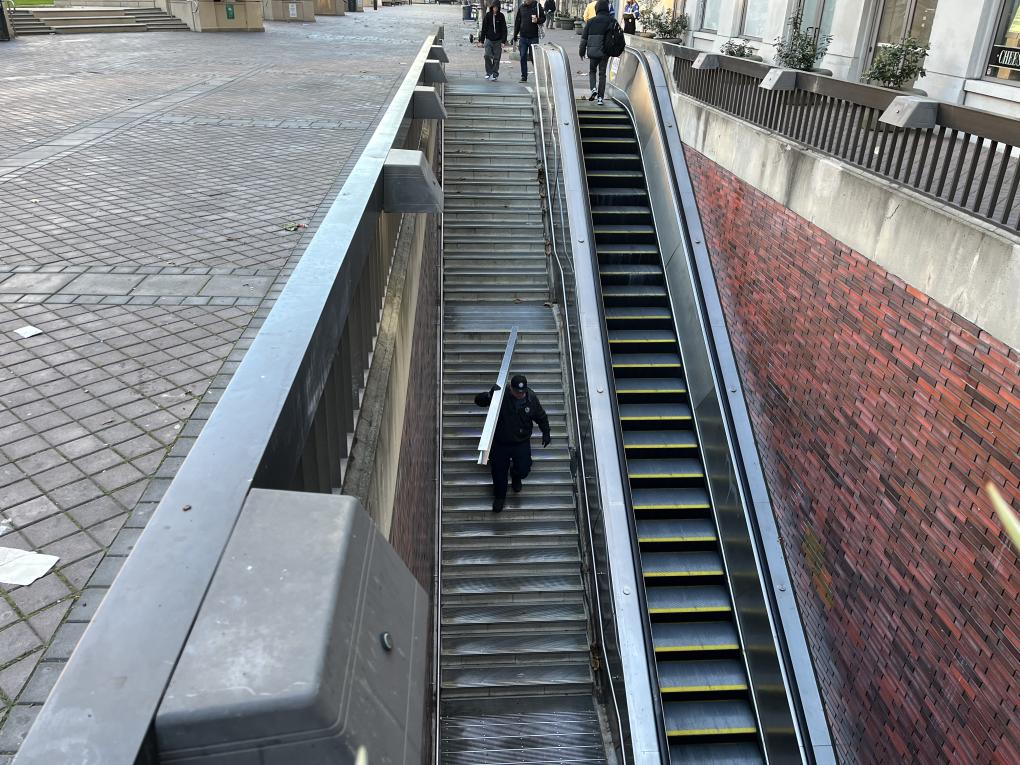
Carrying parts into the station.
While escalator tech Brian McMurtrie and escalator tech trainees Austin Eagleston and Luis Gonzalez prepped the gear from the top, Nategh went down in the machine room directly beneath the escalator. Here, the inner workings of an escalator come to light. As the escalator moves above, you can see the drive chain turning in an endless loop, powered by a drive machine with a gearbox and 480-volt AC motor.
Being down there changes your perspective. When you step onto an escalator, you probably don’t stop to think about how it runs or the little mechanical world beneath it.
Once the bull gear is in place there is much more work to be done.
“We have to hook up the handrails, put the steps backs in, I'm sure there are some sensors we need to replace,” said Gonzalez.
A few weeks later, once the work was complete, a joy ride of the escalator demonstrated the work paid off. The ride was smooth and quiet as the refreshed bull gear pulled us along.
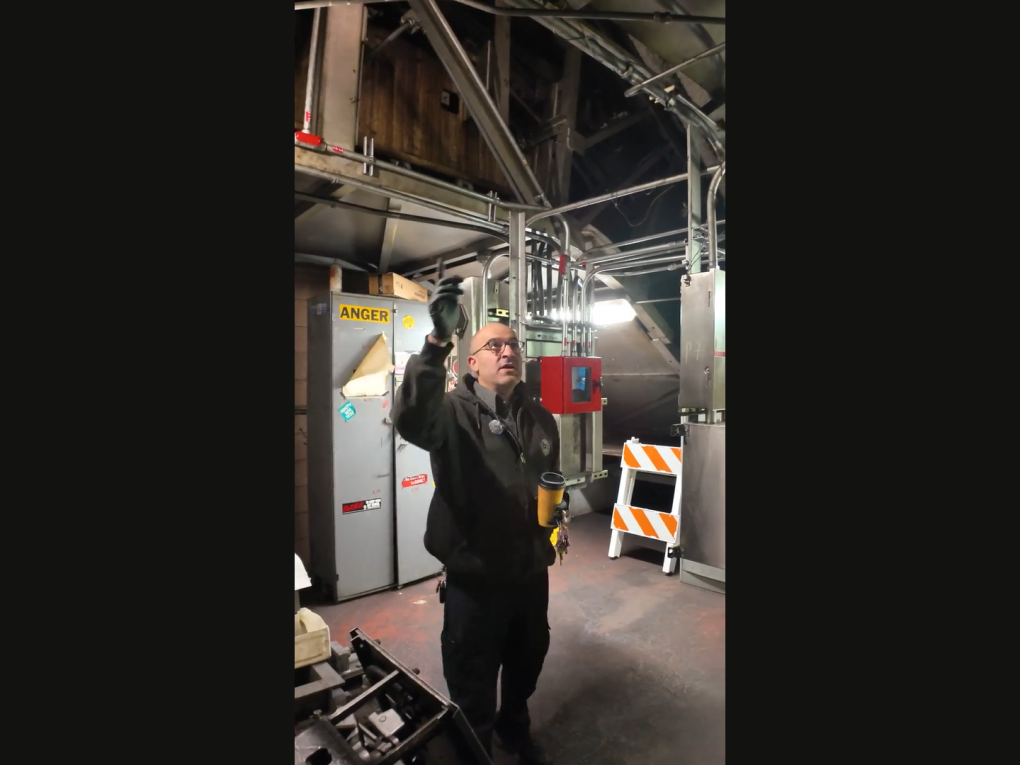
Mehdi Nategh in the machine room.
Join Link21 at educational events to learn more about train options for a future crossing between Oakland and San Francisco
Link21 continues to invest in a more connected, equitable, and accessible future by working toward the goal of linking the San Francisco Bay Area Regional Transit (BART) and Regional Rail network throughout 21 counties – referred to as the “Megaregion” – in Northern California.
This past summer, community members from the Megaregion participated in a variety of virtual and in-person engagement events to discuss Link21 concepts and potential service improvements. Now this fall, Link21 is offering community members the opportunity to learn more about the type of train service, BART or Regional Rail, that would operate in the future train crossing between Oakland and San Francisco. Attendees will learn how these two options benefit riders, communities, and the Megaregion, plus how they differ. They will also have the chance to provide input to help the Link21 Program Team identify a recommendation for consideration of a Preliminary Project to be advanced by the BART and Capitol Corridor Boards of Directors in early 2024.
“The feedback we receive from people across our Northern California Megaregion will help us meet the needs of our diverse communities,” said Sadie Graham, Link21 Program Director for BART. “We can’t do this alone and need the public to continue being part of the planning process at every step of this generational undertaking.”
JOIN THE CONVERSATION!
Virtual Events
Participate in a virtual event or look for Link21 in your community to learn more and help connect Northern California with better train service for future generations. Visit the Link21 Events webpage for more details.
Online Open House
Starting in early November and lasting approximately 30 days, you can conveniently visit Link21OpenHouse.com anytime, 24 hours a day, seven days a week to learn more and provide input.
ABOUT LINK21
Link21 is a long-range transportation program sponsored by BART and Capitol Corridor to transform the train network serving the 21-county Northern California Megaregion, which includes the greater San Francisco Bay Area, the Monterey Bay area, the Sacramento area, and the Northern San Joaquin Valley.
Link21 will make it more convenient for people to take BART and Regional Rail (commuter, intercity, and high speed) throughout the Megaregion.
Learn more at Link21Program.org.
Civic Center Station: one week closure of stairway at UN Plaza entrance 2/9-2/14
UPDATE February 19th
As the jobsite has been hit hard by heavy rains this week, the crew will need two more non-rainy working days to complete the installation. The center stairway will remain closed until 2pm this Friday, 2/20.
UPDATE February 12th
Due to recent rains, this project has been extended so the stairway serving the Civic Center-UN Plaza BART entrance will remain closed through Wednesday, February 18th so crews can complete the work along the new escalator walls.
The stairway that serves the Civic Center-UN Plaza BART entrance will be closed to public access from Monday, February 9 – Saturday, February 14, to complete stainless steel cladding installation along the new escalator walls.
This is the only access into Civic Center Station at this entrance. Riders can exit the station via the escalator next to the stairway.
Riders should use the following options to access the Civic Center station during this one-week period:
North Side of Market Street – Stairway Access
- Entrance in front of Orpheum Theatre
- Stair-only Entrance at 7th Street @ Charles J. Brenham Place
North Side of Market Street – Elevator Access
- Elevator at UN Plaza
South Side of Market Street - Stairway / Escalator Access
- 8th & Market Canopy Entrance
- Mid-Block Stair only Entrance (New Canopy Just opened!)
- 7th & Market Street – Entrance has both stairway and escalator
Status of the Escalator Project
There are two escalator units located above the Civic Center Station that serve the United Nations Plaza on the north side of Market Street. The BART Escalator Renovation Project contractor has been working since August 2025 on the first of the two units and expects to complete the first unit by early March 2026. The contractor will begin work on the second escalator unit in mid-March. All work at the Civic Center / UN Plaza entrance is expected to be completed by August 2026.
BART’s Escalator Renovation Project is replacing 45 escalator units (41 BART plus 4 additional MUNI escalators) in the four downtown stations at both platform and street levels. To date, BART has completed installation of 23 units, 4 are currently under construction, and there are 18 remaining escalator units to be completed through January 2029.
Normal train service has resumed between Richmond and MacArthur Station
(Updated 9am, May 14, 2024)
On Friday, May 10, 2024, a damaged, 20-year-old fiber optic cable was located just north of MacArthur Station late at night before the end of service. The damaged cable was impacting all communication necessary to run train service on the entire line. It was also impacting all station-level communication including the public address systems, phones, and message boards at all stations from Richmond to Ashby. Crews determined the degraded cable was not stable enough for a quick repair.
At 4:48am, the first BART Service Advisory was released alerting the public there would be no Red Line service and the Orange Line would not run between Richmond and MacArthur. Orange Line service was provided from MacArthur to Berryessa and Millbrae service was provided by a shuttle train between Millbrae and SFO. The Yellow, Blue, and Green lines were not impacted.
Partner bus agencies and Capitol Corridor honored BART fares. Extra BART employees were deployed to stations to help guide riders to the various bus options. Given how many stations were impacted, AC Transit was unable to provide a bus bridge with direct service to MacArthur Station. However, Richmond Line stations have high quality transbay and local bus route options and BART riders were able to ride them at no cost. A list of each bus option was posted on the home page of bart.gov and shared on social media.
Crews worked with BART’s fiber contractors to successfully splice BART’s 48-strand fiber optic cable to redundantly located fiber optic cable allowing for service to resume at 11:10am. This solution will remain in place long term.
As of 11:10am, we have restored normal train service between Richmond and MacArthur. We will follow up with more details about the cause of the disruption on Monday.
In an effort to improve communication during disruptions we are asking impacted riders to take this short survey before Monday, May 13th, at 5pm:
bart.gov/delays
We currently have no Red or Orange line service between Richmond and MacArthur due to a wayside equipment problem. Crews are on scene and are trouble shooting the problem. We hope to have this resolved shortly but expect this service disruption to last through the morning commute. The Yellow, Green and Blue lines are not impacted, and we do have normal service throughout the rest of the system.
Richmond riders should seek other means to get to MacArthur Station. Richmond through Ashby station riders should use the existing bus service at each station. For Millbrae riders, take the shuttle train between SFO and Millbrae and transfer to/from the Yellow line (Antioch-SFO). Orange line service is running MacArthur to Berryessa.
While we do have extra staff at each station to help with buses, there isn’t a direct bus bridge. We do have mutual aid from Capitol Corridor and various bus agencies that varies from Station to Station.
Capitol Corridor will offer free rides to BART passengers only between Richmond and Oakland Coliseum until 3PM.
BUSES TO DOWNTOWN SAN FRANCISCO
Richmond Station
- 72M to NL (AC Transit)
- Transfer from 72M to NL at 20th/Broadway in Oakland
- Takes 1 hour and 25 minutes
El Cerrito del Norte
- 72/72M to NL (AC Transit)
- Transfer from 72M to NL at 20th/Broadway in Oakland
- Takes 1 hour and 7 minutes
- L (AC Transit)
- Takes 48 minutes
- 72/72M/72R to G (AC Transit)
- Transfer at San Pablo and Gilman
- 48 minutes
- 72/72M to F (AC Transit)
- Transfer at San Pablo and 40th
- 53 minutes
El Cerrito Plaza
- G (AC Transit)
- 54 minutes
- L (AC Transit)
- Walk from station to San Pablo and Central
- 42 minutes
- 72/72M to NL (AC Transit)
- Transfer from 72M to NL at 20th/Broadway in Oakland
- Takes 55 minutes
- 72/72M to F (AC Transit)
- Transfer at San Pablo and 40th
- 51 minutes
North Berkeley
- J (AC Transit)
- Walk to Sacramento and University
- Takes 48 minutes
- G (AC Transit)
- Walk to San Pablo and Delaware
- Takes 41 minutes
o Casual Carpool: https://sfcasualcarpool.com/
Downtown Berkeley
- F (AC Transit)
- Takes 41 minutes
Ashby
- F (AC Transit)
- Takes 37 minutes
LOCAL OPTIONS for travel between stations.
Richmond Station – El Cerrito del Norte – El Cerrito Plaza
- AC Transit 72/72M
North Berkeley – Downtown Berkeley
- AC Transit 52
MacArthur – Ashby – Downtown Berkeley
- AC Transit 6
- AC Transit 18
Downtown Berkeley – Rockridge
- AC Transit 51B
- AC Transit 79