Search Results
Installation work to begin Friday, May 23 for Next Generation Fare Gates at Ashby Station
The installation of Next Generation Fare Gates is scheduled to begin Friday, May 23 at Ashby Station. The process is expected to take approximately two weeks to complete.
During construction, there will be a barrier around the existing station gates. Riders will use two temporary accessible gates to enter and exit Ashby Station. Both gates are located next to the Station Agent Booth. When facing the booth from the non-paid area of the station, the fare gate to your right is used to enter the station and the fare gate to your left is used to exit. Additionally, a carpet will be installed immediately before the entrance to each temporary gate to make the gates easier to locate for riders with visual impairments.
The work will not delay train service, but riders may experience a few extra minutes wait to pass through the temporary fare gates during peak travel hours.
The latest work comes after BART has successfully installed Next Generation Fare Gates at 35 other stations across the system. All 50 BART stations will have new fare gates by the end of 2025. Learn more about the fare gates project here.

Unclaimed Funds
Parking alert: Parking to be reduced at Fremont Station until early 2027 to support critical track rebuilding project
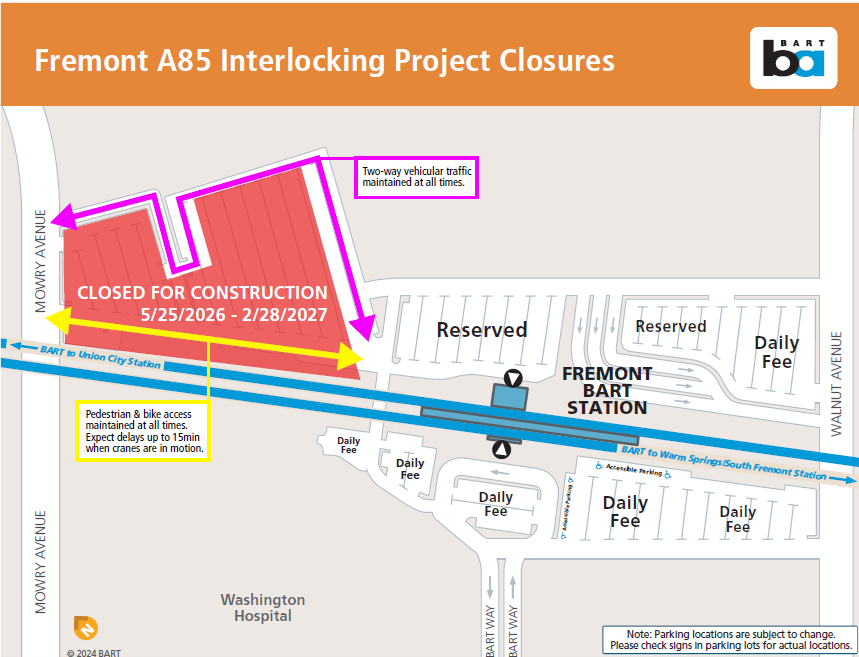
Beginning the week of May 25, 2026, and continuing through February 2027, access to vehicle parking, bike facilities and pedestrian pathways will be limited at Fremont Station due to construction activities. The parking lots next to Mowry Avenue (see map) will be fenced off to stage construction equipment. Traffic control and wayfinding signs will be posted to direct vehicles, bikes, and pedestrians throughout construction. Approximately 750 of Fremont Station’s roughly 1,900 parking spaces will be temporarily closed. Based on spring occupancy counts, there should still be plenty of parking to accommodate current demand.
The parking closure will support the rebuilding of a key section of trackway that has been in service for five decades and must be replaced. This summer, BART crews will replace an interlocking near Fremont Station. An interlocking is a section of the BART system that allows trains to safely move from track to track.
Dates when the work will require weekend shutdowns of train service between Fremont, Union City, and Warm Springs/South Fremont stations include: July 25-26, August 15-16, August 29-30, September 12-13, September 26-27.
Bay Area transit agencies coordinate the Big Sync to unify schedule changes
Bay Area transit agencies are now syncing schedules in a whole new way with a focus on improving transfers between systems and making schedule changes at the same time. Transit riders who use more than one system will see a variety of improvements across the Bay Area this month, saving some riders up to 16 minutes on their trips.
Many Bay Area transit agencies are rolling out new schedules mid-January in coordination with each other and have now aligned the timing of schedule changes twice each year, once in summer (mid-August) and once in winter (mid-January). Since 2022, the number of transit agencies with full schedule change alignment (changing schedules at the same time in August and January) has increased from four to 20 – a 400% increase.
Advancing schedule change alignment is a key priority for Bay Area transit general managers who meet on a weekly basis to make transit more rider-focused and efficient.
The Big Sync reduces travel time
Agencies meet several months in advance of each schedule change to share planned changes and to look for opportunities to improve transfers.
Specific service coordination efforts for January include:
- BART is timing its late evening Millbrae service that runs every 15 minutes to line up with Caltrain’s service every 30 minutes. In September 2024, Caltrain’s new electric service schedule significantly improved transfer times. Both agencies have coordinated on a helpful transfer timetable to show which trains connect and their transfer wait times.
- VTA is making changes to match both BART’s and Caltrain’s schedule changes to ensure timed transfers are maintained at various locations across the South Bay and Peninsula.
- In San Francisco, Muni is restoring the 30X Marina Express bus for two morning trips at 7:15am and 7:45am, beginning in February. Morning commuters will be able to enjoy a fast, direct connection from the Marina to BART and the Transbay Center connecting to various bus lines.
- For transit riders traveling during the morning commute from Napa County’s Redwood Park n Ride on the Napa Valley Transportation Authority’s bus 29 to El Cerrito del Norte Station to catch the Red Line into San Francisco between 5:30am and 8am, their trips will be six minutes faster on average and up to 16 minutes faster.
- For transit riders returning home on their evening commute from the San Rafael Transit Center in Marin County to the Richmond Parkway Transit Center in Contra Costa County between 3pm and 6:30pm on the Golden Gate Transit #580 or #580X and the AC Transit #76 (transferring at Cutting Blvd and Harbour), their trips will be 5 minutes and 40 seconds faster on average and up to 16 minutes faster.
- Transit riders departing the Salesforce Transit Center between 9pm and midnight on the Golden Gate Transit bus 130 and the Marin Transit bus 35 (transferring at the San Rafael Transit Center), will arrive at the Canal Area of San Rafael (Kerner and Larkspur) 15 minutes faster.
“These are examples of how Bay Area transit agencies are acting as one network to better serve the Bay Area to help reduce traffic and improve the quality of service,” said Alicia Trost, Chief Communications Officer at BART. “Making transit faster than driving a car and easier to navigate is possible when the Bay Area invests in transit and we all work together.”
Bay Area Transit in 2025 is anything but business as usual
Riding transit will be more affordable in 2025 as Bay Area transit agencies are working with the Metropolitan Transportation Commission on the upcoming Next Generation of Clipper, which will give transit riders free or discounted transfers between systems. A unified approach to maps and directional signs across the region is also being tested and expanded. And agencies are participating in Clipper BayPass to test the concept of a prepaid unlimited transit pass and fare capping. Clipper BayPass is being sold to interested organizations who would like to offer their employees an all-you-can-ride transit. These programs will help increase transit ridership and will help meet local and state climate goals.
First quarter of 2025 brings big gains for Bay Area public transit ridership
Bay Area transit agencies rode a wave of increasing ridership in the first three months of the year that was felt across the region. Many agencies posted double digit gains in ridership compared with the same period last year. Caltrain led the charge with a 50% ridership increase over the first three months of 2025 fueled largely by the agency’s switch to an all-electric service. The nine agencies reporting gains handled a combined total of 3.24 million more trips from January through March compared with the same period in 2024.
Caltrain was not alone in seeing a major ridership increase during the first three months of the year:
*Sonoma-Marin Area Rail Transit (SMART) saw a ridership bump of 38%. That increase means SMART’s ridership averaged 134% of pre-pandemic levels.
*San Francisco Bay Ferry had a 21% increase from a year ago. That number is 47% higher than ridership in 2023.
*Golden Gate Ferry ridership increased nearly 16% from last year and 40% from 2023.
*Ridership for Marin Transit jumped 10%, Petaluma Transit was up 7%, and Golden Gate Transit increased 5%.
Larger systems also saw significant ridership growth in the first three months of the year. BART ridership was up almost 6.5% from 2024 while Muni increased by 4%.
“This growth in ridership is happening as transit agencies make major investments in improving the rider experience with an emphasis on boosting safety, cleanliness, and reliability,” said BART General Manager Bob Powers. “BART hosts a weekly meeting with the transit leaders from each agency to coordinate on everything from preparing for Super Bowl 2026 and FIFA World Cup to better synching our schedules.”
These ridership gains come as transit agencies are still recovering from post-pandemic ridership declines and are about to run out of federal and state emergency funds. Agencies have used these funds to invest in quality service for the Bay Area as more people are making trips and choosing transit. Many face the potential of devastating cuts that will have serious impacts on the Bay Area’s quality of life.
The Bay Area’s transit agencies, working with the Metropolitan Transportation Commission (MTC), are prioritizing collaboration to make the rider experience more seamless. The goal is to make transit more connected, more efficient, and more user friendly. These efforts include a regional mapping and wayfinding project to provide a unified look and feel for maps and directional signs. Transit agencies have also been working together to identify opportunities to reduce total travel times across services and coordinate schedule changes.
MTC and Bay Area transit agencies have a joint website to share the various projects they are coordinating on to improve transit. Learn more at allaboardbayarea.com.
New escalator and canopy open at downtown SF stations
The two projects transforming entrances at downtown San Francisco BART stations made significant progress in the first month of 2025.
A newly rebuilt escalator at Civic Center Station connecting the platform to the concourse level opened on Friday, January 31st. Soon, work will begin to replace another platform at the station, the last of the four platform escalators to be completely rebuilt.
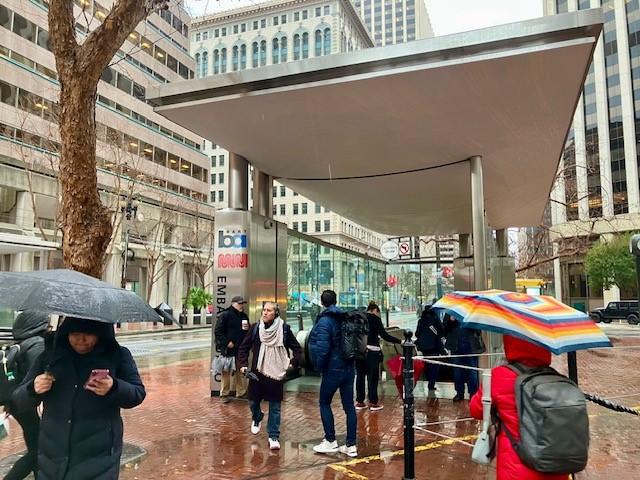
Earlier in the month, a brand-new canopy opened at Embarcadero Station. The canopy protects the entrance on the north side of Market Street near Drumm Street. Work is already underway on a new canopy across Market Street near Main Street.
Meantime, broken glass panels at some of the canopies are being replaced. A total of two dozen panels at Embarcadero, Powell St. and Montgomery St. Stations were vandalized late last year and a suspected perpetrator was arrested
Embarcadero’s panels were replaced the last week of January and the panels at Powell St. and Montgomery St. are expected to be installed in February. The total cost of replacing all the damaged panels is estimated at more than $500,000.
BART is in the midst of a seven-year project to install 22 canopies above the four downtown San Francisco stations. The canopies protect new escalators being installed and improve the rider experience by providing an added layer of station security and cleanliness through motorized gates that allow the entrances to be locked at street level when stations are closed.