
Search Results
New escalator and canopy open at downtown SF stations
The two projects transforming entrances at downtown San Francisco BART stations made significant progress in the first month of 2025.
A newly rebuilt escalator at Civic Center Station connecting the platform to the concourse level opened on Friday, January 31st. Soon, work will begin to replace another platform at the station, the last of the four platform escalators to be completely rebuilt.
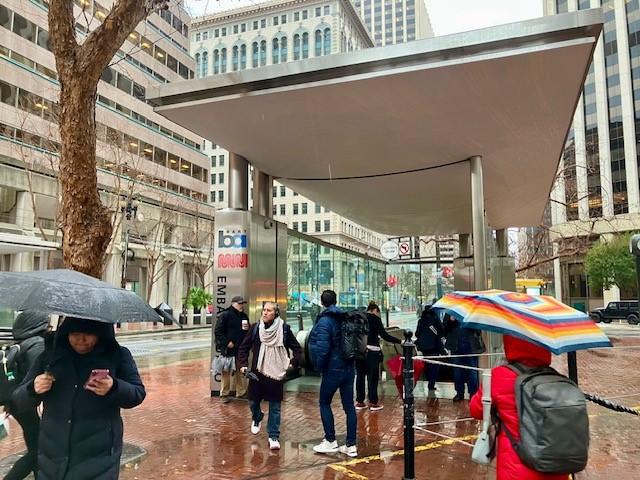
Earlier in the month, a brand-new canopy opened at Embarcadero Station. The canopy protects the entrance on the north side of Market Street near Drumm Street. Work is already underway on a new canopy across Market Street near Main Street.
Meantime, broken glass panels at some of the canopies are being replaced. A total of two dozen panels at Embarcadero, Powell St. and Montgomery St. Stations were vandalized late last year and a suspected perpetrator was arrested
Embarcadero’s panels were replaced the last week of January and the panels at Powell St. and Montgomery St. are expected to be installed in February. The total cost of replacing all the damaged panels is estimated at more than $500,000.
BART is in the midst of a seven-year project to install 22 canopies above the four downtown San Francisco stations. The canopies protect new escalators being installed and improve the rider experience by providing an added layer of station security and cleanliness through motorized gates that allow the entrances to be locked at street level when stations are closed.
Single Tracking Alert: Service reduced from two tracks to one between Downtown Berkeley and MacArthur stations for late night rail replacement (next work night Saturday, June 13)
On the nights of Saturday, June 13, and Saturday, June 20, service will be reduced from two tracks to one between Downtown Berkeley and MacArthur stations for critical rail replacement work. Reducing service to one track will create a safe work zone for crews so they can replace 4,000 feet of rail. The work will begin at 10:30pm on each of the two work nights and will continue until service resumes the next morning. Riders should expect delays of 20-30 minutes. Additional service impacts include:
- 30-minute service on the Orange Line (Richmond-Berryessa North San Jose).
- No transfer meet at MacArthur Station for Berryessa-bound Orange Line trains with San Francisco/SFO bound Yellow Line Trains at MacArthur, except for the last train of the night.
- No Grand Meet
- All Berryessa-bound riders transferring from the Yellow Line must take the second to last train to transfer to an Orange Line train.
- Expect longer transfers at MacArthur and Bay Fair stations.
- Richmond-bound trains will board at Platform 4 at MacArthur Station. There will be temporary signage to help riders find the correct platform.
Most of the work will happen during overnight hours when BART isn’t running trains. The work is not expected to have any impact on BART service the next day.
Meet the Tango team, the mainline technicians who fix trains while they’re moving
Check out what’s inside mainline technician Aaron Dofredo’s bag in the above video.
If train A leaves the station going 50 miles per hour and train B leaves the station five minutes later going 65 miles per hour, how many minutes until train B to catch up to train A?
We’re not trying to spur flashbacks to math class. The ol’ train joke is actually not a joke at all to BART’s Tango team, who makes sure trains are running as they should be running while they’re running.
The nickname “Tango” comes from “T” for “technician” in the NATO phonetic alphabet, but officially, the team is called the Revenue Vehicle Trouble Desk (RVTD).
A Train Operator calls the Operations Control Center to report a vehicle-related issue, such as flickering lights, a communications problem or a hot car (meaning the AC’s not working). From there, the RS&S Central Maintenance Supervisor (call sign Tango-1), identifies the Mainline Technician stationed nearest the affected train and determines the fastest route for them to board and resolve the issue.
Mainline Technicians are strategically positioned throughout the BART system to ensure rapid response. The team’s mission is to assess problems and identify the necessary corrective actions. This includes determining whether the issue can be fixed while the train stays in-service or if it needs to be taken to a shop, as determined by stringent safety protocols.
The dispatch call goes something like this: “Tango 22 – On Train 367 departing San Bruno, a patron reports Car 2673 is making an unusual noise while moving. I need you to head south towards Balboa Park Station to meet the train. You have a train at Embarcadero Station to use as your ride to meet Train 367 at Balboa Park.”
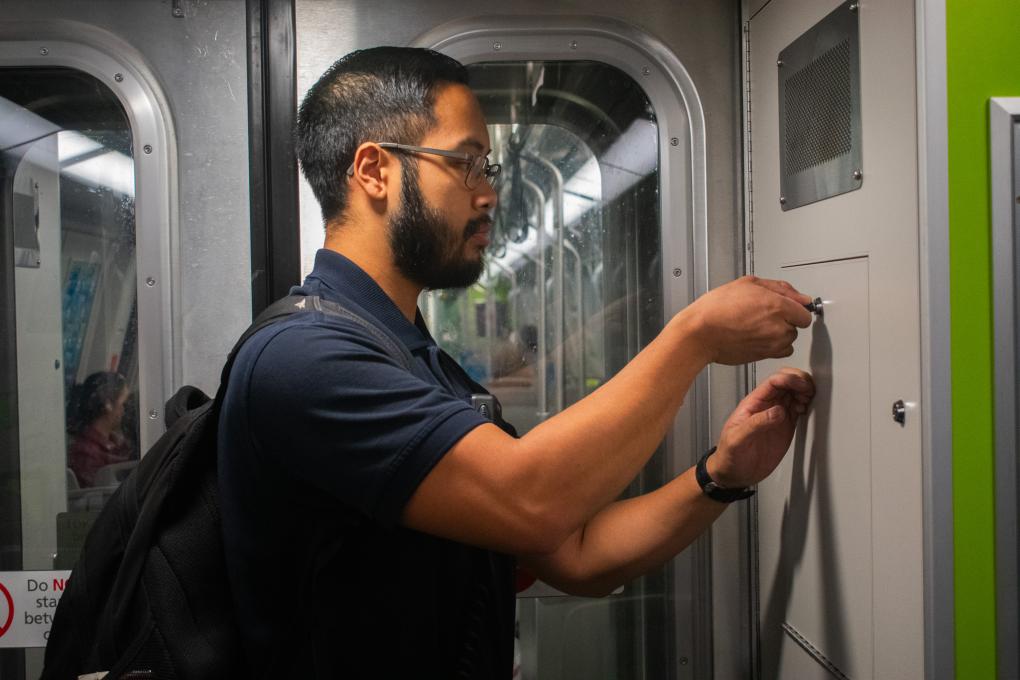
In most instances, the tech is on a train headed to the issue within five minutes of that initial report from the Train Operator. That’s why they keep their equipment at the ready and bags packed. You never know when that call might come in, and you must be ready to jump on that approaching train.
“There’s no time for overthinking it, and you have to know the system inside and out,” said Mainline Technician Don Coulter. “This job is fast paced and requires on-the-fly problem solving.”
Michael Hung, the Superintendent of RVTD, echoed his colleague’s sentiments. Before his current position, Hung was a Mainline Technician and Tango-1.
“When I first started as a Mainline Technician in 2002, my supervisor would say that we’re like firefighters, in the sense that when there is an issue on a train, we’re dispatched immediately to respond and intercept it,” he said. “You have to be ready to respond with a moment’s notice to ensure that you can play your part in helping mitigate any concerns or delays.”
Often, techs are diagnosing and fixing trains in front of an audience of passengers.
“I once reset a car’s power supply and when the lights came on, the whole car cheered!” recalled Mainline Technician Nathan Koch, who carries handmade stickers with him to pass out to children he meets on BART. “Our job description entails running in to save the day, and you know you’ve saved the day when the passengers can keep going on their way."
Vessica Martin, who started as an electrical helper at BART and worked her way up to mainline tech, said she’ll ride as many as 20 trains a shift on the busiest days (the new fleet of train cars experiences significantly fewer issues than the recently retired legacy fleet). Sometimes, Martin won’t see another tech for weeks. That’s because they’re all tangoing around each other in the system every day, all day. It’s a dream job for the lone wolf-type who wants freedom to roam and a workspace on wheels.
Said Dofredo: “And the best part of the job is the Bay Area is your office."
If you see a mainline tech on your train, there’s no need to worry. Their goal is to fix issues without having to stop the train or remove it from service, which would spur system delays. Most of the problems techs fix are routine, such as resetting the electrical system on a car so the information screens turn back on.
Most of the time, you probably won’t even notice these stealthy technicians.
Said Koch: “The biggest success for a mainline tech is when there’s an issue and we fix it before anyone notices."
Link21 holds informational roadshow to share train technology analysis for second train crossing
The Link21 Program is making progress toward its goal of creating a faster, more connected train system across the 21-county Northern California Megaregion that provides equitable, affordable, and accessible travel for future generations. One key aspect is building a second underground train crossing of the San Francisco Bay, allowing riders to travel to various destinations in the greater San Francisco Bay Area, Sacramento area, Monterey Bay area, and Northern San Joaquin Valley.
Link21 recently completed an exciting analysis of the different benefits that standard-gauge (Regional Rail) and broad-gauge (BART) train technologies can provide to the region through this project. This Program milestone will determine which technology should operate in the new crossing as an important step toward defining a project that will provide riders with enhanced and more reliable travel options.
Through the spring and early summer, Link21 is on an informational roadshow sharing analysis findings that demonstrate how the two technologies provide similar benefits and where they differ in terms of service, equitable outcomes, connections, and operations.
“Link21 will make investments to offer more train service for future generations to thrive, connect, and flourish in our vibrant Megaregion,” said Link21 Program Director Sadie Graham. “The community and stakeholder engagement we do now and the decisions we make will help ensure the project delivers accessible, reliable, and environmentally conscious transit solutions that will benefit our communities for years to come."
Virtual Community Meetings
Register at Link21Program.org/events to attend a meeting via Zoom and hear a presentation from Link21 Team members.
- Thursday, June 6, 2024 | 6-7:30 p.m.
- Monday, June 10, 2024 | 6-7:30 p.m.
Meetings will be interpreted in Spanish and Cantonese. To request American Sign Language and other accommodations, email [email protected] or call 855-905-Link (5465) at least three days in advance of the meeting date.
Online Open House
Visit Link21OpenHouse.com anytime 24/7, starting in mid-June, to conveniently participate when it works for you, whether it’s from the comfort of your own home or while commuting on the train. The Online Open House will be available for several weeks.
Can’t make the events? Link21 will be in local communities. Visit Link21Program.org/events for more information.
About Link21
Link21 is a long-range transportation program sponsored by the San Francisco Bay Area Rapid Transit District (BART) and Capitol Corridor Joint Powers Authority. Together with partners, Link21 will transform the train system within the 21-county Northern California Megaregion, which includes the greater San Francisco Bay Area, the Monterey Bay area, the Sacramento area, and the Northern San Joaquin Valley.
Link21 will make it more convenient for people to take BART and Regional Rail (commuter, intercity, and high-sped train service) throughout the Megaregion.
Learn more at Link21Program.org.