
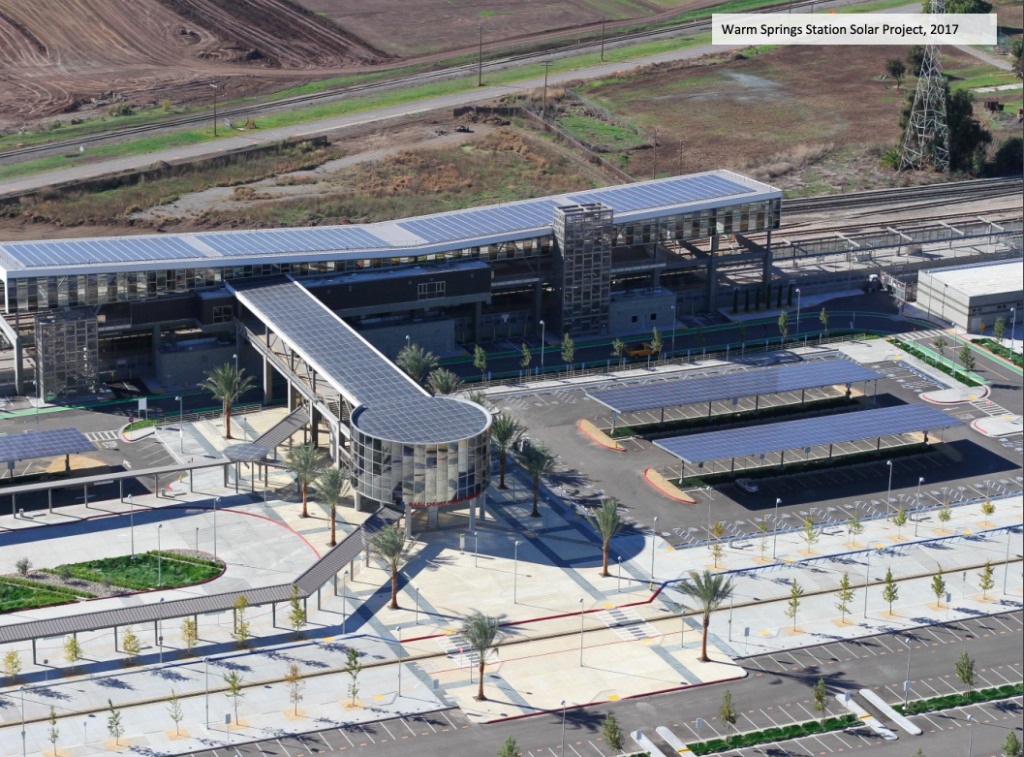
Warm Springs / South Fremont Station has nearly 2,000 solar panels installed on the station roof and on parking lot canopies.
BART’s power supply sources are reported annually in its Power Content Label and independently verified under the California Energy Commission’s Power Source Disclosure Program. The label provides a detailed inventory of BART’s power sources and how it compares to California’s grid average power mix. BART releases its Power Content Label each fall for the prior calendar year.
Electricity generated without producing greenhouse gases (GHG) does not always come from renewable resources. For example, large hydroelectric resources represent a portion of BART’s GHG-free electricity but are not defined as eligible renewable resources under California state law. Bioenergy, geothermal, solar photovoltaic, solar thermal, small hydroelectric, and wind energy resources are all designated as eligible renewable resources under the California Energy Commission’s Renewables Portfolio Standard. More information about BART’s power supply portfolio can be found at the Energy Procurement webpage.
BART’s most current Power Content Label is found below and reports for every year since BART’s reporting started in 2019 as required under Assembly Bill 923 are found by clicking on the year of interest.
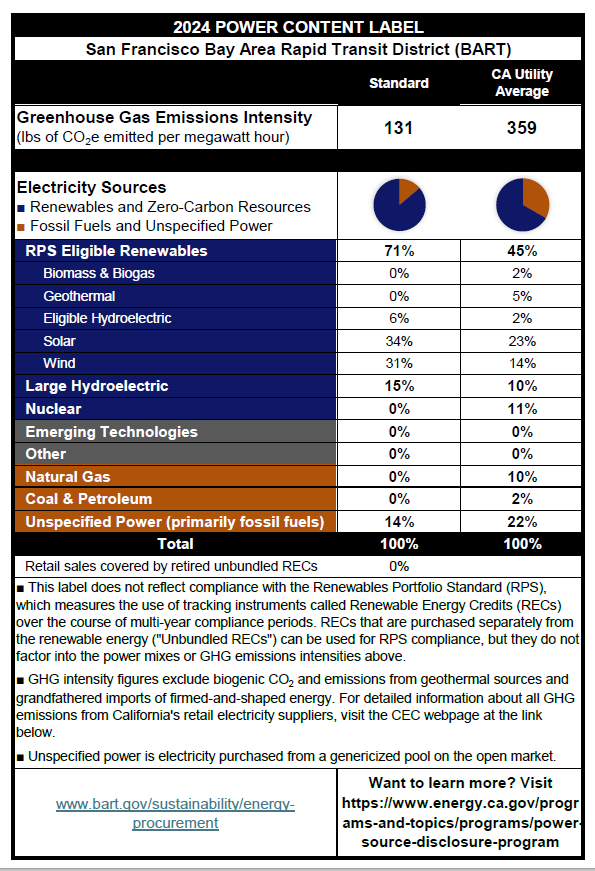
BART’s 2024 Power Content Label
As shown under the “Standard” column in the Power Content Label for 2024 below, BART achieved a power supply that was 86% greenhouse gas (GHG)-free while growing its total share of eligible renewable electricity to 71% (from 66.8% in 2023), far surpassing the California’s grid average power mix of 45% (shown under “CA Utility Average”). BART’s renewable power mix was comprised primarily of solar photovoltaic (34%) and wind (31%), supplemented by a contribution from small hydroelectric resources (6%). Its remaining power was sourced from large hydroelectric generation (15%) and unspecified market power (14%). BART’s Power Purchase Agreements for renewable resources with Slate Solar and Sky River Wind generated 64% of BART’s electricity needs in 2024.
BART's 2023 Power Content Label
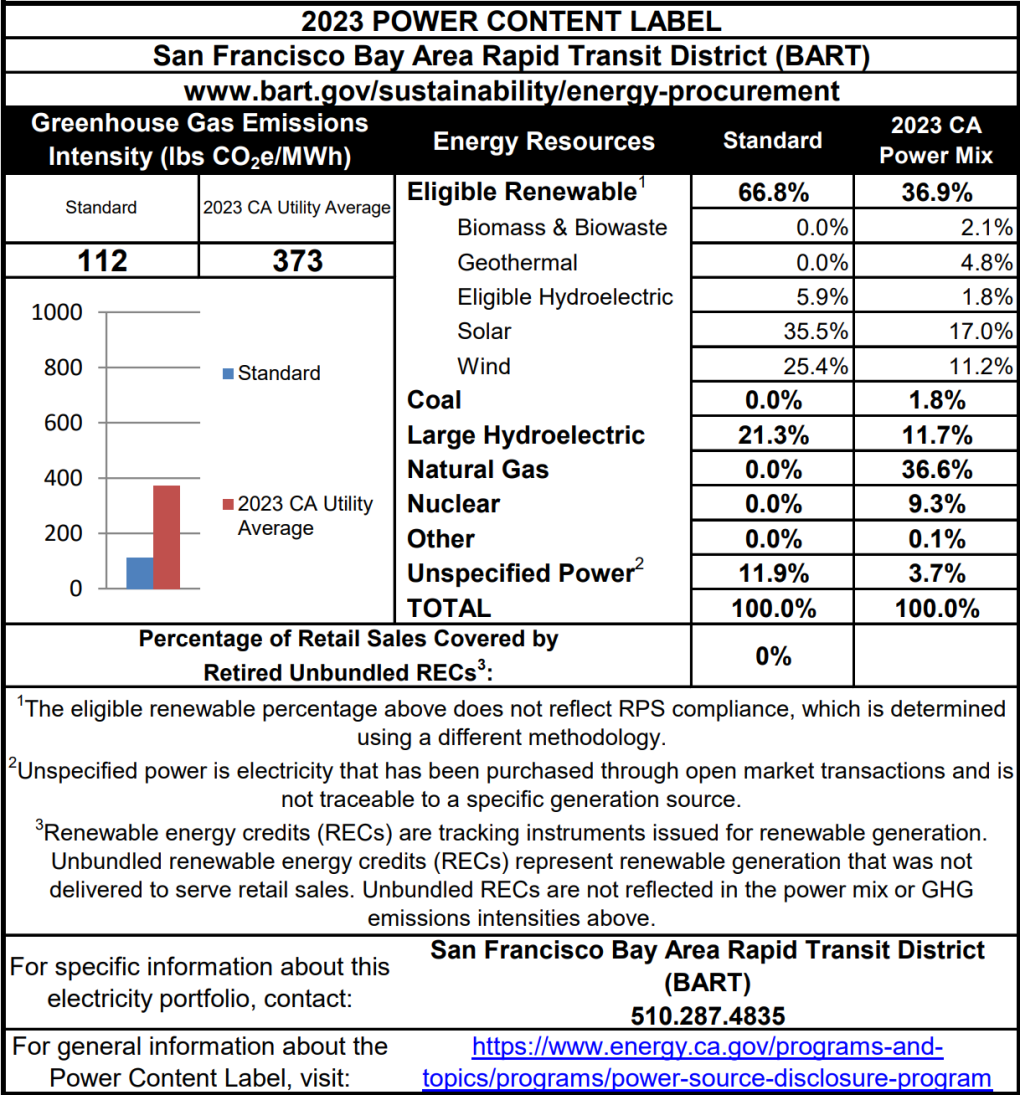
As shown under the “Standard” column in the Power Content Label for 2023, BART achieved a power supply that was 88% GHG-free while growing its total share of eligible renewable electricity to 66.8% (from 61.5% in 2022), far surpassing the California’s grid average power mix of 36.9% (shown under “2023 CA Power Mix”). BART’s renewable power mix was comprised primarily of solar photovoltaic (35.5%) and wind (25.4%), supplemented by small hydroelectric resources (5.9%). Its remaining power was sourced from large hydroelectric generation (21.3%) and unspecified power purchased directly from the electric grid (11.9%). BART’s Power Purchase Agreements for renewable resources with Slate Solar and Sky River Wind generated almost 60% of BART’s electricity needs in 2023.
BART's 2022 Power Content Label
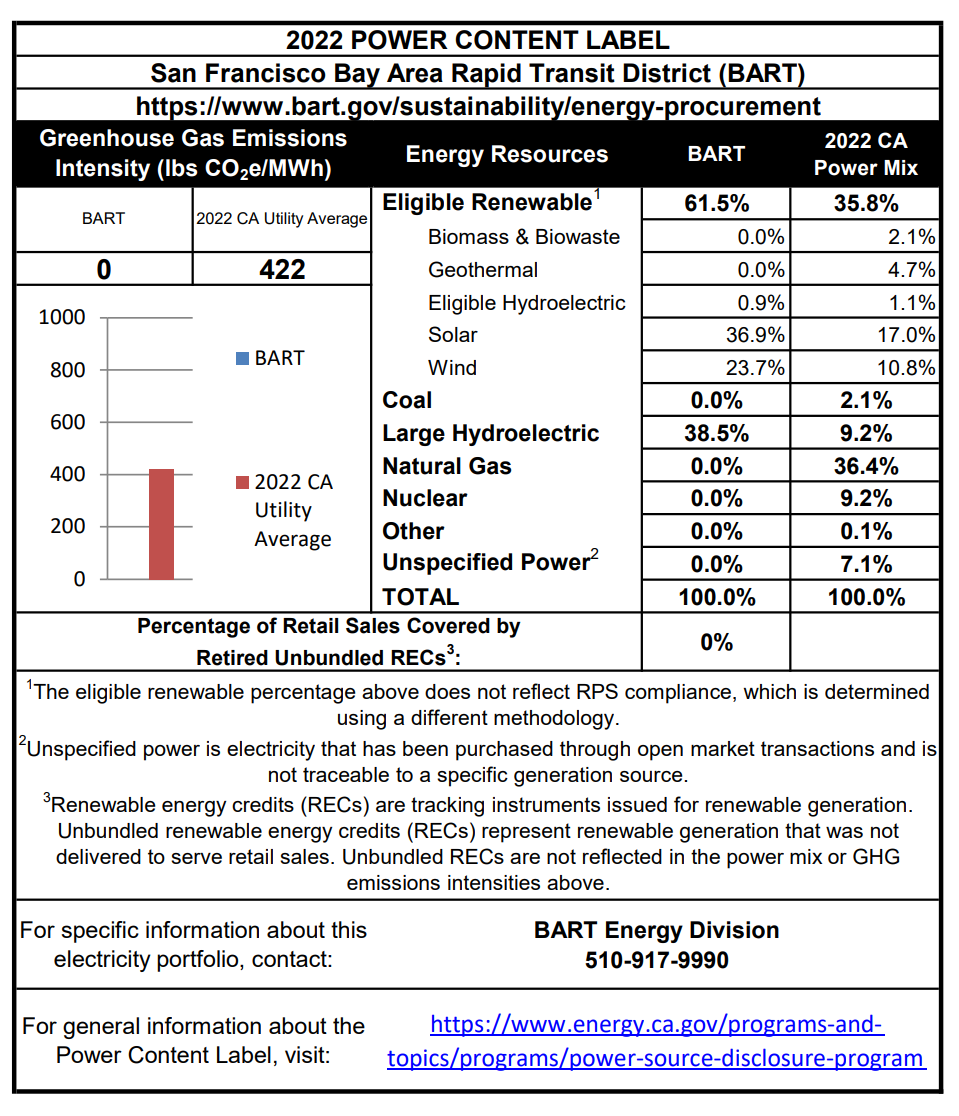
As shown under the “BART” column in the Power Content Label for 2022, BART achieved a power supply that was 100% GHG-free while growing its total share of eligible renewable electricity to 61.5% (from 14.8% in 2021), far surpassing the California’s grid average power mix of 35.8% (shown under “2022 CA Power Mix”). BART’s renewable power mix was comprised primarily of solar photovoltaic (36.9%) and wind (23.7%), supplemented by a contribution from small hydroelectric resources. Its remaining power (38.5%) was sourced from large hydroelectric generation.
This was the first full year of commercial operations for BART’s two new renewable Power Purchase Agreements, Slate Solar and Sky River Wind, after both resources came online in late 2021. Together, these projects generated over half of BART’s electricity needs in 2022.
BART's 2021 Power Content Label
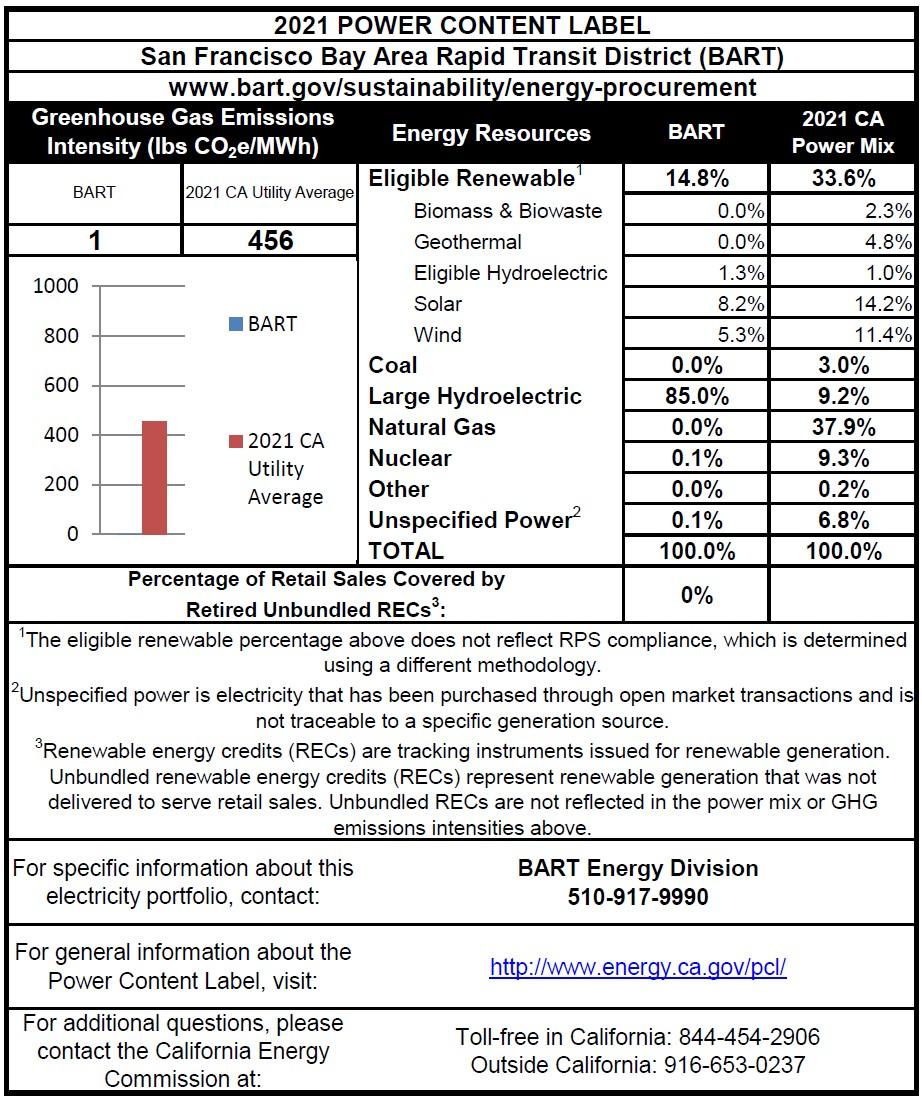
As shown under the “BART” column in the Power Content Label for 2021, BART achieved a power supply that was nearly 100% GHG-free while growing its total share of eligible renewable electricity to 14.8% (from 4.8% in 2020), which was less than California’s grid average power mix of 33.6% (shown under “2021 CA Power Mix”). BART’s power mix was comprised primarily (85%) of large hydroelectric generation, supplemented by substantial contributions from solar photovoltaic, wind, and small hydroelectric resources. Trace quantities of nuclear and unspecified generation are also represented due to modest deliveries of asset-controlling supplier power sourced from Tacoma Power in instances where specified hydroelectric capacity was unavailable.
Notably, 2021 saw the commencement of commercial operations for BART’s two new renewable Power Purchase Agreements with Slate Solar and Sky River Wind with a total capacity of over 50 MW and 30 MW respectively. Together, these projects are expected to serve approximately 50% of the BART’s annual electricity requirements beginning in 2022.
BART’s 2020 Power Content Label
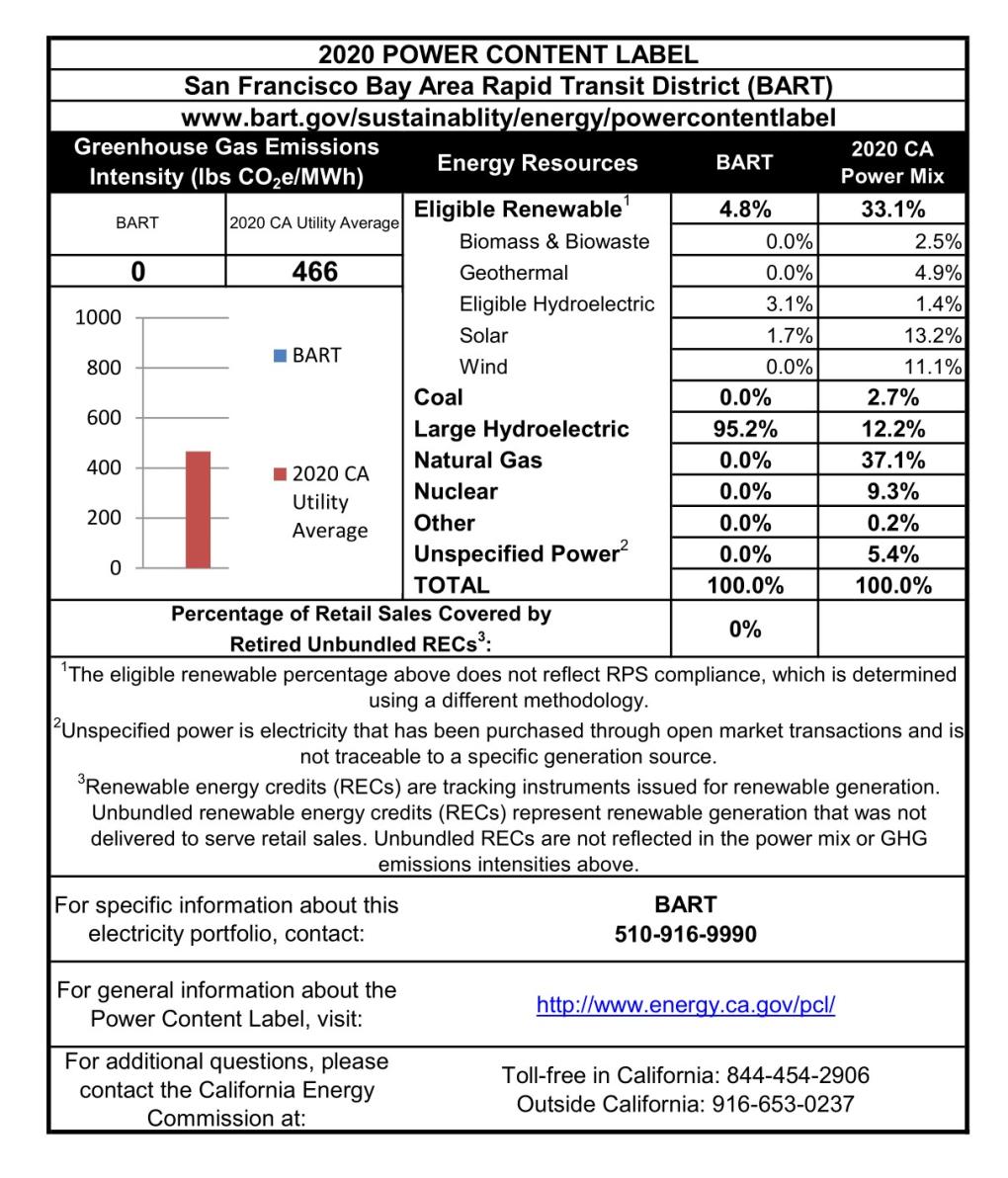
As shown under the “BART” column in the Power Content Label for 2020, BART achieved a power supply that was 100% GHG-free for the first time in its history. BART’s total share of eligible renewable electricity decreased slightly to 4.8% (from 5.1% in 2019), which was less than California’s grid average power mix of 33.1% (shown under “2020 CA Power Mix”). Of BART’s total 2020 power supply, 95% was sourced from large hydroelectric sources, while the balance of its electric supply was generated by small hydroelectric and solar projects which qualify as renewable resources under California state law.
BART’s 2019 Power Content Label
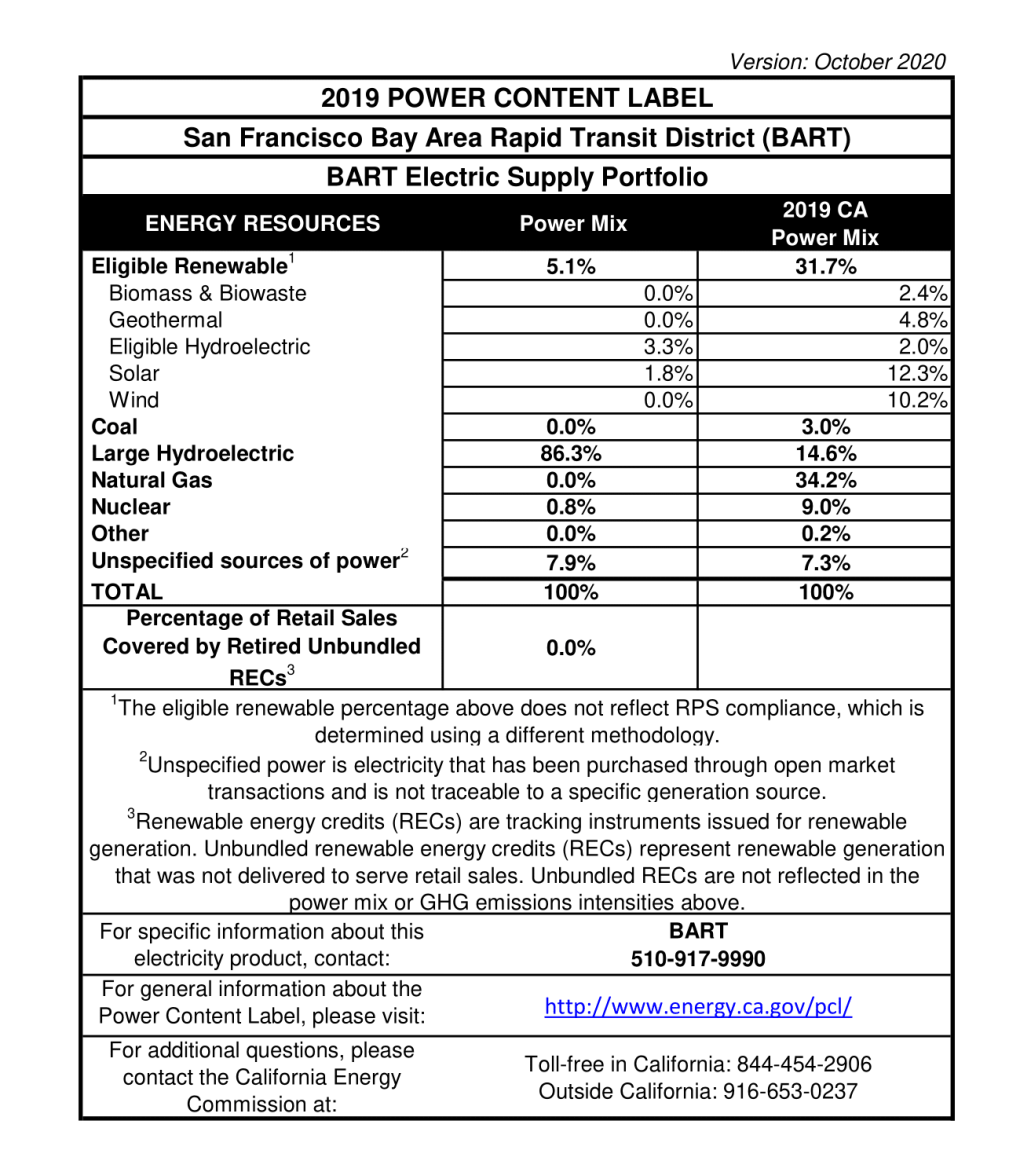
For this inaugural Power Content Label, BART achieved a power supply that was 92% GHG-free as shown under the “Power Mix” column in the Power Content Label for 2019. BART’s total share of eligible renewable electricity was 5.1%, which was less than California’s grid average power mix of 31.7% (shown under “2019 CA Power Mix”).
BART’s electric power portfolio was comprised of specified imports including:
- Large hydroelectric and Asset Controlling Supplier power sourced from the Pacific Northwest
- Federal preference hydroelectric power from Western Area Power Administration (WAPA)
- Renewable hydroelectric power generated by the Lake Nacimiento hydroelectric project
Additionally, on-site solar projects located on BART property added to the power portfolio.
Questions or Feedback
Please send an email to [email protected].