
19th Street Station Display Cases
In 2023, the 19th Street Station completed a significant modernization project that included:
- Replacement of existing lighting with energy-efficient LED fixtures throughout station
- New glass railings and fare barriers replaced opaque walls, creating a more modern and welcoming look
- Reconfiguration of the concourse from three paid areas into one continuous area for easier customer wayfinding
- Expanding the fare paid area at the north end of the station with a new station agent booth and fare gates
- New elevator (platforms-to-concourse) on the north end
- Repairs to terrazzo flooring and ceramic wall tiles
Additionally, the BART Art Program implemented the following:
- Stairwell lightboxes by Ron M. Saunders (San Francisco), Phillip Hua (San Francisco), and Lisa and Hailey Banks (Chico)
- Station environment enhancements by Merge Conceptual Design (Los Angeles)
- 25 illuminated display cases transforming the former telephone alcoves
The illuminated display cases are managed by the BART Art Program and provide a series of rotating displays of artwork by local artists and arts organizations to celebrate the rich cultural community of Oakland and the Bay Area. The display cases are typically changed every 9-12 months. The displays are located adjacent to the three westside entrances from Broadway in the unpaid area, and next to the restroom facilities in mid-station paid area.
The original display was by Julio Martínez Villeda of Studio 1500 in San Francisco.
CURRENTLY ON DISPLAY
IN FULL BLOOM
(On display starting April 23, 2026 until 2027)
Curated by Lisa Solomon
If you commute via BART, a lot your time is spent underground. And, if you aren’t underground then you are often in urban areas. Whatever landscape you can see is speeding by at a fast pace. Captivated by beauty, perfume and healing properties, we humans have been interested in flora for centuries. Flowers have also held a prominent place in art. In the 17th Century, Dutch painters created beautiful still lives from flowers that were from all over the world. The elaborate paintings compressed time, showing us flowers from different seasons together. They also enshrined fleeting and showcased objects worth great value. While flowers fade and die, a painting is forever.
Looking at flowers, real or imagined, offers us a moment to reflect and pause. A moment to consider how lovely it is to sit in a garden, breathe fresh air, and experience nature.
The artists here have varied approaches - from a quick plein air (outside) sketch, to directly scanning flowers to generate prints, to more traditional painting and drawing techniques - but they all clearly revere their subjects. The hope is that bringing some of the outside in will be unexpected, reflective, and give you - the commuter - a minute of joy and beauty during your day.
Lisa Solomon, Curator
@lisasolomon
About the Artists
Courtney Cerruti
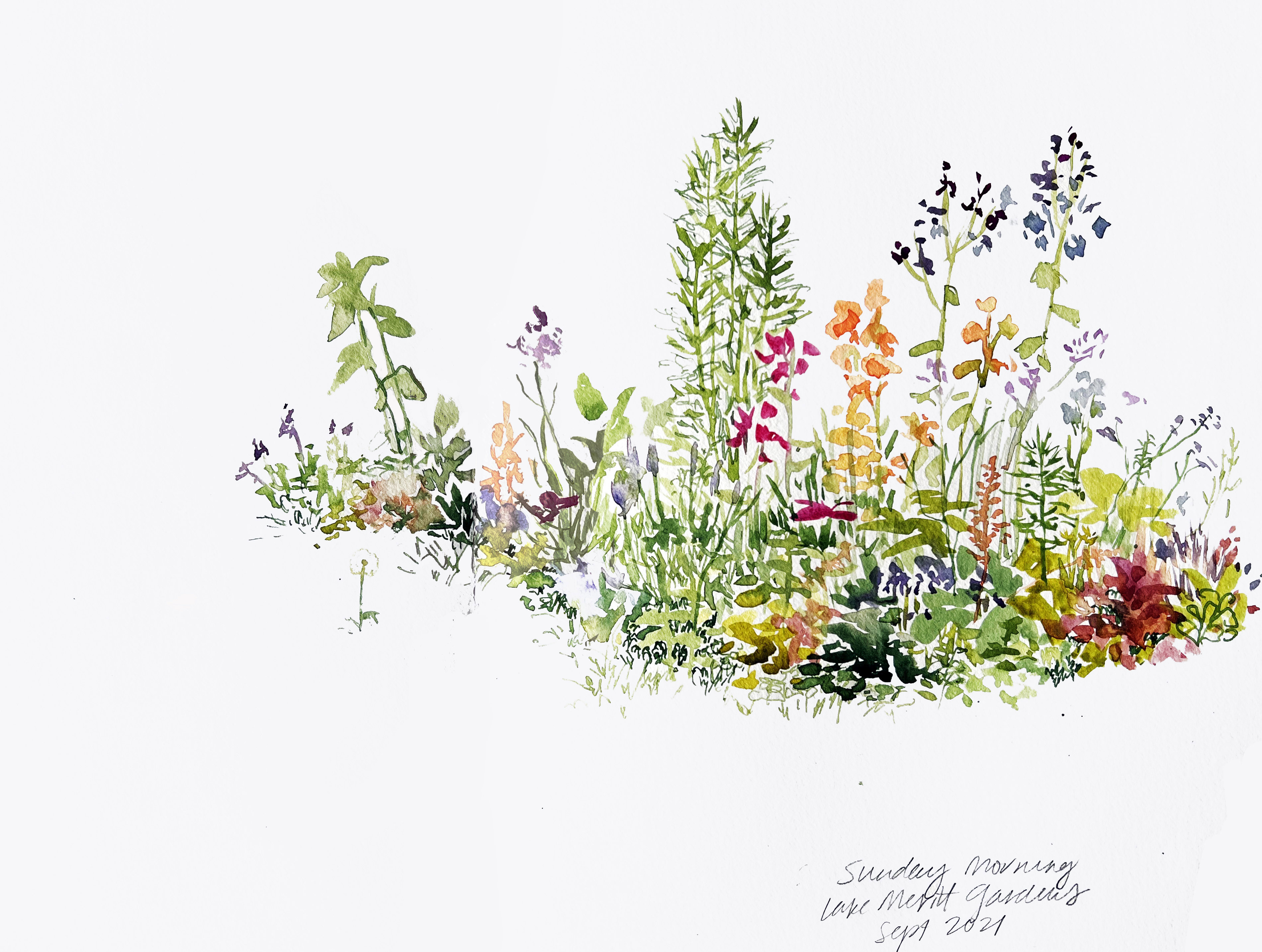
Courtney Cerruti is an artist, author, and collaborator living and working in Oakland, California. She is the author of five books including Make Art Where You Are and One Color a Day. Her titles Playing with Image Transfers, Washi Tape 101 and Playing With Surface Design have been translated into Italian, French, German, Spanish and Chinese. She currently teaches workshops all over the country and online at Creativebug.com where she is Editor-In-Chief.
Statement on work:
Lake Merritt feels like home. As a kid, I took art classes at the Junior Center of Art and Science. As an adult, I had more than a few first dates walking the lake. As a mama, I find exploring the garden with my daughter a local adventure. On this particular Sunday, I had a quiet moment alone to paint the flowers in bloom.
@ccerruti
Liz Hernández
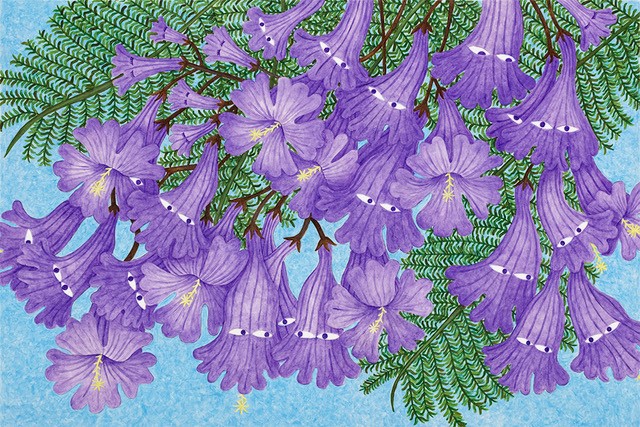
Liz Hernández creates art rooted in storytelling, using painting, sculpture, and textiles to blur the boundary between the real and the imagined. Writing anchors her practice; each series begins with a short story that guides the creation of handcrafted objects and images.
Her work engages both personal and collective narratives, often centered on memory, womanhood, and transformation. Driven by material experimentation, she studies ancestral techniques such as embroidery and repujado (embossed metal), reinterpreting these Mexican craft traditions to shape a visual language of her own.
She has exhibited in San Francisco, Los Angeles, New York, and Mexico City. Her work is held in the permanent collections of SFMOMA, the de Young Museum, and KADIST.
Statement on work:
The piece shows jacaranda flowers blowing in the wind. Upon closer look, we can notice a few flowers have eyes. Most of them are looking at each other, but one stares directly at you. This is meant to represent that nature is our witness. Trees are alive, and we are in community with them, whether we acknowledge it or not.
Jacarandas can be found in many areas of Mexico City, but they're rare in the Bay Area. Although they are uncommon, there's one that grows randomly on my street, and two more near my old studio in West Oakland. These trees don't belong here, but sometimes I feel like neither do I. I'm drawn to them because they're out of place, yet they still bloom. They are rebellious, making beauty in a landscape that wasn't meant for them. They've found their way to flourish, visible enough if you know how to look for them.
 @spellofmyself
Kija Lucas
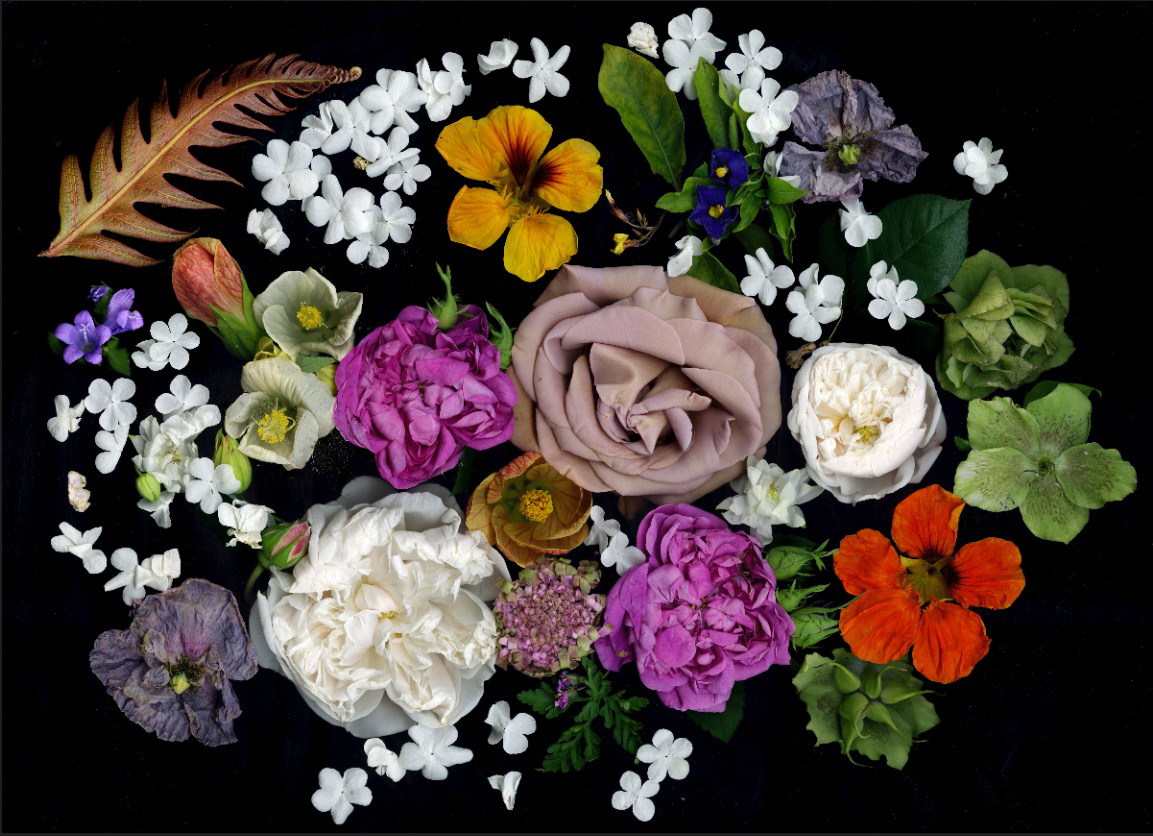
Kija Lucas is an artist based in the San Francisco Bay Area. She uses photography to explore ideas of home, heritage and inheritance. She is interested in how ideas are passed down and seemingly inconsequential moments create changes that last generations. Her work has been exhibited at Mills College Art Museum, Oakland Museum of California, San Francisco Arts Commission Galleries, Palo Alto Arts Center, For-Site Foundation, Black Cube Nomadic Museum HQ (Denver, CO), and International Center for Photography (New York, NY). Lucas has been an Artist-in-Residence at Montalvo Center for the Arts, de Young Museum, and Recology San Francisco. Her work is in the collections of Mills College Art Museum, International Center of Photography, California Institute of Integral Studies, and Montalvo Arts Center. Lucas received her BFA from the San Francisco Art Institute and her MFA from Mills College.
Statement on work:
I grew up with my hands in the dirt, spending some of my summers and days off from school with my siblings and father. We worked in other people’s yards, and I learned which plants to remove and which I was meant to value. In one of my earliest memories, I was told to remove a tiny orange flower with flecks of purple (Scarlet Pimpernel) and when I remarked on its beauty and questioned why, I was told it was a weed. Decades later, I am still questioning why we value some botanicals more than others.
Choosing plants for a garden feels incredibly personal. We decide which ones to bring with us when we move, some are brought across the globe to remember home. They might carry a smell, a taste, or a memory that brings back a person, a place, or a moment in our lives. Last spring I had the pleasure of visiting the garden of Samin Nosrat (noted Bay Area chef and author), a place as full of plants as it is of stories. This image is made from the botanicals Samin chose for her garden.
@kijalucas
Carrie Lederer
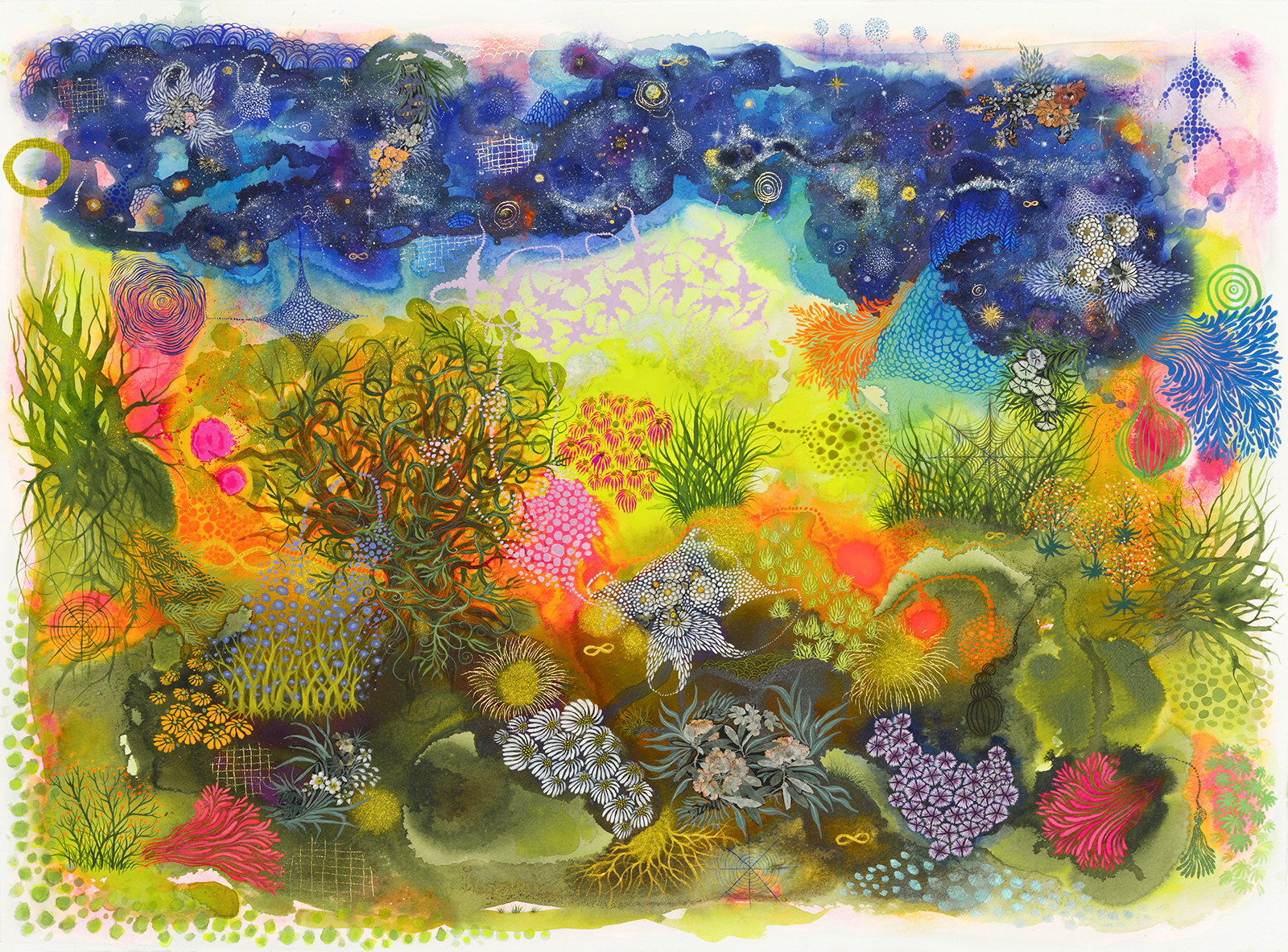
Carrie Lederer is a painter, sculptor, and installation artist whose nature-inspired works have been exhibited across the United States. She is a recipient of the prestigious Fleishhacker Foundation Eureka Award and has completed public art commissions for Facebook, the Cities of Sunnyvale, Palo Alto, Walnut Creek, and Menlo Park; UCSF Medical Center; Hudson Valley Seed Co.; Imagery Winery; and numerous private collections. Lederer is currently (2026) an Artist-in-Residence at Kala Art Institute in Berkeley, California.
She has created site-specific installations for Turtle Bay Museum, the di Rosa Center for Contemporary Art, Art Source, Root Division, the San Jose Institute of Contemporary Art, and other institutions. Her work is included in private and public collections including Oakland Museum of California, di Rosa Center for Contemporary Art, Stanford Medical Center, Montage Health Monterey, First Western Trust Bank, and Prudential Insurance Co., New York.
Lederer’s work was featured in a cover story for MUSES, published by Michigan State University’s Department of Arts and Letters, and included in the nationally recognized New American Paintings catalogue. Reviews and features have appeared in CREATE! Magazine, ARTnews, San Francisco Chronicle, 48 Hills, Diablo Magazine, and SquareCylinder.
Statement on work:
My current work consists of ornate compositions built upon a pattern-based, topographical matrix that reflects the complexity of the natural world. I use fabric, fur, flock, glitter, and glass eyes—materials both organic and artificial—to create images that are simultaneously ordered and chaotic, realistic and abstract. The tapestry-like surfaces are dense and alive, where one hub of activity entwines with another, echoing the interconnectedness of nature itself.
I am fascinated by the intersection of natural and constructed forms. In my process, nature-based imagery is often abstracted until it becomes something entirely new—rooted in the real yet transformed. I combine botanical and cosmic patterns to illuminate the delicate, often unseen systems that exist around us.
The flowers that emerge in my work are reflections of what we might find in our gardens—Shasta Daisies, Craspedia (cornflowers), Zinnias, Agave, Echinacea, Rudbeckia, Salvia, Helleborus, and more—but rarely are they rendered literally. They become hybrid forms that evoke memory, rhythm, and transformation in the natural world
@carrielederer