
BART is one of Northern California’s largest electricity end users, requiring approximately 363,000 megawatt hours annually to power its system. The composition of BART’s power supply is a key determinant of BART’s greenhouse gas (GHG) emission intensity and directly contributes to decarbonization of California’s transportation sector for the benefit of the state, the region, and ridership it serves. BART’s power procurement is guided by its Wholesale Electricity Portfolio Policy (2017) with the intention of maintaining a power supply that is stable, reliable, affordable, and clean.
BART relies on a portfolio of Power Purchase Agreements to supply electricity and other wholesale energy products that advances its clean energy commitments. BART’s ability to enter into these Power Purchase Agreements is enshrined in California Public Utilities Code 701.8 and enacted by two agreements with Pacific Gas & Electric to address distribution system or lower voltage issues and transmission-level issues: the Jurisdictional Electrical Services Agreement (PDF) and the Transmission Interconnection Agreement (PDF).
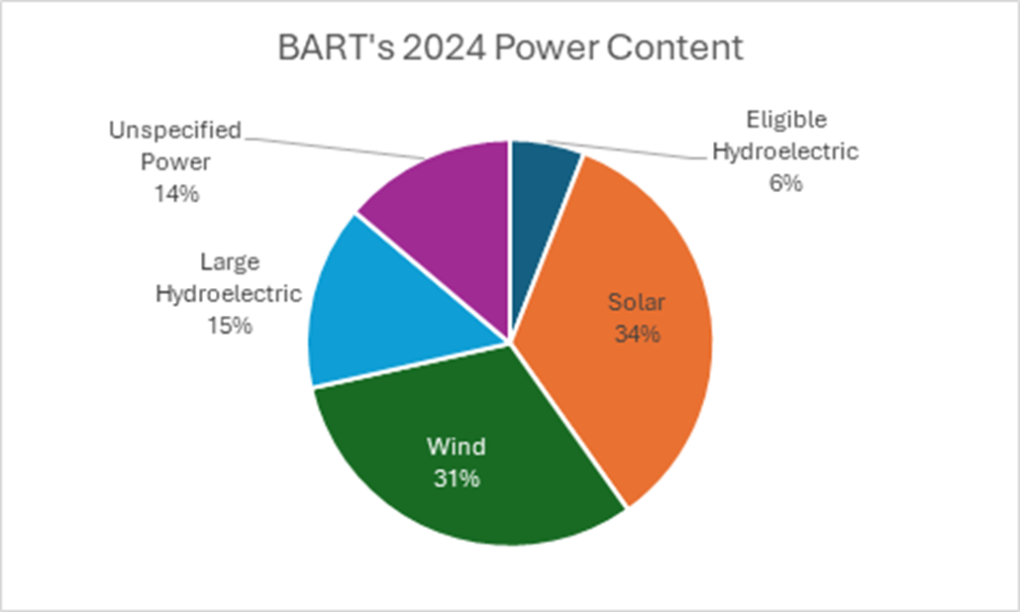
Every year, BART’s power supply sources are inventoried in its Power Content Label and independently verified under the California Energy Commission’s Power Source Disclosure Program. BART’s most recent Power Content Label is found below and reports for every year since BART’s reporting started in 2019 are found at BART’s Power Content Label page.
Power Purchase Agreements
BART’s portfolio of Power Purchase Agreements includes generating resources located both onsite within the BART system and elsewhere across the state. These resources are described below with their location and total capacity expressed in megawatts (MW) or kilowatts (kW).
BART executed two long-term Power Purchase Agreements in 2017 with renewable energy resources that anticipated they would supply approximately 50% of BART’s electricity needs over a 20-year period. The most current Annual Sustainability Report found that these resources are exceeding expectations by supplying 64% of BART’s needs. These projects both achieved commercial operation in 2021:
- Slate Solar: 50.5 MW (Kings County)
- Sky River Wind: 30 MW (Kern County)
In addition, other generating resources are located on BART property and elsewhere across the state. BART buys electricity from the following generation facilities:
- Gridley #2 Solar: 30 MW (Butte County)
- South Feather Hydroelectric: 121.5 MW (Butte County)
- Lake Nacimiento Hydroelectric: 4.4 MW (Monterey County)
BART is the sole consumer of power from its five on-site solar facilities:
- Warm Springs/ South Fremont Station: 550 kW
- Antioch Station: 1.125 MW
- Lafayette Station: 1.125 MW
- Richmond Shop: 160 kW
- Hayward Maintenance Yard: 255 kW
Most Recent Power Content Label
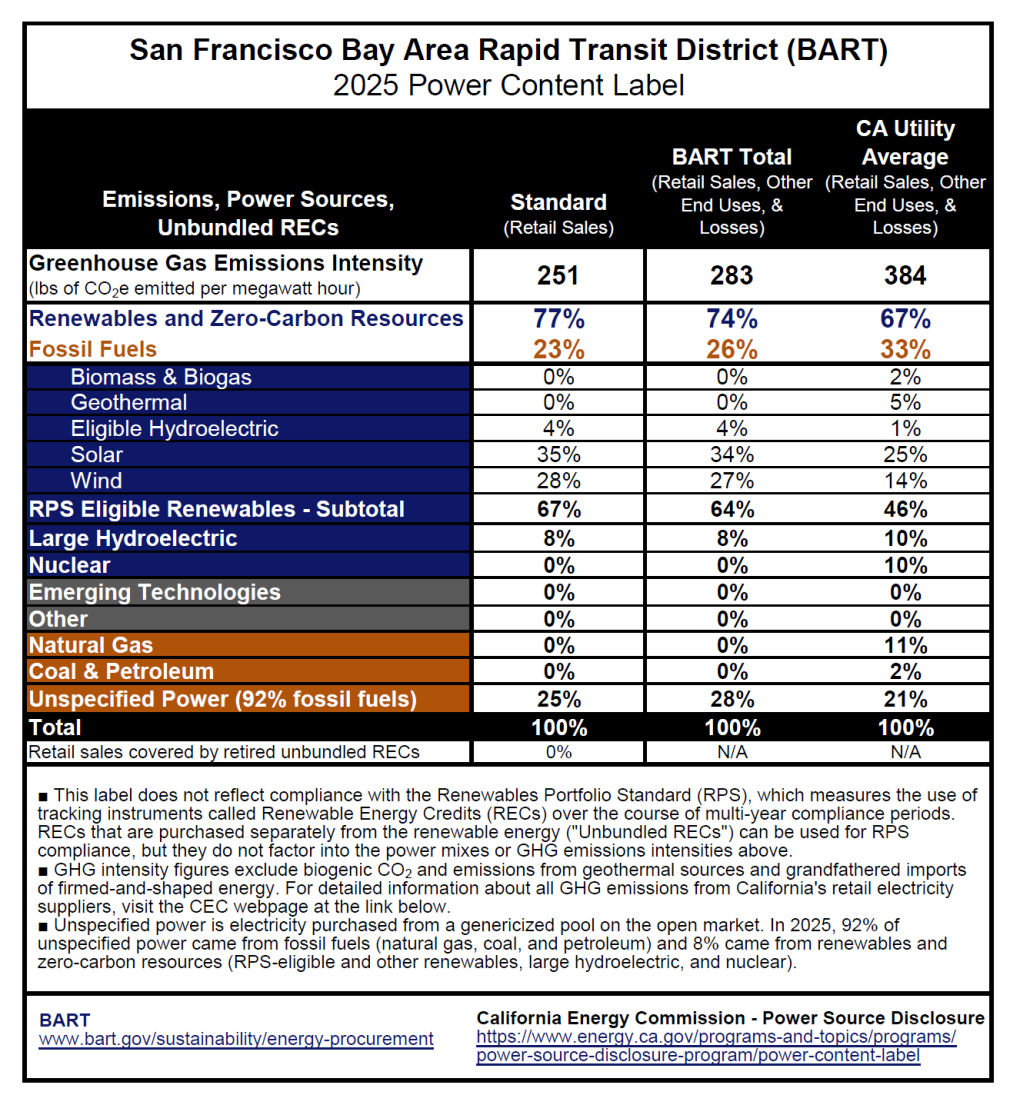
Starting in 2025, the California Energy Commission staff calculated the percentage of unspecified power coming from renewable and zero-carbon resources, resulting in changes to the fuel breakdown and GHG emissions displayed in the "Standard" column. CEC also added an additional column that reflects the fuel mix and GHG emissions intensity of a retail supplier’s loss-adjusted load, which will include all retail sales, other electricity end uses, and transmission and distribution losses, displayed as "BART Total." Using the "Standard" column in the Power Content Label for 2025 below, BART achieved a power supply that was 77% GHG-free while maintaining its total share of eligible renewable electricity at 67% (it was 71% in 2024), far surpassing the California Utility Averages of 46%. BART's renewable power mix was comprised primarily of photovoltaic solar (35%) and wind (28%), supplemented by a contribution from small hydroelectric resources (4%). Its remaining power was sourced from large hydroelectric generation (8%) and unspecified market power (25%). Information for all reporting years is found at BART’s Power Content Label.
Questions or Feedback
Please send an email to [email protected].