
Search Results
Take BART to the 43rd Annual San Francisco Pride Celebration and Parade
Photo by Dan Nicoletta BART will provide longer trains to accommodate the crowds expected to celebrate the return of San Francisco LGBT Pride Celebration this weekend. Purchase a round-trip ticket to avoid lines at ticket machines, or use a pre-loaded Clipper card. This year marks the 43rd anniversary of the
Position open on BART Police Citizen Review Board – Public-At-Large
The BART Board of Directors is currently in the process of recruiting a Public-At-Large appointee for the BART Police Citizen Review Board (BPCRB).
The BPCRB is comprised of 11 members and residents of the following counties: Alameda, Contra Costa, San Mateo and San Francisco. The Public-At-Large position is appointed by all nine BART directors.
Members of the BPCRB work to increase the public's confidence in BART's policing services by:
- Reviewing, recommending, and monitoring the implementation of changes to police policies, procedures, and practices
- Receiving citizen allegations of on-duty police misconduct
- Advising Board of Directors, General Manager, Independent Police Auditor, and Police Chief
- Participating in recommending appropriate disciplinary action
- Meeting periodically with representatives of the BART Police associations
- Participating in community outreach
Submit an e-application or download the printable application.
Application period opens Monday, Nov. 18, and closes on Friday, December 20, 2024.
Call (510) 464-6083 or email [email protected] with questions.
BPCRB Recruitment Flyer - Public-At-Large
General BPCRB information (.doc)
Details about 9/28 shooting at BART to Antioch transfer platform
At approximately 5:25pm on Monday, September 28, BART Police responded to the BART to Antioch transfer platform in Pittsburg after an argument between two people turned into a shooting.
Three victims with gunshot wounds were transferred to local hospitals with non-life-threatening injuries. The victims were not involved in the argument between the two suspects. BART staff on the transfer platform assisted the victims until medics arrived.
BART Police officers on their regular patrol of Pittsburg/Bay Point Station intercepted one suspect, 22-year-old Xavier Johnson of Pittsburg, on the trackway as he fled the scene. Police continue to search for a second suspect.
Train service between North Concord/Martinez and Antioch stations was temporarily stopped while BART Police conducted their investigation, and Tri Delta Transit provided bus service for BART passengers between the stations.
Service between North Concord/Martinez and Pittsburg/Bay Point was restored at approximately 7pm, and a train was carrying passengers between Antioch to Pittsburg Center. Service was restored to the Pittsburg transfer platform at approximately 10:58pm.
Article updated 9/29/26 12:09pm.
New BART Parking features make it easier and faster to pay
BART has introduced several new features to make it easier for customers to pay for parking.
Stall number entry no longer required on the official BART app
Forgot your parking stall number? No problem, we heard you. Stall number entry will no longer be required on the latest version of the official BART app. Instead, register up to 5 license plates on your account and the system will check against all of them.
Introducing “Tap and Go” – Pay for parking with one tap
The latest app version will also include a convenient new “Tap and Go” feature that allows you to pay for parking with one tap from the app home screen. To enable the feature, visit the Daily Fee section of the latest version of the app. You’ll need to create a parking wallet if you don’t already have one and register up to five license plates. Once the feature is enabled, a “pay now” button will appear on the app home screen allowing you to pay for parking with one tap.
Buy Reserved parking on BART’s website
Customers are now able to purchase reserved parking (Single/Multi-day or Monthly) on BART’s website, in addition to the official BART app. This supports those who can’t or don’t want to use an app to purchase Reserved parking. Daily Fee parking will not be available through the website and must be purchased on the official BART app or at the machines inside the station.
For additional information, please review our FAQs or contact us.
BART recruiting for Transit Security Advisory Committee (applications due 6/4/2025)
BART is currently accepting applications to fill several seats on the Transit Security Advisory Committee (TSAC) until June 4, 2025.
BART Police Officers have the authority to issue prohibition orders to offenders who are cited or arrested for certain offenses. The TSAC is the community oversight group comprised of at least five members of the public , that serves as a volunteer review body for the implementation of BART’s prohibition policy.
Board-appointed members of TSAC are professionals in the areas of mental health, homelessness, public safety and youth advocacy and cultural awareness. Drawing from their private and public sector experiences, the committee brings a diverse set of skills to the review and execution of the prohibition policy. The advisory committee reports directly to the BART Board of Directors.
BART is currently accepting applications for the following seats on the Transit Security Advisory Committee:
- One (1) Alternate Committee Member Seat (for any category, no more than one alternate per category)
- Law Enforcement Representative
- Mental Health Representative
- At-Large Representative
- One (1) Mental Health Representative
- One (1) Law Enforcement Representative Seat
- Three (3) At-Large Representative Seats
- One (1) Youth Advocates Representative Seat
Final Filing Date – Applications are due by Wednesday, June 4, 2025, at 5:00 P.M. (PST)
Please download the application here and return the application form and relevant attachments to the BART Office of the District Secretary at:
2150 Webster Street, 10th Floor, Oakland, CA 94612
Applications may also be emailed to [email protected]
You may also submit your application using DocuSign by clicking on the following link: E-Application
Please feel free to call the Office of the District Secretary at (510) 464-6083 with any questions.
Valentine's Day inspiration: You just might meet the love of your life on BART
By MELISSA JORDANBART Senior Web Producer Once upon a time (well, last summer), a woman named Michelle sat next to a man named Jesse on a BART train. And, those strangers on a train turned out to be soulmates. It was not an auspicious start. She tried to strike up conversation, showing him photos of her
BART will run Saturday service for 2024 Presidents Day, 2/19
BART will run a Saturday schedule on Presidents Day, Monday, February 19, 2024. Saturday service means BART will open at 6am and close at midnight. For the most up-to-date schedule information use our Trip Planner or our official BART app to plan your specific trip.
Presidents Day is also a parking holiday. Parking will be free at all stations except for Milpitas and Berryessa/North San Jose. All other parking rules will be enforced.
The Valley Transportation Authority operates the lots at Milpitas and Berryessa/North San Jose and their parking rates still apply. Consult the VTA's site for more info on parking: Parking at the Milpitas & Berryessa Transit Centers | VTA
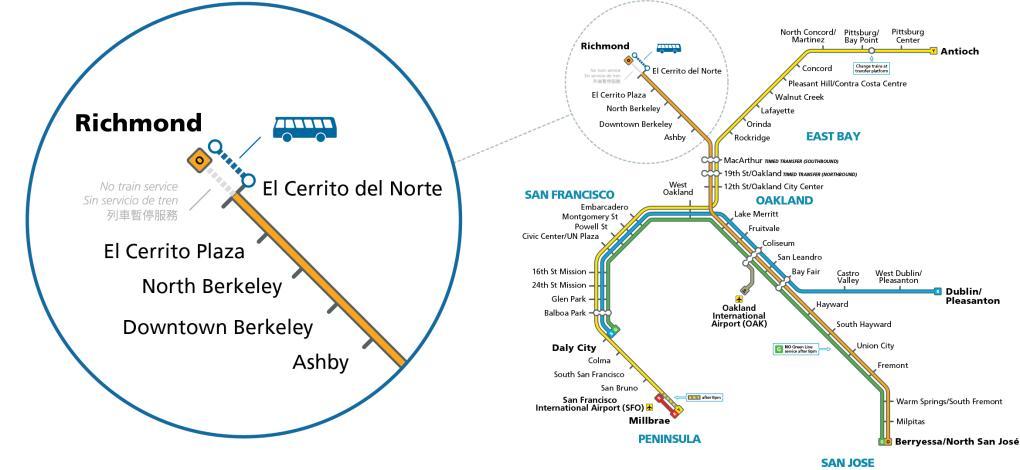
BART Service Will Not Run Between Richmond and El Cerrito del Norte on Red Line on President's Day (Free buses will replace train service)
Over Presidents Day weekend, February 17-19, 2024, BART crews will work around the clock to replace track equipment near Richmond Station. Work will also be done to reduce vegetation that could impact service. Free buses will replace trains on that stretch of track all three days of the holiday weekend.
Additionally, the Red Line will be cancelled while this work takes place. However, a shuttle train will operate every 20 minutes between Millbrae and SFO with regular Red Line departure times.
This is the first of four non-consecutive weekends in February, March, and April when workers will replace an interlocking near Richmond Station.
Riders traveling to or from Richmond Station should expect 20-minute delays on these weekends. Read more about the project here.
Keep up with the latest updates for trackway repair projects that impact service by going to https://www.bart.gov/schedules/advisories. BART’s Trip Planner has been improved to show the full customer journey of bus bridges. The Trip Planner will show the bus bridge on work weekends.
BART to offer regular service during APEC conference in downtown SF
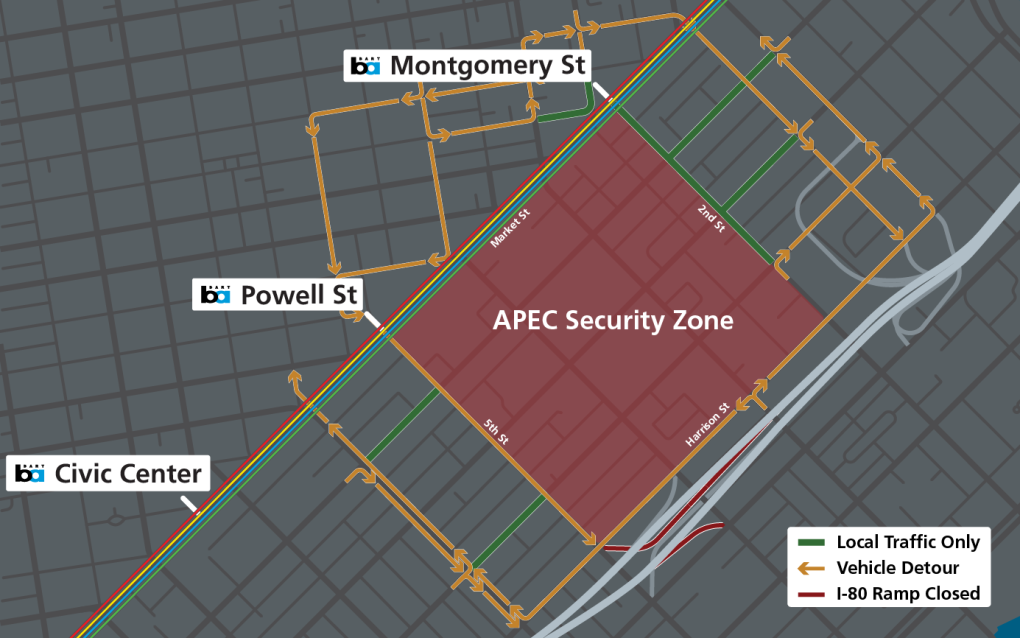
BART will run its normal service during the upcoming Asia-Pacific Economic Cooperation summit, which is scheduled for November 11-17 at Moscone Center in downtown San Francisco. Enhanced security for the summit will lead to some road closures near the event as well as impacts on other public transit services. But BART will continue to run trains with normal stops at all four downtown San Francisco stations throughout the summit. There will be no station closures and no exit/entrance closures.
BART will add train cars to lengthen trains in anticipation of higher ridership due to Bay Bridge lane closures. All transbay trains will run as 8-car trains (currently some transbay trains run as 6-car trains).
View SFMTA's guide for street impacts and Muni impacts.
With major traffic impacts expected throughout the APEC summit, BART will remain a convenient option for traveling to and from downtown San Francisco. Popular landmarks including Union Square and Yerba Buena Gardens (Powell Street) as well as the Ferry Building (Embarcadero) are located near our downtown San Francisco stations. You can get more info on parking at BART here.
BART now has more frequent service to and from SFO than ever before. Check out our airport guide.
BART will no longer accept paper/magstripe tickets beginning Nov 30
Beginning November 30, 2023, paper tickets will no longer be accepted at BART as fare payment and for use at the fare gates. This change is occurring as BART begins to roll out new state of the art fare gates which will not accept paper tickets and as Clipper prepares for the launch of the next generation of Clipper.
Paper tickets balances cannot be transferred onto a Clipper card. BART offers paper ticket refunds for tickets with a remaining value greater than $1.00. It can be multiple tickets that add up to $1 or more. Click here for directions to request a refund.
There is no deadline for requesting a refund. Refund requests do not need to be submitted by November 30th.
Pay By Phone
Clipper is now available through Apple Pay and Google Pay. Riders can get a new Clipper card on their phones for free (normally $3). Funds added using Apple Pay and Google Pay are immediately available for use.
Set up is easy and can be done on the spot or in advance while you are at home. Every rider needs their own digital card. For families travelling together, multiple cards can be added to an Apple phone, but users must turn off Express Transit mode to toggle between each card when tagging at the fare gate.
Next Generation Clipper
BART has moved to a Clipper-only fare payment system because the region has prioritized the use of Clipper as the Bay Area’s all-in-one transit card administered by the Metropolitan Transportation Commission. In calendar year 2024, the next generation of Clipper will be rolled out including open payment which provides the option to tag a credit/debit card at a BART fare gate, including Apple Pay or Google Pay, without setting up a card on your phone in advance. The next generation of Clipper also opens the door for new discount programs, promotions, and potentially fare capping for BART riders.
------
September 11, 2023 Update:
Beginning Saturday, September 30, 2023, BART will no longer sell magstripe paper tickets at SFO. Only Clipper cards will be available at SFO vending machines and riders will continue to be encouraged to add a Clipper card to their phone for a card-free option.
BART began offering paper tickets at SFO in October 2022 in response to global supply chain issues impacting the region’s plastic card inventory. The region now has an adequate supply of cards and BART will eliminate the sale of all paper tickets. This includes the sale of red paper tickets at the Customer Service window at Lake Merritt Station for RTC applicants waiting for their Clipper card to arrive and paper tickets for group sales.
Riders are still able to use the paper tickets they already have on hand, including weekend promotion tickets, to enter and exit through most fare gates until November 30, 2023.
BART mechanics and electricians compete at rail rodeo to improve skills for safety, reliability
By Melissa Jordan BART Senior Web Producer The mechanics and electricians who maintain BART trains rank top in their field. With aging equipment and limited resources, they’re use to thinking on their feet and dealing with surprises. Each year, the rail industry holds local “rodeo” events where individuals