
Search Results
BART to offer customized station-by-station elevator alerts
Starting later this month, BART will roll out an improved elevator alert system that is customizable to include only the stations riders care about.Riders already are able to sign up for different kinds of advisories to be sent to them via email or text; however, there was no way to sign up for info about the
SB 1 funds are crucial for BART and our riders
Senate Bill 1 (SB 1), the Road Repair and Accountability Act of 2017, is expected to raise more than $5 billion annually over the next 10 years for road repairs and improvements to mass transit systems throughout the state. More than $750 million per year goes solely to transit. SB 1 is a dedicated and
BART works on solutions to deal with budget deficit
BART is facing a projected deficit of $35 million for the current fiscal year that ends June 30, 2009, and up to $55 million for the next fiscal year beginning July 1, 2009. The budget shortfall reflects the national economic recession and significant declines in two key revenue sources – passenger revenue
BART PD taking new steps to combat cellphone thefts
BART police detectives are walking trains in the San Francisco corridor this week to hand out cards advising riders to be aware of their surroundings, so they can avoid falling victim to thieves who are after their cellphones. The detectives will focus their outreach efforts during the mid-day and early
BART Police Chief Ed Alvarez on how to build a progressive policing presence
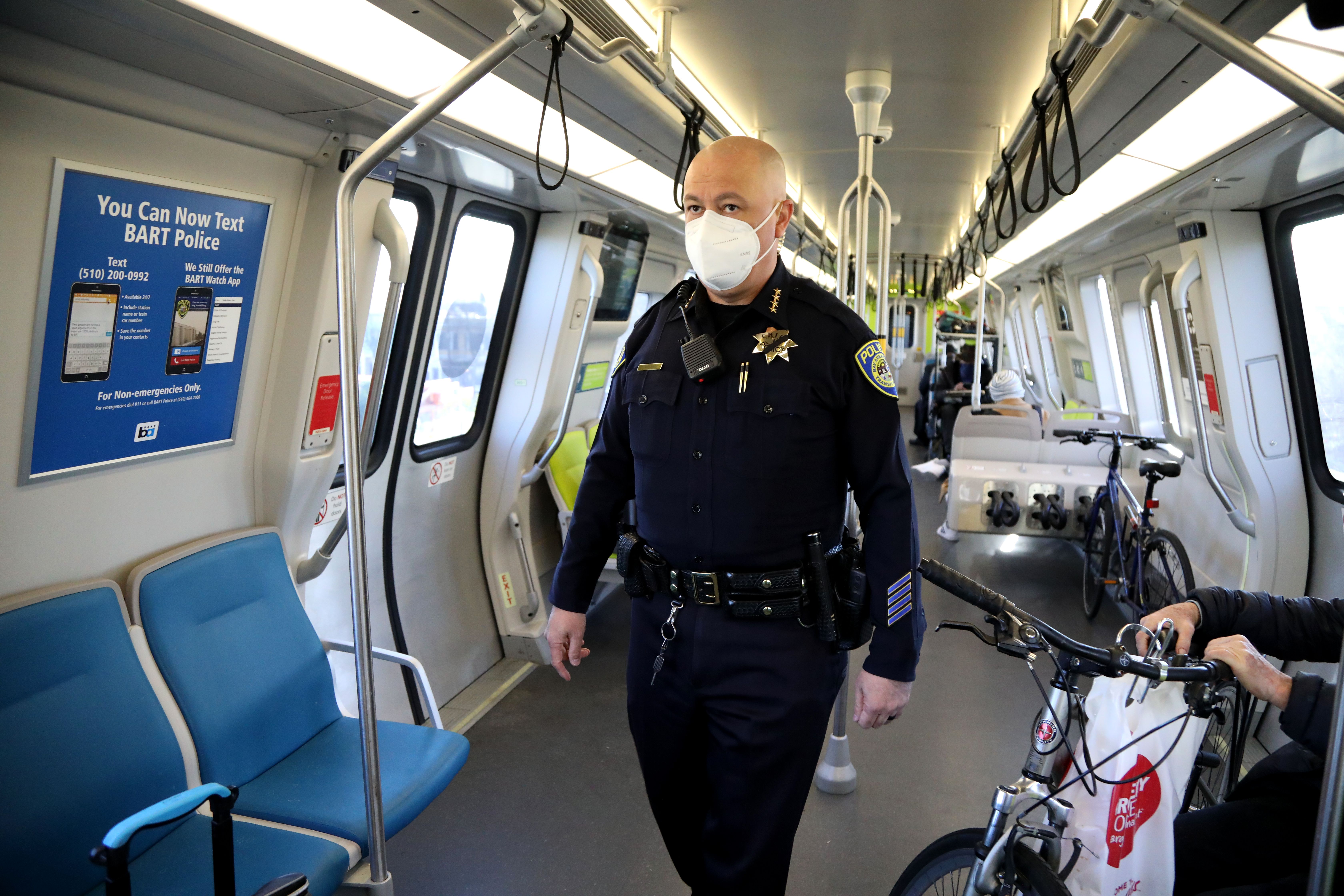
Chief Alvarez regularly walks trains to interact with passengers. Shown here on Feb. 1, 2021; note the poster at left behind blue seats advertising the text-BPD line.
Ed Alvarez has worked his entire career to meet this moment. Reflecting on his first year as BART Police Chief, Alvarez sat down for an interview in which he laid out an ambitious agenda.
“I want to build the most progressive police department in America,” Alvarez said, of the just under 400 personnel under his watch. “Not just the most progressive transit police department. The most of any PD.”
Alvarez joined BPD almost a quarter-century ago. It was his first job in law enforcement and he has served his whole career at BART, working his way up through the ranks and making deep connections to the community.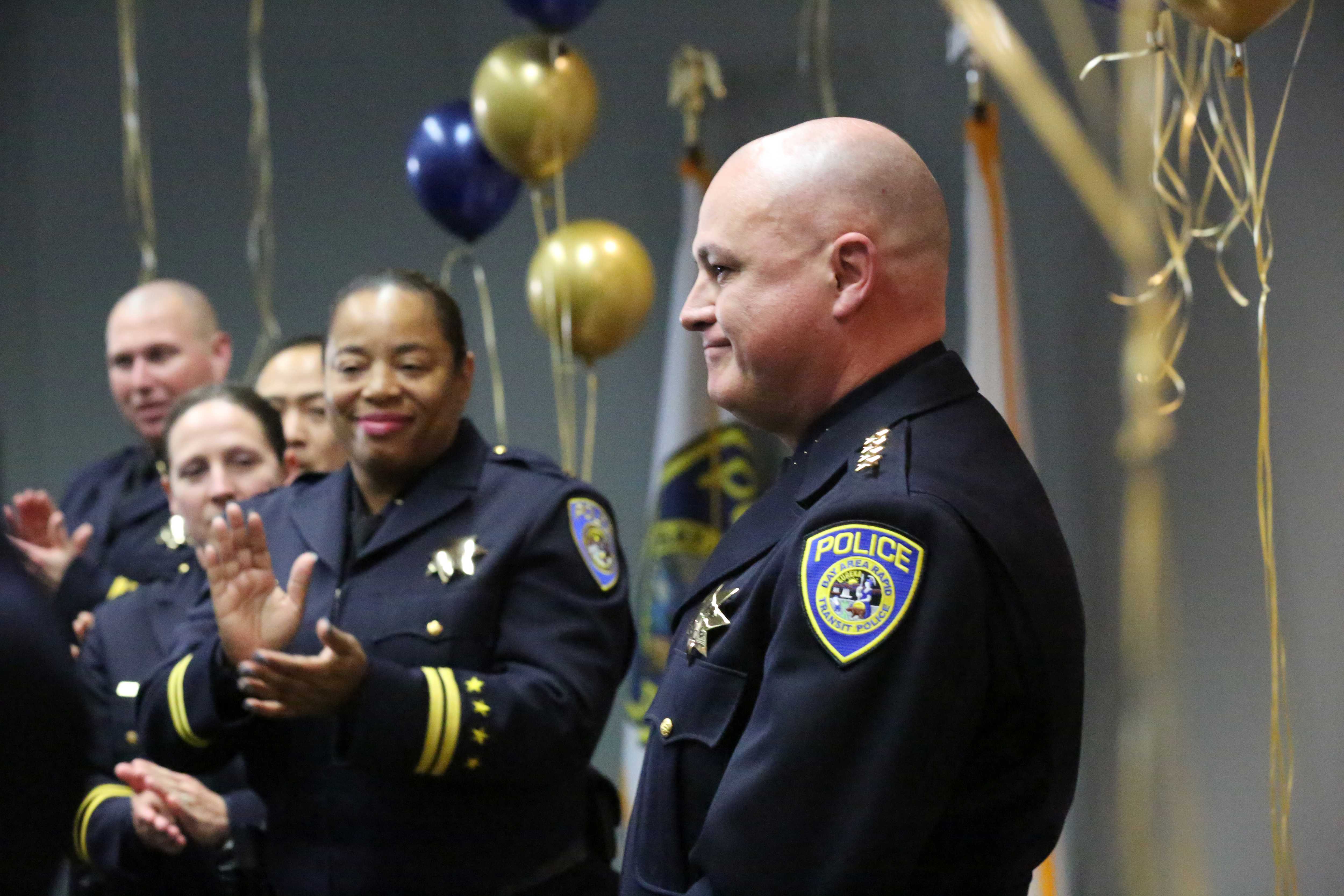
Swearing-in ceremony for Chief Alvarez on Feb. 7, 2020. At left, applauding, is Deputy Chief Angela Averiett, whom Alvarez named to lead the new Bureau of Progressive Policing and Community Engagement
He was appointed as chief on Jan. 1, 2020, and sworn in on Feb. 7, 2020, in a ceremony with blue and gold balloons, sheet cake, handshakes and hugs, just one month before the coronavirus was declared a pandemic. His long years of experience gave Alvarez the insights to quickly implement many strategic initiatives that already have paid off, with more on the way.
Notably, Alvarez created a new Bureau of Progressive Policing and Community Engagement that is an umbrella over a growing team of non-armed personnel that includes the award-winning Transit Ambassadors and soon will include an additional 20 Crisis Intervention Specialists. They’ll focus on connecting those experiencing homelessness, mental illness and substance abuse with services.
The Bureau also will include 10 police officers who will receive specialized training.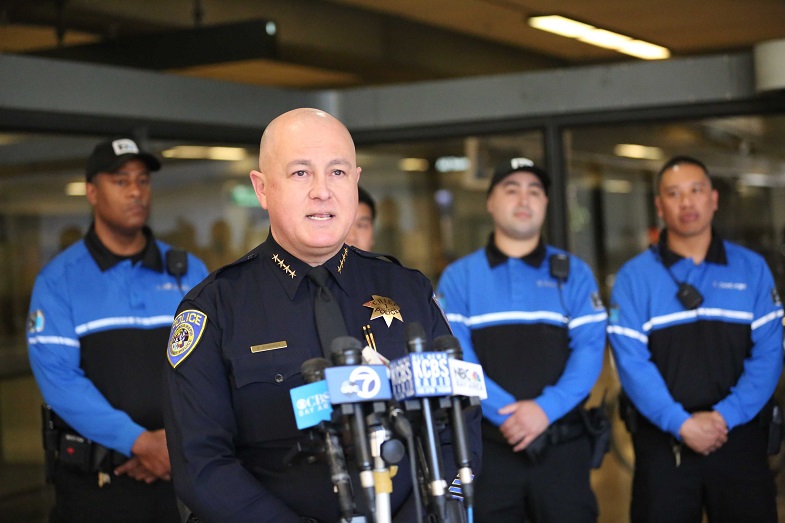
Chief Alvarez introduced the first group of BART PD Ambassadors to the public on Feb. 10, 2020
“We’re infusing 40 additional bodies into our system,” Alvarez said. “These are people who are providing presence, resources, who are extra eyes and ears. We’re going to have more presence than we’ve ever had at BART.” BART Police also have prioritized making it easy to contact them; there is the BART Watch app to communicate in real-time with Dispatch as well as a direct text-BPD line.
Deputy Chief Angela Averiett, who leads the new Bureau of Progressive Policing, said Alvarez has been a steady hand in a time of great change.
“I think the chief’s leadership is a reflection of the resilience of this organization,” she said. “Through all the major challenges of the past year, he has led us courageously and transparently and kept us focused on the mission. His creating this bureau speaks to his very forward-thinking way of how law enforcement needs to change and adapt, how we need to make meaningful reforms.”
The pandemic and associated economic misery has exacerbated homelessness, stressed an already-fractured patchwork of services, and has exposed disparities in health, safety and other outcomes along race and class lines.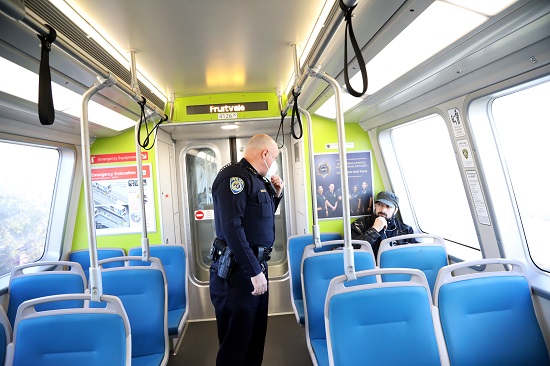
On a train walkthrough Chief Alvarez asked a passenger whose mask was down around his neck to wear it properly
Additionally, the killing of George Floyd by a Minneapolis police officer in May 2020 drew worldwide attention and built a movement demanding more accountability from law enforcement. Alvarez said he was appalled by the abuse of power “and the arrogance” in the Minnesota case – and that he conveys that message to BPD personnel.
“We have to earn the public’s trust every day,” Alvarez said. “We can’t take their trust for granted. We have to do better.”
“It shouldn’t have happened,” Alvarez has said of Floyd’s death. “And a lot of departments are changing how they operate because of it, because of him and the other individuals before and after him. It’s been a call to action.”
He’s committed to meeting the moment by increasing training (which already goes beyond state standards), including the innovative ICAT, or Integrating Communications, Assessment and Tactics course. ICAT is designed especially for situations involving people who are unarmed or armed with weapons other than firearms, and who may be experiencing a mental health or other crisis.
Alvarez also has prioritized working collaboratively with the Citizen Review Board and the Office of the Independent Police Auditor, two civilian oversight bodies that provide another layer of police accountability at BART.
“We all have the same goal of making sure BART is safe for the riding public and our employees,” Alvarez said.
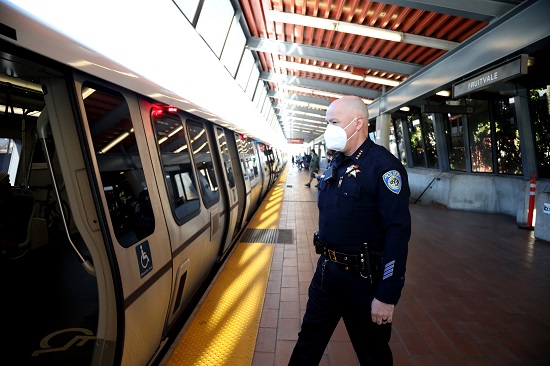
Chief Alvarez on one of his regular walkthroughs to listen to concerns of passengers
As a first-generation immigrant, Alvarez is keenly aware of the issues of mistrust that arise when there are disparate impacts from policing, and that BART is not immune from them.
“We need to be treating all people fairly and equitably,” he said. “That is my expectation for everyone at BPD. We are here to protect and serve. We will continue to work on building bridges and engaging with the communities we serve."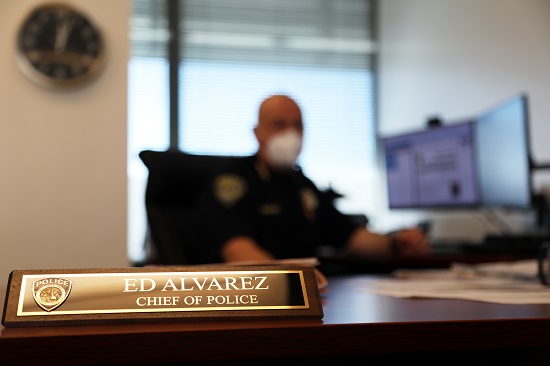
Chief Alvarez at his desk in the BART Police headquarters in Oakland on Jan. 15, 2021
AC Transit, BART enhance service for late night commuters
** Get details on the late night bus service including schedules, bus stop details, and maps at www.actransit.org/allnighter AC Transit and BART have collaborated to launch a one-year pilot program that increases the options for late night commuters, providing new destinations and improved frequency of
BART offers extended service for 2021 New Year’s Eve
For New Year’s Eve we will run standard Friday service but with an extended closing time to help people celebrate the arrival of 2022 as well as to support workers who are relying on BART to get to and from their late-night shifts. The regular last trains of evening (Yellow, Blue, and Orange lines) will be
BART tests brighter, energy-saving LED lights on trains
BART is testing LED – light-emitting diode – lights that will one day replace the light fixtures currently in BART cars, which use the same technology that was around when BART began service in 1972. The LED lights last longer, can save up to 50 percent in energy costs and are noticeably brighter. “It’s
BART urges U.S. Senate to increase transit security funding
Rail Bombing In India Again Shows Inherent Danger to "Open" Transit Systems Just hours after deadly bombs ripped through one of India's busiest commuter rail lines, top BART officials urged the U.S. Senate to increase transit security funding in the 2007 fiscal year by at least $50 million when it votes on
BART mechanics bring train cars back from the dead
BART mechanics and engineers at the Hayward and Richmond maintenance yards have faced some big challenges when it comes to repairing damaged cars. But even those experienced workers had their work cut out for them when they tried to save two cars that were so badly mangled that many thought they would just be