
Search Results
BART Board President issues statement on labor contract vote
BART Board President Tom Radulovich issued the following statement: “Today the BART Board of Directors voted 8 to 1 to accept the $67 million offer that was agreed to at the bargaining table with our unions. We hope the unions will take the agreement minus the six weeks of additional paid leave that was
BART Board to meet Thursday, Oct. 23, at 4 pm
The BART Board of Directors is scheduled to meet Thursday, Oct. 23, at 4 pm, to take up a number of issues including an amended Financial Stability Policy creating a larger reserve fund for times of economic uncertainty. The amended policy would increase the reserve fund from 5% of total annual operating
BART Citizen Review Board considers recommendation on transgender policy
By MELISSA JORDAN BART Senior Web Producer The Citizen Review Board that advises BART Police will continue considering a recommendation that BART PD adopt a policy for interactions with transgender people. “Most law enforcement agencies still don’t have those kinds of policies in place,” said Harper Jean
Take BART to the KPFA Crafts & Music Fair
The KPFA Crafts & Music Fair in San Francisco Dec. 13-14 is the largest weekend holiday fine crafts fair in Northern California, drawing thousands of KPFA listeners and supporters for a celebration of arts, music and free speech radio. There's a free shuttle to the fair from the Civic Center BART Station
BART schedule change aims to provide some crowding relief
On Monday, September 14 th, BART will make improvements to its train schedule and will add more cars to help provide some crowding relief while we wait for the Fleet of the Future to arrive. The number of cars scheduled to be in service during the rush hours will be at an all-time record high, with additional
Violent and property crime plummet on BART
Newly released data shows crime has dropped substantially on BART through the first seven months of this year. The number of violent crimes reported on BART declined from 203 for the first seven months of 2024 to 130 incidents this year. Property crimes also fell from 1,091 for the first seven months of 2024 to 547 this year. All the latest crime numbers can be found in the July Chief’s Report.
The decrease in crime has come as BART PD has remained focused on maintaining a highly visible safety presence in the system. At the same time BART has accelerated the installation of Next Generation Fare Gates. Now 48 of BART’s 50 stations have new high-tech gates, which are proving to be a strong deterrent against fare evasion and other unwanted behavior. BART is well on track to meet its goal to have Next Generation Fare Gates at all stations by the end of this year. Maintaining a visible safety presence and installing new gates are both key components of BART’s Safe and Clean Plan to put the everyday concerns of riders first.
Other highlights from the Chief’s Report:
*Robberies plummeted from 126 for the first seven months of 2024 to 37 this year.
*Only one cellphone robbery was reported for the entire system in July. That follows zero cellphone robberies in June.
*Auto burglaries fell from 449 last year to 162 in 2025.
BART PD’s highly visible safety presence is making it possible for officers to get to incidents more quickly. The average emergency response time for July was 4 minutes, 21 seconds. That’s well below BART PD’s goal of five minutes and one of the fastest response times for any law enforcement agency in the Bay Area.
BART update on train derailment near Daly City Station
BART Spokesperson Alicia Trost released the following update: The derailment that occurred on Saturday May 20 th at 2:55 pm occurred at a rail joint about 400 feet from the Daly City platform. A rail joint is where two sections of rail are mechanically joined. It involved two cars in the middle of a nine-car
Bay Area playhouse puts on play set aboard BART
April Grant and David Boyll in rehearsals for “2 Across” at Pacifica Spindrift Players. Two strangers, both tackling the New York Times crossword, meet on an empty BART train at 4:30 in the morning at SFO. The woman, a psychologist, is organized and rational. The man, unemployed, is flighty and free-spirited
Draymond Green: BART needs to stay safe and reliable
Golden State Warrior, NBA All-Star and Olympic Gold Medalist, Draymond Green says: "BART is the backbone of the Bay Area..BART needs to stay safe and reliable for future generations."
Take BART to Outside Lands Music Festival
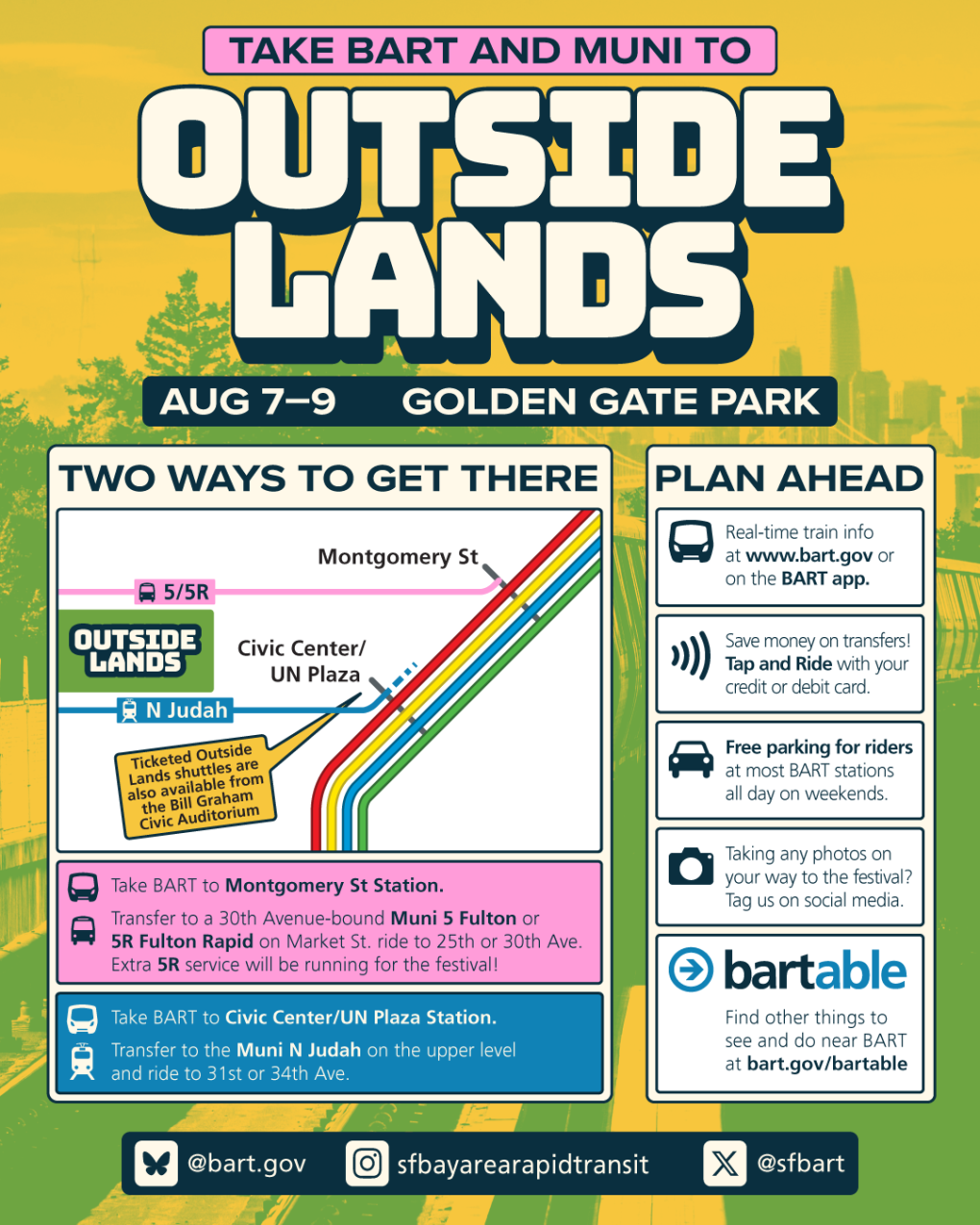
Outside Lands is the Bay Area’s biggest music festival, with thousands of people coming to experience the three-day event in San Francisco's Golden Gate Park. This year, the festival will be from Friday, August 7, through Sunday, August 9. Driving and finding parking can be a nightmare! There is no on-site parking at the festival, and street parking will be extremely limited. Skip the hassle and take public transportation.
Getting there
While BART doesn't offer direct service to Golden Gate Park, you can take BART and transfer to SF Muni or Outside Lands prepaid local shuttles to get to the event.
BART will run regular service until around midnight on each night of the festival. Use BART's Trip Planner for detailed routes and transit options.
Free SF Muni fare with concert wristband: Outside Lands attendee wristbands include all-day Muni fare, except cable car rides, for the day of your concert wristband. Hop on a Muni bus or train at any door -- you do not need to show your wristband to the driver -- and present your wristband if an SFMTA employee ass for "proof of payment." To board at a Muni station, including Civic Center and Powell St. stations, show your wristband to the station agent or approach the wider fare gates for entry.
From BART to Outside Lands
Exit at Montgomery St Station and take the 5R Fulton Rapid, 5 Fulton, 38R Geary Rapid or 38 Geary Bus to the Main Gate. Muni will provide extra service on the N Judah and 5R Fulton Rapid. Each night of the festival, Muni will provide 5X Fulton Express service from Golden Gate Park to Civic Center/UN Plaza BART Station.
From Outside Lands back to BART
You can head back the same way you came or catch a special direct bus service—the 5 Fulton Civic Center Express. Board this bus by the Outside Lands gates at Fulton/30th Ave or Fulton/25th Ave.
If you are taking the Outside Lands shuttle, exit at Civic Center/UN Plaza and head to the Bill Graham Civic Auditorium across the street from the station.
Use the BART Trip Planner to plan your BART ride. For more transportation options from BART to the festival, see the travel & transport section of the Outside Lands info page.