View and download our BART Funding factsheet [pdf]
Remote work has changed how Bay Area residents live, work, and travel. It has hit BART and all other public transit systems hard, decimating transit ridership and, along with it, the transit fare revenue we rely on to keep trains running.
While millions of riders have returned to BART, they are riding less frequently, resulting in fewer trips. The Bay Area has the highest work-from-home rates in the nation and the slowest downtown recoveries and our ridership mirrors office occupancy. This has created an ongoing structural financial deficit of $350M to $400M, impacting BART’s long-term ability to deliver the high-quality transit service the Bay Area relies on.
In addition to receiving emergency funding during the pandemic, BART has acted to right-size service and its workforce, control labor costs, trim non-labor spending, and deliver major projects under budget. These measures have saved hundreds of millions of dollars while preserving essential service for the region.
BART’s funding deficit
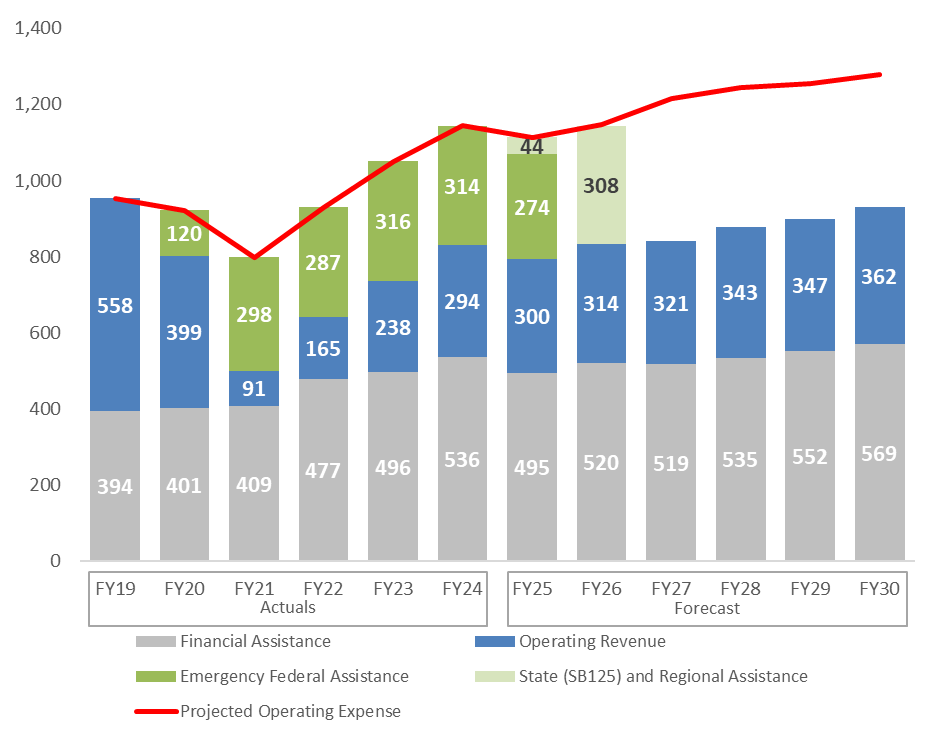
BART is now running service using emergency funds that will run out in 2026. BART balanced the FY26 budget with $35M in ongoing cuts and cost controls. The FY27 deficit is $376M. This chart below shows BART's funding sources ($M). It also shows how current revenues will not support current service levels.
BART is cutting costs*
Labor savings
- Eliminated 672 vacant positions (251 operating positions) in FY20 saving $32M
- A strategic hiring freeze on 56 positions (FY25 and FY26) with this count increasing each quarter, saving $7.8M annually and impacting all levels, including management
- Renegotiated with unions to reduce near-term retiree healthcare costs
- Executive management salary freeze in FY21
- Negotiated a 0% wage increase in FY22 instead of 2% saving $7-8M annually
- Indefinite deferral of planned staffing increases
Efficiencies
- Run shorter trains saving $27M in energy costs through FY26
- 5% reduction in non-labor budgets across all departments in FY26 saving $5M annually
- FY20 and FY21 service reductions saving $124M and currently reduced peak-period service
- Locked in low electricity costs though long-term contracts
- Saved $400M in new rail car acquisition with tight project controls, using in-house engineers, and speeding up delivery
- Parking garage LED lighting installation saving $1M annually in energy costs
- Reduced feeder bus payments saving $3M annually
- Eliminated transfer payment agreements with SFMTA and AC Transit saving $60M through FY26
Reduced office space footprint
- BART purchased its smaller headquarters building to eliminate the expensive long-term lease costs of the larger space, reducing headquarter footprint by 33% saving $13-15M annually or $71M through FY26
Increase revenue
- Installed new fare gates to reduce fare evasion, generating $10M in new revenue per year
- Inflation-based fare increases accounting for $35M per year and demand-based parking price increases
- Offer new fare products, such as Clipper BayPass, generating $7M per year
- Leasing of BART parking lots generating $6M through FY26
* List not inclusive of all savings
Potential new funding and use of loans
In 2025 the California Legislature enacted Senate Bill 63, supported by BART, authorizing a new transportation funding measure for placement on the November 2026 ballot. If the measure is successful, BART will receive an estimated $74M for BART operations in the last quarter of FY27, and an estimated $310M annually beginning in FY28.
View the Metropolitan Transportation Commission's SB63 Fact Sheet.
Because the revenue from the ballot measure will not begin to flow right away, the state has offered a bridge loan, which must be paid back with interest. If a funding measure succeeds, BART will use $88.5M in borrowing to help balance our FY27 budget. However, the state loan does not help delay or prevent station closures because BART will not tap into the loan if the funding measure fails, because we would not be able to pay the loan back.
The state loan would make available to BART $285M, but we have not yet determined how much of it we may use. BART also has access to $395M in proceeds from a federal Transportation Infrastructure Finance and Innovation Act (TIFIA) Loan with the U.S. Department of Transportation as a reimbursement for costs incurred in acquiring our Fleet of the Future rail cars.
Embracing independent oversight
BART is the only transit system in the Bay Area with an Office of the Inspector General to provide independent oversight of BART’s use of revenue. The OIG conducts performance audits and investigations of waste, fraud, and abuse. BART has accepted 92% of the OIG’s recommendations.
A 2025 audit by the Federal Transit Administration found BART is meeting standards in nearly two dozen categories, including financial management.
BART is subject to annual independent audits under the Single Audit Act. This examination of BART’s financial statements is detailed in Annual Comprehensive Financial Reports (ACFR) prepared by an independent organization in accordance with auditing standards generally accepted in the United States of America and the standards applicable to financial audits contained in Government Auditing Standards, issued by the Comptroller General of the United States.
BART’s previous two bond measures (Measure RR for system rebuilding in 2016 and Measure AA for earthquake safety improvements in 2004) both included independent oversight committees. In its 2025 Annual Report, the independent Measure RR Bond Oversight Committee wrote that based on its review of projects and data presented by BART staff, the committee believes BART is living up to the bond mandate and its promises to voters. BART is delivering rebuilding projects in a timely manner, those projects are enhancing the reliability and safety of the system, and the work is being pursued in accordance with industry best practices.
BART financial information is posted on bart.gov/financials
Financial Efficiency Review
BART is participating in the third-party Financial Efficiency Review required in SB 63, the law that enables the November ballot measure. This accountability measure requires agencies to implement cost-saving strategies and revenue generating opportunities. If the ballot measure passes, a second phase will involve adopting and implementing a data-driven action plan to improve financial sustainability.
Read the final MTC report released on May 27, 2026. The third-party report finds that transit agencies, including BART, "have undertaken numerous cost-saving and revenue enhancing measures in response to economic pressures and shifts in travel demand during and after the COVID-19 pandemic.
Between fiscal years 2020-2025 (July 1, 2019 – June 30, 2025) BART achieved $516 million in operating cost savings through a combination of service reductions, workforce controls, and operational efficiencies. They also deferred or scaled back capital investments."
Key Findings:
- BART delivered $516 million in operating cost savings during the reporting period, with an additional $549 million in capital savings. This equates to approximately $178 million in annualized savings, reflecting a sustained and multi-faceted cost-containment effort over several years.
- Cost savings were achieved through a combination of service reductions, workforce controls, and operational efficiencies. Ongoing operating cost reductions included service reductions in FY20 and FY21, optimized train lengths, wage freezes for most employees, reduced bus feeder payments, strategic hiring freezes, and broad reductions in non-labor costs. These actions focused on controlling variable expenses while maintaining core rail operations.
- Cost avoidance and capital savings contributed materially to overall savings. BART avoided future costs by canceling planned service expansions, eliminating planned increases to police staffing, removing vacant positions, consolidating headquarters office space, and scaling back sustainability initiatives. Major capital savings were realized through new rail car project efficiencies and deferral of priority capital local match plans.
- Cost-saving measures offset a substantial share of inflationary pressure on operating expenses. While nominal operating costs increased during the recovery period due to inflation and labor market conditions, actual operating expenses remained consistently below a “no cost-savings intervention” forecast. The gap widened from FY21–22 onward, indicating that sustained cost-containment actions materially mitigated inflation-driven cost growth.
- Inflation-adjusted operating costs remained relatively stable despite rising nominal costs. When expressed in constant dollars, operating expenses remained closer to pre-pandemic levels even as nominal costs rose, demonstrating that underlying (real) operating cost growth was restrained through active management actions.
BART’s funding model before the pandemic
Before the pandemic, BART depended on fares to run service more than almost any other transit agency in the world with money from passenger fares and parking fees covering nearly 70% of the cost to run BART service. Now, because of remote work, only 30% of operating costs are covered by fares (as of FY25).
BART’s operating ratio*
FY26 forecast.............................................32%
FY25..........................................................30%
FY24..........................................................29%
FY23..........................................................26%
FY22..........................................................21%
FY21..........................................................12%
Pre-COVID.................................................71%
*Percentage of costs paid by passenger fares, parking revenue, advertising, and other sources
Cutting service still leaves a deficit
Rail has high fixed costs and low marginal costs. BART would have to cut service 65% to 85% to save 20% to 40%. Cutting service and scaling back on cleanliness and safety efforts could result in lower ridership, further reducing revenue. Without new funding, BART may not be able to sustain even reduced service for more than one or two years.
Planning for two financial scenarios
The BART Board of Directors will plan for both a “funding measure succeeds” and a “funding measure fails” scenario. If the measure succeeds, BART will use loan funds to run normal service with efficiencies implemented until the sales tax revenue becomes available to BART.
At the annual BART Board Workshop on Thursday, February 12, BART staff presented Directors with detailed plans if a November 2026 ballot measure fails and no other operating revenue source is identified. You can read the full presentation here.
On February 26, 2026 the BART Board initially approved an Alternative Service Plan outlining specific budget balancing details to solve a $376M deficit for the next fiscal year if no new funds become available to BART.
The plan includes specific cuts and financial strategies needed to balance both the FY27 (July 1, 2026-June 30, 2027) and FY28 (July 1, 2027-June 30, 2028) budgets. The plan includes service cuts, station closures, fare increases, a 40% reduction in system support services, laying off 1,200 employees, and a series of deferrals and one-time resources. The plan does not name specific stations to be closed and makes clear the BART Board will be responsible for all decisions on station closures. You can read the Alternative Service Plan resolution, resolution attachment, and presentation to the BART Board.
Alternative Service Plan Details
To take place in January 2027:
- A service plan represents a 63% reduction in train hours.
- Closing at 9pm seven days a week (previously midnight)
- 3-line service (previously 5-line). Only the Yellow, Blue, and Orange lines will operate, with limited peak service in only the peak commute direction on the Red and Green lines. Riders will wait longer and the need to transfer will increase.
- 30-minute frequencies on every line (previously 10-20 minutes).
- 30% fare and parking fee increases (the estimated average fare would increase from $4.98 to $6.38).
- Target approximately $30M in savings over 6 months from non-service budget reductions to fleet and non-fleet maintenance, police, cleaning, and administrative support functions.
- 600 employee layoffs.
- Continue deferrals of priority capital allocations and retiree medical contributions.
- Balance remainder of FY27 with one-time resources and financial deferrals.
Following the January 2027 cuts, staff will continuously assess ridership and revenue impacts and the performance of all District functions to determine if further reductions can be safely and legally implemented.
To take place in July 2027 if feasibly safe:
- Target over $175M in annual cost reductions through a cumulative 70% reduction in service hours:
- Maintain 3-line service, 30-minute frequencies on each line, closing at 9pm.
- Close up to 15 stations and/or up to 25% of system track miles.
- The BART Board will be responsible for all decisions on station or line segment closures.
- Increase fares and parking fees up to a cumulative 50%. The estimated average fare would increase to $7.26.
- Target annual operating expense savings of more than a cumulative $130M from non-service budget reductions to fleet and non-fleet maintenance, police, cleaning, and administrative support functions.
- Continue to defer retiree health contributions; defer most remaining capital allocations.
- Another 600 employee layoffs (total 1,200).
Contingency:
- If at any point it is determined BART can’t safely or legally operate with available resources, stop passenger service.
- Use existing District tax revenues to secure system assets.
- Work to determine system’s future.
Operating Expenses
How BART service has been adjusted since the pandemic
In response to new travel patterns, BART has right-sized its service. The primary reason we have more train service hours and miles now, as compared to pre-pandemic figures, is that Berryessa and Milpitas stations opened during the pandemic. VTA funded the construction of these two stations and reimburses BART for the cost to operate these stations and the service to and from them. And while train hours have increased, car hours have shrunk compared to pre-pandemic because we have been running shorter trains to save money. Revenue car hours in FY19-20 were 2,289,197. In FY24-25 they were 2,166,351.
Overall, we’re providing less peak period service with 20 trains per hour through the Transbay Tube compared to 24 pre-pandemic. And while lines serving Dublin, Richmond, Millbrae, Berryessa, and BART to Antioch went from 15-minute frequencies to 20-minute frequencies during the morning and mid-day on weekdays, and we eliminated the extra peak period Yellow Line commute trains, overall, the Yellow Line has had an increase in service mid-day from 15 minute frequencies to 10 minute frequencies. We are also running 25-30% more Saturday service and 80% more Sunday service than we were pre-pandemic for a total of 8% higher train hours. This investment in weekend service has paid off as weekend ridership has recovered at a faster rate than weekday ridership. As a result, in BART’s Alternative Service Plan, weekend service is maintained because it brings in more revenue than it costs to operate it.
Schedule changes since the start of the pandemic
| Date | Summary |
| Pre-COVID | -Midnight closure seven days a week -5am opening Monday-Friday, 6am on Saturday, 8am on Sunday -15 minute frequencies on all lines Monday-Friday daytime with extra commute trains on the Yellow Line creating 5 minute frequencies during peak hours -24 minute frequencies weekdays after 9pm with single tracking through the Transbay Tube -20 minute frequencies on Saturday -24 minute frequencies on Sundays 5-line service Monday-Saturday 3-line service on Sundays with Blue Line trains ending at Montgomery for cable replacement project |
| 3/23/20 | COVID Service: 30-minute frequencies on all lines every day, 9pm closure every day, open at 8am Saturday and Sunday |
| 6/5/20 | Added some Yellow Line trains during commute hours Monday-Friday |
| 6/8/20 | Milpitas and Berryessa Stations opened for service |
| 6/22/20 | Added more Yellow Line trains during commute hours Monday-Friday |
| 9/8/20 | 15-minute frequencies on the Yellow, Red and Green lines in the am/pm commute hours Monday-Friday |
| 3/22/21 | Addition peak period trains added |
| 8/2/21 | In response to calls for BART to expand service and hours to help the economy -15 minute frequencies on all lines Monday-Friday daytime -30 minute frequencies in the evening and on weekends -Monday-Saturday 5-line service with midnight closure -Saturday opens at 6am -Sunday 3-line service with 9pm closure |
| 2/14/22 | Return to near pre-COVID service and hours -Sunday 5-line service with midnight closure -Note: extra commute Yellow Line trains never returned |
| 9/11/23 | Reimagined Service Plan responsive to new travel patterns -20 minute frequencies all hours every day (Monday-Sunday) |
Cost-efficient heavy rail system
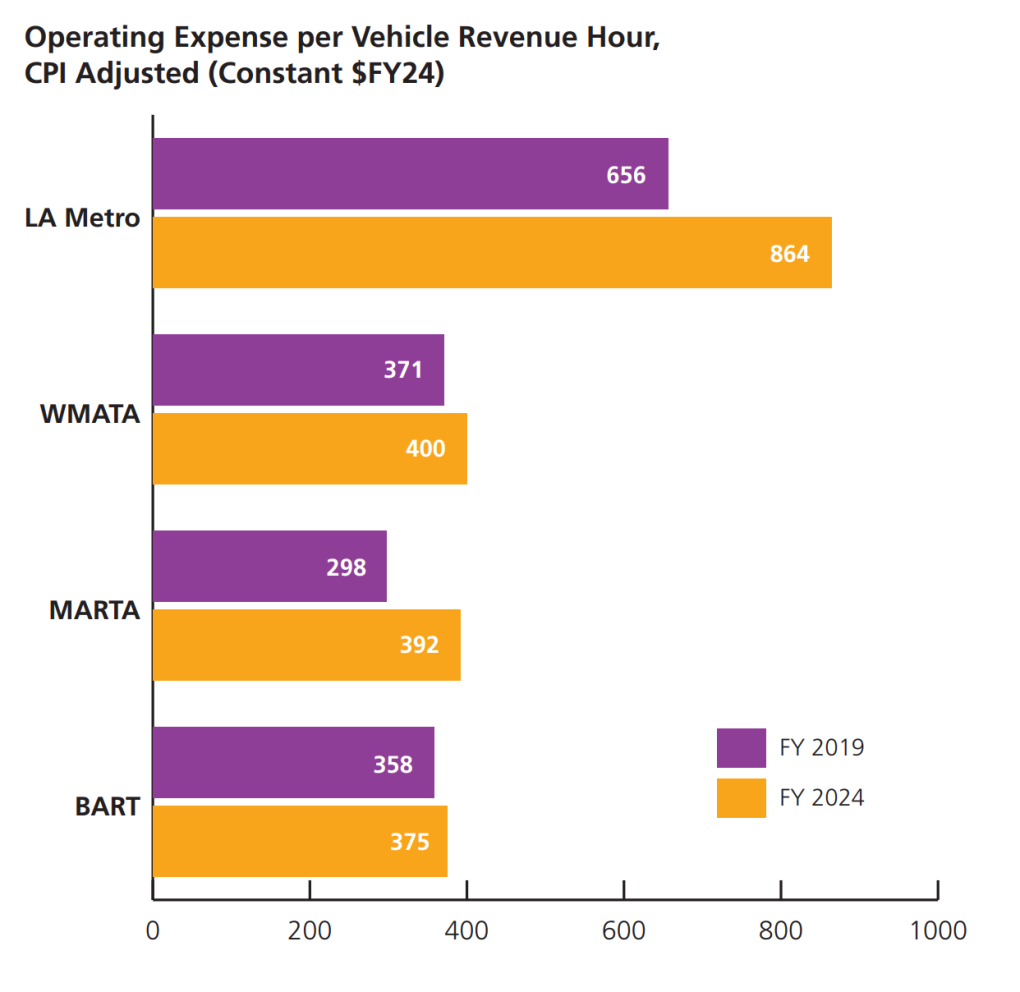
BART is one of the most cost-efficient heavy rail systems in the United States. With an operating cost of $375 per vehicle revenue hour (FY24), BART ranks 7th out of 16 U.S. heavy rail operators. BART’s costs are lower than its two closest structural peers: Washington D.C.’s Metrorail ($400 per hour) and Atlanta’s MARTA ($392 per hour). Both systems were built in the 1970s and share BART’s hybrid urban/commuter operating model. The few U.S. operators with significantly lower costs are primarily legacy systems built in the early 20th century (such as NYC and Chicago), which operate dense city subways rather than longer-haul regional rail.
Despite operating in a high-cost region, BART’s operating expenses have grown at a rate lower than inflation since 2019, even while opening the extension to Berryessa/North San José.
Train Automation Facts
BART trains are automated, but the CPUC requires there be a train operator. Train Operators are required because they play a very important role. There are times they must operate the train, they ensure the platform is clear before the train doors close and the trains take off, they manually move track switches so the train can continue, they report emergencies, and they safely evacuate trains when necessary. They also monitor the trackway and much more.
Train Operator salaries and benefits (including overtime) makes up 7.8% of the FY27 Preliminary Operating Budget $1.05B. That is $81-$83M ($71.5M in wages and benefits and the overtime budget is about $11M). The structural deficit is up to $400M per year.
If regulations allowed BART to remove Train Operators, there would be costs associated with no longer having train operators on board such as increased operation control center staffing and more at the ready staff presence for incident response etc. – and that’s not even considering the significant upfront capital costs.
BART has 503 Train Operators (489 full time and 23 part time).
Total operating positions at BART are 3,760 FTEs. Capital/Reimbursable are 839 FTEs for a total of 4,599 FTEs.
Ridership trends
BART's ridership matches Bay Area return-to-office occupancy rates. Work-related trips make up a smaller share of BART trips and riders are using the system more for personal needs. Evening, weekend, and airport service have retained ridership more strongly than commuting.
| Average Ridership | FY25 | FY24 | FY23 | FY22 | Pre-pandemic |
| Weekday | 171,981 | 162,374 | 149,574 | 111,311 | 408,723 |
| Saturday | 99,766 | 90,795 | 84,844 | 68,253 | 159,133 |
| Sunday | 74,566 | 68,080 | 62,573 | 48,373 | 111,972 |
Total Fiscal Year annual ridership
FY25 52.7M
FY24 49.6M
FY23 45.9M
FY22 34.5M
FY19 118M (before the pandemic)
Presentations given to the BART Board of Directors about the funding deficit
April 22, 2026: Board of Directors Meeting: Strategy for Managing Loans, Deferrals, and Reserves
April 9, 2026: Board of Directors Meeting: Fiscal Year 2027 Preliminary Operating Budget Overview
February 26, 2026: Board of Directors Meeting: FY27 Alternative Service Plan
February 12, 2026: Board of Directors Workshop
November 13, 2025: Board of Directors Meeting: FY27 Budget Strategy
May 6, 2025: Board of Directors Meeting: FY27 Operating Budget Scenarios
February 27, 2025: Board Workshop Meeting: Facing the Fiscal Cliff
October 24, 2024: Board of Directors Meeting: Update of Regional Transportation Revenue Measure
October 24, 2024: Board of Directors Meeting: Bay Area Transit Measure Survey Analysis
September 12, 2024: Board of Directors Meeting: Update on Regional Transportation Revenue Measure
June 13, 2024: Board of Directors Meeting: FY25 & FY26 Budget Adoption
May 7, 2024: Board of Directors Meeting: FY 25 & 26 Budget Sources, Uses and Rail Service Plan
October 26, 2023: Board Budget Workshop: Financial Context
October 26, 2023: Board Budget Workshop: Strategies to Reduce the Deficit
Feb. 23, 2023: Board Workshop: BART's Financial Outlook and Economic Context
Feb. 23, 2023: Board Workshop: Update on Advocacy Strategy
Jan. 26, 2023: Fiscal Action Plan and Advocacy Strategy
June 28, 2023: Statement from BART GM on state budget agreement
Advocacy Letters
May 28, 025 Letter to Governor Newsom regarding May Revision and Cap-and-Invest Plan
May 2023 Transit Operating Coalition letter to Ca. Legislative leaders
March 2023 Transit Operating Coalition letter to Ca. Legislative Budget Subcommittee Chairs
January 2023 Transit Operating Coalition letter to the Ca. Legislative Budget Committee Chairs
November 2022 Transit Agencies Joint Letter to the Pete Buttigieg about Transit Recovery Assistance