
Search Results
Watch One Book One BART's virtual author talk with Pulitzer Prize winner Hua Hsu and Jeff Chang
On Wednesday, August 2, 2023, One Book One BART hosted an author talk with Hua Hsu, the Pulitzer Prize-winning author of the first BART book club selection, Stay True, moderated by award-winning writer, historian, and thinker Jeff Chang. Watch a recording of the talk below.
To keep up with all things BART book club, visit bart.gov/bookclub, and sign up for the mailing list at the top of that page.
Stay tuned for the launch of our next book club on Monday, September 18, 2023
The next book selection is Oakland-based author Margaret Sexton Wilkerson's "On the Rooftop." Reese Witherspoon called the novel, set in San Francisco's Fillmore District, "an utterly original and brilliant story."
Questions? Ideas? Suggestions? Email [email protected].
We look forward to reading with you!

One Book One BART – the official BART book club – invites members of the public to a free, virtual author talk with Hua Hsu, the author of the Pulitzer Prize-winning memoir and official book club selection, Stay True. The event, which marks the culmination of the Spring/Summer ‘23 One Book, One BART club, will be held on Zoom on Wednesday, August 2, at 4pm. A Q&A will follow the discussion.
The talk will be moderated by Jeff Chang, author of acclaimed book Can’t Stop Won’t Stop: A History of the Hip-Hop Generation, which was named one of the best U.S. nonfiction books of the last quarter century. His other books include Who We Be: A Cultural History of Race in Post Civil Rights America and We Gon' Be Alright: Notes On Race and Resegregation. Chang has received the American Book Award, the Asian American Literary Award, and the USA Ford Fellowship in Literature.
When: Wednesday, August 2, 4pm to 5pm
Join the meeting online via Zoom (no registration required): https://us06web.zoom.us/j/84824326758
For updates about upcoming One Book One BART events, including the launch of the Fall/Winter ’23 book club, visit bart.gov/bookclub.
Sign up for the One Book, One BART mailing list by visiting BART’s Profile Center and adding your information. On step 3 – “Manage Subscriptions” – click the caret next to “Other” and check the One Book, One BART box.
Questions? Email [email protected].
“Unwavering Love:” BART PD, outreach workers help mother reunite with her son
Sonja Hagins Perry hugs her son after they were reunited in San Francisco; Photo by Duane A. Hagins, Perry’s brother By MELISSA JORDANBART Senior Web Producer Sonja Hagins Perry never gave up on her son, her firstborn, her boy who loved music, art, being a big brother.Perry, who did tours of Afghanistan, the
BART, Caltrans to close southbound I-880 at Hegenberger Road April 21
Time-lapse video of previous northbound closure on March 17-18.BART and Caltrans will close all lanes of southbound Interstate 880 (I-880) at Hegenberger Road on Sunday, April 21 between the hours of 1:30 AM and 5:30 AM. This early morning closure is necessary to allow crews to construct the Oakland Airport
Take BART to free First Tuesdays at downtown San Francisco museums
Photo: Richard T. Walker, The Speed and Eagerness of Meaning. Courtesy of the artist and Christopher Grimes Gallery, part of a current YBCA exhibt By STEFAN MARTINEZ BART Website Intern Every first Tuesday of the month at noon, a magical thing happens in San Francisco: “free Tuesdays” at several downtown
BART response to ad campaign paid for by Progressives for Immigration Reform
Advertisements paid for by Progressives for Immigration Reform went up this week in parts of the BART system. They’ve been placed primarily at San Francisco’s Civic Center Station and Oakland’s 19 th Street Stations with smaller numbers in other stations and in trains. This campaign complies with free speech
BART seeks input on proposed pilot program for low-income rider discount
BART’s Office of Civil Rights is sponsoring outreach on a proposed pilot program that would give a fare discount to low-income riders. This outreach is required as part of Title VI of the Civil Rights Act, which prohibits discrimination on the basis of race, color and national origin in programs that receive
Take BART to the 8th Annual Asian Heritage Street Celebration
Celebrate Asian Pacific American Heritage Month at the 8th Annual Asian Heritage Street Celebration on Saturday, May 19th in San Francisco's Civic Center, in front of the Asian Art Museum. The event is free and open to the public. The fair will feature a scrumptious collection of pan Asian delights and sweets
Transit Month: Hear from Jaime Espitia, winner of the 2022 BART Ride Contest, who logged more than 400 BART rides last September
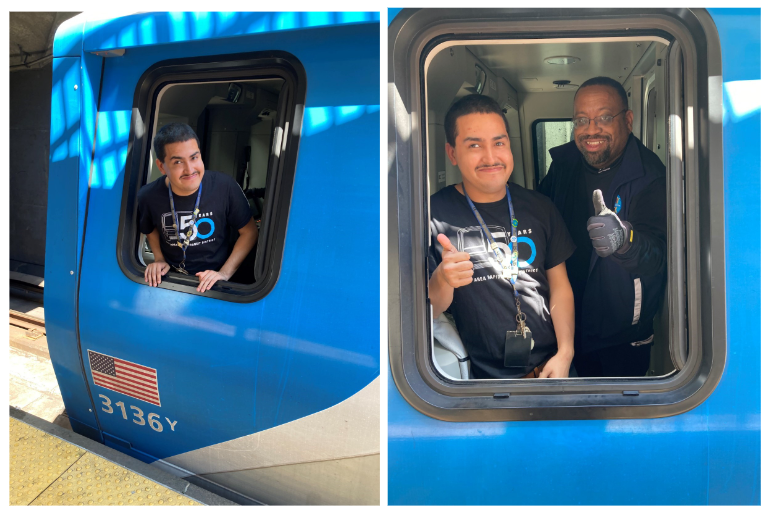
Jaime Espitia (left), who logged the most BART trips during Transit Month 2022, won a ride in a Train Operator’s cab. He claimed his prize in August, riding with Train Operator Dewayne Deams (far right).
To learn more about Transit Month 2023, click here.
Last Transit Month, Jaime Espitia took home the honor of BART Ride Contest winner. The lifelong Bay Area transit fan rode BART an incredible 422 times in September 2022 alone – that averages out to 14 unique BART rides a day! Espitia’s prize was a ride in a BART cab with a Train Operator.
He claimed his prize on a Saturday in August, where he met up with Train Operator Dewayne Deams and Transportation Supervisor Dana Mims for a ride from SFO to West Oakland.
“I boarded with Jaime, gave him a thorough tour of the cab, and demonstrated our pre-dispatch routine, including what all the buttons do. Then, we took off together toward the East Bay,” said Deams, who eagerly volunteered to host Espitia in his cab because he is a “fellow transit nerd.”
The trip was not without excitement, Deams and Espitia reported. As the train neared Balboa Park, Deams was forced to hold the train briefly due to a grass fire near the station.
“Jaime listened as I talked with the Operations Control Center and made continuous announcements to update passengers,” Deams said.
Later, as the train pulled into a Market Street station, Espitia listened as Deams said, “Stand behind the yellow strip!” to a rider standing too close to the trackway.
As the train wound through San Francisco and under the bay, the pair settled into natural conversation, swapping stories about riding transit as kids who grew up in the Bay Area. Espitia asked a series of pointed questions: What types of critters do you see along the tracks? What’s the third platform at Colma for? Why do you blow the horn when coming into stations?
One of the most exciting aspects of the trip for Espitia was rolling through the Transbay Tube in the cab – a vantage point very few people ever get to experience in their lives. He was surprised by the grades in the tube – the way the tracks go uphill and downhill – which you don’t notice as a regular passenger.
“There are no words for the experience,” Espitia said. He was especially mesmerized by a tiny light in the tube that signaled the train had passed from San Francisco into Alameda County.
After reaching West Oakland, Espitia disembarked from the cab only to re-board moments later as a passenger in the first car. He rode the train all the way to Pittsburg/Bay Point and back to his home station, Colma.
Mims, the Transportation Supervisor, recounted the enchantment of the ride in an internal newsletter: “Thanks to Dewayne’s guidance and the magical ride through the world of trains, Jaime’s passion was not only understood but celebrated. As the day came to a close, Jaime knew that he had experienced something truly extraordinary – a day filled with camaraderie, knowledge sharing, and an unwavering passion for trains that would stay with him forever.”
Espitia has been riding BART since he was a toddler obsessed with Thomas the Tank Engine. It was his grandfather who first got him on BART.
“Every weekend I’d ride BART with him just to hang out,” Espitia said.
His grandfather died earlier this year. Riding BART does not feel the same now, Espitia said, but he can still feel his grandpa’s presence on the trains, especially in the “wailing" of the wheels on rail.
“The Transbay Tube is my favorite section because the legacy trains howl in it,” Espitia said – he's one of the rare birds who loves the sound of the train wheels on track. “It brings back memories of my childhood and my grandfather, standing on the platform side-by-side as the train rushed in.”
Espitia said it was a lifelong dream to ride in the Train Operator’s cab.
“I grew up watching the train from the passenger side – watching the lights flicker in the tunnels and the signs rush past,” he said. “I always wondered how the tube looked from the operator’s perspective.”
He was also inspired by his role model Mark Ambus, who operated BART trains for more than two decades.
“Mark always told me it wasn’t an easy job because you have so much responsibility, but he loved doing it,” Espitia said. “He’s my role model and very good friend who always pushes me to do better and progress. Being in the cab that day, I felt like I got to experience a day in his life during those 25 years, when he’d take people like me home.”
When he’s not riding BART to snag a prize, Espitia typically takes the train once a week to work in Daly City. Mostly, though, he rides BART for fun.
“I ride it a lot to relax my brain and clear my head after a stressful day,” he said of his regular “joy rides.” He prefers legacy trains to Fleet of the Future vehicles because he loves the loud sounds they make and the way their fifty-year-old bodies congeal decades of regional history.
During his prizewinning run last September, Espitia would take the train back and forth after work, riding station to station, line to line. He said he sometimes forgot to take breaks to eat and drink water, which he does not recommend to those looking to win the prize this year.
“The best advice I can give people trying to beat my record is just to have fun and don't push or overdo yourself," he said. “And just enjoy it because, well, transit is life.”
BART to run longer trains for Giants playoff games Thursday and Friday
BART will run longer trains this Thursday and Friday to accommodate the tens of thousands of sports fans attending the San Francisco Giants playoff games against the Atlanta Braves. The Giants clinched the National League West division title on Sunday for the first time since 2003. The matchups against
Areas to be closed around BART Administration Building above Lake Merritt Station
The San Francisco Bay Area Rapid Transit District (BART) has recently discovered a safety issue in connection with the Lake Merritt Administration Building. Due to deterioration of the building, pieces of the concrete panels have loosened and could pose a threat of falling off the building into the plaza