
Search Results
BART will run a Sunday schedule for 4th of July 2025
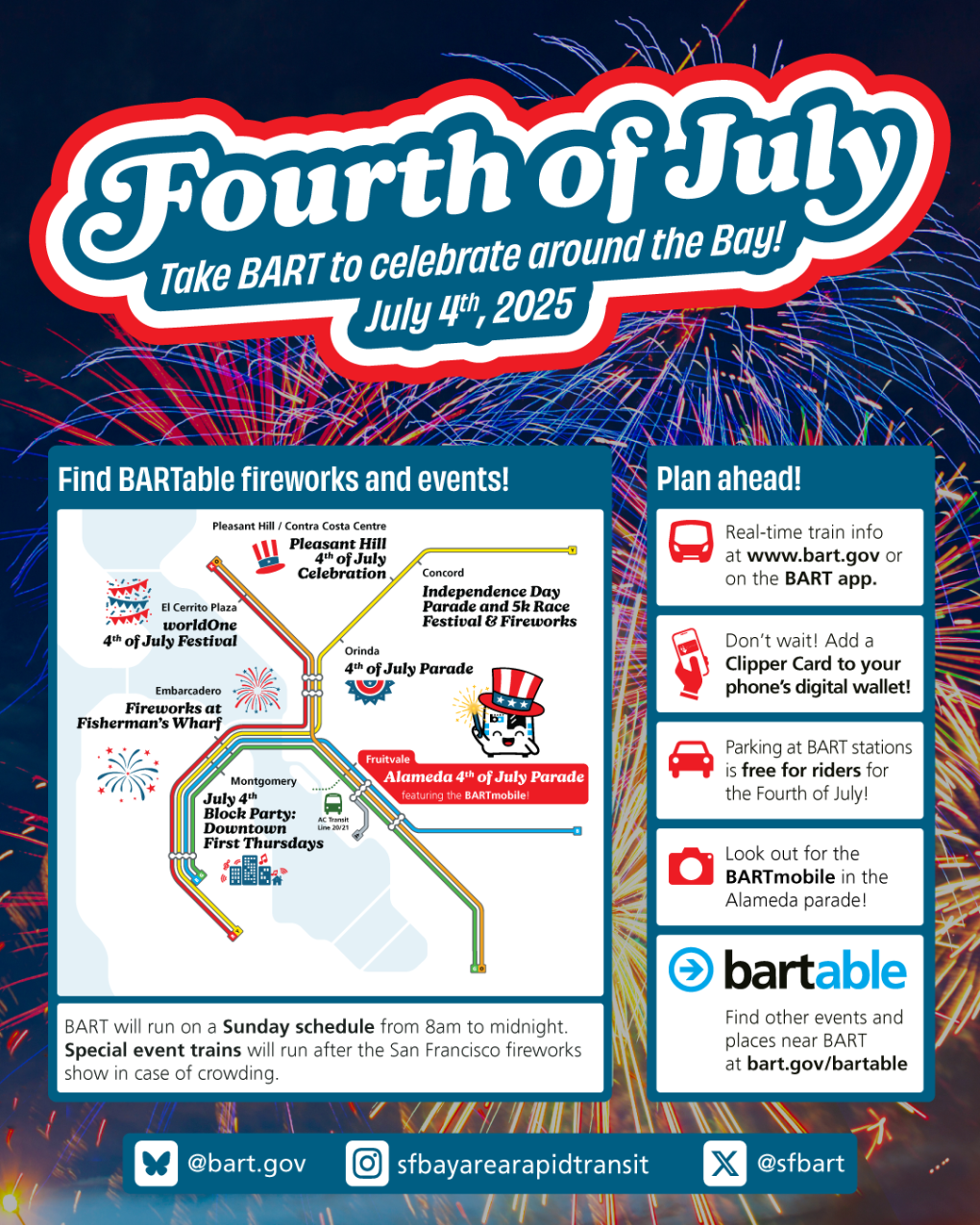
On Friday, July 4th, 2025, BART will be running a Sunday schedule (8am-midnight). We will run five-line service until 8pm and then three-line service after 8pm.
Five-line service means all lines will be running including the Green and Red lines which provide direct service into San Francisco. Extra trains may be added to help people get home from fireworks.
Parking will be free at all BART stations, except Milpitas and Berryessa/North San Jose stations, which has parking lots operated by VTA.
Seat lab for BART's Fleet of the Future hits the road to gather public input
Linda Drattell tries out a seat First of nine meetings is Sunday, May 1 By Melissa Jordan BART Senior Web Producer The public gets its first look this week at an interactive seat lab where riders can give feedback on what they'd like to see in new BART train cars. It's part of the research for the Fleet of
BART PD volunteer chaplain coordinator takes on national role in black law enforcement group
By MELISSA JORDAN BART Senior Web Producer Long after her regular workday ended, Sgt. Tanzanika Carter switched to her volunteer role and convened a monthly meeting of BART Police volunteer chaplains. Carter, the volunteer chaplain coordinator, collected their reports on activities such as visiting injured
BART offers special early service with limited stops for Bay to Breakers 5/15/22
BART will provide four trains with limited stops before regular BART service begins for the Bay to Breakers event on Sunday, May 15, 2022. The special service will get race participants to Embarcadero around 7am. The special early morning event trains will pick up passengers for an Embarcadero arrival with
From NYC to OAK, BART Project Manager Bryant Fields, P.E., has seen it all
Bryant Fields, P.E., has never wanted to be anything other than an electrical engineer. When he was around six years old, Fields – now a Project Manager in the Strategic Engineering group at BART – was a huge fan of the “Mission Impossible” television series. One character especially stood out to him: Barney
BART reminds Giants fans to be aware of possible mid-week late-night service delays
There are 16 home games left in the Giants regular season that fall on either a Tuesday, Wednesday or Thursday night, so BART wants to remind baseball fans that late-night, mid-week work in the Transbay Tube may affect BART service after 10 pm. Another tip: Use Montgomery Street Station. Not only will it be
Crucible chronicles: Go behind the scenes to see how welders are helping rebuild BART
Above: Welders Nick Rosales and Orlando Lozano work on an overnight shift By MELISSA JORDANBART Senior Web ProducerThe job of welder at BART requires manual dexterity and mental agility; it’s an age-old craft that is important in the modern-day rebuilding of BART. The American Welding Society marks National
Win tickets to Outside Lands from BART ... and take public transit to get there!
Don't have tickets yet for Outside Lands? There's still time to win them from BART. The music and arts festival Aug. 22-24 is encouraging people to take public transit to Golden Gate Park, and BART can help you get there. Outside Lands has a stellar lineup of artists from all over the musical map, including
Podcast: Learn what BART’s new, reimagined schedule means for your ride
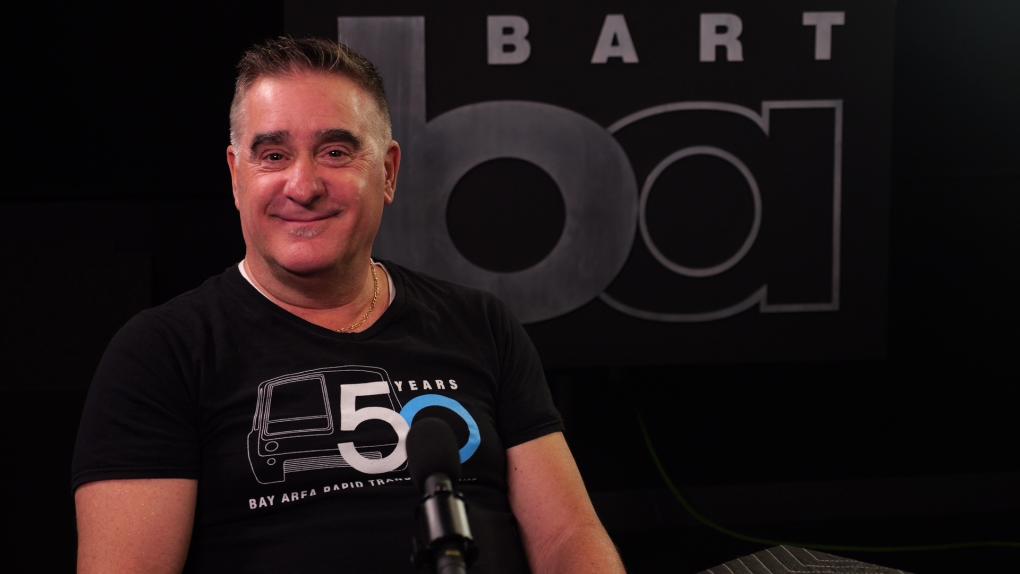
On September 11, BART will roll out a reimagined service plan that will eliminate 30-minute wait times on nights and weekends. That means no BART rider will have to wait more than 20 minutes for a scheduled train no matter the hour or day of the week. This new schedule is responsive to post-pandemic commute patterns and opens new opportunities for BART to expand its ridership. To do a deep dive into the new schedule Jay Sathe sat down with BART’s Manager of Scheduling and Planning John FitzGibbon (below) on the latest edition of our podcast series, "Hidden Tracks: Stories from BART".
(Transcript below)
SATHE: Welcome back to “Hidden Track Stories from BART.” I'm Jay Sathe and with me again because we're talking schedule again is John FitzGibbon, Manager of Scheduling and Planning. Did I get that right this time?
FITZGIBBON: Yes, you did.
SATHE: Excellent. All right. It's been a year. I've had time to practice, and you've been pretty busy, haven't you?
FITZGIBBON: Yeah, it's been a busy, busy, busy year.
SATHE: We are doing a whole new schedule again. I think last time we came out and said, “oh, it’s ground up, it’s complete redone,” but now it’s completely redone more.”
FITZGIBBON: Right. Looking at the data, we were under the impression that we needed to do things much different. And so, looking at how we schedule the trains in our historical context of every 15 minutes, roughly, that wasn't going to work in order to add additional service to the places that needed it and then takeaway service where places didn't need it as much.
Much of the decision making was based on ridership and where we had a need for additional ridership and service and where we could maybe take away a little bit of service. The Board over the years has asked for more service in the evenings, more service on the weekends and by taking a balance of some service during the weekdays and applying that to nights and weekends, we were able to create a more balanced solution that is roughly neutral in cost. So, that's kind of where we started.
SATHE: Just for everybody who might not be familiar, it's the same now. Daytime to nights and weekends on almost every line, right?
FITZGIBBON: Correct. Yep. So, in addition to that, we have the same schedule seven days a week, roughly. One of the techniques I used to build this new schedule was a component in the scheduling software that I have never used because it's generally not used. But in this case, it seemed to make sense and it gave me the ability to create a seven-day timetable, meaning every single trip across all seven days is exactly the same every seven days.
So, if you have an 8 am trip on a Green Line at Bay Fair It's going to be 8 am every single day of the week. So that was a way to kind of lock in and make sure that every dimension of all the trips were clean across the week and it simplifies the schedule.
SATHE: So, if you could talk to just the average rider who maybe doesn’t have the technical knowledge of all this, how would you talk to them and help show that this is a good change in all these different ways? You have the 90 seconds elevator pitch. What do you have for this schedule?
FITZGIBBON: Basically, the pitch would be we have a simpler schedule that’s the same seven days a week so no matter what day of the week it is or time of day you’re going to be able to get your train. That in and of itself I think is going to simplify a lot of people’s lives. They don’t have to go look at a schedule and figure out when is the Yellow Line coming today versus Saturday or Sunday. So that’s a huge thing. And then building the schedule so we have nice even headways across the network to get into the City, which is the number one destination for most people on BART is getting into the City. No matter where you are in the network you have 10-minute service there seven days a week.
SATHE: Yeah, absolutely. I know that last time we were talking about that I think we started that process, and this is kind of a culmination of that where last time I think Red and Green lines were like close weekdays to weekends and the three-line service was correct, but this was close. How did it all click together, this time how how come it worked?
FITZGIBBON: Well, by building it kind of as a wholesome one unit and whatever I built on any given day was going to apply to every single day. So, it took out that dimension of having a little bit different on the weekends and just applying what we did in the one single timetable basically got rid of that imbalance that we had a little bit on the weekends with the Red and the Green lines.
SATHE: Yeah, It's going to be huge I think just having weekend service be as important essentially as weekday service is a real kind of new way that BART is changing our service in the wake of the pandemic and with commute service perhaps not being quite as high priority at the expense of other things.
What's the philosophy right now around expanding and balancing out service for different times of the day?
FITZGIBBON: The post-pandemic ridership reality is that there just isn't the level of peak that there has been over the course of most of BART's life. So, the schedule is much flatter and less reliant because of all the things that are happening socially. Building a schedule that is looking at the places where there's room for growth in the evenings and on the weekends was a way forward.
SATHE: The improvements late night and weekends are going to be tremendous. I think hopefully that’ll spur a lot of growth in ridership on all those times as well. That was one goal. What are the other goals of this new change?
FITZGIBBON: So, the other goal was to really synchronize those lines that have shared trains. So, for the Berryessa to Fremont section, we had a fairly bad imbalance between the Orange and the Green since its inception. When we moved down to Berryessa in 2020, that schedule's always been really awful. So, this time I was able to really coordinate the two lines so that if you're at Berryessa or anywhere in between, Bay Fair and Berryessa you can get on a Green or an Orange line and transfer to the Blue Line when you're on the Orange Line to get to the City in 10 minutes. So, that entire length of our network has a 10-minute schedule to the City, and that's something we've never had before.
SATHE: That's huge. So, all over the system, transfers are going to be better, right?
FITZGIBBON: Yes. So that was one of the major focus was to ensure that no matter which line you're on the line to Berryessa, the line to Antioch, or the line to Richmond, that all those lines would be a 10 minute service into the City and we pretty much achieved that.
SATHE: Yeah, that's great. I know at least I can imagine everybody who's been on the Richmond to MacArthur even knows that how much more crowded the Red Line trains are usually than the Orange in the morning.
FITZGIBBON: Yes, so it'll be really important to get that message out. Jump on an Orange Line transfer to a Yellow at MacArthur. There's twice as much service on the Yellow Line so those trains won't be as crowded as they may have been otherwise with the 15-minute headways. So, I think it's going to turn out pretty well and nobody will have to wait more than 10 minutes really to get into the City.
SATHE: Yeah, that's great. I mean, it's a real it's sort of a shortcut, right? As an Orange Line rider, frequently I'm like, on the one hand, I'm glad everybody else is getting where they’re going. On the other hand, I'm like, damn, this is kind of my little secret, this little secret BART train that got me.
You know, I can always sit down. But I think largely with better headways, especially on the weekends, it's hopefully we'll have plenty of seats for everybody and plenty of space.
FITZGIBBON: The weekend service, we're adding 50% more service, more seats. So, I don't expect there to be too much trouble.
SATHE: So, is so much of this kind of unlocking these 10-minute headways being reliant on transfers, we've definitely had the problem with some canceled trips in the past and I know that's gone away substantially. This schedule helps that even more. Is that right?
FITZGIBBON: Yes, it does. We are currently running 59 trains at any given time and the new schedule only requires 55. So, it's a few less trains that we have to kind of keep on top of which the control center is appreciative of. It is also because of the 20-minute headways on the individual lines, so Orange Line or Green Line or Blue Line are 20 minutes. When they get to their terminal, the operator then has the opportunity to take a break. In our old schedule when it was a 15-minute turnaround there just wasn't quite enough time to get a proper break, according to the contract with the union, and that would result in compound issues. By extending that five more minutes, we're much more likely to give the operators a proper break that they deserve after being on the train for an hour and a half sometimes and get to what they need to do and then back for the next trip around. So, this will vastly improve our breaks for our employees, and it was designed to be, or one of the outcomes of the project was to make the quality-of-life improvements around that area.
SATHE: That's great. You’re basically saying if a train comes in late, the operator and the equipment and everything has more time to still be able to get breaks and be turned around and ready to go to depart on time. Because I know that I've definitely seen it where the train pulls in a few minutes late, then immediately has to pull back out and it's already leaving late and it's going to have issues. So that’s tremendous just to be able to have that sort of extra cushion on the turnaround. And of course, just a better quality of life for operators, too. I I think we're still hiring some new ones as well. I’m sure every existing one is going to be thanking you for that.
FITZGIBBON: And yeah, I mean, we can measure that. I just got a file recently on and how many of those breaks that we missed. And I'm looking forward to running that report in December to see how much improvement we've made.
SATHE: When you were trying to reschedule everything and moving from 30 and 15s to doing this 20s and 10s. When did it all click that this will work and when routings all had to work?
FITZGIBBON: Well the concept itself because headways need to be a multiple of each other so doing a 10:20 mathematically is always going to work but given all the constraints that BART has getting everything to really line up becomes the hard part. Making the little tweaks that are possible I did to the point where we got the cleanest schedule we could get at this point.
SATHE: What does clean meat exactly?
FITZGIBBON: Clean means the trips across the day, they start at the same time. So, there is always a multiple of either ten or 20 across the day. So, you get three trains per hour on the twenties and six trains for hours on the tens. So, when you look at the timetable, you see all these very similar numbers as a rider so you know that your train is always going to be there on the ones or the fives or whatever it is. That’s kind of a clean schedule to me.
SATHE: Excellent. Nice. Is that your personal like, was it your favorite part about this schedule personally? Like what's just very satisfying?
FITZGIBBON: Getting the Orange and the Green line finally to be 10 minutes apart for anybody going into the City. I mean, that was something that I've been trying to get done for a long time. It just never quite worked with the 15-minute headways. But with the tens, it just worked. There are some constraints on the A Line, which is the section of track between Lake Merritt and Bay Fair or Fremont that really preclude moving things around too much because we have a very important constraint. So, getting the service aligned up so that the Green and the Blue at that point in the network are always 10 minutes apart and then pushing that down the line to the Orange and the Green, it all came together this time.
SATHE: Nice. So that's just, it came together in a way better than it could have at 15 minutes, between these trains?
FITZGIBBON: For some reason it fit mathematically this time.
SATHE: Do you think that was ever planned for in sort of the construction and engineering?
FITZGIBBON: Absolutely not. When these networks are engineered, there's no thought about how they would impact a schedule. It's something that I'm very mindful of now in the rollout of the extension to Santa Clara. We need it to be a certain speed and distance in order to make schedules easier for our customers and more reliable.
SATHE: Once the schedule was built, you then took it and presented it to Transportation and to Rolling Stock and everybody. How did that go this time?
FITZGIBBON: I basically created the plan in concept mostly. I hadn't completely built the schedule, but I wanted to get it out to a couple of folks, a very small audience. And so, I sent it to Shane Edwards, who is the Assistant GM for Transportation Operations, and I sent it to Alicia Trost, who is the Director of Comms and initially got some feedback that was pretty positive. Alicia sent back a note saying this is a reimagined service.
SATHE: And that's where the name came from.
FITZGIBBON: That stuck for sure. The rest of the review by Shane Edwards staff was mostly positive and so from there I got kind of the go ahead to push further and actually build a real schedule that we could then look at and evaluate.
SATHE: I'm sure that was just the very beginning of the whole process.
FITZGIBBON: That was February. Yes.
SATHE: It'll be a whole other podcast episode to actually go through every single step of the way until we got all the way here. When we first started posting this and showing the new map and talking about this new schedule, a lot of people were interested, that's maybe perhaps a generous word, but we're interested in the fact that we were changing the service amount over again. What are the advantages this time and do you think you've finally gotten it nailed?
FITZGIBBON: Well, the advantages are when you look at our ridership statistics. The airport is one of the highest ridership places in BART's inventory. And so, getting more service out there, it's just kind of a naturally good thing because we want to have really good robust service at the airport. It's kind of a thing for me personally that origin destination is one of the most important origin destinations of any major city in the world. If you can get really good service from your airport that kind of speaks volumes. We started out just two years ago with only four trains per hour going to the airport, which is not that great. And it's actually been discussed in other social media, is that's really not very good at all. I kind of took that and worked with it to see what we could do better. So, then our last major change, we added trains from the Red Line going directly to the airport, so we made it eight trains per hour. This new iteration is, we're basically doing nine trains per hour so it's six on the Yellow and three on the Red. So, we're improving the airport service for sure.
SATHE: And then both Red and Yellow are direct to the airport. I actually myself have been at Millbrae and seen a bunch of very confused people from the airport getting off the train, very confused that it went the wrong direction first. Of course, it left them after they got off at Millbrae.
FITZGIBBON: And then they are going to wait for the next Red Line.
SATHE: Yeah, I think it's an interesting one where people arriving on BART at the airport are kind of the maybe the least knowledgeable about these quirks. So, I'd imagine it's a much better, nine trains per hour all of which are going direct to San Francisco and the East Bay is going to save a lot of headache for airport riders who are just trying to get home after a long flight or trying to get to their hotel.
FITZGIBBON: Right. It really does take away a lot of uncertainty when you're at the airport or if you're on the Red Line going to the airport. I've been on many of those trips through Millbrae on the way to the airport where people look around, I'm like, they're not sure what's happening. So, this will completely eliminate that to a really important customer base.
SATHE: And for riders from Millbrae, I don’t want to say it's bad news for them specifically, but having to go to the airport first, it's that turnaround. It's going to be a lot tighter than it is right now, right?
FITZGIBBON: Yeah, it basically adds about 6 minutes to their total journey. It's a four-minute ride, right from Millbrae to the airport and then there's a two-minute turn between the stop and the go out to Richmond. So, yeah, we've been doing that kind of turn for more than a year now and it works very effectively.
SATHE: SFO the way the station is it's more on the way than Millbrae was on the way to San Francisco. It takes 6 minutes to turn around, but it also took, what, four minutes to go from San Bruno to Millbrae, right? It's not even that big of an impact, which I think, combined with better airport service and a simpler service pattern helps a lot. I'm sure it also helps untangle some scheduling stuff down there with that track geometry.
FITZGIBBON: Yeah, it does. So, we're no longer needing to use the W Line, which is the line that connects Millbrae to San Bruno. So, all the trains are going to be going through the airport and out of the airport on what's called the Y line. So, it's going to simplify things. That's also where we're going to be doing some work for the future and so it gives that section of track maybe more opportunity for doing maintenance as we move forward.
SATHE: We sort of touched on it very briefly with a kind of simplifying service, but how is this going to improve reliability of BART?
FITZGIBBON: By spacing out the lines, so the Orange Line to 20 minutes Green Line 20 minutes, by spacing the lines, we actually get a little bit more time in between trains, which is a very valuable commodity for the control center if they have a little bit more time to deal with issues which happen all day long, it'll improve the overall solution. They're looking forward it they were one of the, the folks in the control center were one of the major reviewers of the schedule and the result was that this is going to be an improvement to give them more time to correct things when they get a little bit out of order.
SATHE: With what we were saying earlier about the transfers and things being easier, you've kind of managed the impossible in that there's more time between trains, but less time between useful trains because there's more useful trains. It’s a sort of hard thing to wrap your mind around.
FITZGIBBON: Yeah. It's pulsing the systems so that when they get to those main places where we do transfers, that the transfers are nice and clean. That would be MacArthur and 19th Street are major transfer places. But we also have other lines that are also meeting at those places, at MacArthur in particular, we have a six-minute transfer window for people going from Concord to Ashby or Berkeley in both directions, and we've never had that before. So, now there's ten-minute service in both directions between Concord, Walnut Creek, and anywhere from Richmond.
SATHE: Even if you’re making that sort of wrong way transfer.
FITZGIBBON: Right.
SATHE: That's a lot of trips that were just a huge pain on BART before the to stand there at MacArthur.
FITZGIBBON: Or you'd have to run and try to make the train, which is not always the best thing.
SATHE: Now there's plenty of time even if you need the elevator down and over and up. We just need to make sure that's possible for everybody. I've certainly made my fair share of running transfers, but you don’t want to schedule for necessarily.
FITZGIBBON: We look down on folks running on escalators. It's not safe.
SATHE: So that's great. I mean, it’s what? So, it's that transfer between the Yellow Line and the Red and Orange, the northern sections at MacArthur. And then the transfer, I think we'd call it a transfer opportunity down at Bay Fair has now tightened up even as well for people going Berryessa to Dublin.
FITZGIBBON: Right. Yeah. The only place where we kind of lost an opportunity for a transfer that some folks are going to notice is starting in Dublin and going to Richmond. That transfer opportunity used to be a nice clean Blue to Orange Line anywhere between Bay Fair and Lake Merritt and that kind of went away when we had to move the Blue Line to better align with the Green Line and have a ten-minute service all the way into the City. So, it's now a 17-minute wait at Bay Fair if you want to make that transfer. But what I was able to do was adjust the Blue Line in the opposite direction. So, from Daly City to Dublin, I was able to slow it down a little bit so that anybody on the train can take a Red Line transfer at West Oakland, which is a new place that will appear on a Trip Planner.
SATHE: So, if you don't have to wait that 17 minutes right now, you can now make that change at West Oakland. You have to double back very slightly.
FITZGIBBON: Yeah. If we go down and then up the escalator, which is unfortunate, but it gives you a 15-minute advantage of waiting for the other one, It actually adds 3 minutes to the total trip, which is, I think, a reasonable amount. As long as we're running in our on-time performance is running in the 80s to 90s, it should be pretty good.
SATHE: I'm familiar with that area around Bay Fair and obviously having the data shows that more people are riding Berryessa to Dublin, which is why that transfer is now prioritized over the Dublin to Oakland. It all comes back to the data at the end of the day.
FITZGIBBON: But I didn't want to I didn't want to forget about those folks that are going from Dublin to Richmond. It's still a really important origin destination for BART.
SATHE: A 17-minute wait would be kind of rough.
FITZGIBBON: That would be rough. And so, I looked into the schedule as deeply as I could and found that there was an opportunity with a very minor adjustment to connect that Blue Line to the Red Line.
SATHE: Is that the biggest, like little tiny, like tweak with the biggest impact, would you say? Or is there somewhere else that just like, a minute here or there saves people 20 minutes of waiting?
FITZGIBBON: No, that really was the kind of a last thing that I had to figure out a way to accommodate an important origin destination. So, everything else kind of fell together much more easily on the scale.
SATHE: That's like that's got to be pretty satisfying, right? I think we talked a lot last night about when all the puzzle pieces fit all together, it sounds like this time around they fell together just much more cleanly, too. You’ve got to be wanting to play, like, games where I have to schedule something. I doubt the software that you use has a license for it.
FITZGIBBON: Probably not.
SATHE: Maybe someday if you're listening. People who develop this make a game version. So, what's next? I don't know if you can necessarily talk about that quite yet, but it sounds like we're pretty close to something really, really, really good.
FITZGIBBON: Well, what's next is if ridership recovers to the level that we need it to, adding an additional service on a ten-minute headway on the Red and the Green and the Blue and the Orange is a lot simpler. There's a way forward that I think we have without having to restart the entire process or go back to a 15-minute headway that we had pre-pandemic. I'm hopeful that as we move forward and ridership recovers to where we really need it to be, that we're able to use this new base and leverage what we have in order to improve, it.
SATHE: Because a future service we'll just basically drop right in on tens, and it'll still be very clean?
FITZGIBBON: Right.
SATHE: Was that intentional?
FITZGIBBON: It's not intentional, but mathematically it just works out. We're lucky that way.
SATHE: If I had done it, I'm sure I would have, if you doubled the service then all of a sudden, you've got four trains on top of each other trying to go through the Transbay Tube at once.
FITZGIBBON: Yeah, that doesn't work.
SATHE: No. I know we've talked about this a little bit, sort of off camera, but with future big capital projects coming to BART, the extension down to Santa Clara, CBTC (Communications Based Train Control) coming along. What are the impacts that those are going to have on scheduling sort of in the next, what do the next ten years of BART scheduling look like?
FITZGIBBON: It's going to be challenging. There's a lot going on, especially with this CBTC project, and it really does impact our ability to operate a schedule that we build. So, in some cases we actually have to build a schedule around the capital project itself. There's a chance that we're going to have to do some major schedule rebuilding on the Blue Line between Bay Fair and Dublin in one direction because that section of track at BART is the longest, straightest section that we have that we can use as an alternate test track for doing a lot of the tests that need to happen. We have an agreement with the vendor to do some of that work, but it does pretty seriously impact the ability to keep that line. The Blue Line is a clean and reliable and customer focused, which is a huge worry for me. We'll see what we can do.
SATHE: Even then, like once, once these projects are over, right? I know obviously it's going to be; we’ll cause job security for you have to plan around all these construction projects. But like, what's the world of scheduling going to be like once CBTC signaling is completely over?
FITZGIBBON: It really does change things up a lot and it simplifies. We don't have the constraints we had. We won't have many of the constraints that we currently have with the block1based train control system and so it gives more freedom to be able to put trains closer together in higher speeds in some cases. It really does simplify, takes away those constraints so I don't have to worry about that.
SATHE: Well, that takes some of the fun out of your job.
FITZGIBBON: No, it'll still be fun.
We may get to a point in the future that if we go backwards, maybe ten years or so, the BART network did not change very much for very long periods of time, and the schedule itself didn't really change very much for long periods of time. So, there's a chance that as we go forward, once all these capital projects are finished, the BART schedule will become very static, which is a good thing for our customers. So, we'll see how it goes.
SATHE: All right, so I think that’s just about it. Thank you so much for another great discussion on schedules. I think hopefully we’ll do this again soon though if, as you were saying, things will hopefully not change so much now that it’s figured out for the current ridership.
That was John FitzGibbon our Manager of Schedules and Planning here at BART and that was “Hidden Tracks: Stories from BART”. If you’d like to listen to more you can download our podcasts on Sound Cloud, iTunes, Google Play, or on our website at BART.gov/podcasts.
Position open on BART Police Citizen Review Board – District 2 (Accepting applications until 9/16/22)
The BART Board of Directors is currently in the process of recruiting a District 2 appointee for the BART Police Citizen Review Board (BPCRB). The BPCRB is comprised of 11 members and resident (s) of the following counties: Alameda, Contra Costa, San Mateo or San Francisco. The District 2 position is