
Search Results
New art exhibit recalls silver android who rode BART for performance art piece in 1978
Photo by Kathleen Karp, copyright JBLee 1978 By Melissa Jordan BART Senior Web Producer The year was 1978. Star Wars fever had swept the nation a year earlier, with fantastic characters like the droid C-3P0 capturing the public imagination. In San Francisco, an artist who went by the name JONaEON took on the
Poster art by Berkeley illustrator brings touch of natural beauty to BART stations and trains
A new series of three art posters featuring California native flora and fauna is bringing a touch of natural beauty to BART stations and trains. The posters were created for BART by award-winning Berkeley illustrator Mick Wiggins, who drew inspiration from natural history museums. "I spent some time in the
Online survey: BART seeks input on what public wants in a new general manager
This online survey is now closed. BART’s general manager recently retired, and the search for a new general manager has begun. The position of general manager reports directly to the Board of Directors, and is responsible for the operation of the service, including the various support functions and services
U.S. House Committee increases transit security funding eight times for BART and other mass transit
Congresswoman Ellen Tauscher spearheads efforts to base funding on risk U.S. Representative Ellen Tauscher (Walnut Creek-D) and a bi-partisan group of powerful congressional committee members are so determined to better protect BART riders and the passengers of the nation's other mass transit systems from a
BART will run Saturday service for the 2023 Martin Luther King Jr. Day, 1/16
BART will run a Saturday schedule on Martin Luther King Jr. Day, Monday, January 16, 2023. Saturday service means BART will open at 6am and close at midnight. BART will also run all five lines until from opening until around 9pm, and three-line service from around 9pm until end of service. For the most up-to
BART invites members of blind and low-vision community to safety orientation on 1/31
BART is inviting members of the blind and low-vision community to a safety orientation on an out-of-service train at 19th Street Station in Oakland on Tuesday, January 31st. BART staff will demonstrate features such as Braille car identification numbers, inter-car barriers, and the location of train intercoms
“BART 2023 is all about the customer experience”: BART Board President and General Manager speak with Manny Yekutiel aboard moving train about future of Bay Area transit
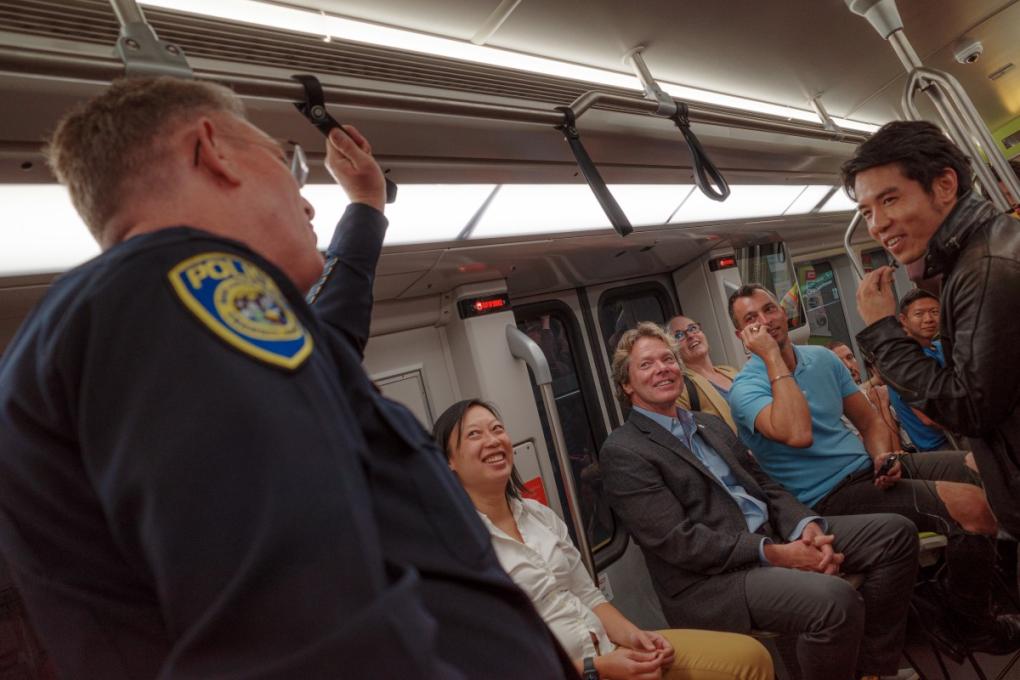
From left to right: Interim Chief of BART Police Kevin Franklin, BART Board President Janice Li, BART General Manager Bob Powers, and Manny Yekutiel during a public conversation on a moving BART train on Friday, Sept. 8, 2023.
Photos courtesy of Evan Dorsky
On Friday, Sept. 8, around 65 people gathered in the concourse of 16th Street Mission Station to welcome in their weekends aboard a BART train.
The group buzzed on the concourse – many people seemed to know one another – anchored around a charismatic man in a blue polo shirt, who stood on a small Persian-style rug.
The man in blue is a recognizable face around San Francisco: Manny Yekutiel, a director on the board of the San Francisco Municipal Transit Agency and the owner of the eponymous Manny’s, a restaurant, bar, coffee shop, political bookstore, and civic gathering and events space located a block from 16th Street Mission Station. Yekutiel’s the sort of person whom civically minded San Francisco seems to know or have heard of. The standard six degrees of separation narrows to one or two degrees when Yekutiel’s involved.
On this evening, Yekutiel was hosting a unique conversation. It was to take place aboard a moving BART train during regular passenger service. The first car of a ten-car train would be blocked off for attendees, who had earlier RSVPed online for their free spots in the car. Yekutiel’s conversation partners were BART Board President Janice Li and BART General Manager Bob Powers. He intended to ask them about the current and future state of the transit system. It was to be an opportunity for BART leaders to hear directly from riders, and riders to hear from them, on the space in question. Tickets sold out fast.
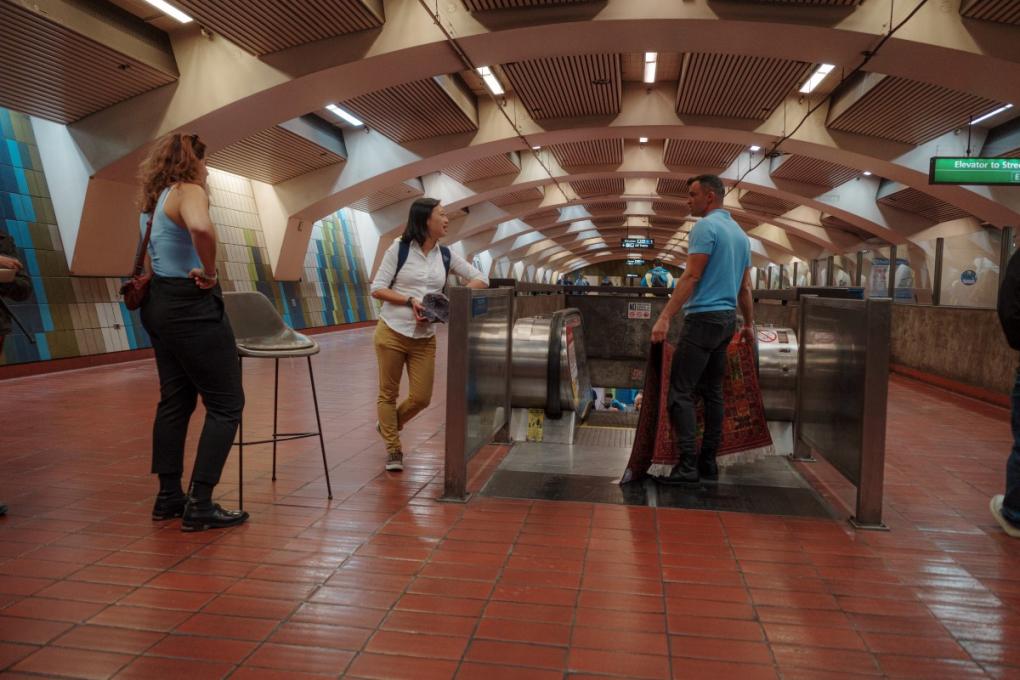
BART Board President Janice Li (center) and Manny Yekutiel (right) at 16th Street Mission Station on Friday, Sept. 18, 2023.
Attendees showed up for a jumble of reasons and motivations.
“I’m dependent on BART and public transit, so, as a customer, I’m curious about leadership’s thoughts about the future,” said Anna Kim, an MBA student at UC Berkeley.
“I’m here to take it all in,” said Ethan Levi, who hoped the train wouldn’t be too loud so he could hear the conversation. “It’s fun to be in the space you’re discussing.”
Erica Mitchell identified herself as a huge transit fan. “She’s the biggest transit fan,” chimed her friend, Rachel Leiter. Mitchell’s dad worked for BART, and she hopes to do so too one day.
BART Transportation Supervisor Nathon Ison, who was on hand to help with the event, said he was excited that BART participated in public forums such as this. “It’s nice to mix things up a bit,” he said. “And it’s great for the community.”
Noor Elmasary said she learned about the conversation from a roommate’s social media post. She was there “in solidarity” with her late family friend, the transit advocate Courtney Brousseau.
“I know he would have loved this,” she said.
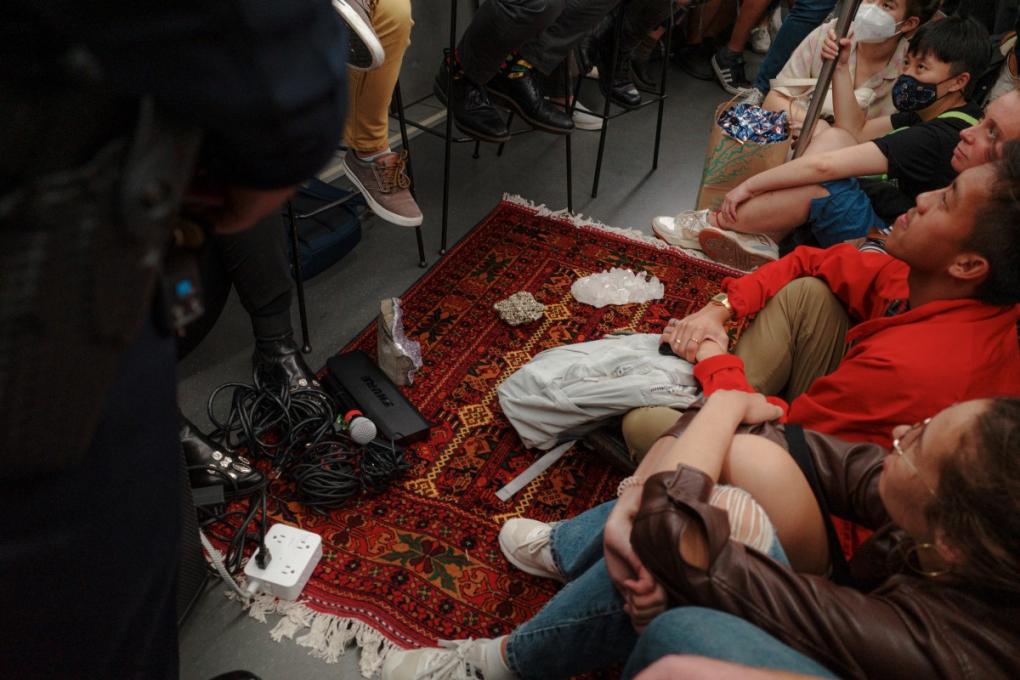
Attendees listen to BART Board President Janice Li and BART General Manager Bob Powers discuss the future of public transit on a moving BART train on Friday, Sept. 8, 2023.
As the group boarded the first car, bumping elbows with Li and Powers, who introduced themselves to attendees as they boarded, Yekutiel unfurled his red rug and laid three crystals atop – a chunky raw amethyst, a glittering pyrite, and a spiky quartz.
“Welcome to our conversation on a moving BART train,” he said. “The idea behind this series is to have conversations in the actual public spaces we’re discussing.”
Yekutiel opened with a tough question for Powers: What grade would the GM give BART?
Powers paused for a moment before replying. “I’d give it a B, B+,” he said.
“I continue to be impressed by BART,” he continued. While there are elements that “keep me up at night,” he added, he’s optimistic that the transit agency “will be at the core of the solution for many of the issues the region is facing right now.”
“BART 2023 is all about the customer experience,” he said.
Li nodded in agreement. “Are we responding to what you’re telling us? Are we focusing on the right things? If not, we want you to tell us!” Forums such as this one proved a ripe space for public feedback as Manny frequently asked attendees to weigh in and ask questions.
As the train rolled along toward its destination, SFO Station, Yekutiel lobbed more questions at Li and Powers. At points, he had to shout over the Train Operator’s announcements and the rumble of train on track.
Following a question about safety from an audience member, Interim Chief of BART Police Kevin Franklin, there for the ride and to listen to the public, got on the mic. (Read BART’s Safe and Clean Plan here.)
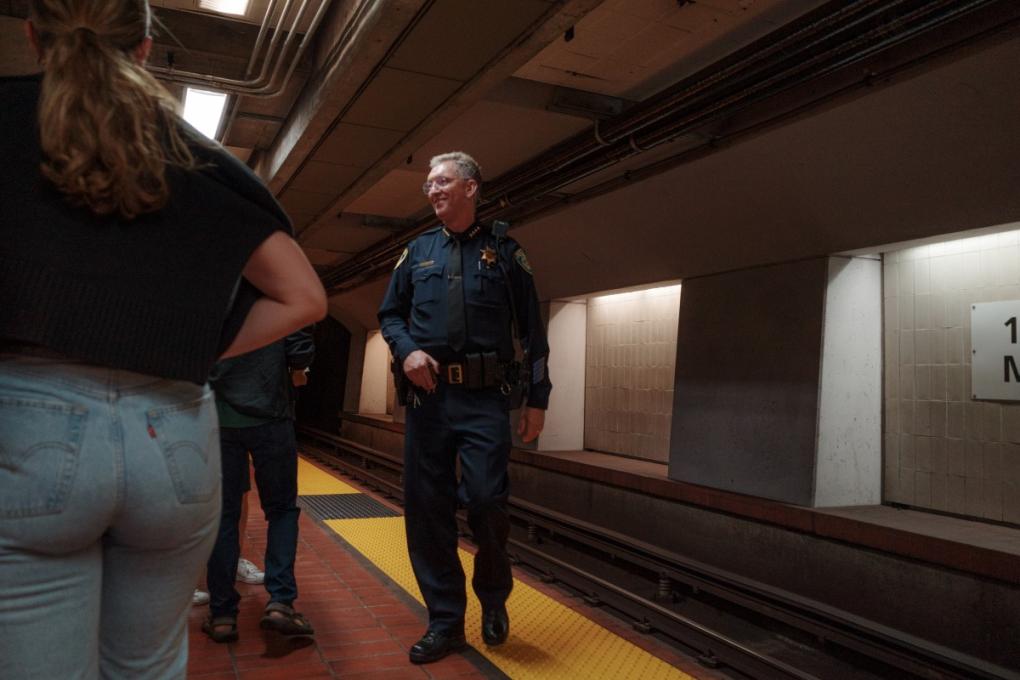
Interim Chief of BART Police Kevin Franklin is pictured on the platform at 16th Street Mission Station before boarding the SFO-bound train on Friday, Sept. 8, 2023.
“We’ve heard clearly from employees and riders that they want greater presence on these trains,” he said. “We do not tolerate behavior that does not meet our code of conduct.”
Franklin cited as example BART’s Not One More Girl initiative, a BIPOC youth-led project in partnership with community-based organizations working to end gender-based violence and harassment on transit. The initiative recently launched its second phase, emphasizing "stories of courage” and steps bystanders can take when they witness harassment.
The police chief said the initiative is personally important to him. “My daughter, my wife, my mother ride BART,” he said. “And they must feel safe doing so.”
“We are all in this together,” Li added.
Manny later asked about BART’s financial situation as the train held shortly at SFO Station.
Powers responded by listing off a series of cost-saving initiatives BART has implemented or is looking to implement – things like shortening trains with a commitment to flex up, modifying the way the agency purchases energy, refinancing debt, and continuing advocacy on the regional and state levels.
Said Li: “These funding challenges are happening in Chicago, DC, and smaller regions, too. Transit is not funded like a public good.”
As the train started moving again, heading back to 16th Street, Yekutiel – a mischievous twinkle in his eye – asked Powers a final question: Does BART have any secret lairs or Room of Requirements-type spaces?
Powers laughed. “Well,” he said, “We have an office at SFO for M Line staff with a secure conference room where we can meet out of towners. It's through a series of corridors.”
“I was hoping for something spicier than that,” Yekutiel replied.
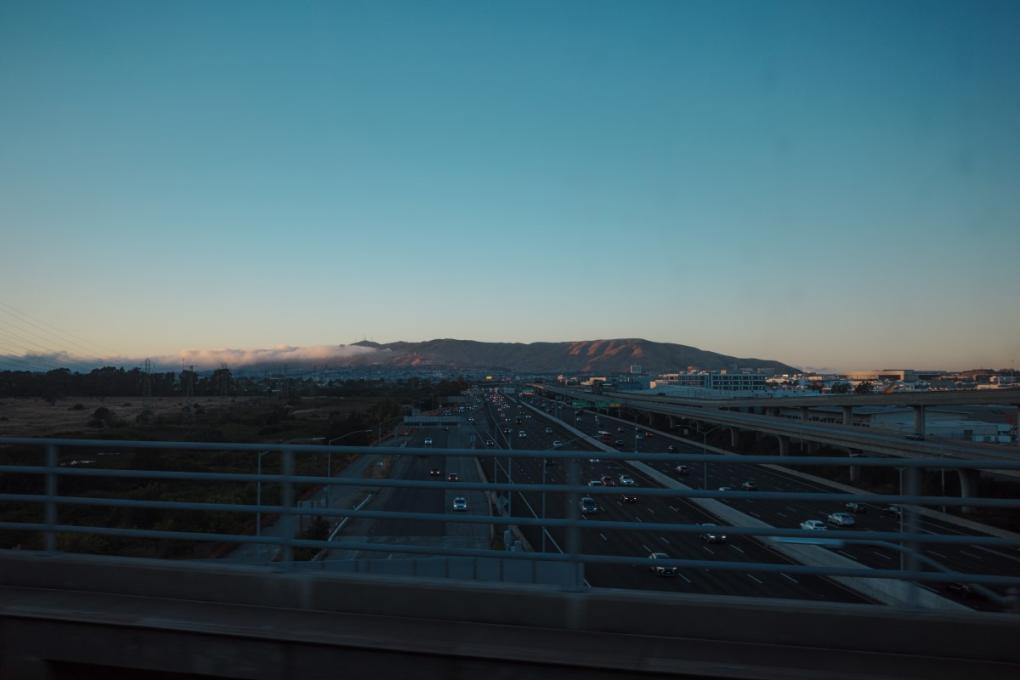
The view as the train pulled out of SFO Station on Friday, Sept. 8, 2023.
As the train rolled by the airport, the sky darkening through the windows, Yekutiel asked the audience to take a moment to let the vista wash over them.
“Can we just take a second to look out the windows and appreciate this? Don’t you love coming in from SFO and seeing this?” he said dreamily.
At the end of the journey, a few stops away from 16th Street Mission Station, Yekutiel, turning away from Li and Powers, decided to ask something of the audience.
“Now I want all of you to turn to someone you don’t know and make a commitment to do something to help BART,” he said.
Audience members obliged, turning to one another to share their ideas and optimism for the future.
“If these changes BART is making are effective, ridership should feel a difference,” said rider Michael Poremba after his commitment declaration. “All of these improvements – to safety, improved service with the new schedule, timed transfers – should be an encouragement to riders.”
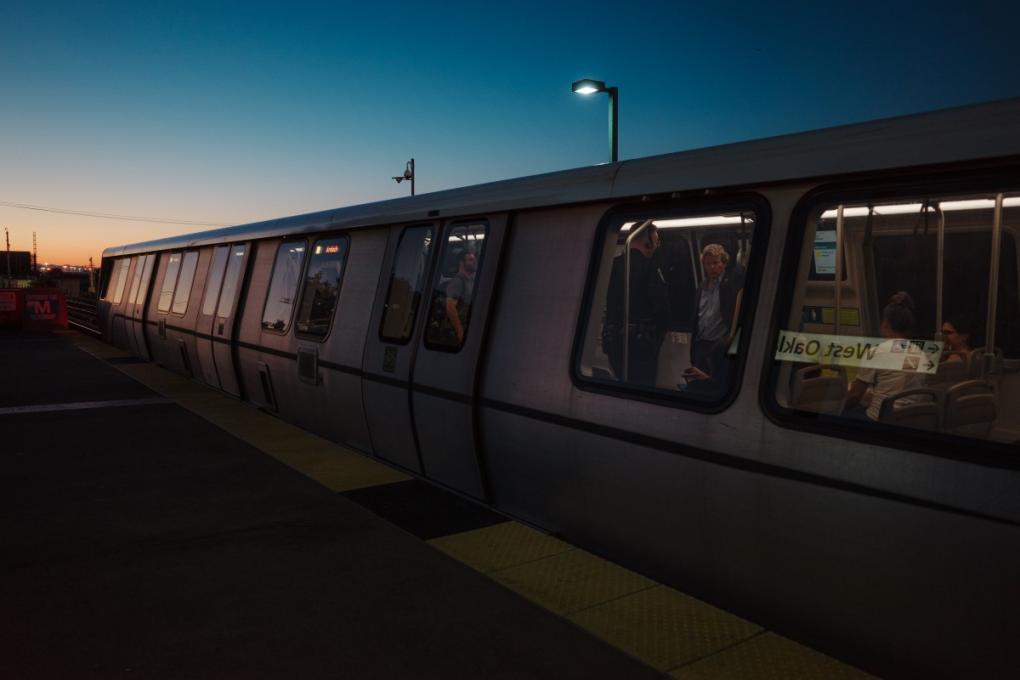
BART General Manager Bob Powers pictured through a train window at West Oakland Station as the train made its way back to the East Bay on Friday, Sept. 8, 2023.
Rockridge and Warm Springs monthly permit payment and waitlist moves to the official BART app
Reserving parking at Rockridge and Warm Springs stations is now available through the BART official app. Rockridge and Warm Springs customers will need to transition from Select-aSpot to the official app to purchase monthly reserved, single day reserved, and multi day (previously known as Airport/Long Term)
BART phases out EZ Rider for fare payment this week; get your Clipper card now
BART is phasing out its EZ Rider card for fare payment this week and urges you to switch to the Clipper card (info at www.clippercard.com). The shutdown of EZ Rider cards for fare payment begins on Wednesday, December 15 -- your EZ Rider card may not work at faregates in your station beginning on that day
New BART Trip Planner now in beta, offers real-time end to end trip planning
BART has launched the beta version of its new Multi-Modal Trip Planner, which will help riders go anywhere in the Bay Area using the various modes of transportation the region provides. Riders can now plug in their home address, work address or their next destination to find the most transit-friendly route at