
Search Results
Interns in their own words: A firsthand account of BART’s summer internship program
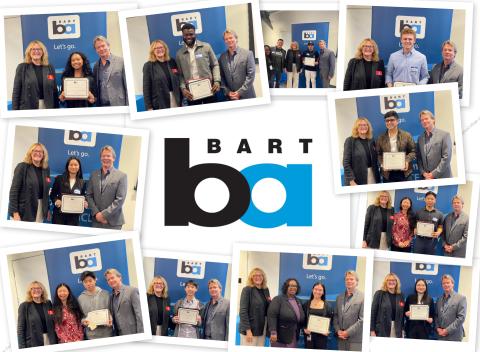
Each summer, a cohort of young people land at BART to learn about the organization and get a glimpse inside the working life that awaits them in their future careers.
Run by BART’s Workforce Development Division, the BART Internship Program pairs young adults on the cusp of entering the workforce – from high schoolers to collegiates – with BART mentors who show their mentees the ropes and guide them through hands-on projects that have real-world impacts. The interns work across departments, from Engineering and External Affairs to Human Resources and the District Secretary’s Office.
“We’re looking for energy and excitement about BART,” said Kimberly Davis, Sr. Workforce Development Analyst, who runs the BART Internship Program. “Are you willing to explore? Are you flexible? Are you going to be a positive influence in the workplace? These are some of the things I’m watching for during the interview process.”
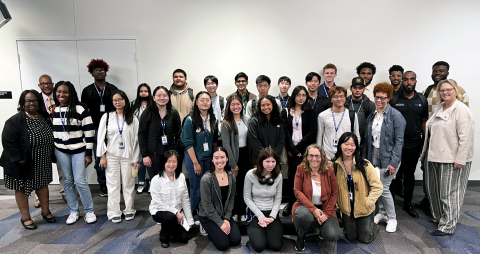
BART interns have opportunities to attend career development and readiness workshops, networking events, career panels, and special behind-the-scenes tours of the innerworkings of the agency. Every intern is paid, whether through BART or a community partner, such as local city offices, nonprofit organizations, and educational institutions.
At the end of the internship, participants showcase their final projects in a formal presentation to executives, mentors, staff, peers, and community sponsors. When they say farewell to BART, they leave with a refreshed resume, a letter of recommendation, and some hard-earned insight into life post-graduation – wherever it may take them.
That’s enough from us – let’s hear from the BART interns themselves!
Responses have been edited for space and clarity.

Q: Why did you want to intern at BART?
Ruben: I’ve commuted for the past few years on BART, and I wanted to know what was going on behind-the-scenes and see how it works.
Michai: I wanted the work experience and to learn more about work.
Brian: I wanted to intern at BART because I want to expand my knowledge of construction management because I’m interested in working for PG&E.
Elizabeth: I wanted to intern at BART because it’s public sector, and I have always wanted to learn more about transportation.
Question: What projects are you involved in?
Isabella: I’ve been working on a digital record management system. I’ve been entering Board resolutions into the computer so they’re easier to find.
Austin: I’ve been going to every single station and counting their inventory. I’m helping BART save money!
Katy: I am making a mock-up of the new faregates out of PVC and cardboard to help people figure out how to move the gates into labs and through tight corners and doorways. I’ve learned that a lot of the fun things are also the challenges. I have to be methodical about the project and not forget anything.
Nahom: I’ve done a lot of different tasks during my internship. Looking at new technology in the field is cool.
Matthew: I’m involved in two projects related to automated software that allow you to automate your workflow. I obviously cannot finish it in six weeks, but my goal is to finish the outline and create the program. Every day is fun.
Q: What have you learned during the internship and how might you apply it in the future?
Isabella: I learned how to organize, adjust, and adapt things to the future to make things easier for people.
Matthew: I’ve learned a lot, especially about the importance of gaining experience, networking, and professionalism.
Katy: I’ve learned a lot about the reality of working. I don’t want to work in an office, but the experience has been great.
Q: What have you learned from your mentor? How have they helped you throughout the internship?
Elizabeth: My mentor Ally has been very supportive of me and very patient. Even if I don’t know what to do, she loves answering questions. It was good leaning on her for things I needed help with.
Brian: When I got to this department, I was really confused as to what was going on. But since being here, I’ve learned a lot, including about the differences between being in the field and being in the office.
Q: Do you think you’d like to work at BART in the future?
Ruben: If the opportunity comes, then yes, I would like to.
Isabella: I think I would if the opportunity is presented. I would like to work in a field where you talk to people, so the communications department.
Matthew: It depends. I don’t like working for but working with. I like the environment here.
Students interested in internships at BART can email the Workforce Development team at [email protected]. General internships are sponsored through partnerships with various community-based organizations in the BART service area.
BART Police launches redeployment strategy to boost rider safety and staff balance
The BART Police Department recently implemented a new deployment strategy that has significantly reduced the number of mandatory overtime shifts required each month, cutting what was once nearly 400 mandatory fills to a far more manageable level, giving employees more predictable schedules and valuable time to recharge.
Working closely with the BART Police Officers Association and the BART Police Managers Association, the department developed a strategy that prioritizes uniformed presence on trains and in stations with existing resources while protecting work-life balance for employees.
That visible presence extends beyond sworn officers. Crisis Intervention Specialists, Fare Inspectors, Ambassadors, and Community Service Officers now play a key role alongside police officers in enhancing safety and service for riders.
BART PD’s partnership with its labor partners positions the department as a leader in law enforcement in prioritizing work-life balance. This focus compliments BART PD’s officer recruitment campaign as well as efforts to retain current staff.
BART Police Chief Kevin Franklin commended the staff for their daily commitment to rider safety, emphasizing that, “Safety within the BART system remains paramount. This strategy allows us to keep our system secure while also supporting the health and well-being of our staff.”
He added, “Our officers and staff work tirelessly each day to protect community members and ensure BART remains a safe and reliable way to travel throughout the Bay Area.”
BART PD is also focused on building a strong culture of wellness to help ensure the department can provide the highest level of service to the community.
The deployment plan directly aligns with BART’s Safe and Clean Plan, launched in late 2023, which focuses on improving the rider experience by expanding safety resources, increasing cleanliness, and upgrading fare gates across all 50 stations.
BART PD also continues its commitment to filling vacancies with both entry-level and lateral officers to further strengthen the department’s capacity. Those interested in a career with the department can learn more and apply at joinbartpd.com.
Upcoming opportunities in July to learn more about proposed Ashby BART TOD
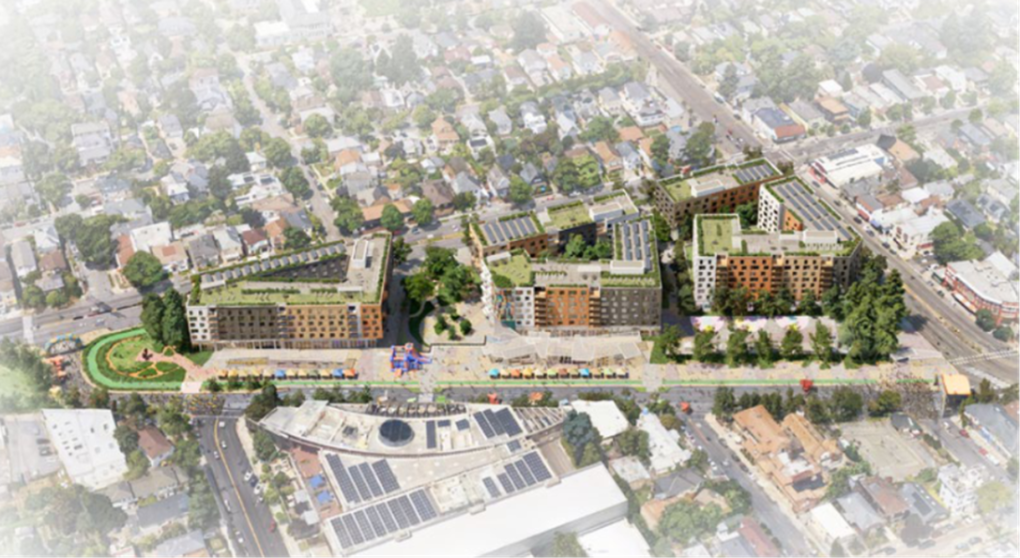
The public is invited to three upcoming community events related to the proposed Ashby BART Transit-Oriented Development (TOD).
Adeline Alliance Partners, together with the City of Berkeley and BART, are hosting a Community Open House and virtual Office Hours in July to gather input from community members on the future of the Ashby TOD. In addition, the City of Berkeley and BART are hosting an Ashby BART Access and Public Space Community Workshop that is designed for all abilities and ages.
The proposed project will see the development of hundreds of mixed-income homes, new community/commercial spaces, and enhanced access to BART on the Ashby BART West Parking Lot. Adeline Alliance Partners was selected by the BART Board of Directors at its July 2025 meeting to enter an Exclusive Negotiating Agreement with BART for the development of the site.
Thursday, July 16: Ashby TOD Community Open House (in person)
What: Ashby TOD Community Open House (in person), hosted by Adeline Alliance Partners, together with the City of Berkeley and BART
When: Thursday, July 16, 6pm-8pm
Where: South Berkeley Senior Center (2939 Ellis St., Berkeley)
More information: Event flyer
If you are unable to attend the open house, you can either share your feedback with the developer on the Ashby TOD here or come to virtual Office Hours.
Wednesday, July 22: Ashby TOD Office Hours (virtual)
What: Ashby TOD Office Hours (virtual), hosted by Adeline Alliance Partners, together with the City of Berkeley and BART
When: Wednesday, July 22, 5:30pm-7pm
Where: Zoom Meeting Link: http://tiny.cc/ntn6101
OR:
Call-in Number: (669) 444-9171, Meeting ID: 871 7579 1898
Saturday, July 25: Ashby BART Access and Public Space Workshop (in person)
Join this hands-on workshop to share how you move through and experience the area around Ashby BART station. What would help you get to and move around the space more easily and comfortably? What would make this space feel welcoming for all ages and communities?
What: Ashby BART Access and Public Space Workshop (in person), for all abilities and ages, hosted by the City of Berkeley and BART
When: Saturday, July 25, 10am-noon
Where: Ed Roberts Campus (3075 Adeline St., Berkeley)
RSVP/Accommodations: Visit bit.ly/ashby-bart-workshop to RSVP and to request language assistance or accessibility accommodations.
---
Accommodations for July 16 virtual office hours: To request accommodations, please call (510) 991-2770 or email [email protected]. Requests must be made 72 hours in advance of the event.
Language Assistance: If you need language assistance services, please call (510) 991-2770 at least 72 hours prior to the date of the event.
如需語言援助服務,請於活動日期之前至少 72 小時致電 (510) 991-2770。
Si necesita servicios para comunicarse en otro idioma, por favor llame al (510) 991-2770 al menos 72 horas antes de la fecha del evento.
Kung kailangan mo ang tulong ng m–ga serbisyo ng wika, paki tawagan ang (510) 991-2770 hindi liliit sa 72 na mga oras bago ang petsa ng pangyayari.
언어 지원 서비스가 필요하시면, 행사 날짜로부터 늦어도 72시간 전에 (510) 991-2770 로 전화해 주십시오.
Nếu quý vị cần dịch vụ trợ giúp về ngôn ngữ, xin vui lòng gọi số (510) 991-2770 ít nhất là 72 tiếng đồng hồ trước ngày của dịp tổ chức.
50 stations in 6 hours: Join a group BART speedrun on Sunday, September 14
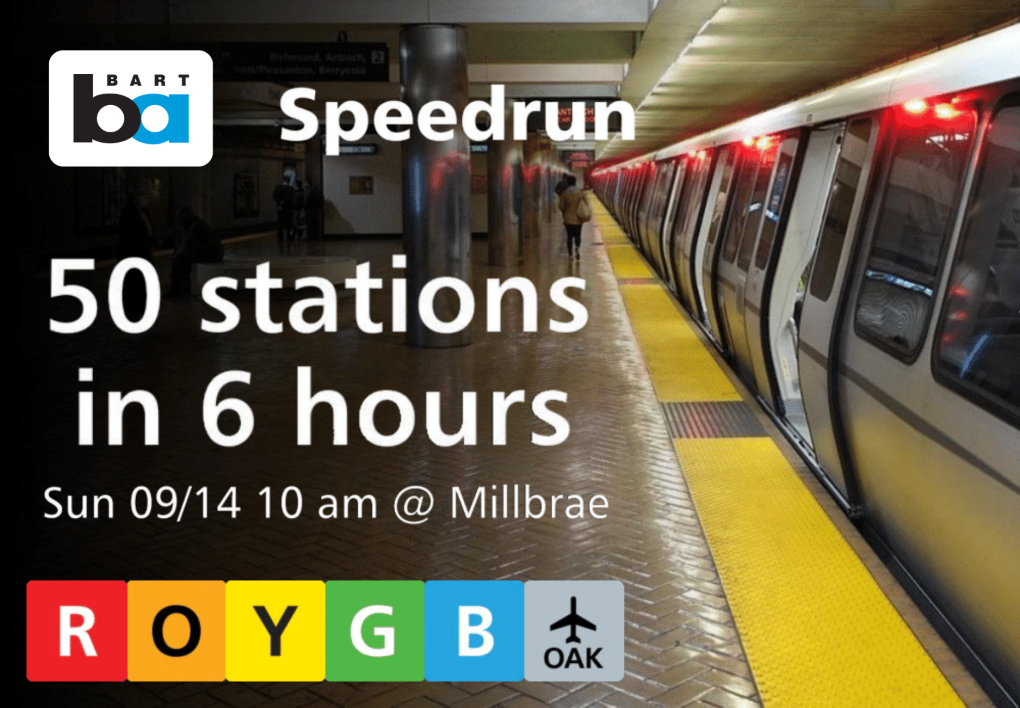
A group of Bay Area high schoolers are inspiring people to get on BART for Transit Month by doing something big, bold, and potentially record-breaking.
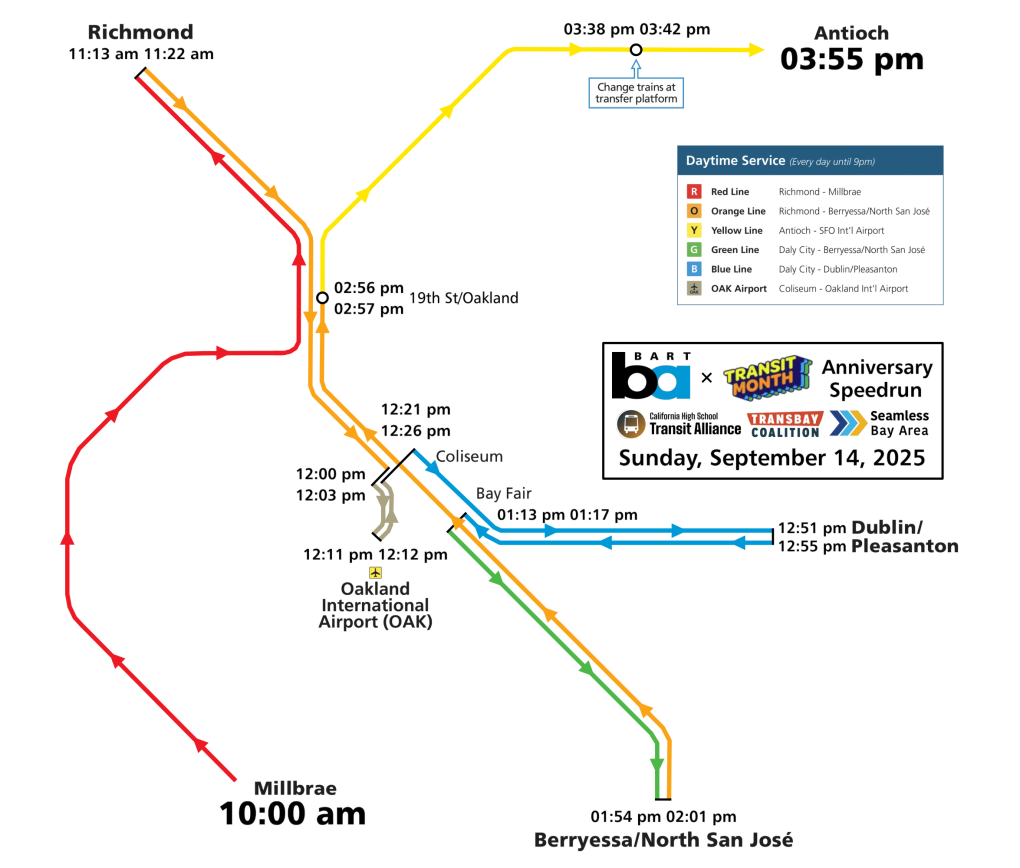
On Sunday, September 14, starting at 10am, dozens of transit enthusiasts will gather at Millbrae Station and spend the next 5 hours and 55 minutes visiting every single BART station – and doing it as fast as possible.
Speedrunning has become a big trend in transit. The idea is travel through every single stop on a transit system in as little time as possible. More than 20 speedrun attempts have been made on BART since 2012 (that BART knows about). BART tracks speedruns on our dedicated webpage.
Co-organizers Harvy Chang, Matthew Leon, Seeger M, and David Rabinovich hope to see more than one hundred people turn out for what they’ve deemed Speedrun Day 2025, hosted by the California High School Transit Alliance (CalHSTA). During the BART speedrun, their comrades in Southern California will be speedrunning the San Diego Trolley.
The organizers don’t foresee breaking any speed records on Sunday, but they do intend to gather the largest number of people for a single speedrun of any national transit agency ever.
“We wanted to do this during Transit Month because gathering a bunch of people to have fun on transit is the spirit of the month,” said Chang, who meticulously planned the schedule for the day, down to the minute. View the full schedule here.
On the train, there will also be trivia about the various stretches of track they're traveling on with transit-themed prizes.
Speedrun Day is about making connections in the most literal sense – you miss one transfer, and you’re whole speedrun is thrown off – but also connecting with other transit riders, enthusiasts, and advocates.
It’s also an efficient way to take un tour de Bay Area. BART is a massive system that covers a huge swath of the region. When you travel all 131 miles of BART trackway in six hours, you get an exhilarating sense of the patchwork of places, climates, and people that make up the region.
Organizers encourage people to join for the full speedrun or to hop on along the route. If the group does miss a transfer, they’ll let folks know at the top of the schedule document and on social media (follow CalHSTA on Instagram and Bluesky).
You’ll need $30 on your Clipper card to cover the cost of fares for the whole run (plus cost of travel to Millbrae Station). Organizers encourage attendees to bring water and whatever else they might need to comfortably ride trains for six hours.
What: 53rd Anniversary BART Speedrun
When: Sunday, September 14, starts at 10am at Millbrae Station
Route/Schedule: docs.google.com/document/d/1MuIP_cFx_CLyOLAl5ALUdRu6MIdru02xsh3SkY-9feE/edit?usp=sharing
RSVP: luma.com/yj73dmrc
CalHSTA social media: Instagram (@calhstatransit) and Bluesky (@calhstatransit.org)
More on BART Speedruns
A speedrun is the total time it takes to travel through all BART stations. BART tracks speedrun records on bart.gov/news/fun/speedrun.
In 2024, UC Berkeley grad students applied to the Guinness World Records to make speedrunning an official category. The current official GWR record is 5 hours, 47 minutes, and 35 seconds, though a new record of 5 hours, 43 minutes, and 10 seconds was submitted to GWR in July 2025 and awaits word from the organization.
Listen to our podcast with some of BART’s most prolific speedrunners here.
Did you do a BART speedrun with documentation that isn't listed? Even if it doesn't break a record, email us at [email protected] to be added to the page.
Our speedrun page inspired some transit fans to start transitruns.org to provide a worldwide centralized website to compile leaderboards. The website details the basic of speedrunning, how to compile evidence, recommended timing standards, and other FAQs.
Disability Pride Month: Harold Willson's fight to make BART accessible for all
Last week, Governor Gavin Newsom proclaimed July as Disability Pride Month. The month marks the anniversary of the Americans with Disabilities Act (ADA) that was signed into law on July 26, 1990. The ADA was a major milestone for civil rights in the U.S. that "prohibits discrimination against individuals with disabilities in all areas of public life, removing barriers to employment, transportation, public services and other critical areas," per Newsom's proclamation.
More than 7% of BART riders have a disability, and BART is continuously working to make the system as easy to use as possible for every single person who rides and relies on us. Our work is ongoing.
This month, BART will be celebrating riders with disabilities and the contributions they have made to our transportation system and region.
We begin with the story of Harold Willson, originally published in 2022.
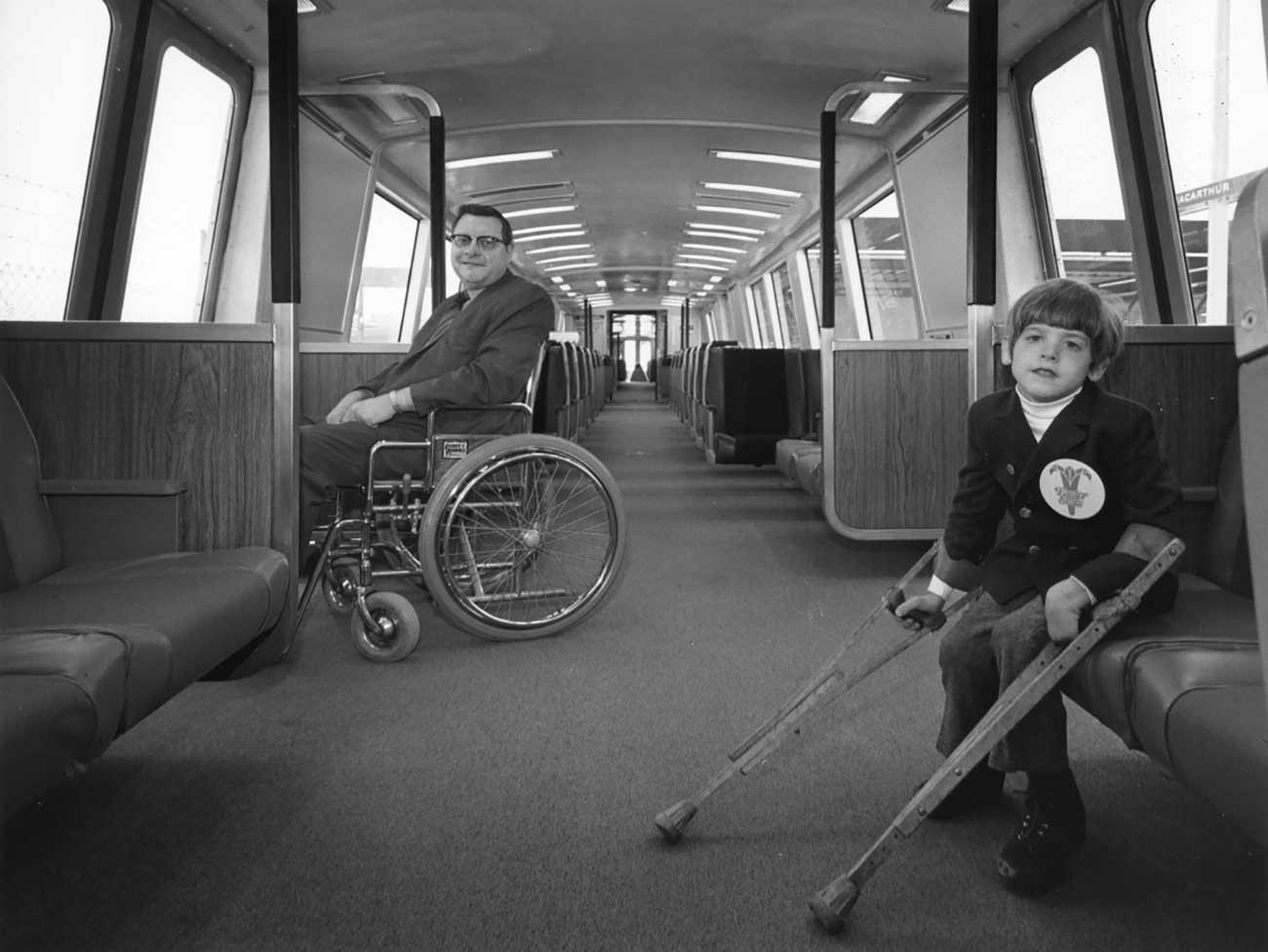
Harold Willson (left) smiles at Eric Staley (right) on a BART train in 1972. Photo courtesy of Kaiser Permanente Heritage Resources.
“There is a special personal pride in being the first handicapped person in a wheelchair to use a subway train, and to represent all handicapped travelers who will use the BART system in years to come. I’ll never forget that sense of freedom I experienced as I boarded the BART train.”
– Harold Willson, quoted in “Accent on Living,” Spring 1973
When Harold Willson was 21 years old, his life forever changed.
The West Virginia native dropped out of university when his funds ran out and started working as a coal miner. On a regular day in February 1948, about two years after he began working in the mines, Willson was caught in a slate fall. He suffered severe spinal damage, broken ribs, and a broken back.
Willson’s tragic accident spurred a lifetime of advocacy. His work to raise awareness and secure rights and access continues to impact the freedom and mobility of transit riders across the nation. Thanks to Willson’s efforts in the 1960s, BART became the first public transit system in the nation with accessible trains and stations.
“Never again would skeptics be able to argue that trains could not be made wheelchair accessible" after Willson, write Doriz Zames Fleischer and Frieda Zames in “The Disability Rights Movement."
Four months after his accident, Willson was transferred by train to the Kaiser Foundation Rehabilitation Center in Vallejo. It was a felicitous move, one that would forever alter the course of his life and public transportation. In his two years at the facility, Willson underwent intensive physical therapy and multiple surgeries. Doctors told the young man he would use a wheelchair for the rest of his life.
In 1950, Willson joined Bank of America and married Patricia Leister, who was a member of the nursing staff that treated him at Kaiser. Six years later, he completed a degree in business administration at Golden Gate College, and a year after that, he was hired as an accountant at the Kaiser Foundation Medical Care Program. Willson would go on to hold a variety of positions at Kaiser throughout his life. He’d retire as a senior financial analyst for the Kaiser Foundation Health Plan in 1977.
Said Cuong Le, historian for the nonprofit health care provider: "Kaiser Permanente is fortunate to have passionate and influential employees like Harold Willson, whose remarkable success advocating for historically overlooked needs of people with disabilities led to substantially improved conditions."
During the years that Willson lived in the Bay Area, the region was aflutter with the news of a soon-to-be-constructed rapid transit system that would connect the Bay. The tenor of excitement shifted for Willson when he learned the system, to be called the San Francisco Bay Area Rapid Transit District, or BART for short, would not be accessible for people with disabilities. Four percent of the Bay Area population at the time had severely limited mobility, meaning the BART system would exclude them from its ridership.
“When the system was built in the 60s, the elevators weren’t a consideration,” said Bob Franklin, BART’s Director of Customer Access and Accessibility. “They were completely an afterthought.”
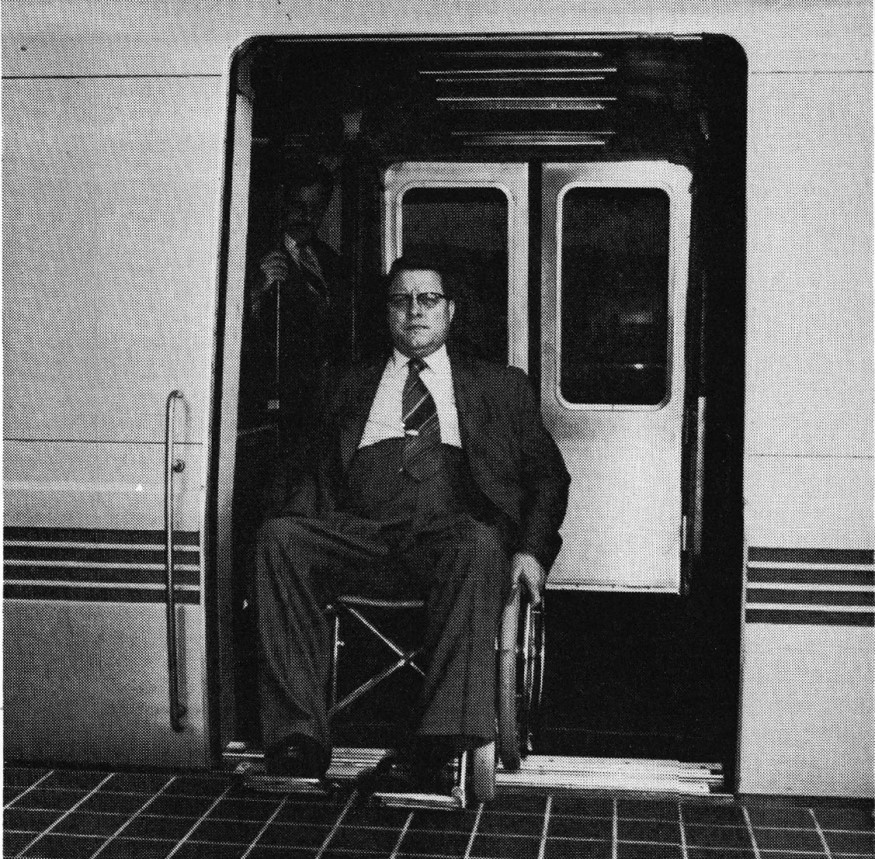
Photo courtesy of Kaiser Permanente Heritage Resources.
Willson reached out to BART and offered his services as a “volunteer consultant” to the BART Board starting in 1964. He had a unique and compassionate approach to advocacy, according to the people who knew and worked with him.
“His suggestion was novel for rapid transit, no one had tried it,” A.E. Wolf, the General Superintendent of Transportation for BART, is quoted as saying in the Spring 1973 issue of “Accent on Living." “It posed all kinds of problems; cost was significant. Our staff, including myself, was hardly enthusiastic.”
“But, he did not threaten, nor picket, nor sulk, nor lose patience,” Wolf continued. “Instead, he was professional, pleasant, firm and persistent. As a result, he won the support of each of our board members while maintaining a friendly relationship with our staff.”
Willson’s approach was to “sell” the idea for an accessible BART system by contacting people one by one and having individual conversations with them, slowly winning them over to his cause.
“You could be a pioneer in being the first major public transportation system to be accessible to the handicapped,” Willson told the BART Board and staff in 1963, according to Michael Healy’s “BART: The Dramatic History of the Bay Area Rapid Transit System.”
Willson’s methods worked. In 1968, the BART Board requested $7 million from the California legislature to include accessible elevators in its plans (the figure was later revised to $10 million).
Willson’s advocacy did not stop there. He and representatives from BART continued to lobby Sacramento until $150 million in additional funding for wheelchair accessibility was allocated to the under-construction system in March 1969. BART, with Willson's guidance and persistence, was ahead of its time. It would be more than two decades later that the Americans with Disabilities Act (ADA) was signed into law.
Among the accommodations the funding secured were elevators at every station, telephones in elevators and stations that were accessible for wheelchair users, special service gates and handrails, Braille symbols on elevator door casings, loudspeaker directions for those who are low vision and blind, closed-circuit televisions as needed, and level boarding between the platform and train.
In the years since Willson’s advocacy, BART has added even more accessible features to the system, which you can read about on bart.gov/guide/accessibility.
After BART was built, Willson would go on to continue advocating for accessibility. In 1971, Willson and Wilmot R. McCutchen, Chief of Design for BART, testified before a special U.S. Senate Committee on Aging. Their testimony was “an important precursor to raising public consciousness of the issue of disabled access,” writes Healy in his "BART" book. A robust disability rights and independent living movement would emerge in the years that followed Willson's lobbying.
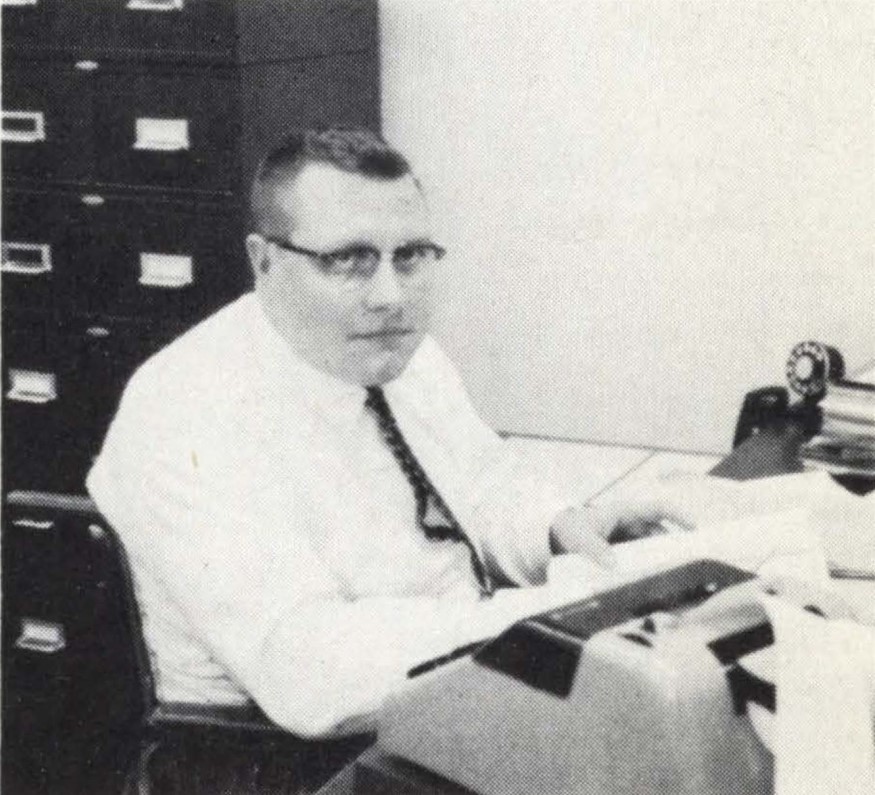
Image courtesy of Kaiser Permanente Heritage Resources.
Willson died in the Bay Area in 1994.
His legacy continues to reverberate across the nation. After BART, the newly built transit systems WMATA and MARTA also made their systems accessible, setting a new precedent for future generations of public transit.
“All of this is possible because one man had a bright shiny dream, and he made it come true,” Wolf is quoted as saying in a 2008 journal.
Denise Figueroa, the Executive Director of the Independent Living Center of the Hudson Valley and a longtime transit advocate, noted that transit has “come a very long way in terms of accessibility” from the 1950s and 1960s.
“In those days, when Willson first started out, there wasn’t an expectation of accessibility,” she said by phone. “Over the years, what has changed is that the public expects transit to be accessible – even non-disabled people.”
Figueroa said the mentality of transit systems was often, “It’s not my problem.” She said agencies would routinely cite cost as the prohibiting factor.
“The argument was always: It’s too expensive,” she said. That changed with the passage of ADA (1990), as well as Section 504 of the Rehabilitation Act (1973), which requires public entities that receive federal funding to ensure that people with disabilities are not discriminated against, nor denied goods or services.
Today, BART continues to bolster its efforts to make the system accessible for all riders. The transit agency hosts a monthly BART Accessibility Task Force on the fourth Thursday of each month, where the public can voice concerns, ask questions, and provide input. BART, which is ADA accessible by law, also encourages passengers to make a Reasonable Modification Request if their needs are not being met.
When transit systems are accessible for all, said Franklin in closing, everybody wins.
“It’s a federal law now that we’re accessible to everyone,” he said. “And when we design it that way, everyone benefits. The more universally we can design something, the better it will be.”
The BART Accessibility Task Force (BATF) is actively recruiting new members. If you are interested or have questions, please contact, Elena Van Loo, Customer Access and Accessibility Department, by phone at (510) 874-7366 or by e-mail at [email protected].
Provide feedback on BART’s 2026-2035 Sustainability Action Plan by October 31
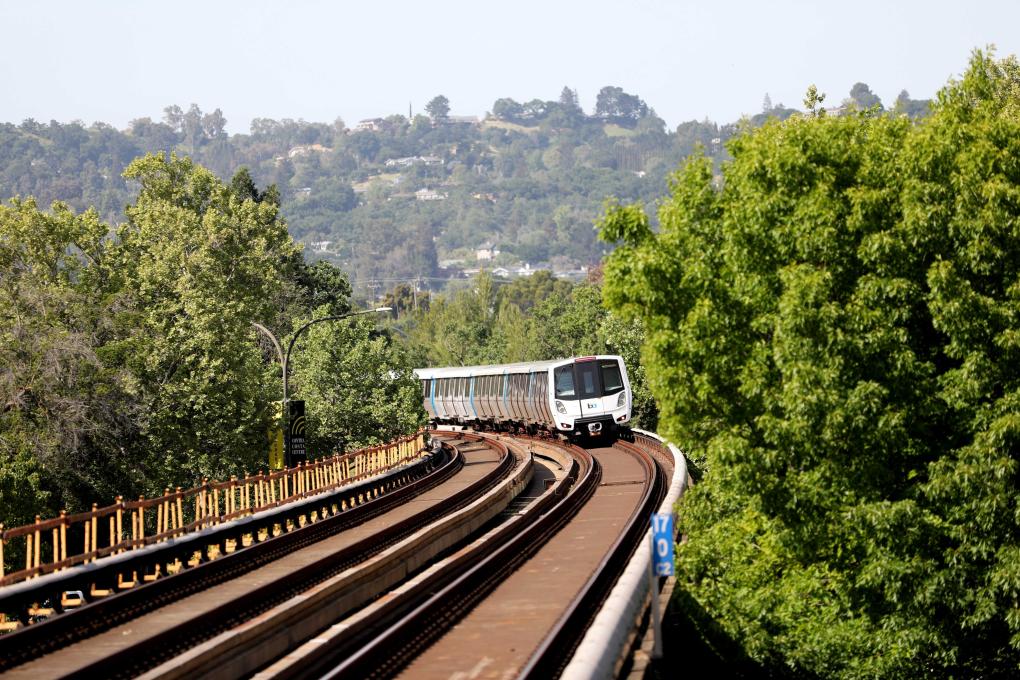
Over the past year, BART has been engaging with our riders and employees via surveys and community meetings to determine our sustainability program priorities over the next decade. We have received your feedback and are excited to share a draft of our new 2026-2035 Sustainability Action Plan (SAP), which will serve as our roadmap for implementing our Sustainability Policy through 2035.
The SAP outlines new goals, metrics, targets, and actions that will define our sustainability efforts, which means using energy and water more efficiently, reducing waste and emissions, improving access to BART stations, and delivering a quality experience for our riders.
The draft of the 2026-2035 SAP will be available for viewing online until October 31, 2026, after which we will make final revisions and publish the completed document in December 2026.
View the draft 2026-2035 Sustainability Action Plan
Please send any comments on the draft to [email protected] by October 31.
Overview of 2026-2035 Sustainability Action Plan
The San Francisco Bay Area Rapid Transit District (BART) is more than a transit system—it’s the backbone of the Bay Area. Every day, it connects people to jobs, schools, healthcare, and each other, linking key destinations across the region, including ferry terminals, airports, and other major transit systems. As the Bay Area grows and changes, BART’s role in supporting a more sustainable, resilient, and just future has never been more important.
The 2026–2035 Sustainability Action Plan (SAP) outlines how BART will continue to support climate resilience, public well-being, and responsible environmental practices through its operations and services. From reducing greenhouse gas emissions and conserving water to expanding access to clean, reliable transit, this plan reflects BART’s commitment to improving quality of life for all who live, work, and travel in the region.
Sustainability covers both environmental and social factors – protecting the environment and the people within those environments go hand in hand. BART aims to create cleaner air, safer stations, and more accessible communities, helping make Bay Area transit essential and transformative.
BART previously published a 2015-2025 SAP, which outlined our sustainability-related initiatives through calendar year 2025. We have taken many of the lessons learned from implementing that plan and applied them to our approach developing this new plan.
BART will publish annual sustainability reports throughout the 2026–2035 SAP to track progress toward its 2030 targets and any interim goals along the way. These reports help ensure transparency, show what’s working, and highlight where course corrections may be needed. As part of this process, BART will update its targets in 2030 to set goals for 2035.
For more information about other aspects of BART’s Sustainability program, please visit bart.gov/sustainability.
How BART's Earthquake Response Team is preparing for the next "Big One"
Find BART’s earthquake safety tips here.
When a big earthquake strikes the Bay Area, BART is ready with a series of stringent protocols and a specially trained team that's prepared to dispatch the moment after a quake hits to assess the system and ensure it’s safe to run.
BART is an industry leader when it comes to preparing and mitigating the impacts of major earthquakes. BART was an early adopter of the ShakeAlert Earthquake Early Warning System that gives us an alert before ground shaking happens. Read more about the system here.
BART also recently completed its Earthquake Safety Program (ESP). The ESP was instigated in the early 2000s and included a major retrofit of the Transbay Tube, which some engineers consider one of the safest places to be during a big earthquake.
Though the project is complete, BART engineers never let their guards down when it comes to earthquakes, and the recent Great ShakeOut earthquake drill is an example of the lengths BART takes to be prepared. BART knows its importance in the wake of major earthquakes. After the devastating Loma Prieta earthquake, when the Bay Bridge collapsed and BART was up and running within hours, the region witnessed how BART is as a transportation lifeline for the SF Bay Area during major disasters.
“Re-establishing train services quickly after a major earthquake is essential for regional emergency response and economic recovery. One key element of making this happen is prompt assessment and reporting of structure conditions throughout the system,” said Phoebe Cheng, Engineering Group Manager.
BART Principal Structural Engineer Alvin Tsui leads the Earthquake Response Team (ERT) with support from Engineer Recy Calma. Their goal is to train employees and continuously improve BART’s post-earthquake inspection procedures.
The ERT consists of around sixty engineers and thirty maintenance employees that fan out across the system in the advent of a major earthquake, defined as an earthquake with a magnitude of 6.0 or greater with an epicenter within 50 miles of the BART system. Since its inception, the ERT has never been activated for a real event, but they train throughout the year to prepare for the real possibility of a massive earthquake rattling the Bay Area.
The Great ShakeOut is the ERT’s big show. Once the international earthquake drill commences at 10:16am, BART staff hit the ground running. The first step is triggering the ShakeAlert early warning earthquake system, which signals trains to automatically slow to 27mph before briefly stopping. During the drill, BART also tests its internal communications systems while the Operations Control Center ensures the train control systems are working properly.
Meanwhile, ERT members travel to all 50 stations to conduct structural assessments, simulating damage inspections that would occur during a real earthquake. They inspect walkways, support structures, elevators, escalators – anything that could sustain damage in a powerful earthquake.
The Great ShakeOut simulation is designed to exercise “muscle memory” for BART’s earthquake response as well as identifying areas for improvement.
Safety is BART’s mission above all, and the practiced ERT is crucial for getting service up and running quickly.
The team focuses their observations on stations and aerial structures. They’re looking for physical damage – cracks, leaning, displacement, unevenness, and foundation damage – as well as issues like station power outages, falling signage, and water intrusion.
Members of the ERT can be activated at any time, and staff volunteer to join the team. Every ERT member is issued two big backpacks full of supplies they might need, from batteries and measuring tools to safety vests and protein bars. One backpack stays at their house: the other in their office. See what’s in their bags in the video.
It’s honorable to be a member of the ERT, who have signed themselves up to prioritize the safety of their community during a major disaster. Calma wanted to be a part of the ERT after witnessing big earthquakes while living in the Philippines.
“I was hesitant to join at first – it's a lot of responsibility,” she said. “But as an engineer, your goal is to serve the public.”
Added Tsui: “As an employee at a public agency, we are the heart of regional emergency response. As members of the ERT, we want to serve the community and help keep them safe during emergencies.”
BART's Safe and Clean plan transforming rider experience at Civic Center Station
BART’s efforts to reimagine the rider experience through an unprecedented commitment to safety and cleanliness appear to be making a difference at a San Francisco station with a history of issues. Recent Passenger Experience Survey (PES) data shows an increase in satisfaction with Civic Center/UN Plaza Station as well as a jump in the percent of respondents who say they feel positively about station cleanliness and safety. Among the findings:
- Satisfaction with the overall BART experience for riders who boarded BART at Civic Center Station increased 9 points from 68% to 77% in the latest quarter (October-December) compared with the previous quarter (July-September).
- Satisfaction with rider safety at Civic Center Station surged by 20 points from the previous quarter from 32 to 52%
- Ratings of concourse cleanliness shot up 18 points from 32% to 50%.
- Ratings of platform cleanliness increased by 17 points from 31% to 48%.
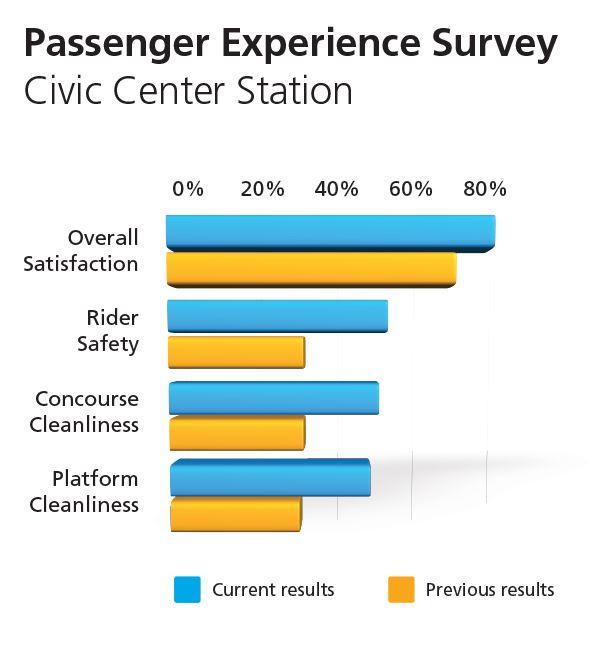
The improvements at Civic Center come as BART has implemented its Safe and Clean plan, which focuses on boosting BART PD’s visible safety presence and increasing station cleaning crews by nearly two thirds.
“Civic Center has been a challenging station but that hasn’t stopped us from tackling a difficult situation and bringing stakeholders along with us,” said BART Board of Directors President Bevan Dufty. “The investments being made at Civic Center make it clear that BART cares that people of all walks of life should be able to access a safe, clean, and reliable system.”
“Maintaining a consistent safety presence has been critical to improving the overall rider experience at Civic Center Station,” said BART Police Chief Kevin Franklin. “Our presence involves traditional sworn officers as well as unarmed Crisis Intervention Specialists and Transit Ambassadors. Not only are we deterring bad behavior, but we have a Tier 1 emergency response time of about four minutes, which is among the fastest for any Bay Area law enforcement agency.”
Cleaning crews are now stationed at Civic Center during all BART operating hours on top of regular overnight power cleaning shifts. Every day there are 2-3 cleaners devoted specifically to the station. You can see an example of deep cleaning at Civic Center Station here.
BART has successfully boosted its cleaning staff but still has about 14 openings, which represents a vacancy rate of nearly 8%. BART is drawing from a list of qualified candidates to fill those positions. In the meantime, anyone interested in applying should visit BART’s Careers page and subscribe to receive notifications for when openings become available.
More improvements are on the way for Civic Center. The station was named earlier this month as one of the next eight in line to receive Next Generation Fare Gates once field testing of prototype units at West Oakland Station is complete. The Market Street Escalators Renovation Program is replacing 41 escalators at BART’s four downtown San Francisco stations including a new platform escalator that opened just last month at Civic Center. Within the last year BART reopened the Station Agent Booth at the UN Plaza entrance of the station which had been closed for more than a decade. Also, new canopies are being installed over entrances at all the downtown stations to make them more welcoming as well as to better protect escalators from the elements.
2025 BART holiday sweaters and merchandise available for preorder through August 17
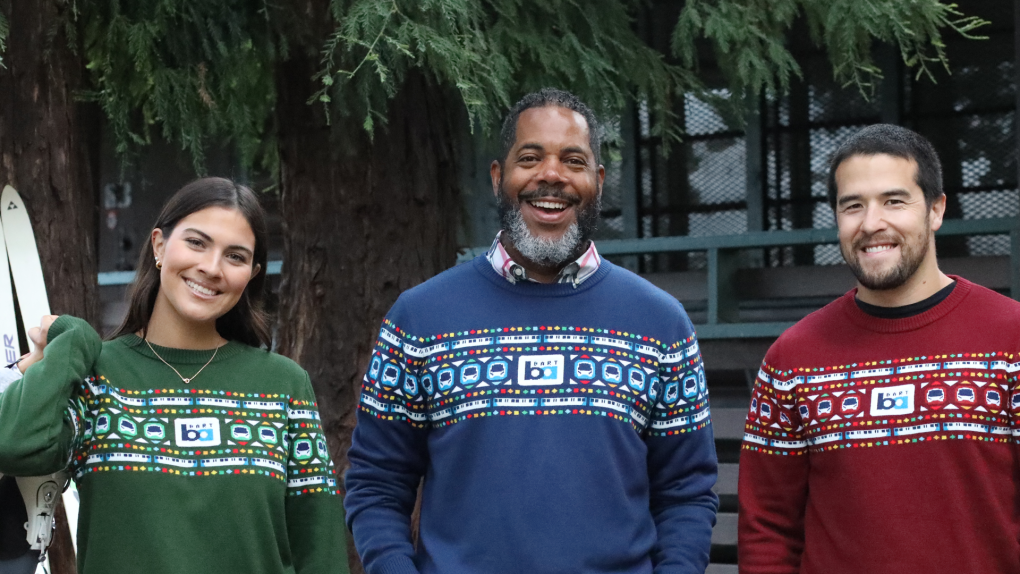
Click here to shop the BART holiday merch presale
Update: Railgoods.com has extended the presale through August 17.
It’s chic and sophisticated. It’s cozy and warm. And it's available for preorder now.
Introducing the 2025 BART holiday sweater.
BART's holiday merchandise presale starts July 24, and runs through Sunday, August 17, on Railgoods.com.
This year’s soft knit sweater is dashing and refined, colorful yet understated, and as always, it’s the best way to rep your BART and Bay Area pride during the winter season.
The new sweater is available in your choice of blue, red, and green -- only blue adult sweaters will be available for purchase after the presale. Collect them all!
And for the first time in BART holiday sweater history, we're offering a special BARTy sweater in youth sizes.
Don't forget your beanie -- the new design pairs perfectly with the sweaters.
Preordering ensures you'll get the BART holiday merch you want before it sells out! Sweaters and beanies ordered during the presale ship the first week of November, so you'll be the first to have your BART holiday merch in hand.

“The Bay Area should buy this year’s BART holiday sweater because it’s an elevated version of the fan favorite,” said Director of Customer Services Erica Iñiguez-Diaz, noting that this year’s holiday merch is being produced by local small business Oaklandish. “In past years, our sweaters featured traditional or playful ugly sweater designs. This year, we’ve gone with more of a ski-style sweater—a sophisticated look that BART fans can proudly wear not just to holiday parties, but to work throughout the season.”
BART was among the first public transit agencies in the U.S. to sell branded holiday sweaters, debuting its first design in 2021 followed by original designs each year thereafter. Sweater sales generate profit for the agency in addition to building community and generating goodwill. Last year alone, BART sold more than 5,700 holiday items.
The details + discount
Railgoods is offering $10 off when you spend $50 and $25 off when you spend $100 on holiday sweaters and beanies with discount codes HOLIDAY10 and HOLIDAY25.
Holiday merchandise purchased during the presale will ship and be available for pickup at the Lake Merritt Customer Services Center the first week of November.
If you don't preorder holiday merch during the presale, it will be available for purchase the first week of November via Railgoods; in-person at the BART Customer Services Center; and at Railgoods pop-ups at various BART stations (dates and locations to come).
Sizes + Pricing:
Adult Sweater – $49.99, S - 4XL
Youth Sweater - $34.99, S (6/8), M (10/12), L (14/16), XL (18/20)
Beanie – $15.99, one size
SweaterFest returns Saturday, December 13
SweaterFest returns on Saturday, December 13. We'll gather with the community and the thousands of people who own BART holiday sweaters to toast transit and the season with family-friendly activities, a group photo of everyone in their sweaters, and more.
We’ll share additional details as the date approaches. Railgoods will be selling holiday merchandise at the event.

Meet the BART Anime Mascots Saturday, Sept. 16, at Powell St Station
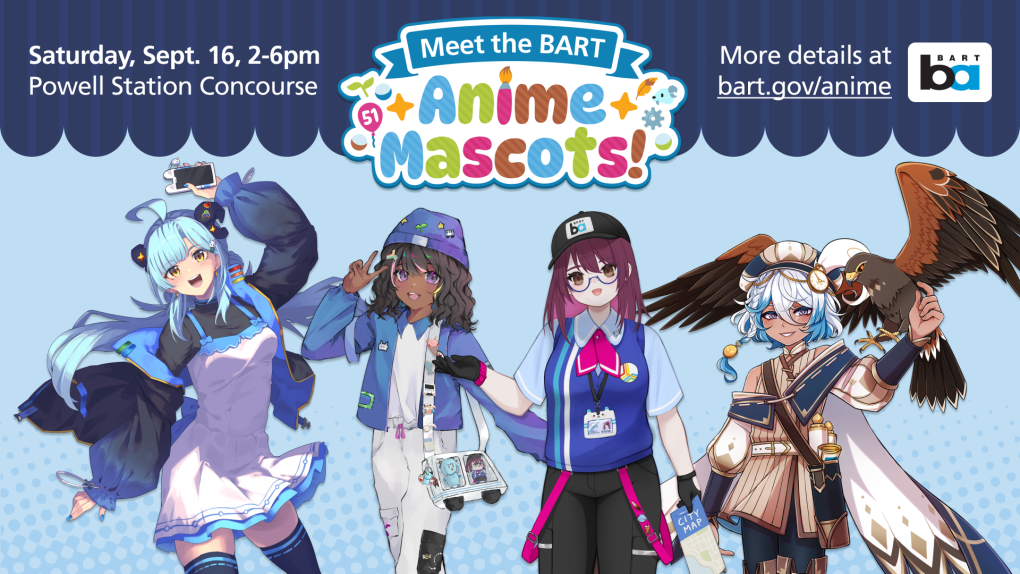
Join BART as our new Anime Mascots overtake Powell St. Station for Transit Month and BART’s 51st anniversary. Take photos with the mascots, make buttons with staff, grab a prize from the BART capsule ball machine, and meet cosplayers! Come in cosplay and get a rare BART anime charm.
The Link21 outreach team will also be there to talk about our project to build a second train crossing connecting Oakland and San Francisco.
When: Saturday, September 16, 2pm-6pm
Where: Powell Street Station in the free area on the concourse level between BART secondary Station Agent booth and Muni agent booth (4th and Market entrance/exit)
Learn more about BART's Anime Mascots at bart.gov/anime.