
Search Results
Take BART to Oakland Museum's 15th Annual Dias de los Muertos Celebration
Dancing skeletons and sugar skulls return as the Oakland Museum of California hosts its 15th annual Días de los Muertos celebration. The exhibition opens Wednesday, October 8, continuing through December 7. Guest curator Fernando Hernández titled the exhibition "Evolution of a Sacred Space: Días de los
Join BART's General Manager on a ride-along and happy hour with Transit CEOs on 9/29/23
In celebration of Transit Month 2023, the Bay Area transit agencies and the Metropolitan Transportation Commission (MTC) are hosting a third “All Aboard with Transit CEOs,” a ride-along and social event giving the public a chance to ride with and meet regional transit leaders. The event is also an opportunity for transit leaders to call for on-going financial support for transit operations and to showcase the coordination happening among agencies to improve the rider experience in the Bay Area.
The event is Friday, September 29, 2023, starting at 5pm at the Palo Alto Caltrain Station/Transit Center. The Palo Alto Transit Center is an intermodal transit center served by Caltrain, SamTrans, VTA, Dumbarton Express, the Stanford University Marguerite Shuttle and several local shuttle services.
Trip details:
Before 5pm: The public and Transit CEOs will come from different transit systems, connecting with the public along their route to the Palo Alto Caltrain Station/Transit Center.
5pm: The public and Transit CEOs meet at the Palo Alto Transit Center (Caltrain Northbound Platform to San Francisco) for photos and mingling.
5:19pm – Everyone boards Caltrain #709 for an onboard Happy Hour (BYOB)
5:44pm – Train arrives at Millbrae Transit Center (100 California Drive, Millbrae)
6:03pm – The Ride-a-long ends as the train arrives at San Francisco Caltrain Station (700 4th Street, San Francisco)
Members of the public and the media are invited to ride for the full or partial journey. This event is a great opportunity for the public to chat with CEOs about transit service and transit career opportunities. Follow on social media for real time updates of the CEOs journey.
Participating CEOs include: SamTrans (April Chan), Caltrain (Michelle Bouchard), VTA (Carolyn Gonot), MUNI (Jeff Tumlin), BART (Bob Powers), WETA/SF Bay Ferry (Seamus Murphy), County Connection (Bill Churchill), and LAVTA/Wheels (Christy Wegener).
The CEOs will be taking transit to the Palo Alto Caltrain Station and posting on social media using the #TransitMonth hash tag. Several CEOs will announce their routes to get to Palo Alto Transit Center if you want to join them on the journey.
BART General Manager Bob Powers will take BART's Red Line to Millbrae leaving 19th Street Station at 2:57pm and transfer to Caltrain at 4:02pm
SamTrans CEO April Chan will ride ECR leaving San Carlos Ave / El Camino Street at 4pm
Caltrain Executive Director Michelle Bouchard will ride Caltrain #410 leaving San Carlos Station at 4:48pm
VTA CEO Carolyn Gonot will ride the VTA Blue Line from River Oaks Station leaving at 3:45, changing trains at Baypointe to the 4 pm Orange Line to Mountain View. Then Caltrain #309 departing Mountain View at 4:40 pm
BART Lines: 826 Valencia brings poems and stories by youth to train ad spaces and short story dispensers

Just in time for National Poetry Month, BART has unveiled BART Lines: 826 Valencia, a partnership between the agency and local literary nonprofit that brings a selection of BART-themed 826 Valencia student poems and short stories to BART’s five Short Story Dispensers (locations below) and online at bart.short-edition.com.
Four pieces are also being featured in advertising spaces on BART train cars to bring joy and wonder to customers’ rides.
More than 100 students ranging in age from 9 to 18 participated in the project, which was developed by 826 Valencia and centers BART as both inspiration and subject.
The resulting poems and short stories capture young writers’ perspectives on transit, community, and everyday Bay Area life. BART previously partnered with 826 Valencia for the BART Lines: Teen Poetry Contest in 2024.
For many students, this will be the first time their work is formally published outside of 826 Valencia.
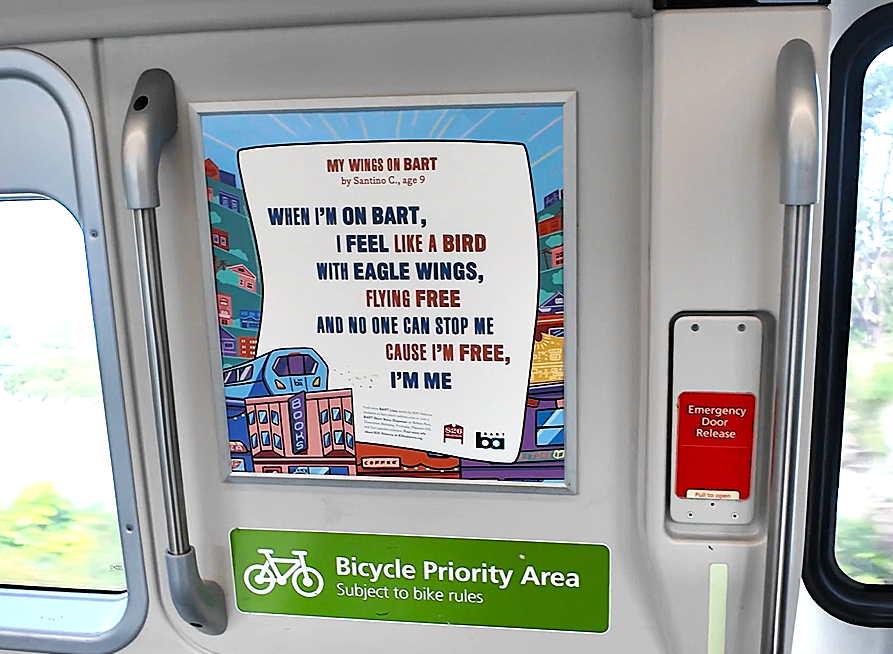
BART's free Short Story Dispensers are located at the following stations:
Balboa Park
Downtown Berkeley
Fruitvale
Pleasant Hill
San Leandro (new!)
To read a BART Lines: 826 Valencia work, simply wave your hand over the 5-minute (or “Local Authors”) button, and a story will be dispensed on eco-friendly, recyclable paper.
To increase accessibility to literary works for all riders, BART’s Short Story Dispensers will soon offer free audio stories, allowing riders to listen on their phones by scanning a QR code on the machine.
The collaboration with 826 Valencia builds on BART’s history of celebrating creativity in transit spaces. In recent years, the agency has hosted writing and poetry contests, featured rider-submitted work in stations and online, and used arts programming to make stations more welcoming and community-centered.
“The notion of mixing poetry and other literary forms with transit is not new. New York, London, Paris, Los Angeles, to name a few, all have programs. What makes the BART program so engaging is our commitment to featuring local writers – especially our youth writers,” said BART Art Program Manager Jennifer Easton, whose department launched the dispensers in collaboration with BART Communications. “We love sharing their creativity with our riders, and giving their voices a platform on our Short Edition story dispensers and website is particularly meaningful – and particularly Bay Area.”
“At 826 Valencia, we believe our students write a better future for all of us,” said Bita Nazarian, Executive Director of 826 Valencia. “Through this partnership with BART, we’re celebrating the creativity and insight of our future leaders as they reflect on what it means to move through the Bay Area. Their stories transform everyday commutes into moments of connection, wonder, and belonging.
“Bringing the voices of local youth into our stations and trains through their own words is a powerful way to activate public space and connect riders to the Bay Area’s rich stories,” said Michelle Robertson, Principal Marketing Representative with BART Communications. “The creativity and insight students brought to the 826 Valencia curriculum — with BART as their muse — reminds us that transit is more than movement; it’s context for community, connection, and imagination.”
Since its first day of service, BART has viewed its stations and trains as shared civic spaces. Arts and literary programs help transform wait times into meaningful moments, highlight local talent, and create a more welcoming, human-centered environment for riders. By supporting community voices, especially young riders, BART aims to strengthen connection, creativity, and a sense of belonging across the spectrum of communities the system serves.
About 826 Valencia
826 Valencia is a San Francisco–based nonprofit organization dedicated to supporting under-resourced students ages six to eighteen with their creative and expository writing skills and to helping teachers inspire their students to write. They have three writing centers in San Francisco: in the Mission, Tenderloin, and Mission Bay. Learn more at 826valencia.org.
BART avoids service cuts for one more year with balanced budget while facing historic deficits without new revenue
The BART Board of Directors voted to adopt a balanced budget for FY26, protecting safe, clean, and frequent service for one more year before facing a fiscal cliff in FY27 that could have dire and widespread impacts on the Bay Area's greater transportation network. The BART board continued its strategy of avoiding service cuts by using the remaining $318 million of state and regional emergency funds to help pay for the cost of running train service, while supporting deficit-reducing, cost-cutting measures, such as a strategic hiring freeze and running shorter trains. A planned 6.2% fare increase, expected to go into effect January 1, 2026, also helps close a projected $35 million deficit.
The FY26 budget is also supported by a fiscal year-over-year 4% increase in paid trips thanks to new fare gates, new fare programs, such as Clipper BayPass offering employer-paid unlimited transit passes, attracting more riders with a cleaner, safer ride, and schedule coordination with connecting transit agencies.
BART’s overall expenses grew by less than 1% in FY26, demonstrating that cost controls and targeted cuts to non-labor expenses are holding costs down, as well as the effectiveness of BART’s disciplined approach to belt tightening and prudent fiscal management. No new positions were added to the budget and dozens were frozen in a strategic hiring freeze.
“Our riders are noticing the improvements we have made to the overall BART experience, resulting in the highest satisfaction rates in ten years,” said BART Board President Mark Foley. “We made strategic decisions in this budget to show the Bay Area we must be part of the solution in reducing costs, but also ensuring we have frequent, clean, and safe service at this critical moment when traffic congestion is increasing and people are returning to the office and wanting to take car-free trips on nights and weekends as well.”
Operating budget prioritizes Safe and Clean Plan
BART’s $1.2 billion operating budget will continue to fund the current service plan with no planned cuts to service this fiscal year. In August, small adjustments will be made to BART’s schedule in coordination with other transit systems to improve timed transfers with Caltrain at Millbrae Station and to improve transfers with Wheels Bus service at Dublin Station. Improvements to the BART to Antioch transfer are also planned.
While the FY26 operating budget includes $35 million in reductions and cost controls, these cuts will not impact BART’s ability to provide clean and safe service or impact BART’s efforts to have an increased safety presence on trains and inside stations.
Capital budget prioritizes reliability improvements and modernization efforts
BART’s $1.1 billion capital budget prioritizes funding Fleet of the Future rail cars, BART’s project to upgrade its aged train control system to a modern Communications Based Train Control System, new traction power equipment which will improve reliability, new escalators, a new BART Police headquarters, and other rebuilding efforts. 98% of the capital investments are allocated to system reinvestment and service and capacity enhancements that will allow us to continue to serve as the backbone of the region’s transportation system. These projects are funded by voter-approved Measure RR and other local, regional, state, and federal grant sources, in addition to allocations from BART’s operating budget to help pay for these essential projects.
Fiscal cliff is rapidly approaching
The FY27 preliminary budget, which includes no emergency assistance, shows a $376 million deficit due to BART’s outdated funding model and the fact the Bay Area has embraced remote work at higher rates compared to the rest of the country. The BART Board has voted to support SB 63 (Wiener/Arreguin), also known as the Connect Bay Area Act, which would authorize a regional transportation funding measure on the November 2026 ballot to enact a sales tax in Alameda, Contra Costa, and San Francisco counties, with an option for San Mateo and Santa Clara counties to opt in. Funds from the measure would support transit agency operations and rider-focused transit coordination improvements.
BART is also advocating for state budget funding to prevent service cuts in FY27 as well as requesting that BART’s current funding allocations from state programs continue to be honored in the coming state budget, which is under development now.
BART holiday sweaters are here! Order on Railgoods.com or purchase in-person at stations and SweaterFest 2025
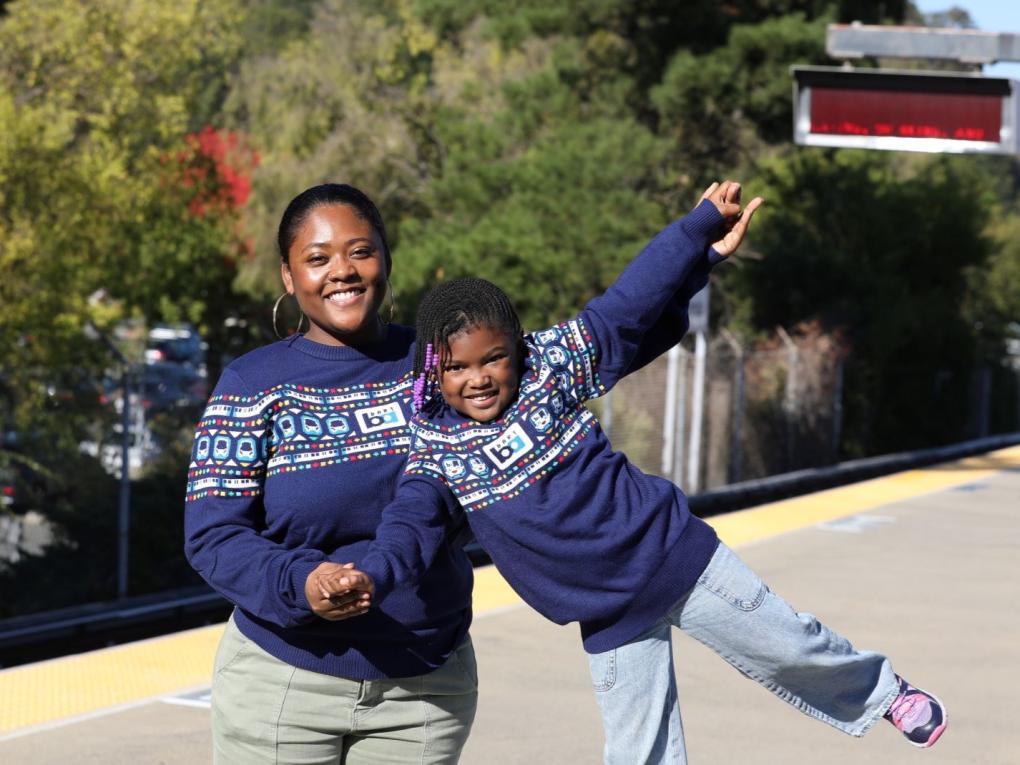
The temperature is dropping and gray skies are rolling in. You know what that means – it's time to buy your 2025 BART holiday sweater! Stay cozy, rep the Bay, and support BART at the same time.
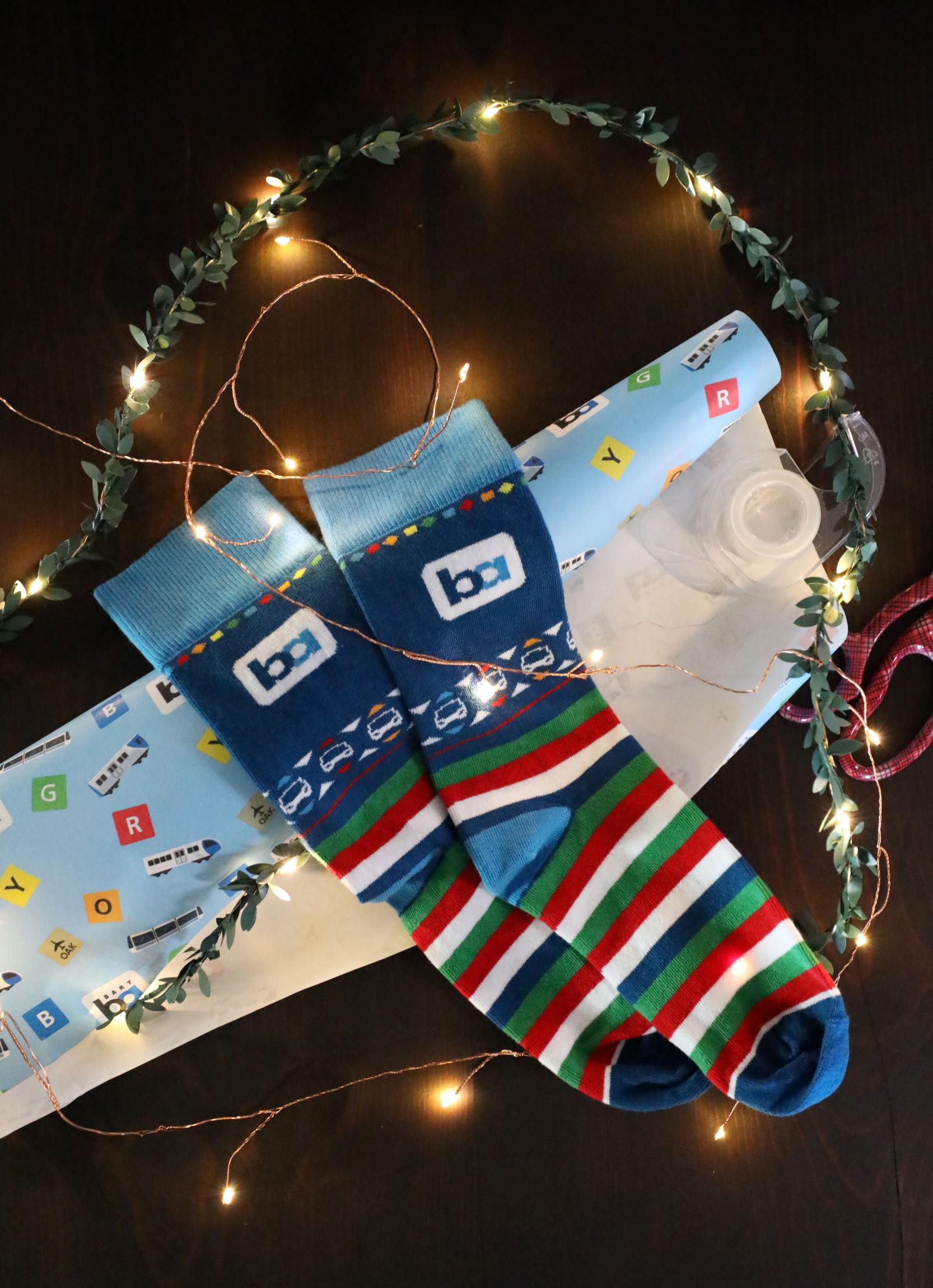
BART holiday sweaters, beanies, and just-released holiday socks are now available for purchase on Railgoods.com, as well as in person at BART’s Customer Services Center in Lake Merritt Station, at station pop-ups (see below for dates and locations), and during SweaterFest on Dec. 13.
At checkout on Railgoods, you will have the option to select shipping or pickup at the Customer Services Center. Orders will be ready for pickup at Lake Merritt and begin shipping the week of Nov. 3.
In addition to the new adult sweater and beanie, BART is selling a special sweater for youth featuring BARTy. Red and green sweaters were available only during the presale – if you missed ‘em, you missed ‘em, but you can still get a sweater in beautiful BART blue.
Planning to gift BART merch to the transit lover in your life? Railgoods.com just unveiled wrapping paper that features a Fleet of the Future D car, the BART to Antioch Diesel Multiple Unit (DMU) car, and a BART to OAK car. If you know, you know.
Sizes + Pricing
Adult Sweater – $49.99, S - 4XL
Youth Sweater - $34.99, S (6/8), M (10/12), L (14/16), XL (18/20)
Beanie – $15.99, one size
Railgoods Station Pop-Ups
Wednesday, Nov. 5, 3pm to 6pm, Downtown Berkeley Station
Wednesday, Nov. 12, 3pm to 6pm, Fremont Station
Wednesday, Dec. 3, 3pm to 6pm, Walnut Creek Station
Wednesday, Dec. 10, 3pm to 6pm, Dublin/Pleasanton Station
Wednesday, Dec. 17, 3pm to 6pm, Embarcadero Station
Preorder your holiday merchandise this summer?
If you preordered BART holiday merch over the summer, check your email for a notification that your sweater is being shipped or is ready for pickup in-person at the Customer Services Center at Lake Merritt Station (depending which option you selected at checkout).
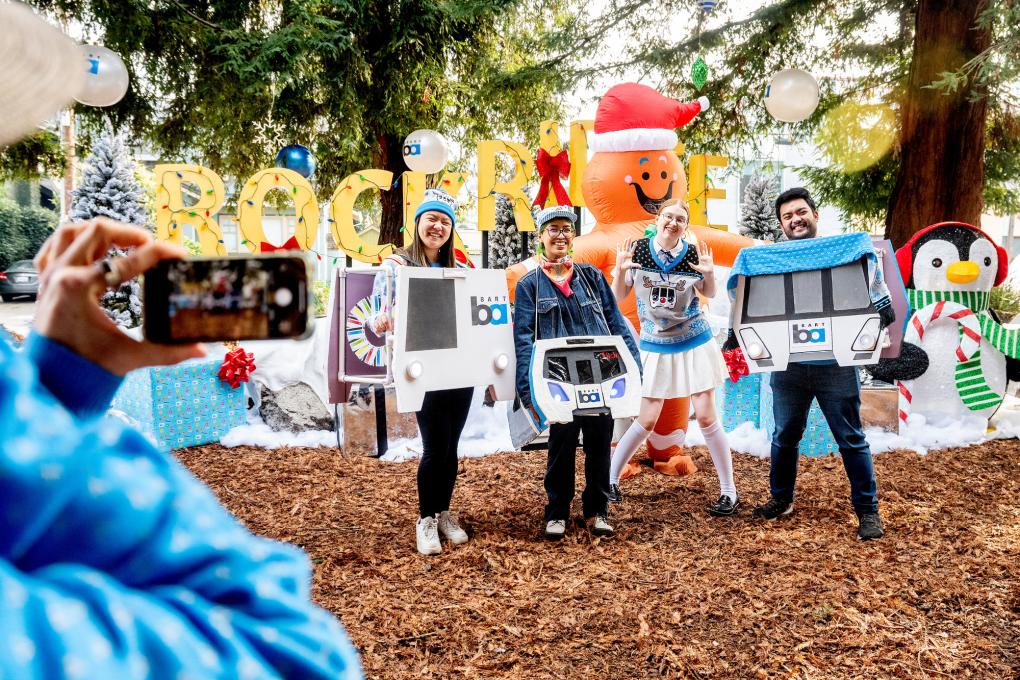
SweaterFest 2025 – Saturday, Dec. 13, Rockridge Station
SweaterFest returns!
For the third year, BART will bring holiday cheer – and lots of merch and activities – to Rockridge Station Plaza for a celebration of the season and the public transit that takes us to our favorite seasonal activities.
At SweaterFest, we encourage the Bay Area to wear a BART holiday sweater and take a group photo. Wear this year’s sweater – you'll be able to purchase one at the event – or rock a sweater from prior years. Bonus points to anyone who shows up in the first BART holiday sweater.
What to expect: Railgoods pop-up shop, live music, transit-themed crafts and other family friendly activities, snacks, photo opps, and more.
If you've been collecting stamps for your BART Stamp Passport, bring it to the event to get the new SweaterFest stamp.
A dream come true for a railroad history museum: The first of 3 legacy BART cars delivered to Western Railway Museum
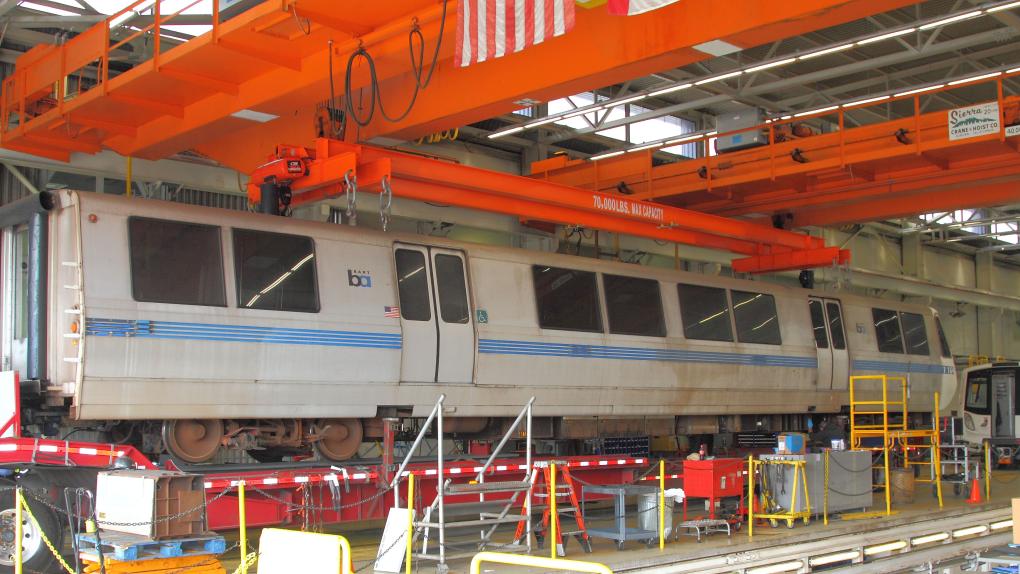
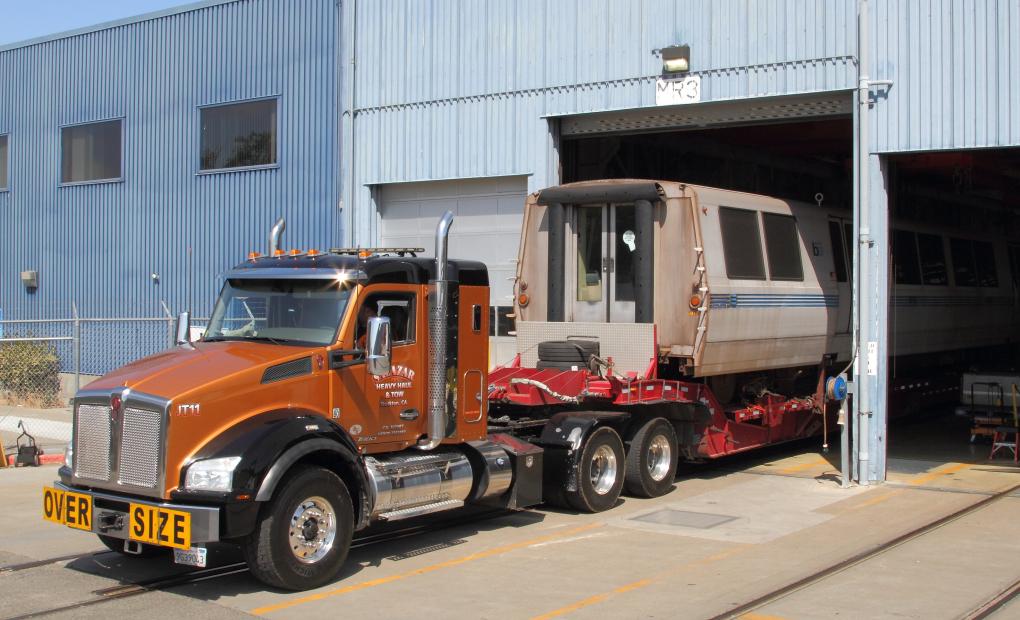
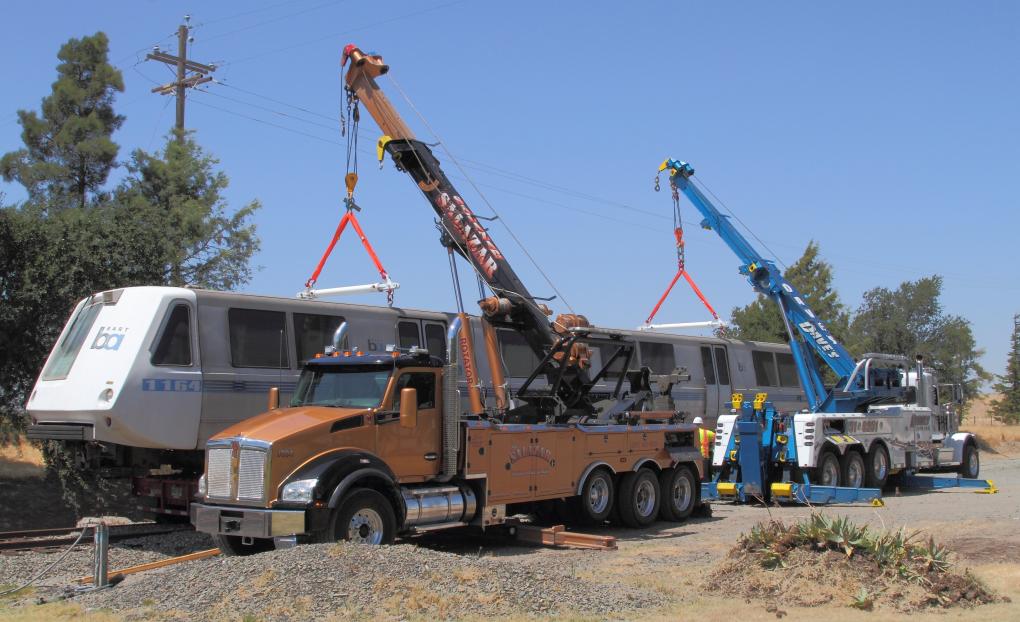
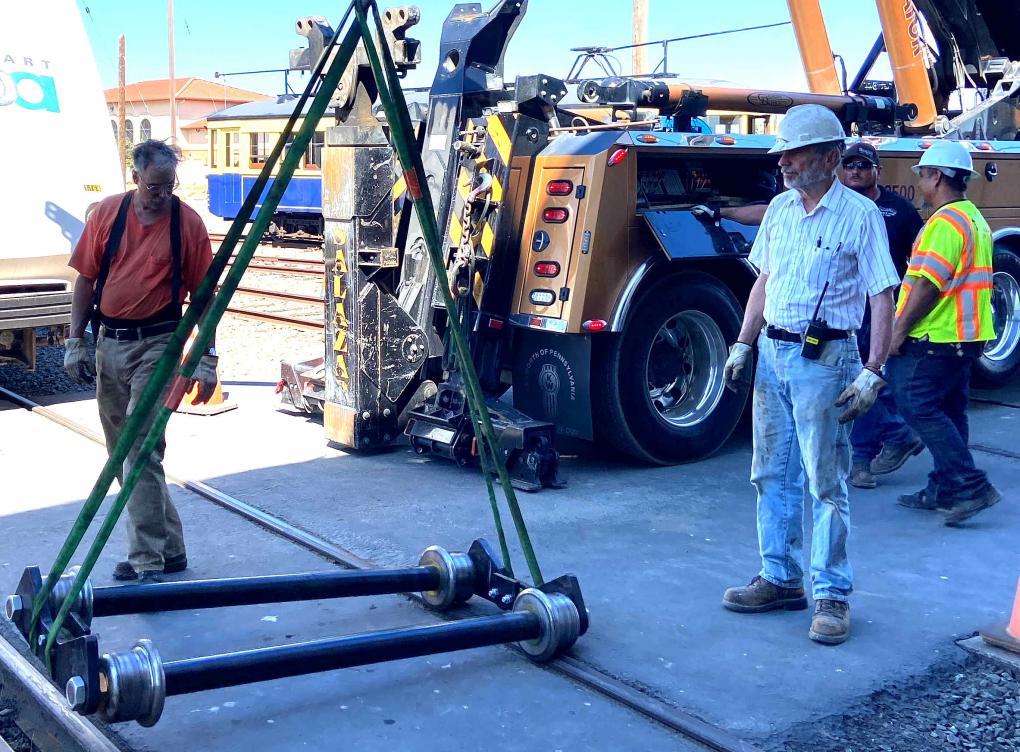
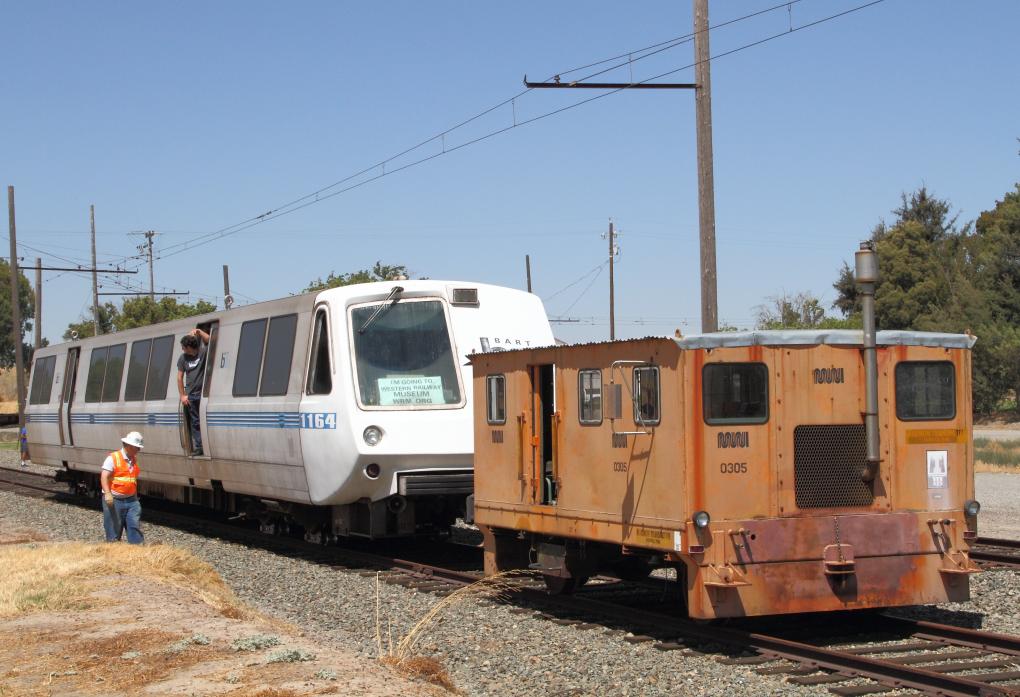
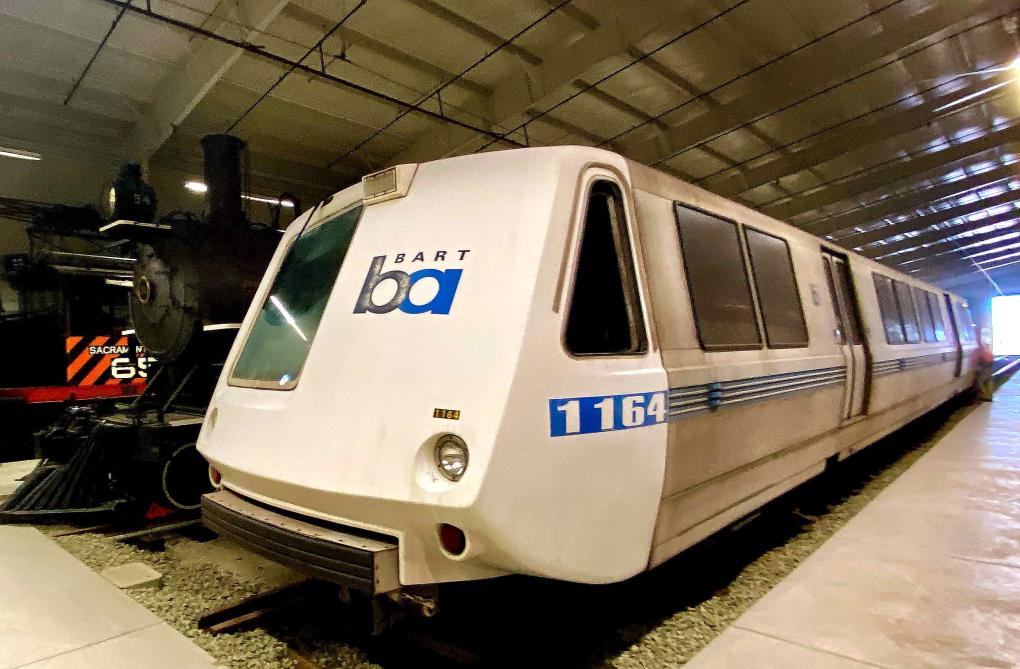
Friday, August 9, was a thrilling and long-awaited day for the Western Railway Museum (WRM) as the railroad history museum received the first of three decommissioned legacy BART cars for its forthcoming Rapid Transit History Center.
The museum was awarded the three retired cars – an A, B, and C car – following a call for proposals in 2021 that selected eight recipients to receive decommissioned cars (two recipients later declined). BART officially retired its legacy fleet, which carried passengers for more than 50 years since the opening of the system, at a ceremony and final ride in April 2024. All 55 trains in service are now made up of new cars.
BART’s legacy cars have a tremendous sentimental value with passengers in the greater San Francisco Bay Area, and we wanted to ensure the historic vehicles would have a second life, or more accurately, second lives. The chosen six groups will reuse their cars for a multitude of purposes, including a short-term rental in the Sierras, a bike shop and clubhouse for Oakland youth, a dining car with retro arcade games, and more. The Hayward Fire Department picked up their car earlier this year for its new Regional Fire Training Center.
There was one major catch the recipients had to agree to: BART would give the cars to the groups for free, but they had to transport the cars from their temporary home at BART’s Hayward shops to their final destinations.
As you can imagine, moving a 64,000-pound BART car is not something that can be accomplished with your average trailer hitch. It requires a flatbed truck with a yellow “OVERSIZE” banner as well as a crane for getting the car off the bed. Moving just one car costs thousands of dollars.
The Western Railway Museum raised money to make sure they could get the cars to their new temporary home in Car House 3 until their proposed Rapid Transit History Center is completed. The history center will educate the public about BART and its history of innovation. In addition to the three cars, which the public will be able to enter and explore, the center will include displays, videos, a set of wheels from the front of a cab car, third rail equipment, and the antennas that enable the train to pick up power and communicate with train control. In all, the history center will celebrate the "amazing technology of the 'world's first' automated rapid transit system," said Bob Simon, a retired BART Engineering and Operations Manager who sits on the Western Railway Museum's board of directors.
"The creation and implementation of cutting-edge technologies began with BART's visionaires understanding the great challenge to design a new transit concept. They were not unlike the visionaries who went on to build Silicon Valley," he continued, offering his thanks for the support and enthusiasm of BART General Manager Bob Powers, the BART Board of Directors, and the museum's dedicated volunteers and staff.
So what does it take to move a BART car? Western Railway Museum staff found out firsthand on August 9 when they showed up to the Hayward shops with a flatbed truck and helping hands. BART employees prepared for their visit by transferring the car – #1164 – from its holding track (where the soon-to-be-decommissioned legacy cars are held) to the shop bay with a crane.
When the truck arrived from Salazar Heavy Haul – the same company that delivered BART’s Fleet of the Future cars – BART staff hooked the car up to the crane and attempted to load it on the bed. There was an unforeseen problem: The undercar equipment was just a few inches too big for the truck bed, so BART staff had to improvise by removing the battery box and HVAC underneath it. Most decommissioned cars won’t have this problem as they’ll be picked up with the wheels and mounts removed. That wouldn’t do for Western Railway Museum, however.
“They want everything on the cars so they are as authentic as possible,” explained Brian Tsukamoto, BART Manager of Special Projects – Decommissioning. “They’ll be coming back to pick up the battery box and HVAC.”
Once the temporarily modified car was loaded and secured by the highly skilled driver, it was on its way from Hayward to Suisun City up north. A sign in its front window read: “I’m going to the Western Railway Museum.”
At the museum, the team unloaded the car from the truck using a rented crane and used conversion dollies to allow the car, built for BART’s wide gauge, to be maneuvered on their standard-gauge track. Then, using a former Muni work train locomotive, they zig-zagged the car to Car House 3 and unloaded it onto the BART gauge track they built for it. To save on cutting concrete and rebar, a steel rail strap bridge was fabricated to get the car over the car house door foundation and the public walkway to its platform.
The process will soon be repeated with the B and C cars, which the museum is working to schedule with BART staff and Salazar Heavy Haul. We’ll be sharing updates.
Learn more about the Western History Museum here and the Legacy Fleet Decommissioning project here.
BART to run Sunday schedule for Fourth of July and offers tips for those attending SF's fireworks show
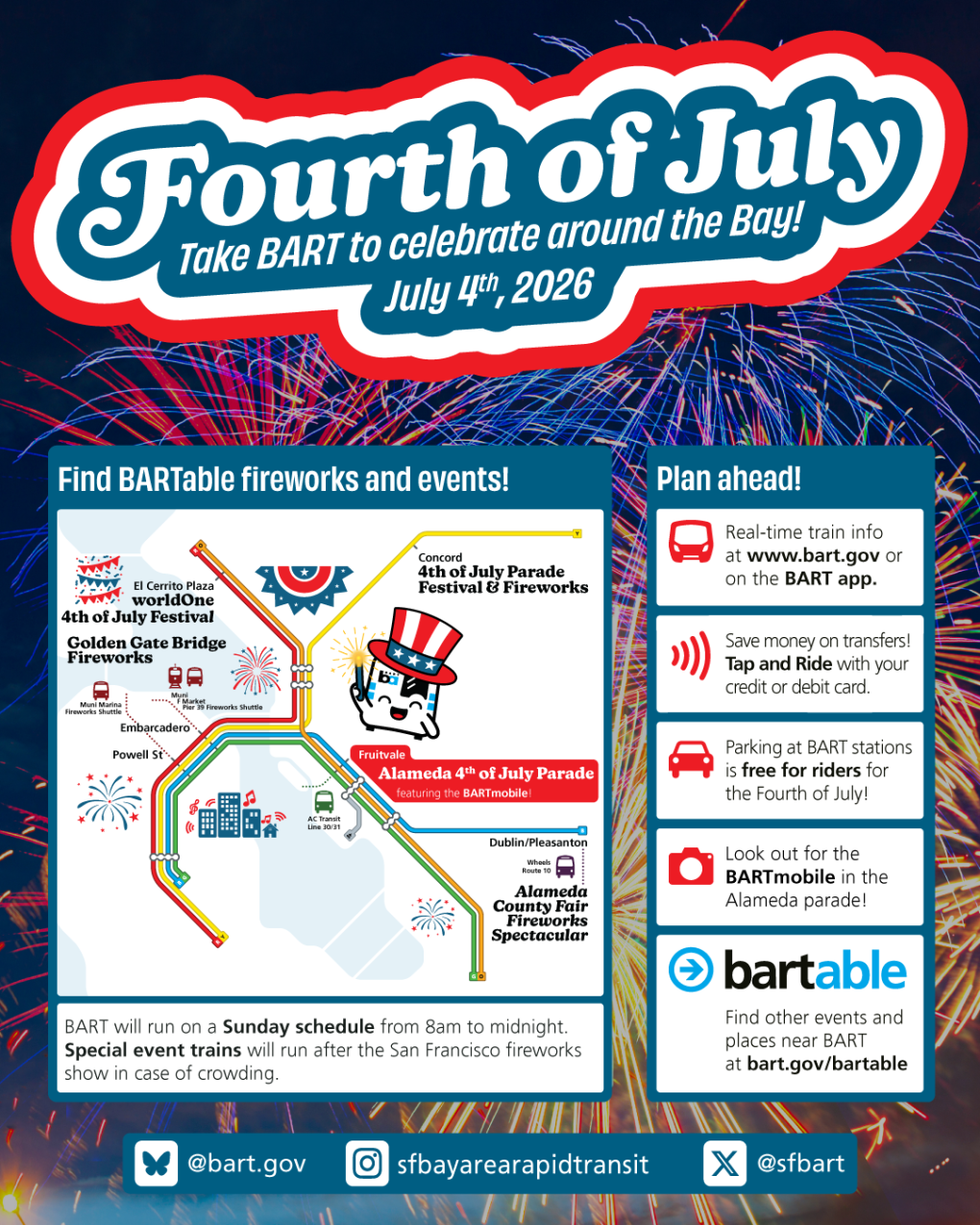
For Fourth of July on Saturday, July 4, BART will be running a Sunday schedule (8am-midnight). We will run 5-line service until 8pm and then 3-line service after 8pm.
5-line service means all lines will be running, including the Green and Red lines, which provide direct service into San Francisco.
Extra trains may be added in case of crowding after fireworks in San Francisco. The fireworks show in San Francisco will be from the Golden Gate Bridge beginning at 9:30pm. The best viewing spots are at Crissy Field, Marina Green, and Pier 39.
Muni is providing a Marina Fireworks Shuttle from Powell Street BART Station and a Pier 39 Embarcadero Fireworks Shuttle from the Embarcadero BART Station. Muni's F-Line also serves Embarcadero to Pier 39. See Muni's webpage with information. People looking to take BART home, should immediately return to BART to catch the last trains of the evening. The Muni shuttle service could take up to 60 minutes to connect to a BART Station.
The last train to run through downtown San Francisco stations towards the East Bay (with connections to all stations) is at around 12:25am. The last train to run through downtown San Francisco stations towards Daly City/Millbrae is at around 1:10am (this train does not stop at SFO Station). The last train to run through downtown San Francisco that will stop at SFO Station is at around 12:40am.
Planning and paying for your trip
Plan your door-to-door trip using BART’s Trip Planner. Itineraries will include key transfer information. You can also check Real Time Departures for the stations you use.
Parking at BART stations (except Milpitas and Berryessa stations) is free on weekends.
Every BART station has restrooms except Pittsburg Center, 12th St./Oakland City Center, Civic Center, 16th St. Mission, 24th St. Mission, and the Oakland International Airport Station (Coliseum Station has a restroom).
All Bay Area transit, including BART, accepts contactless debit or credit cards and mobile payment methods such as Apple Pay and Google Pay for adult fare payment. No setup is required. Just Tap and Ride. Each person needs their own card or device. Clipper cards are also accepted.
Riders who use more than one transit agency in a single trip (e.g., BART to VTA) will only be charged full fare on the first operator. A transfer discount of up to $2.85 will apply on any additional transit agency the rider uses within a two-hour window. Transfer discounts are calculated automatically using Tap and Ride or Clipper for accounts that have been upgraded to the next generation system (click here to upgrade your card).
BART Resources
Real Time Departures from each station
Tap and Ride contactless payment
Text BART Police to report concerns at 510-200-0992
BART launches pilot of Aira video interpreter service to help blind and low vision riders navigate the system
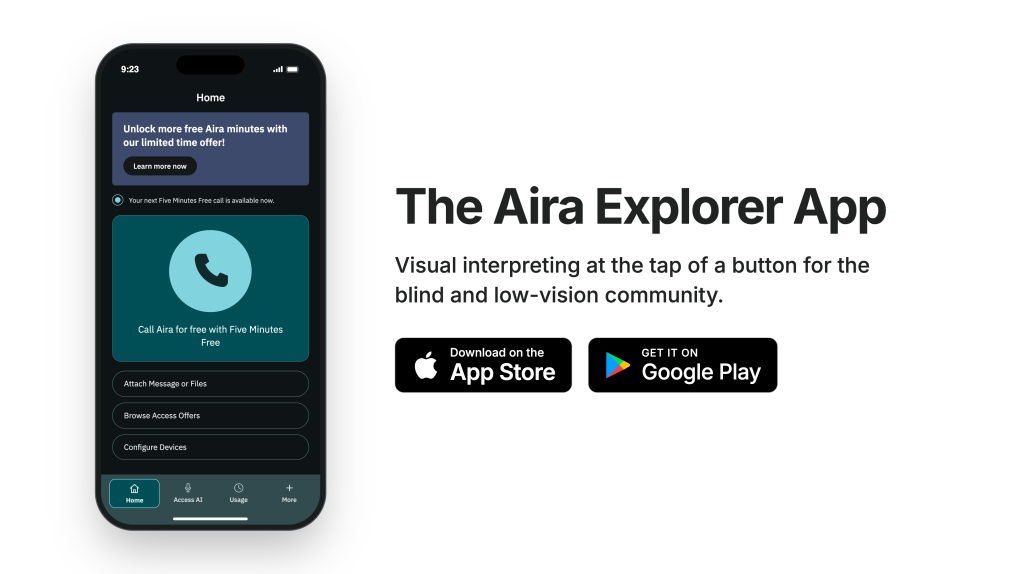
New smartphone app connects riders with live visual interpreters, free of charge, from October 6 through January 3
BART is launching a pilot program to test Aira, a video interpreter service designed to help blind and low vision customers navigate to, from, and through the BART system. The pilot begins Tuesday, October 6, and runs through Sunday, January 3.
Aira connects users with live, professionally trained visual interpreters through a video call on a free smartphone app called Aira Explorer. Using the camera on a rider's phone, interpreters can describe surroundings, read signs and text, and help with tasks such as finding a station entrance, locating fare gates and ticket vending machines, identifying the correct platform, and boarding the right train.
"Blind and low vision riders have told us that navigating to and through our stations can be a real challenge, especially finding fare gates and other key features," said Ryan Greene-Roesel, Director of BART Customer Access and Accessibility. "This pilot gives us a chance to test whether a live, on-demand interpreter can make those everyday trips easier."
How the pilot works
Aira interpreters will receive basic training on the BART system and will have access to BART's website and mobile app to help answer rider questions. Normally, Aira charges users by the minute, but during the pilot period, the cost of any call related to a BART trip — from a rider's front door all the way to their destination – will be covered. Riders do not need to be inside a BART station to use the service, and it can be used anywhere in the BART system.
To get started:
- Download the free Aira Explorer app from the Apple App Store or Google Play.
- Open the app and create an account. You will need to give the App permission to use your phone camera, microphone, and GPS location so the interpreter can assist you.
- In the app, on the home screen, tap Browse Access Offers, and then in the search bar at the top of the next screen, type in BART. The offer is then applied to your next call.
- When you’re ready to place the call, open the app and tap “Call an AIRA agent” to connect. You will reach a live visual interpreter in ten to fifteen seconds.
- Let the interpreter know you are making a BART-related trip, point your camera at what you need information on, and the visual interpreter will assist you.
The service is available 24 hours a day, seven days a week throughout the pilot. Aira works best where a cell signal or Wi-Fi connection is available. BART riders can access free Wi-Fi at SFO, West Oakland, 16th St./Mission, 24th St./Mission, Glen Park, Balboa Park, Embarcadero, Civic Center, and Powell St. stations, with more stations coming soon.
Feedback and evaluation
Throughout the pilot, BART will gather feedback from users and review usage data to evaluate how riders are using the service, what they find most helpful, and whether BART should seek funding to offer this type of service in the future.
Support
For questions or comments about the pilot project overall, contact BART Customer Services.
For support with the Aira app, reach Aira support any time from the Aira Explorer menu, email [email protected] or call Aira Customer Care at 1-800-834-1935.
This pilot is funded with a grant from the Federal Transit Administration.