Search Results
BART invites the public to “ride into history” at a legacy car retirement ceremony and final ride on 4/20/24
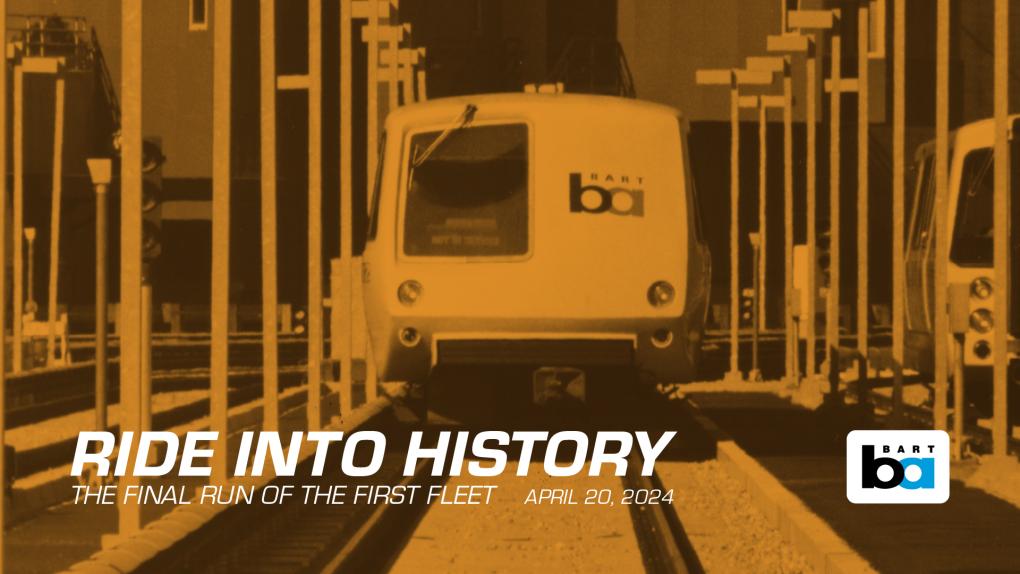
BART invites the public to join us to mark and celebrate the end of an era: the last run of BART’s legacy trains composed of rail cars that have been serving the Bay Area for more than half a century. We’re calling the event “Riding into History: Final Run of the First Fleet.”
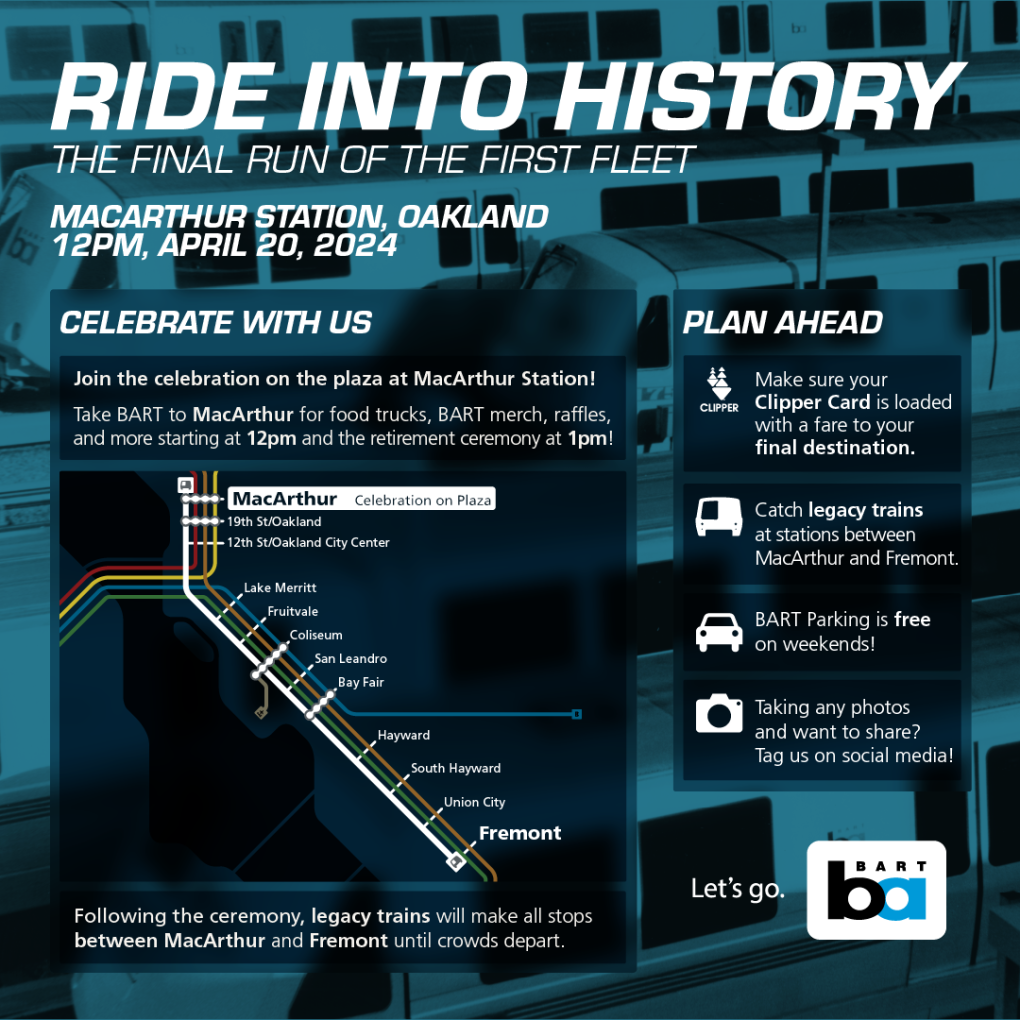
The retirement ceremony will begin at 1pm on Saturday, April 20, 2024 at Oakland’s MacArthur Station with the and final dispatch of legacy trains happening after the speeches.
We recommend arriving around noon to enjoy the food trucks and activities we have planned.
The ceremony will take place in the plaza (free area) of the MacArthur station and will include food trucks (bayareamunchiez.com and noodle-cone.com), activity tables, a raffle for legacy car number plates, a pop-up merch store, and a stamp rally. Bring your stamp rally passport if you have one. Many of the groups who are repurposing old BART cars for new uses will be in attendance to share information about their projects.
Following the ceremony, the public will line up in the plaza and then board a legacy train and ride from MacArthur to Fremont Station, mirroring the initial service BART provided when it opened September 11, 1972. It’s a 45-minute trip that travels along approximately 24 miles of the original section of tracks. There will be more than one legacy train for the event. The trains will make all station stops and may turn around at Bay Fair depending on the number of attendees waiting to ride.
Every rider will need to pay for the ride with their Clipper card. The fare depends on where each rider is going after the ride.
“These train cars are part of the history of the Bay Area,” said Bob Powers, BART General Manager. “While we are excited to modernize the system, we recognize the profound cultural importance of these cars, and we want to celebrate their rich history and give them a proper send off.”
BART is able to completely retire the legacy fleet thanks to the success of the Fleet of the Future project. Seven hundred six new Fleet of the Future train cars are now certified for service – that’s 30 more cars than the legacy fleet inventory. A total of 720 new cars are on BART property as of April 1, 2024, and twenty cars a month are now being delivered to BART – twice as many as when the new cars first began to be delivered to the Hayward test track in 2016.
While the April 20 trip will be the final time the public will be able to ride the legacy fleet cars, it won’t be the last opportunity to spend time with the historic vehicles.
Three legacy cars will be headed to the Western Railway Museum in Suisun City for preservation and to provide a space for transit enthusiasts, researchers, and museum guests to enjoy and study for years to come. The three cars, including an iconic sloped-front A car, will be the only cars from the legacy fleet to be displayed at a museum.
A handful of other legacy cars will be transferred to those who successfully submitted proposals to repurpose the cars for short-term rentals, entertainment venues, and training facilities.
Most of the legacy cars, however, have been recycled, so April 20 is the last chance to ride these historic cars.
BART is turning unused parking into a new source of revenue by renting spots out to local businesses with new online tool
BART has generated $6 million in new revenue since the pandemic by leasing its underutilized parking lots to companies looking to rent parking spaces for daytime use. BART began offering select parking lots to non-BART riders to generate new revenue to help address its FY27 $376M operating budget deficit brought on by remote work. To streamline the process and attract more business, BART recently launched a new online portal for those looking to rent at least 25 spaces for six months or more. Interest to date has come from local businesses looking for employee and fleet vehicle parking.
BART is leasing portions of its parking lots at all stations offering parking except for the six stations which fill up with BART parkers on weekdays (Glen Park, MacArthur, Orinda, Rockridge, Walnut Creek, and West Oakland). Restrictions to this new program include, but are not limited to, long-term parking storage, nearby residence parking, or conducting any kinds of commercial activity such as car rentals. Limited exceptions can be made related to these restrictions for those who accept all maintenance and operations responsibilities for the permitted areas.
BART also offers special event permits to allow others to use parking lots or plazas for community events at a rate of about $2,000 per day in addition to operational costs. Some events that have recently taken place include the 2025 Bizerkeley Food Fest at North Berkeley BART Station parking lot, as well as The Wardrobe Project (a Vintage & Makers Market) at Rockridge Station on the third Saturday of the month.
“BART is looking to generate new revenue in creative ways,” said Chief Communications Officer Alicia Trost. “While demand at some of our lots exceed supply on weekdays, many of them have capacity we can offer to others to generate new revenue. Our parking lots are also a great venue to hold outdoor events on the weekends, offering easy access to transit and parking spaces.”
Long term, BART has active Transit-Oriented Development projects to build housing on BART’s parking lots and land to increase both ridership and lease revenue. Projects in the planning or development phase include Ashby, El Cerrito Plaza, Fremont, Lake Merritt, North Berkeley, Richmond Transit Village, Walnut Creek, West Dublin and West Oakland.
During the height of the pandemic, BART reimagined its parking lots as COVID testing sites, farmers markets, vaccination sites, and even rented parts of the Castro Valley Station parking lot to display model accessory dwelling units, or ADUs, which interested parties could tour ahead of purchasing a home.
BART has also hosted sold-out events in its parking lots to increase ridership. Last year the Concord BART Station was transformed into an outdoor movie night and the BART Sound Tracks Jazz Festival was held at the North Berkeley Station complete with BART themed mocktails.
BART continues to explore revenue generating ideas utilizing our existing resources.
Holiday schedule: BART will run Sunday service (8am-midnight) on Christmas Day and extended service on NYE (5am-1am)
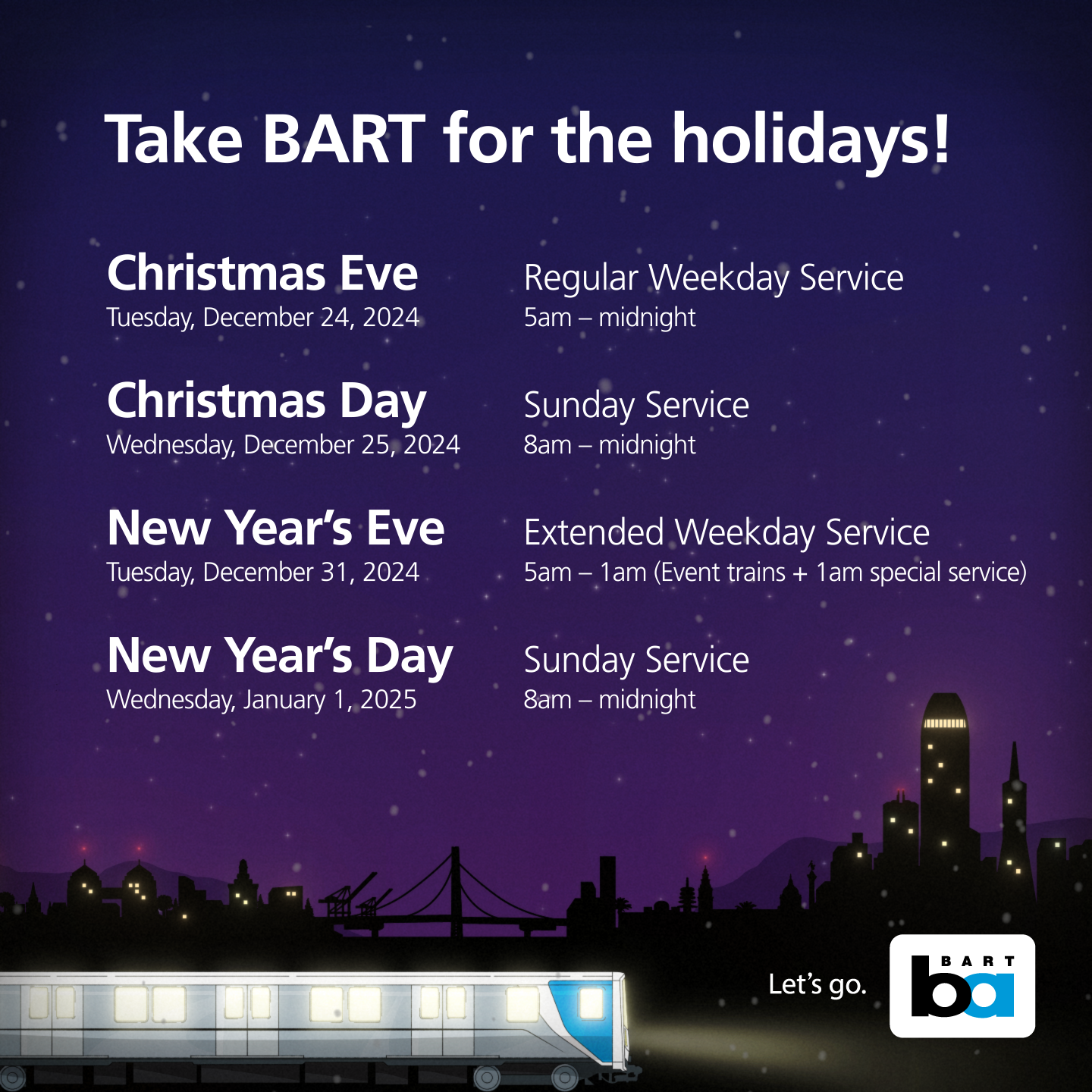
BART will be running special service on Christmas Day, New Year's Eve, and New Year's Day. Plan your trip using BART's Trip Planner.
Holiday Schedule
Christmas Eve, Tuesday, December 24: Regular weekday service (5am-midnight)
Christmas Day, Wednesday, December 25: Sunday service (8am-midnight)
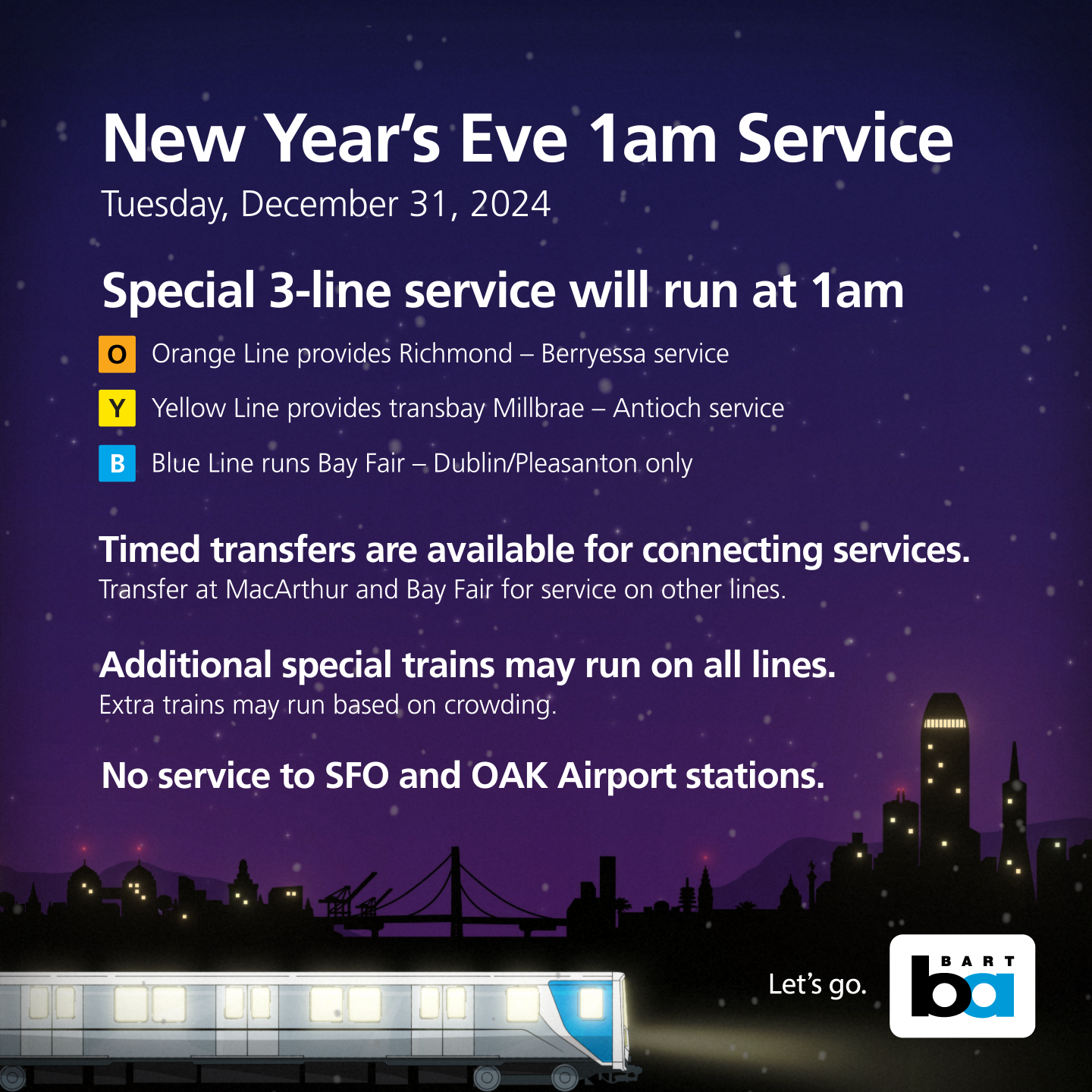
New Year's Eve, Tuesday, December 31: Regular weekday service (5am opening) with extended late-night service, extra staffing, and additional event trains as needed. BART will be providing extended service until 1am for late-night riders coming back from fireworks shows and celebrations. More on this below.
New Year's Day, Wednesday, January 1: Sunday service (8am-midnight)
New Year's Eve 1am Extended Service - More Info
Our 1am extended service will be as follows:
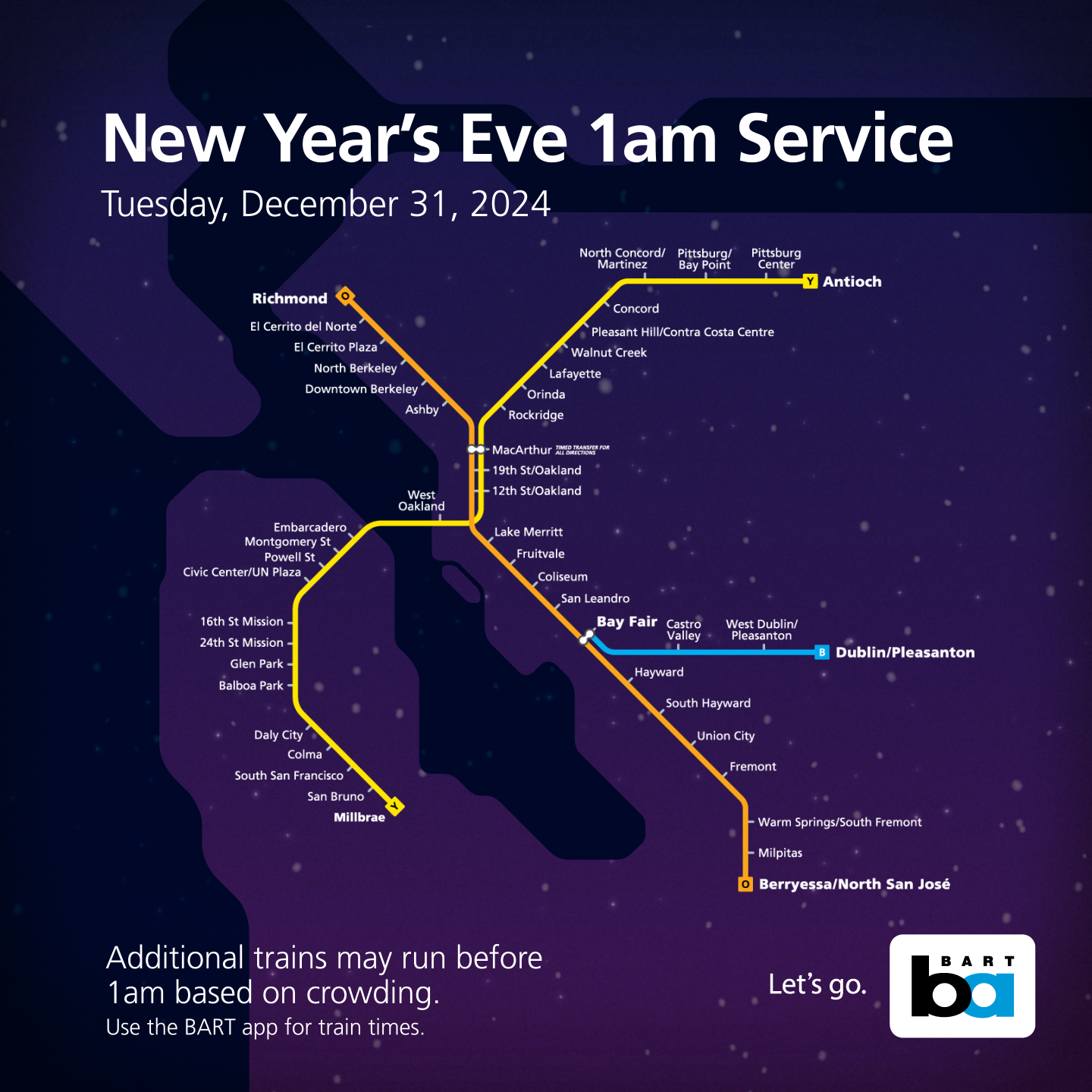
- Three-line special service (Yellow, Blue and Orange only in both directions, for total of six trains for 1am extended service). Yellow Line will be the only line running in San Francisco and Peninsula. Blue Line will run between Bay Fair and Dublin/Pleasanton.
- Trains will be waiting at MacArthur and Bay Fair to complete timed transfers.
- Yellow Line and Orange Line trains in all directions will be timed to meet at MacArthur Station at 1:47am in a "grand meet." This is the transfer point for riders coming from San Francisco heading toward Richmond or Berryessa or riders coming from the East Bay heading toward San Francisco.
- Orange Line and Blue Line trains will be timed to meet at Bay Fair Station at 2:16am. Dublin-bound riders can take the Berryessa-bound Orange Line train and transfer at Bay Fair Station.
- SFO and OAK airport stations will NOT be served.
- Last East Bay-bound train running through downtown San Francisco will be at around 1:30am.
- Last southbound train heading toward Millbrae will run through downtown San Francisco at 2:10am.
- The regular last trains of the evening (Yellow, Blue, and Orange lines) will be dispatched from the end of their lines at midnight and then at 1:00am, we will run another set of last trains of the evening to serve 48 out of our 50 stations. The 1am trains will not serve SFO and OAK airport stations.
BART’s Trip Planner has been updated to include the extended service trains.
Parking at BART on Holidays
Parking is always free after 3pm and on weekends. Parking will also be free on Christmas Day and New Year's Day. This applies to all BART stations except for Milpitas and Berryessa/North San Jose, as they are operated by VTA.
All other parking rules will be enforced.
Parking at BART for Holiday Travel
Airport parking can be a hassle and is always expensive, except at BART stations. We offer inexpensive multi-day parking (see options below) at many stations with easy online reservations. Purchase parking on the Official BART App or pay by website.
To accommodate the increased demand for Reserved Parking at Millbrae Station during the holidays, Reserved Parking is allowed on any level of the garage for reservations with a start date between December 23, 2024 – January 10, 2025. Reserved Parking at San Bruno Station is also allowed on all levels of the garage during the holiday season.
Single/Multi-Day Reserved parking is for consecutive overnight stays of up to 20 weekdays. You will need to provide the license plate of the car you plan to drive and a phone number. Reference our guide for paying for Single/Multi-Day Reserved parking here.
Monthly Reserved parking is for stays of up to 24 hours at a time, charged on a recurring monthly basis, and provides a guaranteed space until 10am. This is not to be used while travelling for several days in a row.
Reserved parking signs are blue + white or yellow. During the holidays we experience a higher demand in Reserved parking; if there is not a reserved spot available when you arrive, park in the Daily Fee area and you will not be cited. Daily Fee parking is only allowed in the Daily Fee area.
Find an overview of parking at BART at bart.gov/parking.
Taking BART to SFO or OAK
Traveling by plane for the holiday? It’s easy to ride BART to the airport. You can take the train directly to San Francisco International Airport (SFO) and Oakland International Airport (OAK). Plan your trip and find fares by using BART’s online Trip Planner and read our comprehensive guide on riding BART to the airport.
Another option for travel to SFO via BART is to purchase Multi-Day Reserved parking on the Official BART App or website and drive to Millbrae Station or San Bruno Station, then take a quick ride to SFO Airport.
Stay Safe
Save these numbers in your phone:
- 510-200-0992 to text BART Police dispatch to discreetly report criminal activity
- 510-464-7000 to call BART Police in an emergency (It’s faster than calling 911)
We also offer the BART Watch App--a free mobile app available on the App Store and Google Play that allows you to quickly and discreetly report criminal or suspicious activity directly to BART Police.
You can reach the Train Operator using call buttons in each car located by the side doors on the new trains.
Note your train car number when contacting police or the Train Operator. The train number is located above the doors on the inside of each end of the train car.
BART will have extra safety staff working on New Year’s Eve.
Holiday Fun
Low-cost e-bike lending program for Oakland residents launches at Fruitvale BART Bike Station with discounts for Clipper START users
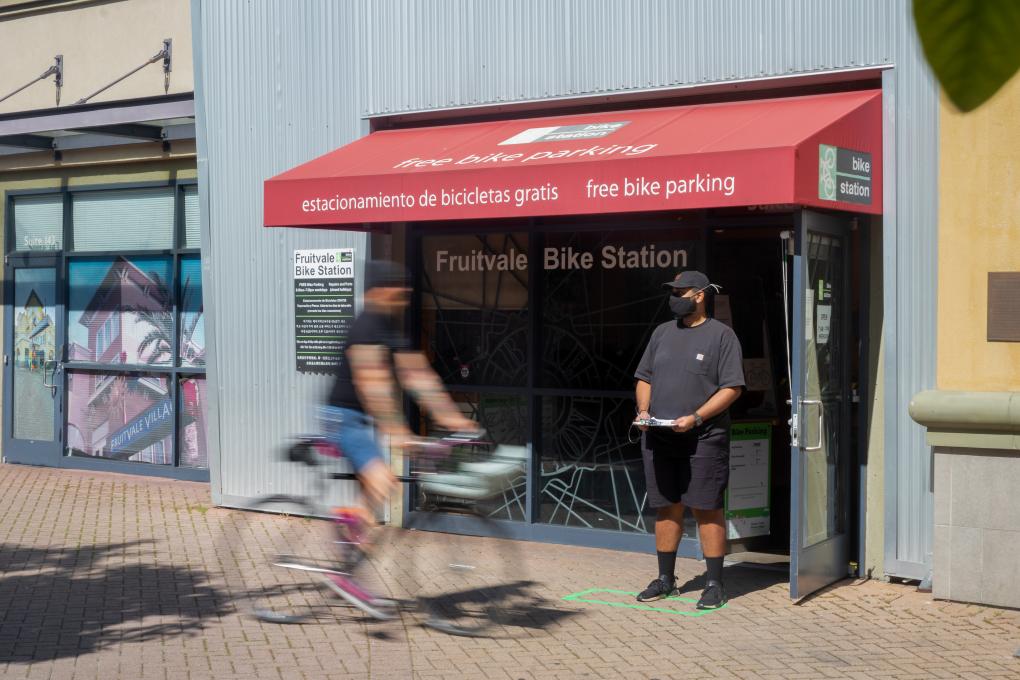
The Fruitvale BART Bike Station is now home to a fleet of electric bicycles Oakland residents can borrow for a very low fee.
The City of Oakland selected the station to launch its new e-bike lending program, which allows Oakland residents 18 and up to borrow an e-bike for four weeks for $120. Qualifying low-income residents, including those signed up for Clipper START, pay just $20. Visit oaklandca.gov/ebike for more detailed information as well as qualifications for the low-income discount. The program is funded by a $1.8 million, five-year grant from the Clean Mobility Options (CMO) voucher program.
The initiative helps advance BART’s mission to provide affordable and environmentally friendly transportation to the region while leveraging the existing capacity of BART’s Fruitvale Bike Station, which offers free valet bike parking, bike repairs, parts, and gear. BikeHub operates the Bike Station for BART and contracted separately with the city to offer the lending service. Lent bikes can be serviced at Fruitvale as well as the Uptown Oakland BART Bike Station at 19th St. Station.
“BART is thrilled to be the first location for Oakland’s new e-bike lending program,” said Heath Maddox, BART Manager of Bike Access. “BART’s bike stations aren’t just for securely storing bikes; they serve as a community resource to support and promote bicycling as a clean, affordable, and fun mode of transportation that can get you to and from BART and beyond."
E-bikes help riders travel long distances and climb hills with greater ease than traditional bikes, and BART has embraced them in the system. Like regular bikes, e-bikes are allowed on most BART escalators and in every train car but the first. To assist cyclists with big bikes, BART created this Elevator Dimension Guide that outlines the dimensions of every elevator in the system. BART also recently completed installation of modern bike stairway channels that make it easy to roll your bike up and down stairs at 19th Street/Oakland, 12th Street/Oakland, Lake Merritt, Coliseum, Walnut Creek, Embarcadero, and 24th Street Mission.
As many bike shops and the bicycle industry at large suffer in the post-pandemic bike boom contraction, BART offering full-service bike stations is an important community resource.
“It can be hard to find a shop to fix your bike without the ability to drive it across town,” Maddox said. “As full-service local bike shops, our bike stations are filling a real community need.”
E-bikes are in high-demand right now, he added, and many people on a budget naturally gravitate towards less expensive online models, “which are often not built to last and can have dangerous electronics.”
The e-bike available for lending is the Gazelle Medeo T-9 City, a high quality, Class I e-bike selected specifically for its quality, durability at a low-cost, and easy riding position for riders of all sizes. BikeHub is also encouraging people interested in purchasing their own bike to the Ava Bike Electric program, an incentive offering $400 to $1,500 off new e-bikes.
Learn more about Bikes on BART at bart.gov/bikes.
Win big prizes, including a $250 Clipper card, when you download BART’s Digital Holiday Passport and explore places and adventures near stations
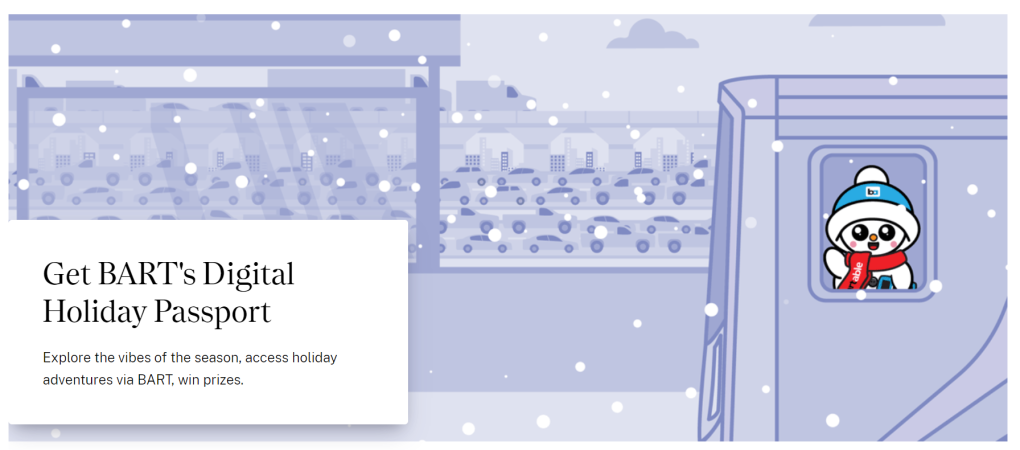
On Thursday, Dec. 7, BART launched a Digital Holiday Passport to encourage riding BART to explore the region and access holiday fun and adventures. Participants can win big prizes, including a $250 Clipper card and a 2023 Ugly Holiday Sweater and Holiday Beanie.
BART created the Digital Holiday Passport in partnership with Vibemap, a city discovery app that uses “vibes” to connect users to places, events, and experiences. Vibemap will join BART at SweaterFest ‘23 on Sunday, Dec. 10, 2pm to 3pm, at Rockridge Station, to promote the challenge and answer questions. Members of the public who attend SweaterFest ‘23 will also be the first to receive the brand-new BART Stamp Passports for the BART Stamp Rally.
The Digital Holiday Passport challenge will run from Thursday, Dec. 7, 2023, to Monday, Jan. 1, 2024. Seven stations will serve as check-in locations:
- Downtown Berkeley
- Fruitvale
- Montgomery
- MacArthur
- Lake Merritt
- West Dublin/Pleasanton
- Walnut Creek
To participate, download Vibemap on the iOS App Store or the Google Play Store. After downloading, travel within 0.5 miles of one of the seven stations listed above, and you’ll receive a notification to unlock the Digital Holiday Passport. The passport is geofenced so you can’t participate unless you’re physically in the area.
Participants will earn “Challenge Points” for every nearby activity they do – from checking-in at stations and places around BART, to adding “vibes” and tips to the app. The more points you have, the higher your chances of winning prizes, such as:
- $250 Clipper card
- 2023 Ugly Holiday Sweater (Size Large), Holiday Beanie
- $50 Clipper card
- $11 Clipper cards + BART swag bag
After the challenge concludes, Vibemap will host an IRL event for participants to meet and mingle. Date and location TBD. At the event, you can get a special holiday stamp as part of the BART Stamp Rally.
To learn more about the Digital BART Holiday Passport visit bartable.bart.gov/vibemap.
“If you see me on a train, ignore my dog”: How to treat service dogs and their handlers with respect on BART
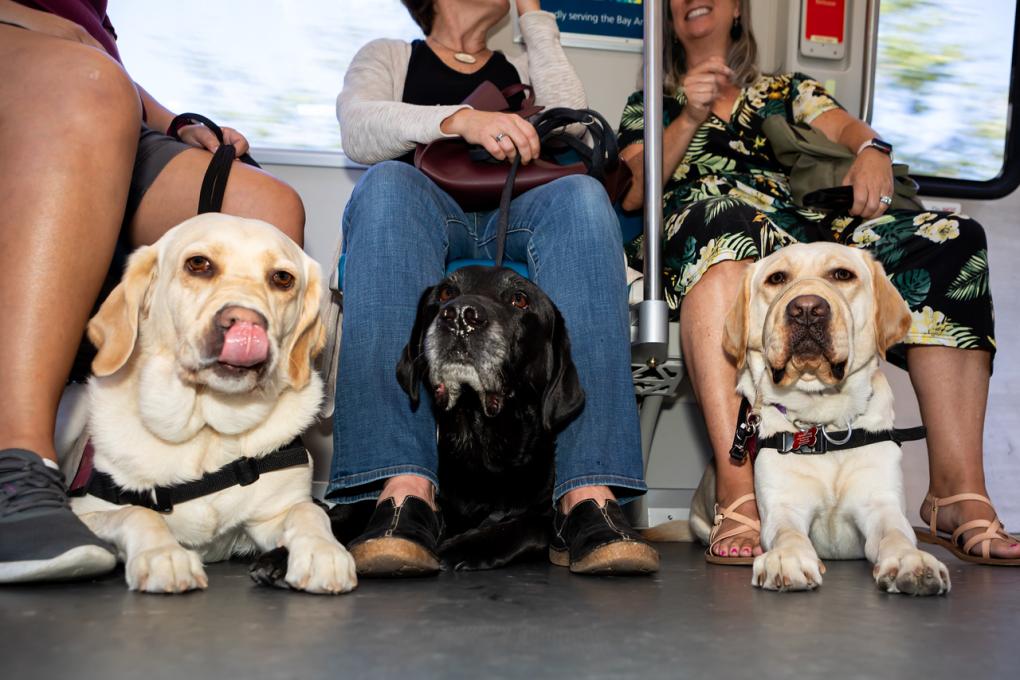
Early Alert Canines service dogs on BART, from left to right: Scarlett with handler Alysia Santos, Handsome Ransom with handler Kathleen Fraser, Sheldon with puppy trainer Suzie Scher.
See our DOs and DON’Ts for pets on BART below.
TLDR: You may only bring a pet onboard and in stations if it is secured in an enclosed carrier made for the transport of animals. Animals on leashes are prohibited with the exception of trained service dogs. Service dogs are allowed off leash if their owners are unable to hold a leash and the animal is under voice command of their owner. Please contact BART's Access and Accessibility Department for more information.
Service animals are defined by the American Disabilities Act as any guide dog, signal dog, or other animal individually trained to work or perform tasks for an individual with a disability. Emotional support animals are not service animals and must be in a carrier when on BART.
BART offers free BART rides for those training service animals on the system. Arrangements must be made with BART’s Customer Access Department beforehand.
Read more about our pets on BART rules at bart.gov/pets.
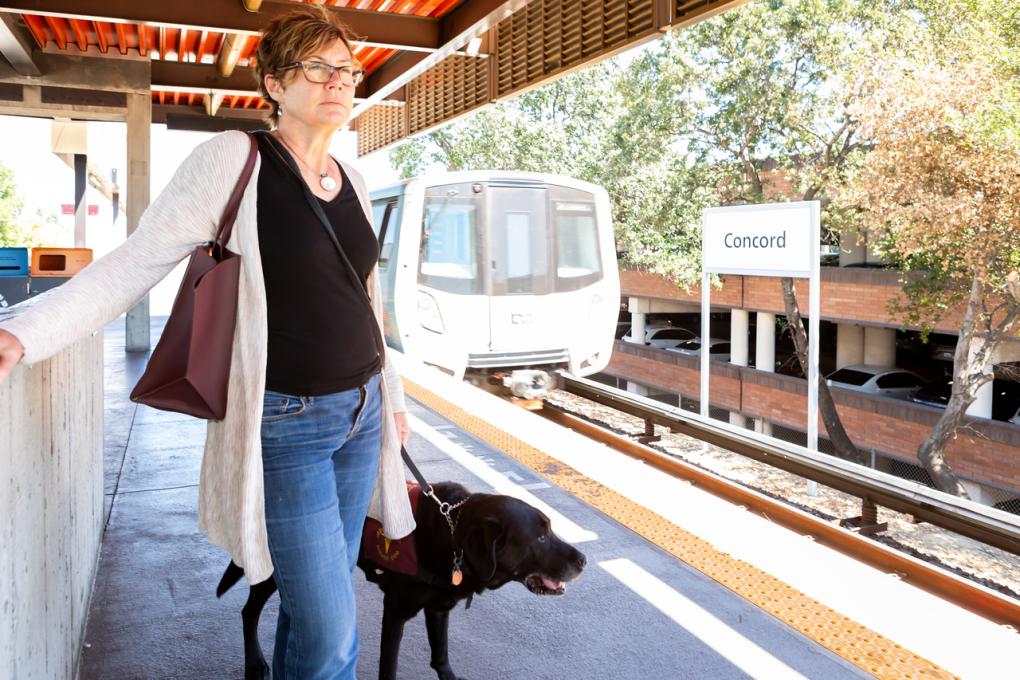
Kathleen Fraser and her service dog, Handsome Ransom, on the platform at Concord Station.
Dogs are cute. But some dogs have jobs to do, including when they’re riding BART.
Handsome Ransom is San Francisco resident Kathleen Fraser’s dog. He's got a big, goofy smile and soft black fur. Over that smooth coat, he wears a dark red vest with yellow embroidered text that reads: “Medical Alert Service Dog.”
Many of us see a dog out in the world and our brains scream, CUTE CUTE CUTE, MUST PET PET PET. Ransom, like all dogs, can be distracted however, and unlike all dogs, he’s specially trained to save his handler’s life.
“If you see me on a train, please ignore my dog,” Fraser said as a PSA to her fellow BART riders.
Fraser has type 1 diabetes, a lifelong condition where her pancreas doesn’t make any insulin, leading to high blood sugar levels. This can lead to a series of complications, including but not limited to nerve damage, heart attack, stroke, seizures, and in the most tragic cases, death.
In 2016 after a series of close calls, Fraser reached out to the Concord-based nonprofit Early Alert Canines in search of a service dog that would alert her when her blood sugar was dropping. The organization is one of a handful that trains medical alert dogs and connects them to people with type 1 diabetes.
Early Alert paired Fraser with Handsome Ransom, who quickly became her best friend and most steadfast companion. Wherever Fraser goes, Handsome Ransom comes too, including on BART rides. He has to; without Ransom by her side, Fraser's blood sugar could fall, and she might not even realize it. Ransom can detect blood sugar crashes sooner than any modern medical device and often before the person recognizes the signs of an oncoming drop, such as sweating, shakiness, dizziness, anxiety, intense fatigue, etc.
“Trained dogs pick up the scent of the chemicals your body releases when your blood sugar is dropping,” said Carol Edwards, the Executive Director of Early Alert Canines.
“As soon as they smell those particles, they go, ‘There it is!’ and they alert their handler with a simple lift of their paw,” Edwards said. When a dog gives the alert, their handler can pause, look at the number on their glucose monitor, “and make an informed decision on what to do next before they get to that low state where one of the first things to go is cognitive ability."
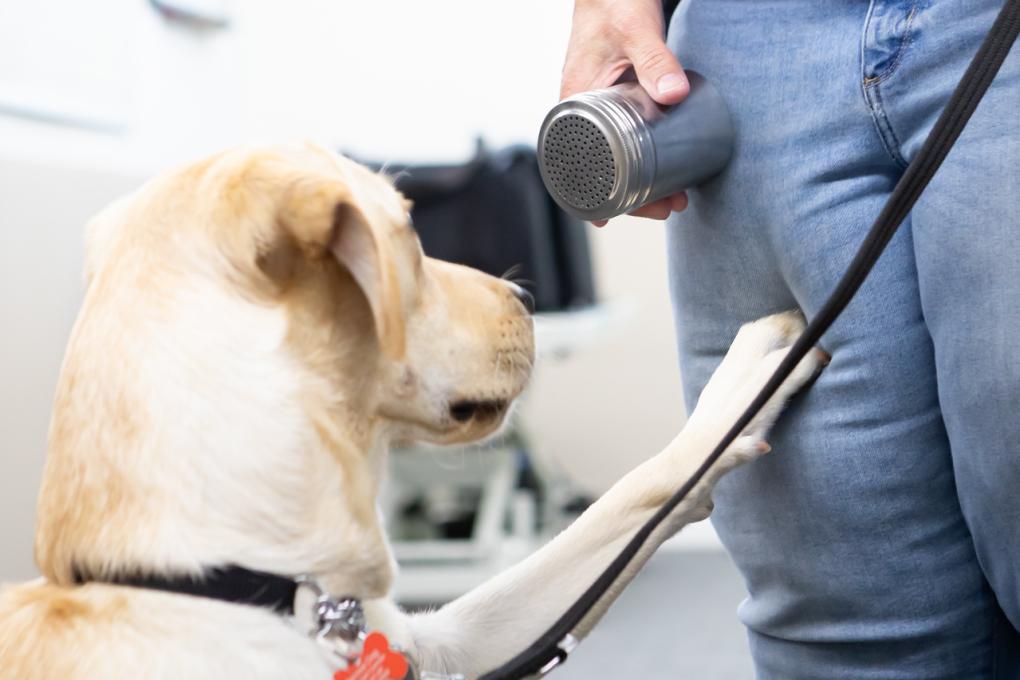
Service dog Scarlett correctly identifying a canister containing scent samples with a blood sugar level of 70mg/dL or lower at Early Alert Canines in Concord.
The dogs are scent trained for around six weeks using a 12-arm scent wheel, with each arm ending with a small canister with a perforated lid (think spice shaker). The scent samples within are collected from individuals with type 1 diabetes experiencing a blood sugar level of 70 mg/dL or lower. Once the dogs are familiar with searching the scent wheel, they undergo a series of 500 double-blind trials. In these trials, neither the trainer nor the dog knows which canister contains the target scent. In all, the process takes around six weeks.
Fraser said Ransom has alerted her thousands of times since they were first matched eight years ago. Sometimes, Ransom will give the alert more than a dozen times a day.
“What I wish people would realize is that service dogs provide medical support that is just as important as a wheelchair or a white cane or hearing aid," Fraser said. "Yes, they are adorable, and yes, we all want to go up and squish them and all of that. But when they're out, they’re in work mode, and they need to be attending to their person.”
Many don’t realize this because they just don’t know. And that’s exactly why Fraser is sharing her experiences, including some that are painful to remember.
Fraser used to take transit to work in San Francisco all the time. But things became too challenging – and terrifying – when fellow passengers would consistently scold her for bringing a dog on transit or for using a seat reserved for disabled people in the front. Fraser often uses one of these seats as a safety measure for the dog because sitting against a wall limits the chances of someone trampling or stepping on him, thereby preventing him from doing his job. If the dog gets distracted or injured, it puts Fraser’s safety at risk.
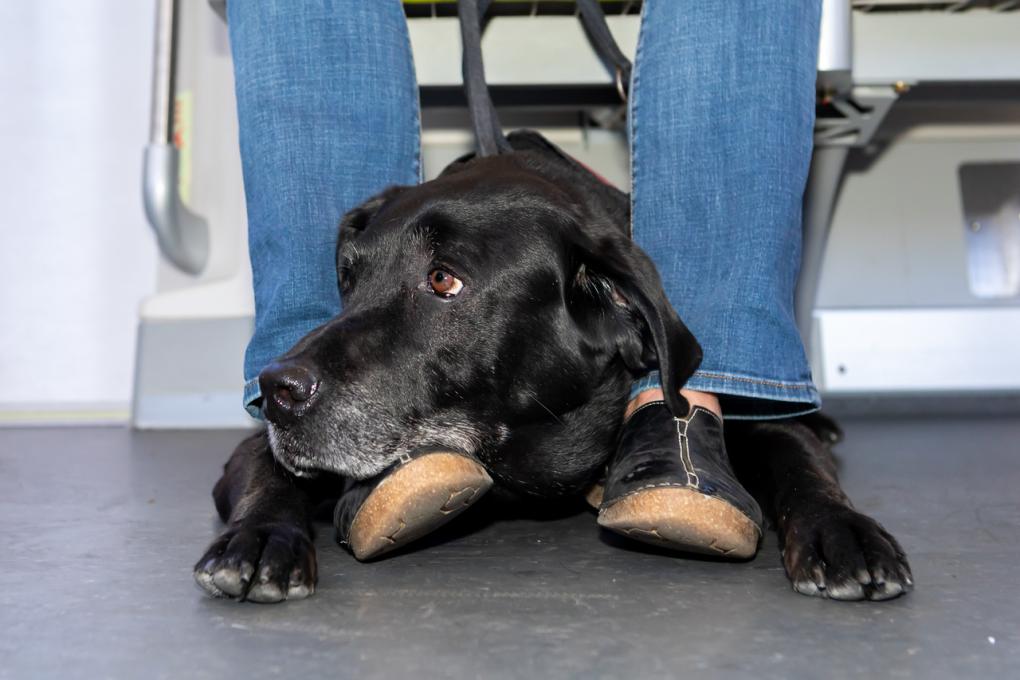
Handsome Ransom on BART between Kathleen Fraser’s legs in a seat against the wall.
"There have been many times where I'm sitting in one of the reserved seats and the public, for one reason or another, starts yelling at me about ‘How dare I sit in that seat, when XYZ person should have that seat,’” she said.
These encounters, on more than one occasion, spiraled into an “angry mob” situation, with people asking Fraser questions like: “What’s wrong with you? Why do you get to bring a dog on transit?”
“We live in a world now where there are many ‘fake’ service dogs,” Fraser said. “People are sensitive about it in San Francisco because we have strong laws around emotional support animals and renting apartments.”
"It's also complicated by the fact that my disability is somewhat invisible,” she added. “People say to me, ‘Well, you don’t look disabled,’ and I say, ‘What does disabled look like to you?’ Most people think ‘disabled’ refers to those with visible physical disabilities, but that’s not the case. And it’s caused me a heck of a lot of trouble.” According to multiple sources, the vast majority of disabilities are “invisible.”
Type 1 diabetes is a protected class under the Americans with Disabilities Act (ADA), which prohibits discrimination against those with disabilities in all areas of public life, including transportation. ADA defines service animals as any guide dog, signal dog, or other animal individually trained to work or perform tasks for an individual with a disability.
Dogs whose sole functions are to provide comfort or emotional support do not qualify as service animals under the ADA, and Fraser wants to be very clear: Ransom's job is not providing emotional support. That's an added bonus. People with diabetes are two to three times more likely to have depression than those without diabetes, and “having a dog who loves you unconditionally helps with that,” Fraser said.
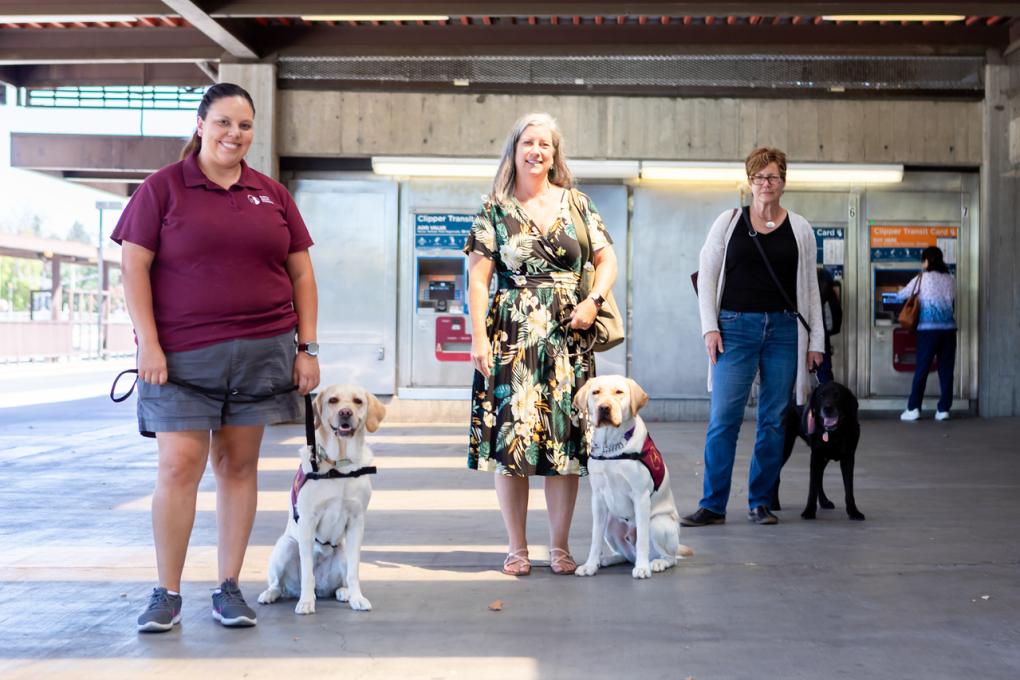
From left to right: Scarlett with handler Alysia Santos, Sheldon with handler Suzie Scher, Handsome Ransom with handler Kathleen Fraser. Pictured in the unpaid area of Concord Station.
When you encounter a person with a service dog, there are two questions you can ask. One, is the dog a service animal required because of a disability? And two, what work or task has the animal been trained to perform? People with service dogs do not have to disclose their disability.
Because of her traumatic experiences, Fraser no longer takes transit, instead opting to drive three miles to her office and pay for an expensive parking spot. Sometimes, that’s the way it is when you’re maneuvering around a world that is not designed with a diverse spectrum of disabilities in mind.
"This disability is vicious, it's volatile, it's unforgiving, it's cruel, and completely unpredictable,” Fraser said of type 1 diabetes. "There is research that says people with type 1 diabetes have to make 300 additional decisions a day just to stay alive.”
Early Alert Canines makes a point to train their dogs on public transportation because the animals’ future handlers may use it back home. 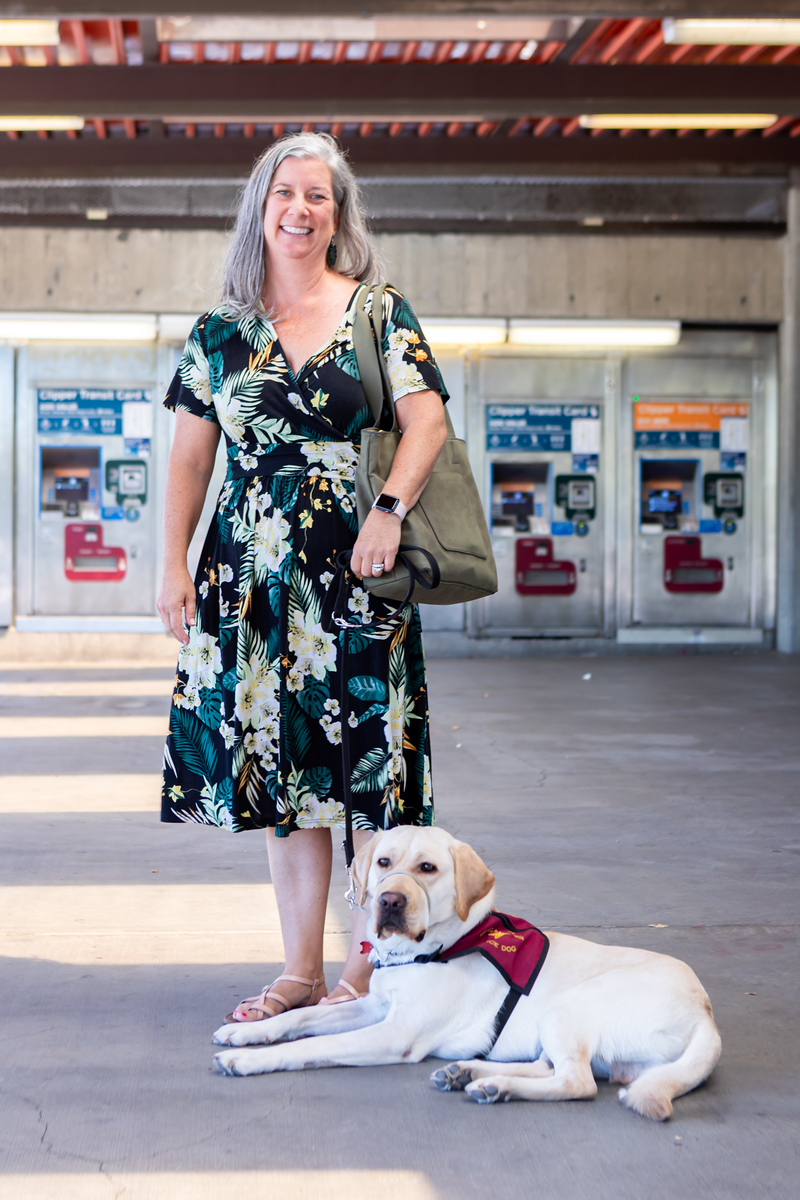
Suzie Scher (pictured on the right with Sheldon) is a volunteer puppy raiser, and she made sure her trainee pup, Sheldon, got some experience riding the trains. She recently took BART to Downtown Berkeley Station for a visit to the Ed Roberts Campus, a universally designed, transit-oriented campus that was created by disability organizations that share a common history in the Independent Living Movement of People with Disabilities.
“I wanted to make sure he's been on BART before he’s paired with his handler,” she said. “These dogs can be placed with people anywhere in the country – they could be riding the Chicago L or the New York subway, and they need to be prepared.”
There are many stimulants in a transit space – the click of the fare gates, the whoosh of a train pulling into the station – and puppy raisers like Scher ensure their dogs know what they’re getting into before they’re sent off to live with their owners.
Fraser said Ransom is a “champ on BART.” On a recent visit to Concord Station, Ransom serenely followed Fraser through the fare gate, walked up the stairs, and waited on the platform beside her until they got on a train. Onboard, Fraser found a seat against the wall, and Ransom deftly maneuvered himself underneath the seat, poking his head between the protective barrier of Fraser’s legs. He sat there serenely for the entirety of the ride.
Fraser has a few asks for her fellow passengers. As mentioned earlier, do your best to ignore Handsome Ransom – that includes not making eye contact with him. She also asks that you consider giving up your seat for her and Ransom on a crowded train.
“When we’re standing,” she said, “we have to put the dog between our legs and make sure the tail is not stepped on. We’re doing all this while holding onto the handrail, maybe holding onto a shopping bag or purse. It’s a lot to handle.”
It’s also important to not eat on the train and in the paid area of the station, and not just because it's against BART’s rules. Even miniscule crumbs can pull a service dog away from his task. Afterall, they’re dogs, and when they’re paying attention to food on the floor, it means they’re not working.
“I want him to have his full attention on his person, so if their levels change, he can alert them right away,” Edwards said. “I don’t want him distracted by a piece of dropped hamburger.”
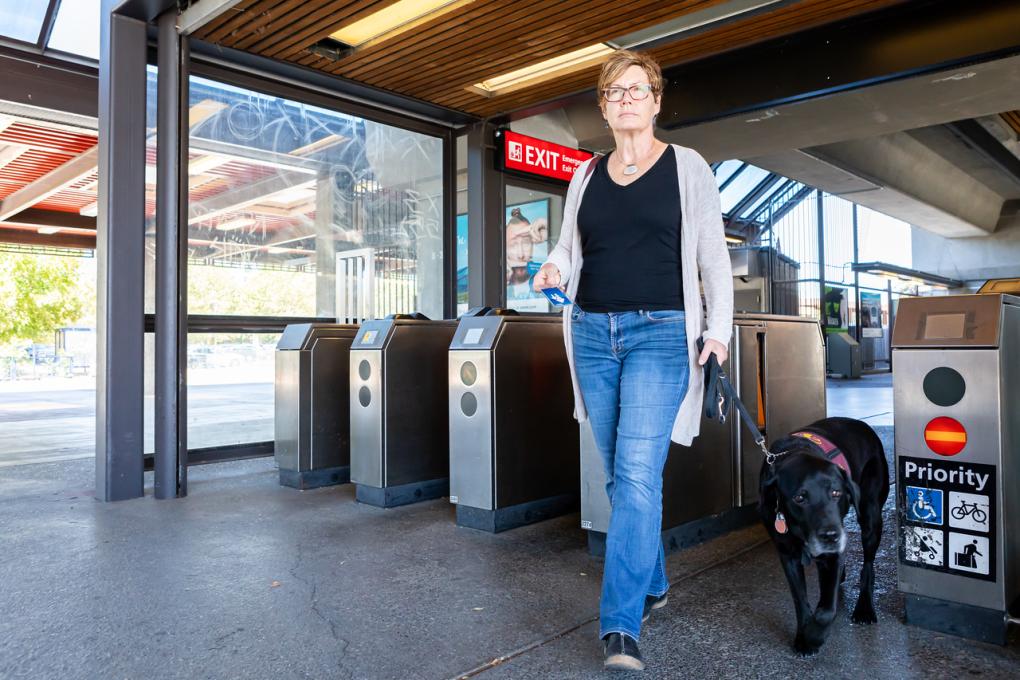
Kathleen Fraser and Handsome Ransom walk through the fare gates at Concord Station.
Most importantly, Fraser asks that you follow BART’s pet policy. Pets are allowed on BART, but they must be properly secured in an enclosed carrier manufactured for pet transportation. In turn, that carrier must be kept off the seats and cleared from the aisle (keep service animals off the seats and out of the aisles, too). Pets on leashes are prohibited.
If these policies are not followed, it puts people with disabilities in danger, as well as their fellow passengers. Bringing your pet on BART without a carrier is inviting interactions with potentially life-threatening consequences, whether it’s Ransom failing to alert Fraser of a blood sugar crash or a poorly behaved dog biting a passenger. A person found to be in violation of BART’s pet policy could be issued a citation and/or ejected from the system.
So far, Fraser hasn’t had any problems on BART, but that doesn’t mean she’s not constantly calculating what could happen when she steps on a BART train or anywhere out in public for that matter.
“If you bring your dog on BART and it behaves badly, people remember that bad experience. Then, when I get on BART with my service dog, they take it out on me,” she said. “It makes everything harder.”
Added Scher: “Follow the rules, and if you won’t do it for humans, do it for the service dogs."
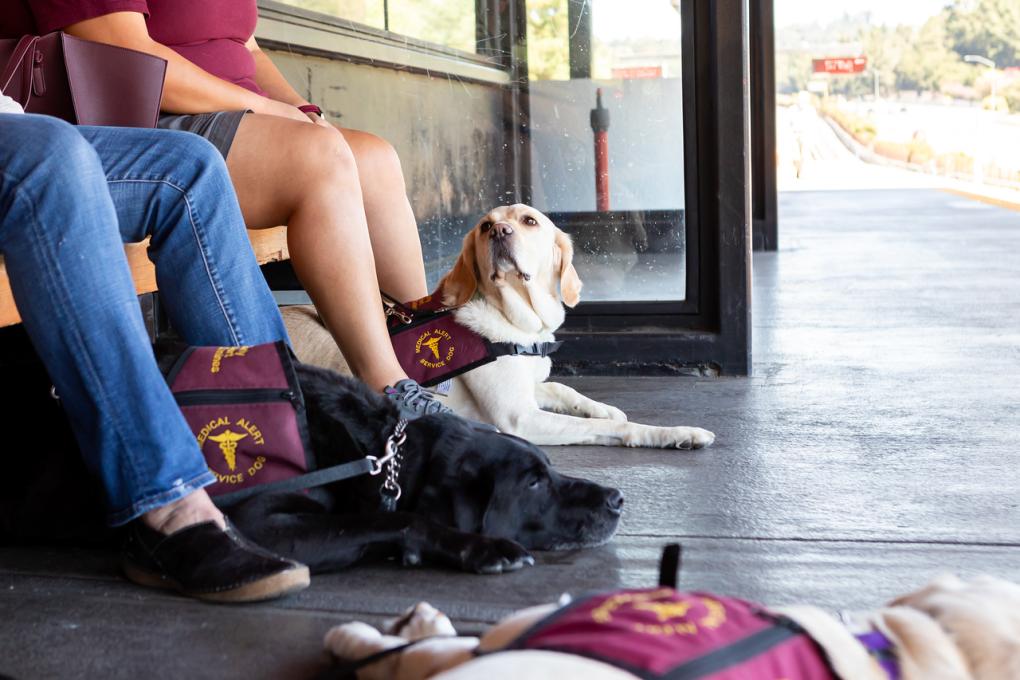
Service dogs reposing on the platform as they wait for a train at Concord Station.
The DOs and DONT’s of Pets on BART
DO bring your non-service animal on BART in an enclosed carrier made for transporting pets. This includes not just trains, but stations as well.
DON’T put the carrier on a seat or in the aisle and keep your service animal off the seats and out of the walkways.
DO be considerate of fellow patrons who may have allergies or fears around certain animals.
DON’T bring a leashed pet onboard (with the exception of trained service animals). Service dogs are allowed off leash if their owners are unable to hold a leash and the animal is under voice command of their owner.
DO remember that not all disabilities are as visible as others.
DON’T pet a service dog, offer it a treat, or distract it in other ways. Try not to acknowledge the animal at all (we know it’s hard).
DO be aware that Station Agents can advise owners that their service animals may not enter a station if the animal is behaving in a way that may threaten other passengers.
DON’T forget that BART Police may issue a citation and/or eject a person from BART if they are found to be in violation of BART’s pet rules.
DO remove all food and trash from trains and deposit it in station receptacles to ensure service animals like Ransom don’t get distracted.
DON’T ask a person what disability they have that enables them to have a service animal. Stick to these two questions: “Is this a service animal?” and “Is this animal working for you?”
DO consider giving up your seat to a person with a service animal to make things easier for them.
DON’T take service dogs on escalators, which could potentially pinch their paws. We recommend using the stairs or elevators. (This is a BART recommendation; California law does allow service dogs on escalators.)
DO be aware that service dogs in training may accompany their disabled owners or authorized trainers on BART. No service animals in training, other than dogs, are allowed on BART on leash or harness.
DON’T bring an emotional support pet on BART unless it is in an enclosed carrier. Emotional support pets are not service animals, per the ADA.
DO reach out to BART’s Customer Access Department, which can arrange free BART rides for those training service animals on the system.
Take BART to The Unity Council’s Día de los Muertos Festival (Sunday, Nov. 3) and view 5 new murals at Fruitvale Station
Purchase a BARTy x Dia de los Muertos t-shirt and stickers on Railgoods.com.
Scroll down to read this news release in Spanish.
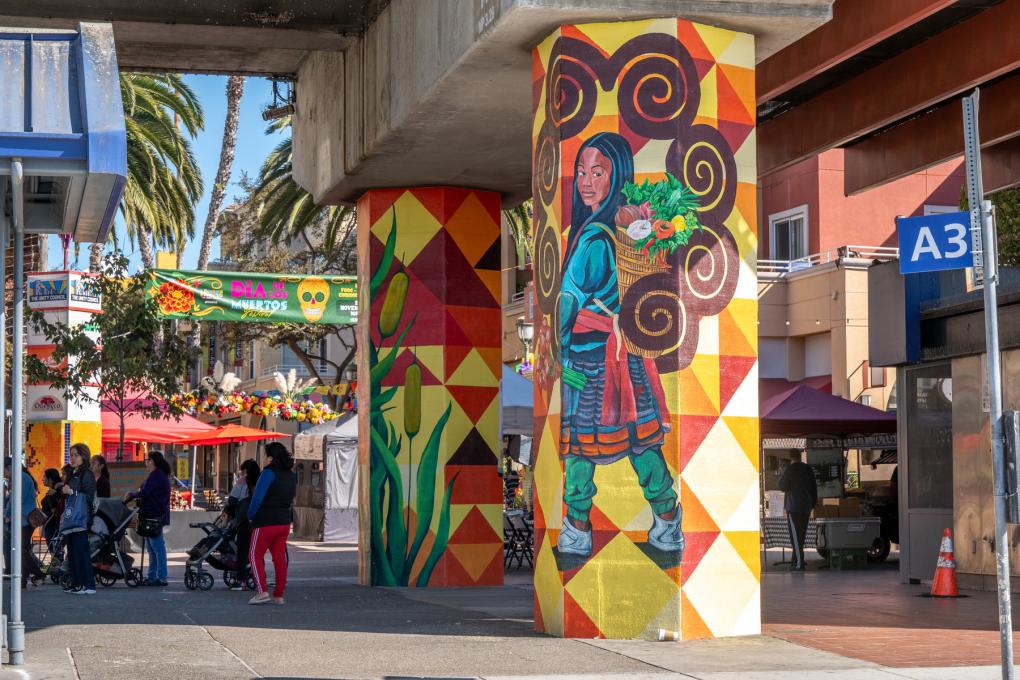
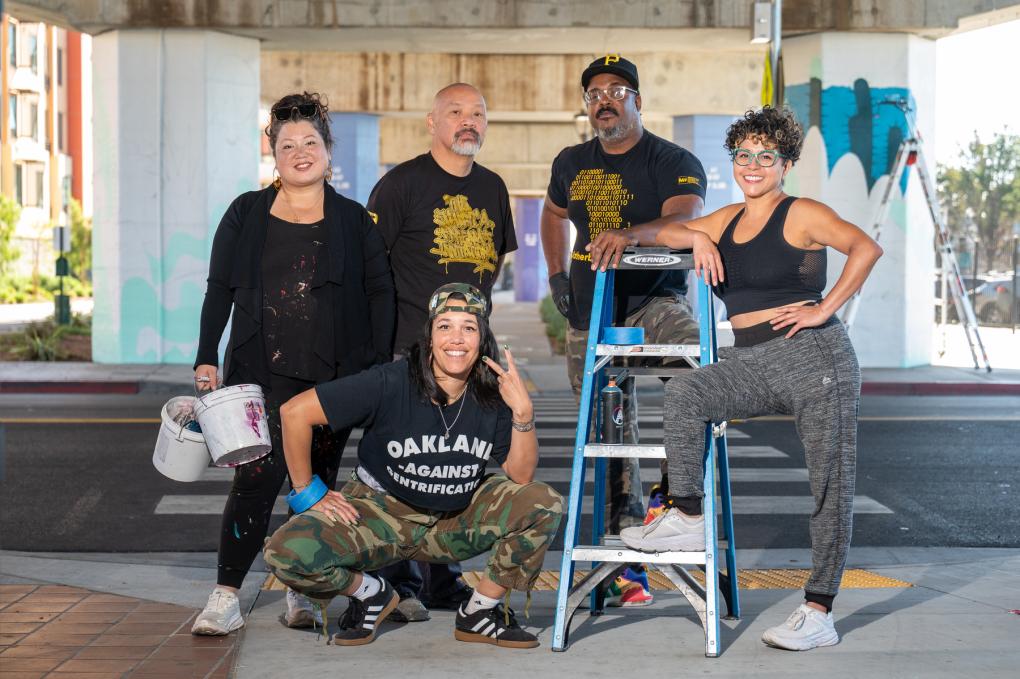
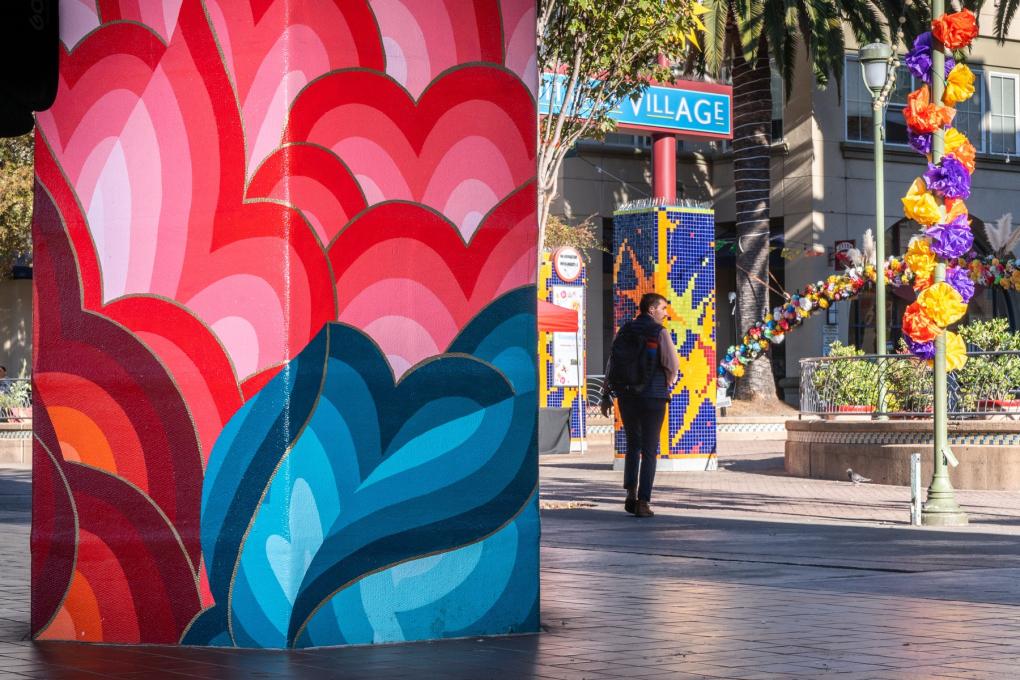
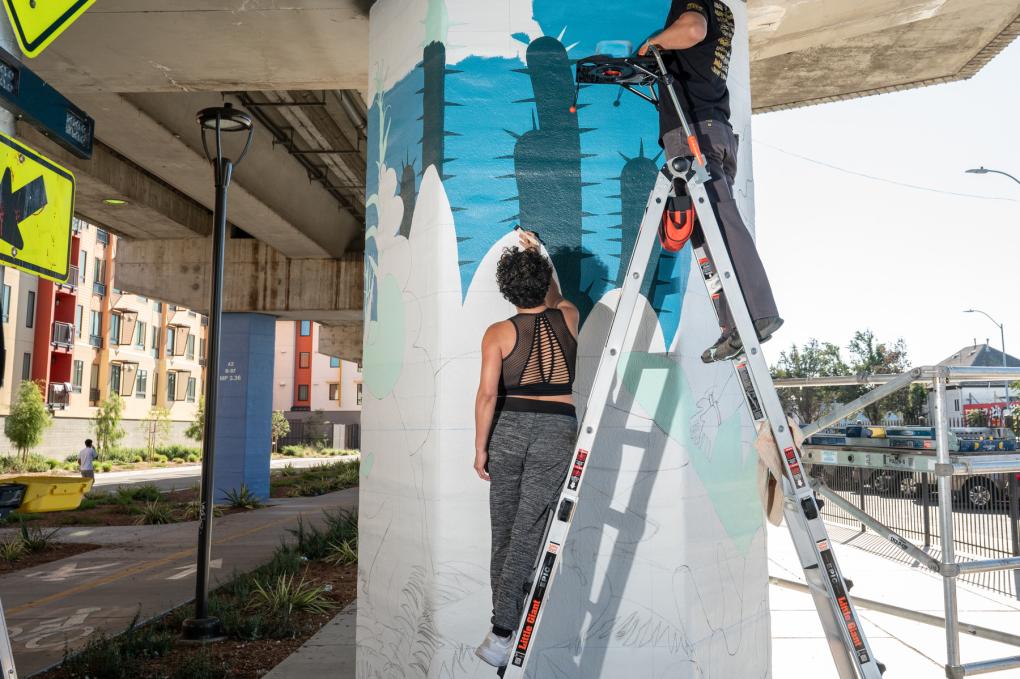
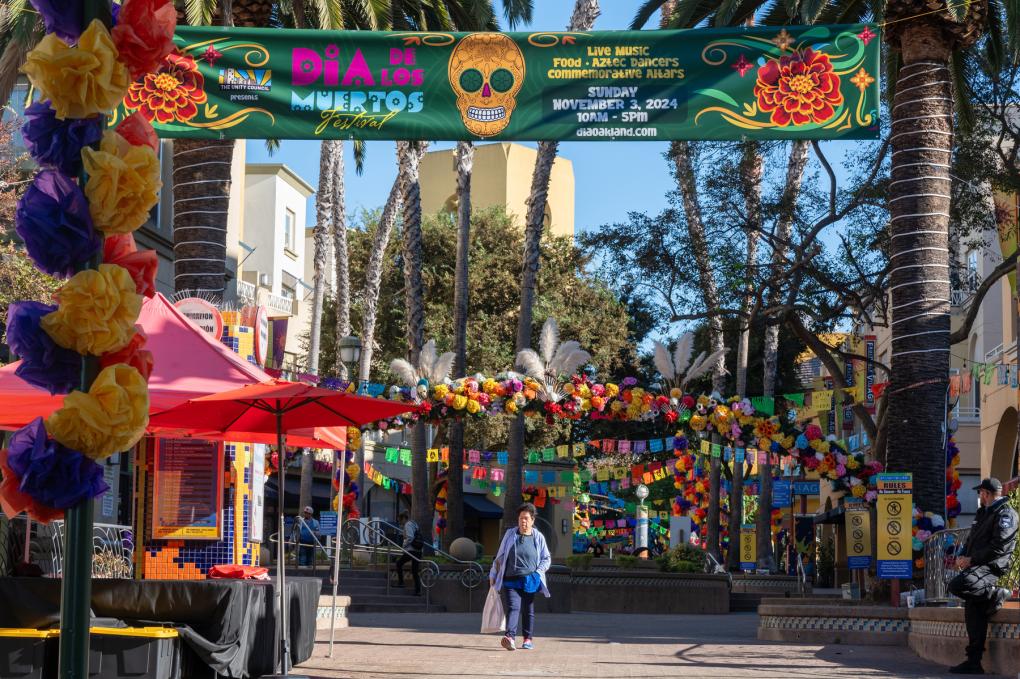
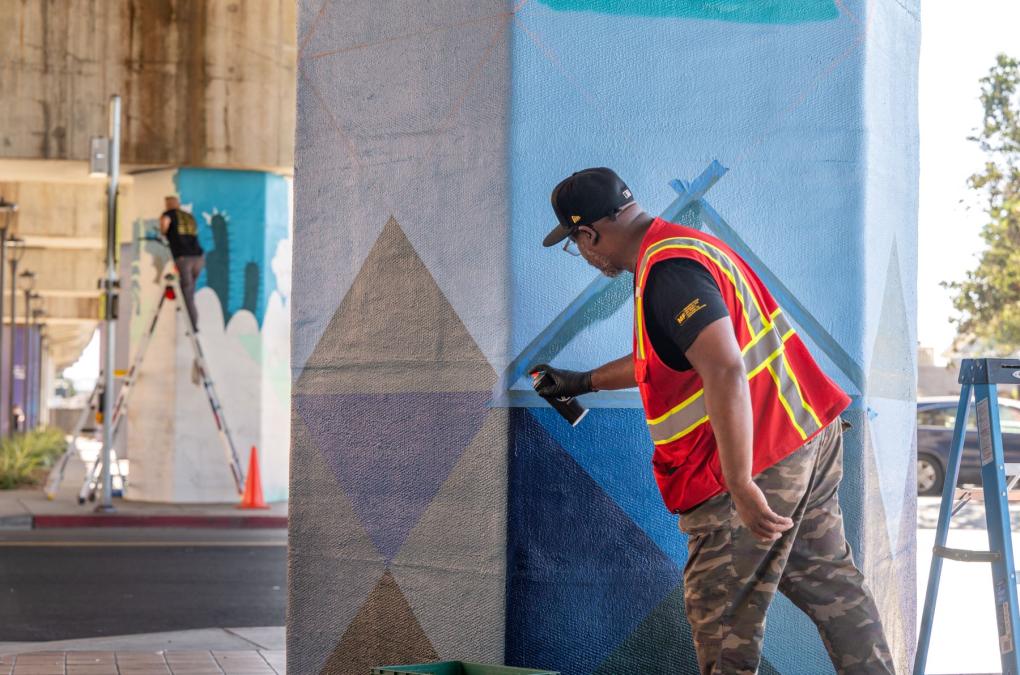
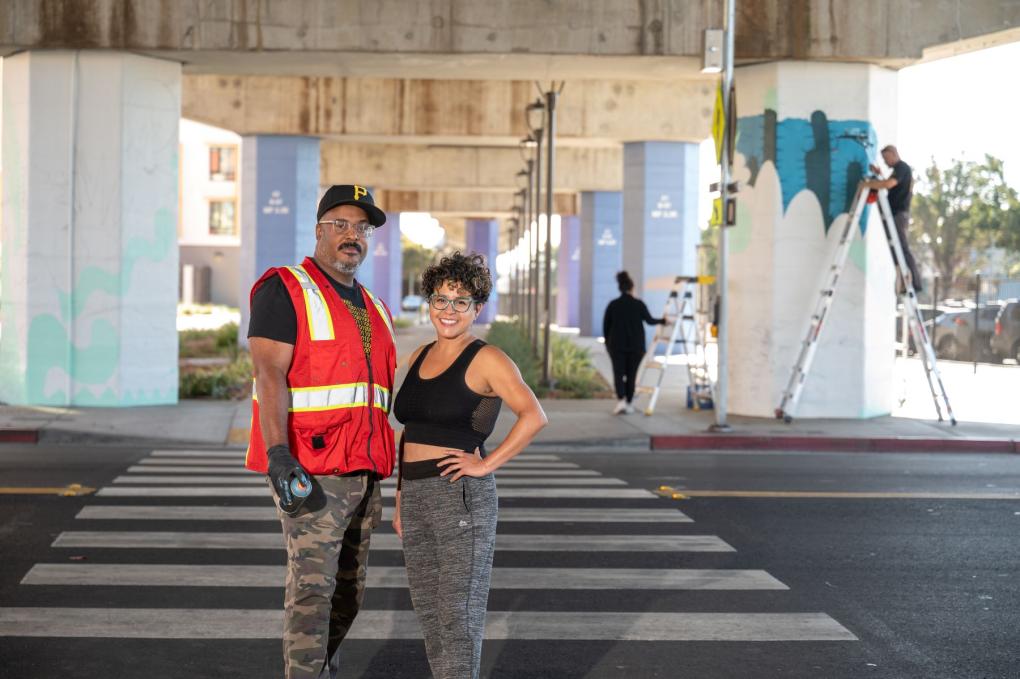
BART invites you to take public transportation to The Unity Council’s Día de los Muertos Festival on Sunday, Nov. 3, from 10am to 5pm, in Oakland’s Fruitvale neighborhood. This year, the annual event coincides with the unveiling of new murals on ten columns in the unpaid area under the platform of Fruitvale Station. The mural project was spearheaded by The Unity Council, and all of the artworks were created by Oakland-based artists: Senay “Refa One” Alkebulan, Cece Carpio, Jet Martinez, and Favianna Rodriguez. (Note: Some murals are works in progress.)
“Since its founding in 1964, The Unity Council has been dedicated to uplifting and advocating for underrepresented communities,” said Unity Council CEO Chris Iglesias. “Today, we build on that legacy with new affordable housing developments near a transit hub, featuring murals that reflect our community’s culture. At the Fruitvale BART station, our latest murals celebrate Fruitvale’s rich cultural heritage, transforming the station into a vibrant, welcoming environment and a testament to the community’s creativity, resilience, and unity.”
Said BART Director Robert Raburn, whose district includes Fruitvale: “The thumbprint of the community is on Fruitvale Station. Thanks to the partnership between BART's Art Program and the Unity Council, talented local artists created beautiful murals with designs that reflect the vibrant Fruitvale neighborhood.”
BART is a longtime partner of The Unity Council and supporter of the Día de los Muertos Festival, a free outdoor event that brings more than 100,000 people to the Fruitvale neighborhood with live music, games, rides, activities, arts and crafts, Latin American artisans, and incredible altar artistic installations created by community members to honor los muertos.
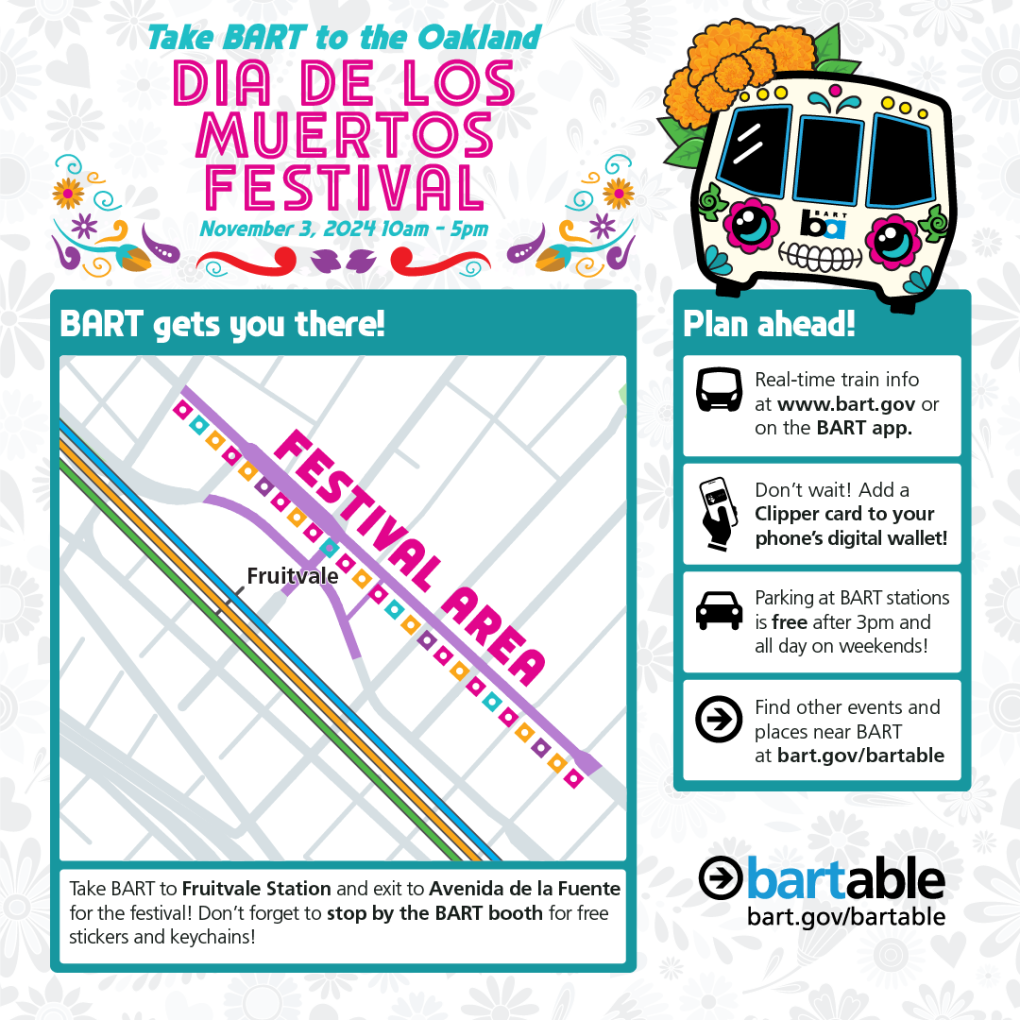
As you enjoy the festival, BART and The Unity Council encourage you to wander among the beautiful new murals, which have contributed to the transformation of the station into a living canvas that reflects the diversity and cultures of the local community. Fruitvale has become a destination for mural making, and the creation of this street gallery at the station is a reflection of the neighborhood’s many culturally rich public artworks. The unveiling of these murals is especially timely given that art, culture, and community gatherings are central components to the Día de los Muertos holiday.
"The murals we are creating at the Fruitvale BART station are not just standalone works of art; they are part of a larger, interconnected vision that extends across the community,” said Evelyn Orantes, Curator. “By linking them with the murals at CASA Sueños, just across the way, we are forming a cohesive 'street gallery'—a vibrant, open-air collection that celebrates the rich cultural heritage and creative energy of Fruitvale. This concept not only beautifies the area but also transforms our public spaces into a dynamic gallery where art and community intersect, inviting residents and visitors alike to experience the neighborhood as a living canvas.”
The idea for the street gallery gained momentum following the 2019 completion of the Fruitvale Station “Long Live Oscar Grant” mural by Refa One, an Oakland artist who also created artworks for this mural project. The five murals were developed and funded by The Unity Council with support from the BART Art Program and a significant grant from the Rainin Foundation. The Unity Council selected the four artists through a process that ensured the vibrant community around the station would be meaningfully honored and reflected.
BART is working to continue deepening its relationship with the historic Unity Council and the Fruitvale community by supporting efforts like this culturally resonant street gallery, which not only reflects the identities of many of the people who live in the neighborhood but contributes to making Fruitvale Station a brighter and more welcoming space to everyone who passes through.
Said Jennifer Easton, BART Art Program Manager: "Art has a critical role in defining spaces. The new murals flipped a switch on Fruitvale Station making its relation to Fruitvale Village and the rest of the Fruitvale neighborhood one of welcome and celebration. Through this monumental partnership with The Unity Council, the BART station now aligns with the cultural richness of the community.”
BART and The Unity Council’s longtime partnership
For decades, BART has partnered with The Unity Council to support the Día de los Muertos Festival and encourage the public to ride BART to the festivities.
BART Director Robert Raburn and BART staff will have a booth at the event to provide information about relevant BART programs, chat with the community, and hand out free keychains and Día de los Muertos x BARTy stickers. Show your spirit for the event and BART by purchasing a BART Día de los Muertos t-shirt on Railgoods.com.
“For over a decade, BART has proudly partnered with The Unity Council to support the annual Día de los Muertos celebration in Oakland's Fruitvale District,” said BART Principal Marketing Representative Jill Buschini, who oversees BART’s external partnership program. “It is an honor to collaborate on this event each year, not only because of The Unity Council’s tremendous contributions to the Fruitvale community, but also for the way this cherished tradition brings people together. The celebration honors loved ones and embodies the cultural richness that resonates with both residents and visitors alike. With the event's growing popularity, taking BART is a convenient and eco-friendly alternative to driving, making it easier for everyone to enjoy the murals and festivities.”
About The Unity Council
The Unity Council is a social equity development organization devoted to improving the quality of life, economic and educational opportunity, and health and safety of low-income communities. The Unity Council was established in 1964, during the civil rights movement, by a group of community members who wanted to ensure the political representation of the Latino community. The organization’s programs and geographically based community development strategy now focuses on building an economically vibrant, physically attractive, and livable neighborhood for the Fruitvale community regardless of ethnic affiliation or national origin. Today, TUC serves over 11,000 clients annually in five languages in the following program areas: early childhood education, youth mentorship and leadership development, employment services, career readiness training, housing and financial stability, senior citizen services, affordable housing and neighborhood development, and arts and cultural events.
About the neighborhood and the Fruitvale Transit Village
The Lisjan Ohlone people, who thrived in the region long before the arrival of European settlers in 1769, are the original inhabitants of the territory of Huchiun. Their rich and vibrant culture has deep roots in the land that would become more widely known as the vibrant city of Oakland.
In the 1800s, the area surrounding the Fruitvale BART Station held a different identity - 'Fruit Vale.' This name was bestowed upon the neighborhood due to its lush and abundant apricot and cherry orchards. The bountiful fruit trees that graced this area not only offered sustenance, but they also added a natural beauty and allure to the landscape, which has since evolved into a thriving urban center known for its diverse and rich history.
Today, it's a vibrant neighborhood and one of Oakland's main commercial areas. Fruitvale is hailed as one of the most diverse districts in Oakland. Its residents have said that the district’s diverse cultural community makes it an ideal place to live and raise children. The largest concentration of Oakland’s Latine population resides in Fruitvale, and the district hosts some of Oakland’s most popular cultural events and International Blvd is a major shopping and dining corridor. Fruitvale is also 25% persons of diverse Asian backgrounds, and 10% Black.
Fruitvale Village, created by The Unity Council in the early 2000s, is a national model for livable communities. Located in the heart of the vibrant Fruitvale neighborhood, Fruitvale Village is a mixed-use development with prime retail spaces, offices, a high school, senior center, and apartments. Fruitvale Village is adjacent to the Fruitvale BART station, the system’s 4th busiest and 9th most widely traveled station, and a bustling AC Transit hub, making the property an internationally renowned Transit-Oriented Development (TOD). The pedestrian plazas running through the Village are host to weekly farmers market and event spaces and are a great place to sit and enjoy the sun.
About the artists
Senay “Refa One” Alkebulan is an Oakland native who has been instrumental in the development of the innovative genre known as “Aerosol Art” (Spray Can/Style Writing). Refa's refined HipHop calligraphy is inspired by a cultural tradition originating from the New York City subway art movement. A lifetime of involvement in HipHop culture and political organizing has afforded Refa a successful career as a professional muralist, illustrator, activist, and arts educator. His work has been featured throughout the U.S. and various countries in Europe and the African continent. Refa One is currently the director of AeroSoul, an international organization of spray can artists from the African Diaspora, transforming the visual landscape of the African world.
Cece Carpio is a multifaceted artist, educator, and community organizer whose work is deeply rooted in social justice and cultural empowerment. With a background in mural painting and public art placemaking installations, Carpio's vibrant and dynamic artworks often explore themes of ancestry, resilience, and collective liberation. As an Indigenous immigrant, she paints everyday people who have been invincible to share their thriving presence and to show the dignity and power of their existence. Through her murals, workshops, and community projects, Carpio creates spaces for dialogue, healing, and celebration, inspiring others to engage with social justice and provoke the power of their imagination. Her art serves as a powerful tool for storytelling and resistance, challenging dominant narratives, and envisioning more inclusive and equitable futures.
Jet Martinez is an Oakland-based artist known for creating vibrant works of art that engage the traditions of Mexican folk art with contemporary aesthetics. Originally from the small beach town of Tuxpan, Veracruz, Mexico, and raised in Cuernavaca, Morelos, Martinez takes inspiration from his native culture’s rich traditions of pottery, weaving and embroidery, enlivening the rigid architecture of urban environments with ornate patterns and abstract forms. Through his paintings and murals, Martinez evokes a multi-cultural dialogue that explores the consistencies of visual culture throughout time. Martinez’s work can be found locally and globally. He is proud to call Oakland home and is a dedicated father, and husband to fellow artist Kelly Ording.
Favianna Rodriguez Giannoni is an interdisciplinary artist, cultural strategist, and entrepreneur based in Oakland. Her art and praxis address migration, gender justice, climate change, racial equity, and sexual freedom. Her work centers joy and healing, while challenging entrenched myths and dominant cultural practices. Favianna's creative partnerships include companies like Ben & Jerry's, Spotify, Old Navy, and Playboy Magazine. She has completed a number of large-scale public art commissions with the City of San Francisco and the Presidio National Park. Her signature mark-making embodies the perspective of a first-generation American Latinx artist with Afro-Latinx roots who grew up in Oakland, California during the era of the war on drugs and the birth of Hip Hop.
Evelyn Orantes has spent over two decades creating community-centered experiences in museums and beyond. Her work celebrates the uniqueness and commonalities within communities, using collaboration, visitor-centered design, and participatory methods. She co-creates projects with community groups, educators, artists, and cultural leaders, with a focus on serving multilingual and diverse audiences. Ms. Orantes is passionate about connecting institutions with cultural leaders, scholars, and artists. She develops strategies that engage communities, assess their needs, and align them with institutional resources, strengthening relationships and bringing art and culture to new spaces.
Domingo 3 de noviembre en la estación Fruitvale: Tome BART al Festival del Día de los Muertos de The Unity Council y disfrute de 5 nuevos murales creados por artistas locales
Los invitamos en BART a tomar el transporte público para el Festival del Día de los Muertos de The Unity Council el domingo 3 de noviembre, de 10 a. m. a 5 p. m., en el vecindario Fruitvale de Oakland. Este año, el evento anual coincide con la finalización de cinco nuevos murales en diez columnas en el área no remunerada debajo de la plataforma de la estación Fruitvale, un proyecto encabezado por The Unity Council. Las obras de arte fueron creadas por los artistas de Oakland Senay “Refa One” Alkebulan, Cece Carpio, Jet Martinez y Favianna Rodriguez. El Festival del Día de los Muertos de The Unity Council es un evento gratuito al aire libre que atrae a más de 100,000 personas al vecindario de Fruitvale con música en vivo, juegos, atracciones, actividades, artes y manualidades, artesanos latinoamericanos e increíbles instalaciones artísticas de altar creadas por miembros de la comunidad para honrar a los muertos.
“Desde su fundación en 1964, The Unity Council se ha dedicado a elevar y abogar por las comunidades subrepresentadas,” dijo Chris Iglesias, director ejecutivo de The Unity Council. Hoy, construimos sobre ese legado con nuevos desarrollos de vivienda asequible cerca de centros de transporte, que incluyen murales que reflejan la cultura de nuestra comunidad. En la estación Fruitvale de BART, nuestros murales más recientes celebran la rica herencia cultural de Fruitvale, transformando la estación en un lugar vibrante y acogedor, y un testimonio de la creatividad, resiliencia y unidad de la comunidad.”
El director de BART, Robert Raburn, cuyo distrito incluye Fruitvale, dijo: “La huella de la comunidad está en la estación Fruitvale. Gracias a la asociación entre el Programa de Arte de BART y The Unity Council, talentosos artistas locales crearon hermosos murales con diseños que reflejan el vibrante vecindario de Fruitvale”.
Mientras disfruta del festival, BART y The Unity Council lo invitan a pasear entre los hermosos murales nuevos, que han contribuido a la transformación de la estación en un lienzo viviente que refleja la diversidad y las culturas de la comunidad local. Fruitvale se ha convertido en un destino para la creación de murales, y la creación de esta galería callejera en la estación es un reflejo de las muchas obras de arte públicas culturalmente ricas del vecindario. La inauguración de estos murales es especialmente oportuna dado que el arte, la cultura y las reuniones comunitarias son componentes centrales de la festividad del Día de los Muertos.
"Los murales que estamos creando en la estación Fruitvale de BART no son solo obras de arte independientes; son parte de una visión más grande e interconectada que se extiende por toda la comunidad", dijo Evelyn Orantes, curadora. “Al vincularlos con los murales de CASA Sueños, justo al otro lado de la calle, estamos formando una 'galería callejera' cohesiva: una colección vibrante y al aire libre que celebra el rico patrimonio cultural y la energía creativa de Fruitvale. Este concepto no solo embellece el área, sino que también transforma nuestros espacios públicos en una galería dinámica donde el arte y la comunidad se cruzan, invitando a residentes y visitantes por igual a experimentar el vecindario como un lienzo viviente”.
La idea de la galería callejera cobró impulso tras la finalización en 2019 del mural de la estación Fruitvale “Long Live Oscar Grant” realizado por Refa One, un artista de Oakland que también creó obras de arte para este proyecto de mural. Los cinco murales fueron desarrollados y financiados por The Unity Council con el apoyo del Programa de Arte BART y una importante subvención de la Fundación Rainin. The Unity Council seleccionó a los cuatro artistas a través de un proceso que garantizó que la vibrante comunidad alrededor de la estación fuera honrada y reflejada de manera significativa.
BART está trabajando para continuar profundizando su relación con el histórico Unity Council y la comunidad de Fruitvale al apoyar esfuerzos como esta galería callejera culturalmente resonante, que no solo refleja las identidades de muchas de las personas que viven en el vecindario, sino que contribuye a hacer de la estación Fruitvale un espacio más brillante y acogedor para todos los que pasan por allí.
Jennifer Easton, directora del programa de arte de BART, comentó: "El arte tiene un papel fundamental en la definición de espacios. Los nuevos murales cambiaron la relación de la estación Fruitvale con Fruitvale Village y el resto del vecindario de Fruitvale, convirtiéndose en una relación de bienvenida y celebración. “A través de esta asociación monumental con The Unity Council, la estación BART ahora se alinea con la riqueza cultural de la comunidad”.
Asociación de larga data entre BART y The Unity Council
Durante décadas, BART se ha asociado con The Unity Council para apoyar el Festival del Día de los Muertos y alentar al público a viajar en BART a las festividades.
El director de BART, Robert Raburn, y el personal de BART tendrán un stand en el evento para brindar información sobre programas relevantes de BART, charlar con la comunidad y repartir llaveros gratuitos y pegatinas del Día de los Muertos x BART. Muestre su espíritu por el evento y BART comprando una camiseta BART Día de los Muertos en Railgoods.com.
“Durante más de una década, BART se ha asociado orgullosamente con The Unity Council para apoyar la celebración anual del Día de los Muertos en el Distrito Fruitvale de Oakland”, dijo la representante principal de marketing de BART, Jill Buschini, quien supervisa el programa de asociación externa de BART. “Es un honor colaborar en este evento cada año, no solo por las tremendas contribuciones de The Unity Council a la comunidad de Fruitvale, sino también por la forma en que esta preciada tradición une a las personas. La celebración honra a los seres queridos y encarna la riqueza cultural que resuena tanto entre los residentes como entre los visitantes. “Con la creciente popularidad del evento, tomar BART es una alternativa conveniente y ecológica al automóvil, lo que hace más fácil para todos disfrutar de los murales y las festividades”.
Acerca de The Unity Council
The Unity Council es una organización de desarrollo de equidad social dedicada a mejorar la calidad de vida, las oportunidades económicas y educativas, y la salud y seguridad de las comunidades de bajos ingresos. The Unity Council se estableció en 1964, durante el movimiento por los derechos civiles, por un grupo de miembros de la comunidad que querían asegurar la representación política de la comunidad latina. Los programas de la organización y la estrategia de desarrollo comunitario basada en criterios geográficos ahora se centran en construir un vecindario económicamente vibrante, físicamente atractivo y habitable para la comunidad de Fruitvale, independientemente de la afiliación étnica o el origen nacional. En la actualidad, TUC atiende a más de 11,000 clientes anualmente en cinco idiomas en las siguientes áreas de programas: educación de la primera infancia, tutoría juvenil y desarrollo de liderazgo, servicios de empleo, capacitación para la preparación profesional, vivienda y estabilidad financiera, servicios para personas mayores, vivienda asequible y desarrollo de vecindarios, y eventos artísticos y culturales.
Acerca del vecindario y Fruitvale Transit Village
El pueblo Lisjan Ohlone, que prosperó en la región mucho antes de la llegada de los colonos europeos en 1769, son los habitantes originales del territorio de Huchiun. Su cultura rica y vibrante tiene raíces profundas en la tierra que llegaría a ser más conocida como la vibrante ciudad de Oakland.
En el siglo XIX, el área que rodeaba la estación Fruitvale de BART tenía una identidad diferente: "Fruit Vale". Este nombre se le dio al vecindario debido a sus exuberantes y abundantes huertos de albaricoques y cerezos. Los abundantes árboles frutales que adornaban esta zona no solo ofrecían sustento, sino que también añadían belleza natural y encanto al paisaje, que desde entonces se ha convertido en un próspero centro urbano conocido por su diversa y rica historia.
Hoy en día, es un vecindario vibrante y una de las principales zonas comerciales de Oakland. Fruitvale es aclamado como uno de los distritos más diversos de Oakland. Sus residentes han dicho que la diversa comunidad cultural del distrito lo convierte en un lugar ideal para vivir y criar a los hijos. La mayor concentración de la población latina de Oakland reside en Fruitvale, y el distrito alberga algunos de los eventos culturales más populares de Oakland y International Blvd es un importante corredor comercial y gastronómico. Fruitvale también está compuesto por un 25% de personas de diversos orígenes asiáticos y un 10% de personas negras.
Fruitvale Village, creado por The Unity Council a principios de la década de 2000, es un modelo nacional de comunidades habitables. Ubicado en el corazón del vibrante vecindario de Fruitvale, Fruitvale Village es un desarrollo de uso mixto con espacios comerciales privilegiados, oficinas, una escuela secundaria, un centro para personas mayores y apartamentos. Fruitvale Village está adyacente a la estación Fruitvale de BART, la cuarta estación más concurrida del sistema y la novena más transitada, y un activo centro de AC Transit, lo que convierte a la propiedad en un Desarrollo Orientado al Tránsito (TOD) de renombre internacional. Las plazas peatonales que recorren Village albergan mercados de agricultores semanales y espacios para eventos y son un excelente lugar para sentarse y disfrutar del sol.
Sobre los artistas
Senay “Refa One” Alkebulan es un nativo de Oakland que ha sido fundamental en el desarrollo del género innovador conocido como “Aerosol Art” (Spray Can/Style Writing). La refinada caligrafía HipHop de Refa está inspirada en una tradición cultural que se origina en el movimiento artístico del metro de la Ciudad de Nueva York. Una vida dedicada a la cultura HipHop y a la organización política le ha proporcionado a Refa una exitosa carrera como muralista profesional, ilustrador, activista y educador artístico. Su trabajo se ha exhibido en todo Estados Unidos y en varios países de Europa y el continente africano. Refa One es actualmente el director de AeroSoul, una organización internacional de artistas del aerosol de la diáspora africana, que transforma el paisaje visual del mundo africano.
Cece Carpio es una artista, educadora y organizadora comunitaria multifacética cuyo trabajo está profundamente arraigado en la justicia social y el empoderamiento cultural. Con experiencia en pintura mural e instalaciones de creación de entornos de arte público, las obras de arte vibrantes y dinámicas de Carpio a menudo exploran temas de ascendencia, resiliencia y liberación colectiva. Como inmigrante indígena, pinta a personas comunes que han sido invencibles para compartir su próspera presencia y mostrar la dignidad y el poder de su existencia. A través de sus murales, talleres y proyectos comunitarios, Carpio crea espacios para el diálogo, la curación y la celebración, inspirando a otros a comprometerse con la justicia social y provocar el poder de su imaginación. Su arte sirve como una poderosa herramienta para contar historias y resistir, desafiando las narrativas dominantes e imaginando futuros más inclusivos y equitativos.
Jet Martinez es un artista con sede en Oakland conocido por crear obras de arte vibrantes que combinan las tradiciones del arte popular mexicano con la estética contemporánea. Originario del pequeño pueblo costero de Tuxpan, Veracruz, México, y criado en Cuernavaca, Morelos, Martinez se inspira en las ricas tradiciones de cerámica, tejido y bordado de su cultura nativa, animando la arquitectura rígida de los entornos urbanos con patrones ornamentados y formas abstractas. A través de sus pinturas y murales, Martinez evoca un diálogo multicultural que explora las consistencias de la cultura visual a lo largo del tiempo. El trabajo de Martinez se puede encontrar a nivel local y global. Está orgulloso de llamar a Oakland su hogar y es un padre dedicado y esposo de su colega artista Kelly Ording.
Favianna Rodriguez Giannoni es una artista interdisciplinaria, estratega cultural y emprendedora radicada en Oakland. Su arte y su práctica abordan la migración, la justicia de género, el cambio climático, la equidad racial y la libertad sexual. Su trabajo se centra en la alegría y la curación, al tiempo que desafía mitos arraigados y prácticas culturales dominantes. Las asociaciones creativas de Favianna incluyen empresas como Ben & Jerry's, Spotify, Old Navy y Playboy Magazine. Ha realizado una serie de encargos de arte público a gran escala con la Ciudad de San Francisco y el Parque Nacional Presidio. Su estilo característico encarna la perspectiva de un artista latino estadounidense de primera generación con raíces afro-latinas que creció en Oakland, California, durante la era de la guerra contra las drogas y el nacimiento del Hip Hop.
Evelyn Orantes ha pasado más de dos décadas creando experiencias centradas en la comunidad en museos y centros de encuentro cultural. Su trabajo celebra la singularidad y los puntos en común dentro de las comunidades, mediante la colaboración, el diseño centrado en el visitante y métodos participativos. Ella co-crea proyectos con grupos comunitarios, educadores, artistas y líderes culturales, con el objetivo de servir a audiencias multilingües y diversas. A la Sra. Orantes le apasiona conectar instituciones con líderes culturales, académicos y artistas. Desarrolla estrategias que involucran a las comunidades, evalúan sus necesidades y las alinean con los recursos institucionales, fortaleciendo las relaciones y llevando el arte y la cultura a nuevos espacios.
Congressmember Mark DeSaulnier helps BART usher in a new era with Next Generation Fare Gates at Pleasant Hill/Contra Costa Centre Station
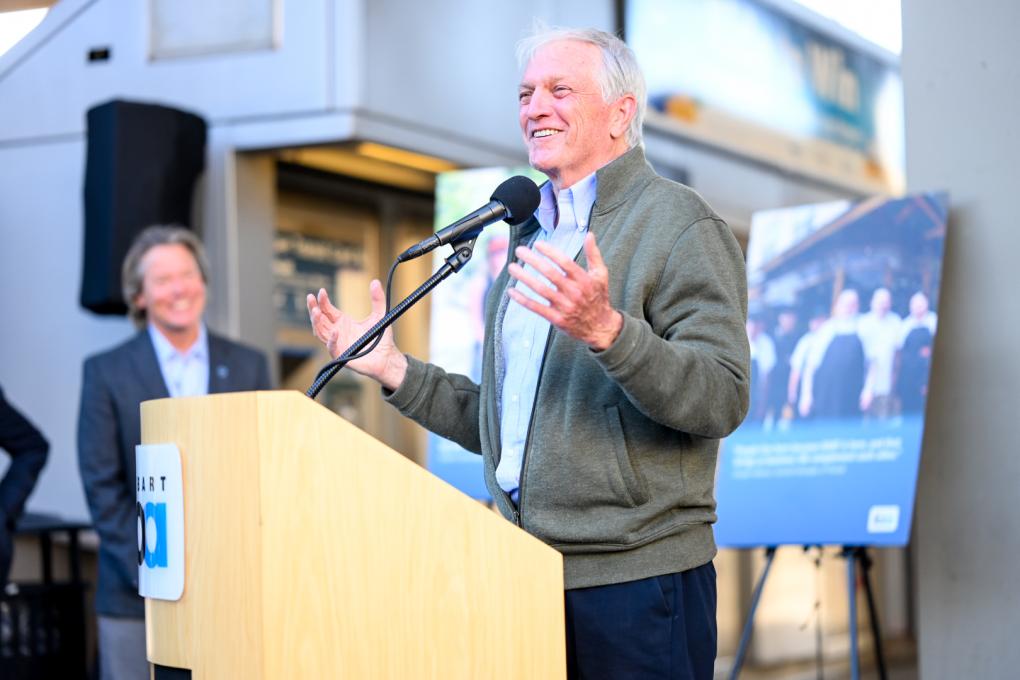
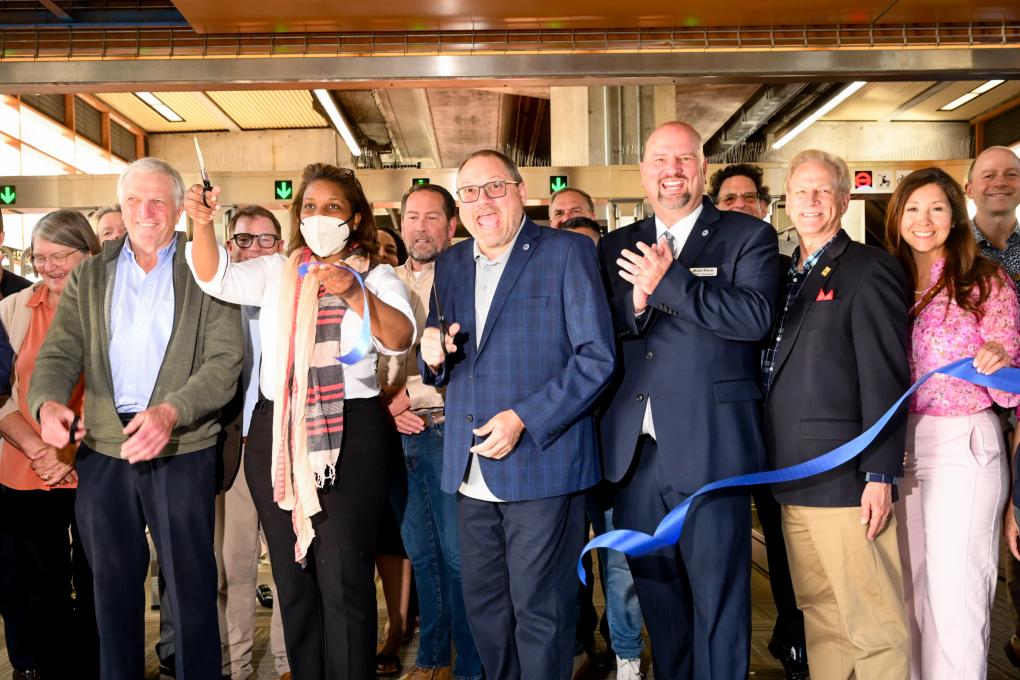
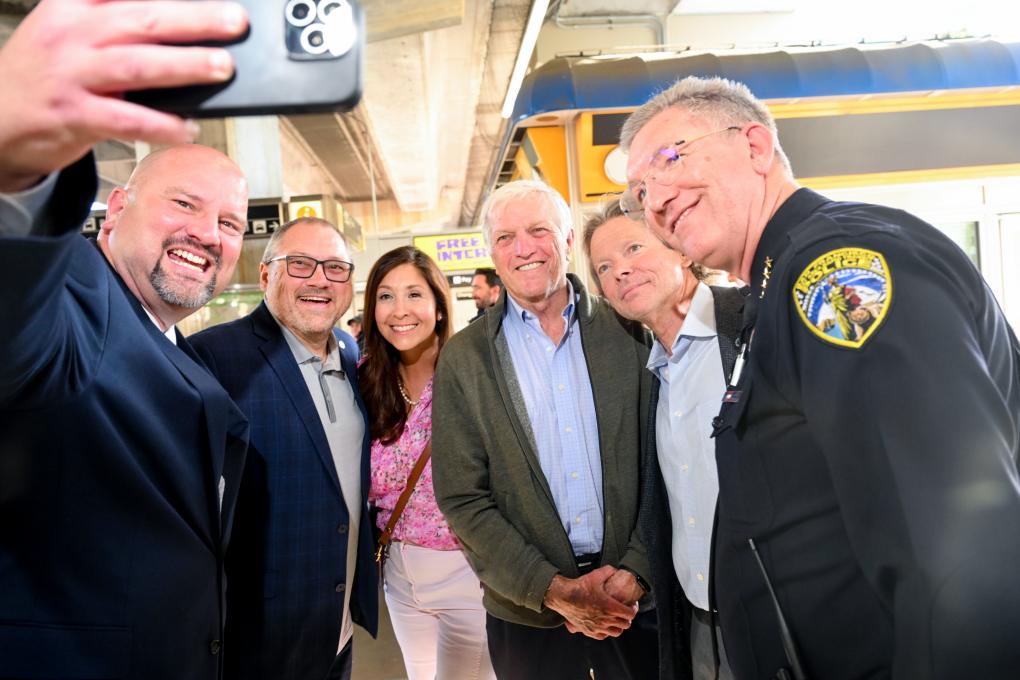
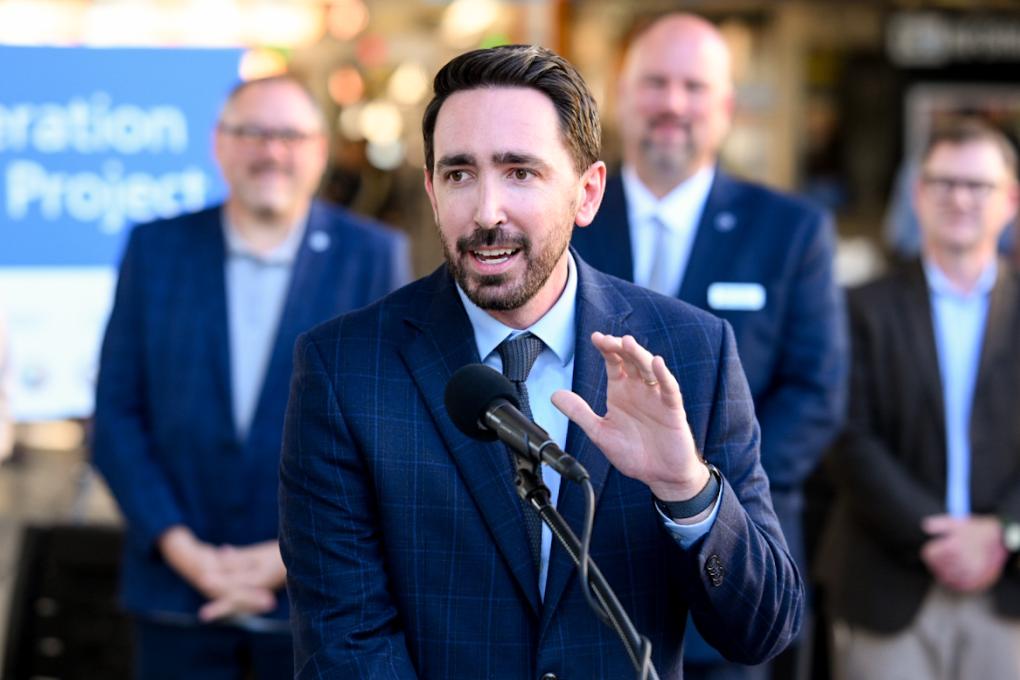
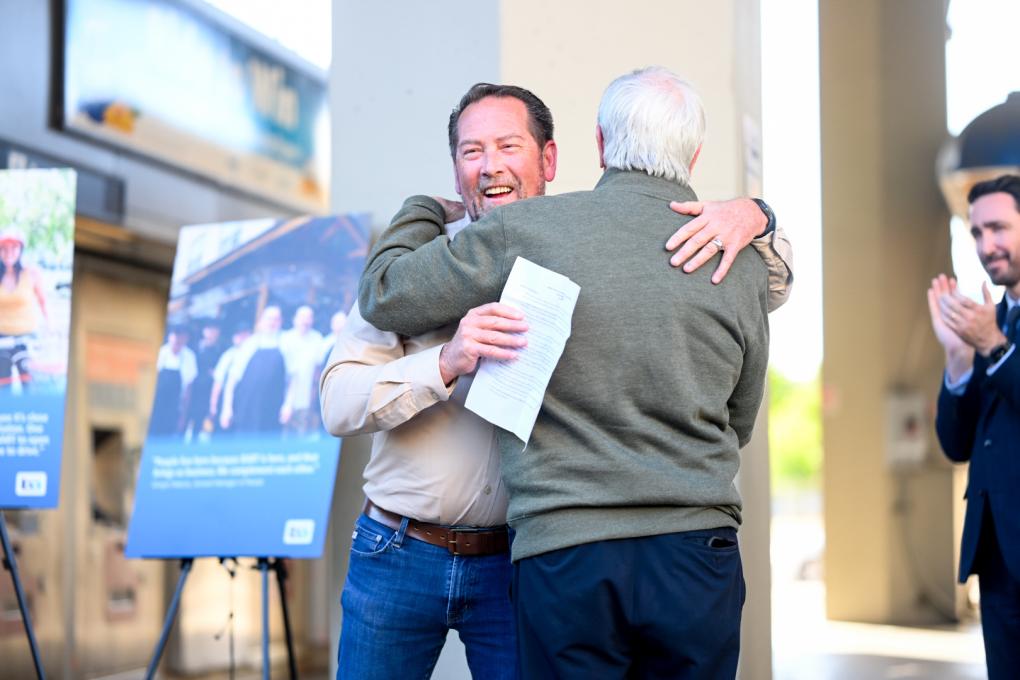
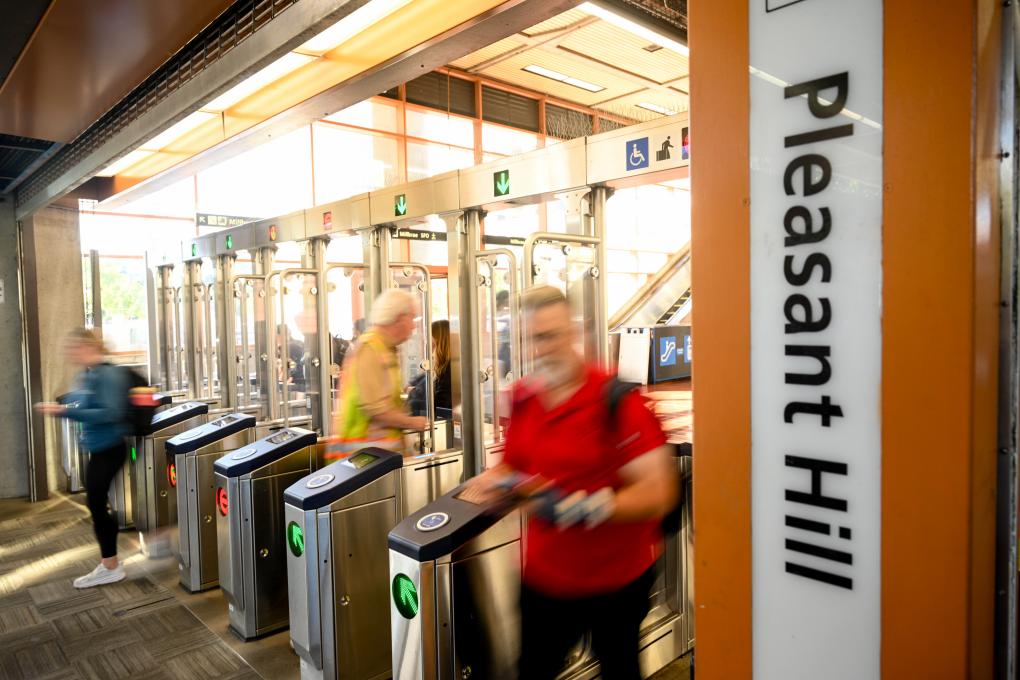
Congressmember Mark DeSaulnier, so often at the forefront of transportation improvements in Contra Costa County, helped commemorate the installation of Next Generation Fare Gates at all 12 BART stations in Contra Costa County with a ribbon cutting ceremony at Pleasant Hill/Contra Costa Centre Station on May 29, 2025. The event marked a major milestone in BART’s systemwide plan aimed at enhancing safety, accessibility, and the overall rider experience.
The Next Generation Fare Gates feature cutting-edge security and user-centered design elements, including enhanced reliability, better accessibility, and reduced fare evasion. With transparent barriers and faster processing technology, the new gates offer a seamless experience for all passengers, including those with mobility devices, strollers, and luggage.
Congressmember DeSaulnier, who provided leadership for the BART to Antioch extension during his time in the state legislature, noted the importance of investing in the future of BART in Contra Costa County.
"We know that these fare gates will make a tremendous impact for farebox recovery, safety, and the overall experience," Congressmember DeSaulnier said. "This is a significant project for the region, and I'm grateful to be a part of it."
This milestone was made possible thanks to critical funding contributions from partners such as the Contra Costa Transportation Authority (CCTA), led by Executive Director Tim Haile. CCTA’s support underscored a strong regional commitment to modern, integrated transit solutions.
BART Board President Mark Foley and Director Matt Rinn, who represents Pleasant Hill/Contra Costa Centre Station, also spoke at the event, emphasizing the importance of updating aging infrastructure and restoring rider confidence.
“I am thankful for the opportunity to showcase these fare gates, which are just one example of our new approach to safety and security on BART,” Rinn said. “Pleasant Hill/Contra Costa Centre Station is a big part of the community, and I appreciate the opportunity to showcase the station and what it’s all about.”
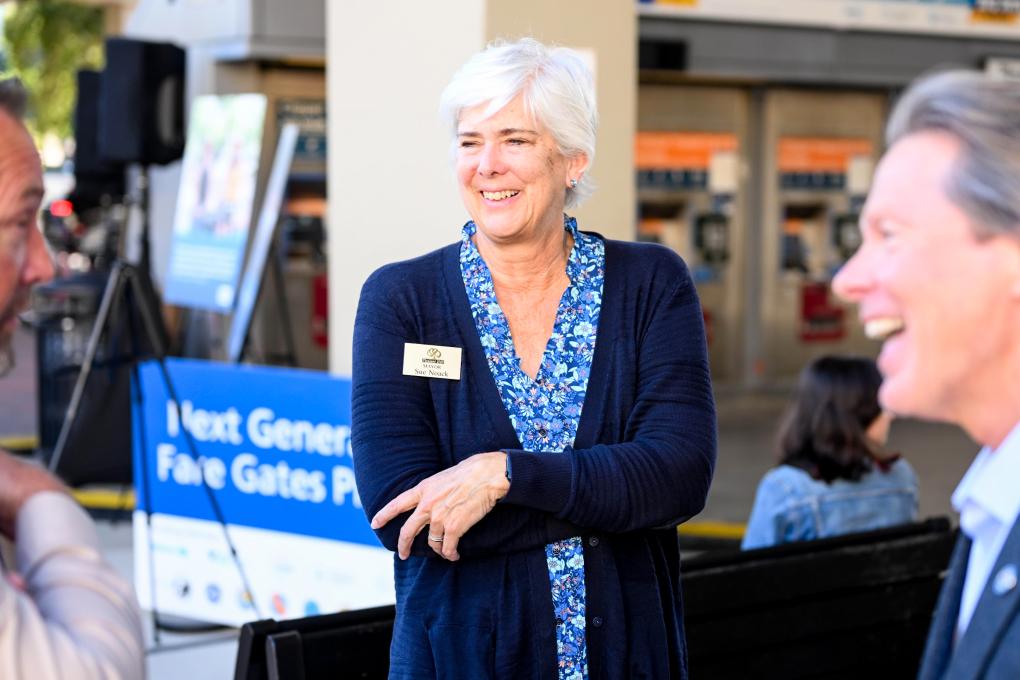
Metropolitan Transportation Commission chairperson Sue Noack, who is also the mayor of Pleasant Hill, noted the role of Pleasant Hill/Contra Costa Centre Station in connecting the surrounding community to the region, providing convenient and easy access to places of employment, recreation, and services. New fare gates across the system are increasing paid ridership and improving customer safety.
In his remarks, President and CEO of the East Bay Leadership Council Mark Orcutt stressed the importance of transportation to the region's economic well-being.
“The rollout of the Next Generation Fare Gates behind me represents something more than safety upgrades; it’s a strategic investment in regional economic competitiveness,” said Orcutt. “Transit moves people, and people move the economy. This is a visible step towards a safer, cleaner, and more welcoming experience for riders.”
As a BART rider, CCTA Commissioner and Contra Costa Supervisor Ken Carlson said he is "thrilled to have these new gates."
“CCTA is committed not only to our local transportation system, but the regional system at large, and I applaud BART and the efforts they’ve made to build trust in the community and to make the system more efficient and secure," he said.
With the successful completion of the Contra Costa County installations, BART reaffirmed its commitment to completing fare gate upgrades at all 50 stations in the system by December 31, 2025.
The installation of the new fare gates at Contra Costa County stations would not have been possible without the support of BART’s funding partners:
The California Strategic Growth Council / California Housing and Community Development (HCD)
Caltrans / California Transportation Commission
The Contra Costa Transportation Authority
The Federal Transit Administration
The Metropolitan Transportation Commission
BART's low-income fare discount to increase to 50% on Jan. 1: Here's how the program impacts an East Oakland community
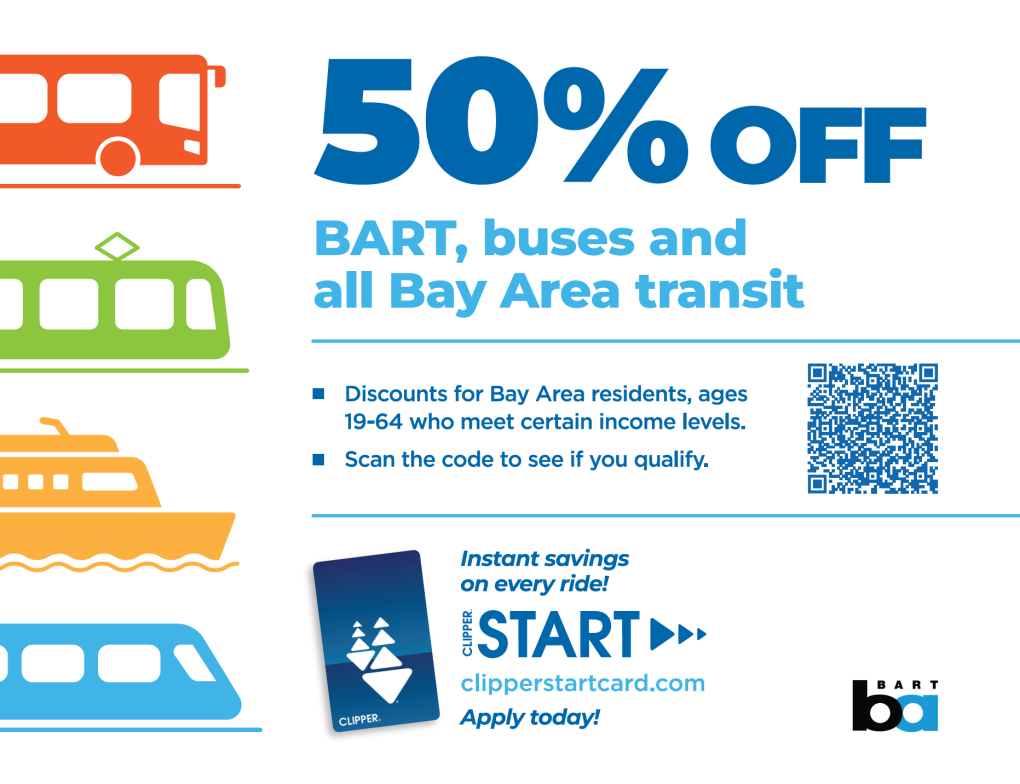
BART is helping lower-income riders pay their fare by increasing its Clipper START means-based fare discount from 20% to 50%, beginning Monday, Jan. 1, 2024. This means that Clipper START users will pay half the regular BART fare.
Clipper START, a pilot program facilitated by the Metropolitan Transportation Commission, offers the discount for Bay Area residents ages 19 to 64 whose incomes are less than 200% of the federal poverty level. Clipper START is accepted by more than 20 regional transit operators. Those who qualify can apply for the program here.
Keep scrolling to read about an East Oakland-based organization's efforts to register people for Clipper START and hear about its impact on community members.
BART offers multiple fare discounts in addition to Clipper START, including discounts for youth (50% off with a Youth Clipper card), seniors (62.5% off with a Senior Clipper card), passengers under 65 with qualifying disabilities (62.5% off with an RTC Clipper card), and a High-Value Discount (adult Clipper users who buy $45 or $60 Clipper cards when autoload is set up get $48 and $64 worth of value, or a 6.25% discount).
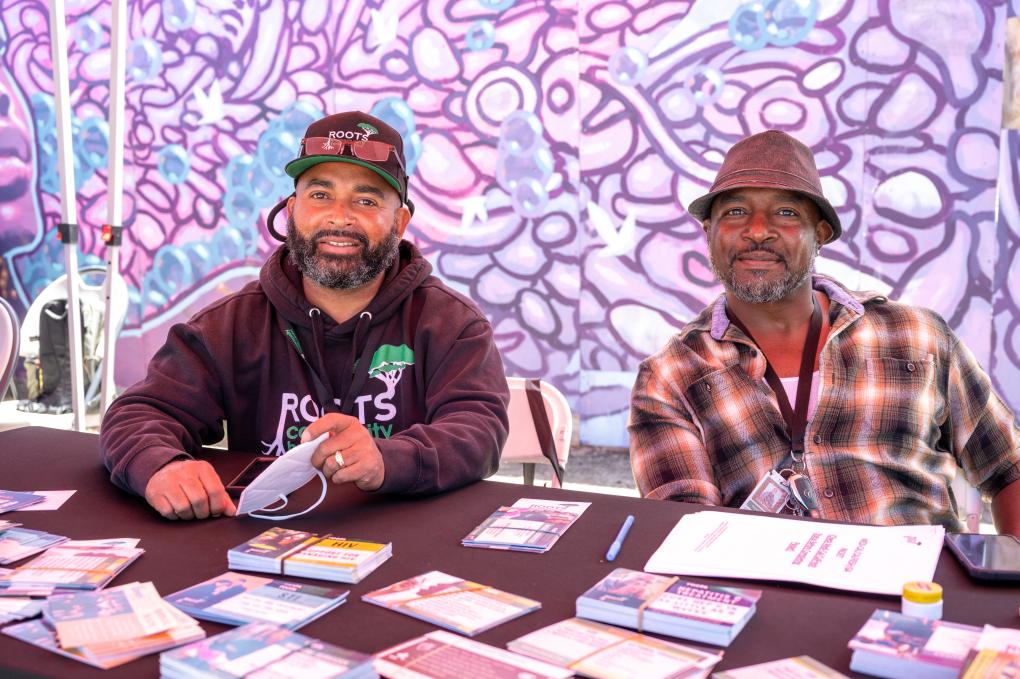
Members of the Roots Community Health Center outreach team. Roots conducts outreach to promote and register community members for Clipper START.
“When you have a Clipper card, your first thought isn’t 'I can't' but ‘What time can I get there?’” says Jamaica Sowell, who has witnessed firsthand the importance of increasing access to affordable transportation in the Bay Area.
Sowell is the Director of Programs and Policy at Roots Community Health Center, an organization working to uplift people impacted by systemic inequities and poverty, especially in a stretch of the East Oakland community known as the 40x40, where nearly half of Black families living in poverty in Oakland reside.
Since 2022, Roots has been conducting outreach to promote and register community members for Clipper START, a pilot program from the Metropolitan Transportation Commission (MTC) that offers discounts on transit fares. To qualify, applicants must be Bay Area residents between the ages 19 and 64 with a gross annual income at or below 200% of the federal poverty level. Beginning January 1, 2024, BART’s Clipper START discount increased from 20% to 50%, meaning users pay half the regular BART fare.
Roots Clinic has a holistic approach for supporting the health and well-being of the communities it serves. Enabling access to transportation, especially affordable transportation, is a key piece of the puzzle.
“Mobility has a lot to do with access, including things like health care,” said Sowell. If people don’t have the means to get to the Roots’ clinics, “they’re not going to come.”
Mobility is a central component of one's physical and mental health, Sowell stressed. Transportation, especially affordable transportation, ensures that people can access things like medical appointments, mental health care, treatment programs, benefits enrollment support, and other crucial services that organizations like Roots offer.
But going to appointments is "just one facet” of the benefits of public transportation to community members, Sowell said. Transportation gives people easier access to civic engagement activities, like city council meetings, and takes people to parks and green spaces, where you can walk, soak up sunshine, picnic with your family, and play sports with friends. For some people, just getting out of their neighborhood for a few hours is healing in and of itself.
“Transit takes you places outside your own block, including places you might not have had access to before,” Sowell said.
Clipper START actively conducts outreach to organizations like Roots, which have well-established lines of communication and trust within the communities they serve. Sowell said Roots jumped at the chance to partner with MTC on Clipper START because her organization understands the specific needs of the East Oakland community.
“When our people hear Roots is partnering with MTC and BART, it automatically establishes buy-in,” she said. “Our community members trust us and trust that we’ve vetted the program.”
Since Clipper START launched in June 2020, MTC reports that more than 30,000 people have signed up for the program. Between 2020 and 2022, the period for which the most recent data is available from MTC, Clipper START users took more than 1 million transit trips, with most of these trips taken on BART (40% of total trips).
“[Clipper START] makes me want to do more [with my family] on public transportation for necessity, but also for fun, like going to San Francisco for free museum days,” one user said.
As awareness of the program grows around the region, so too does usage.
That’s in no small part thanks to organizations like Roots, whose outreach teams promote the program at community events, apartment complexes, encampments, faith-based organizations, and door to door. Roots is exploring additional outreach avenues for the new year.
“Being able to tap into a discounted transportation platform like this is huge for our folks,” Sowell said. “Clipper START has been beneficial in improving transportation accessibility to our East Oakland community, and we look forward to our continued partnership in the new year.”
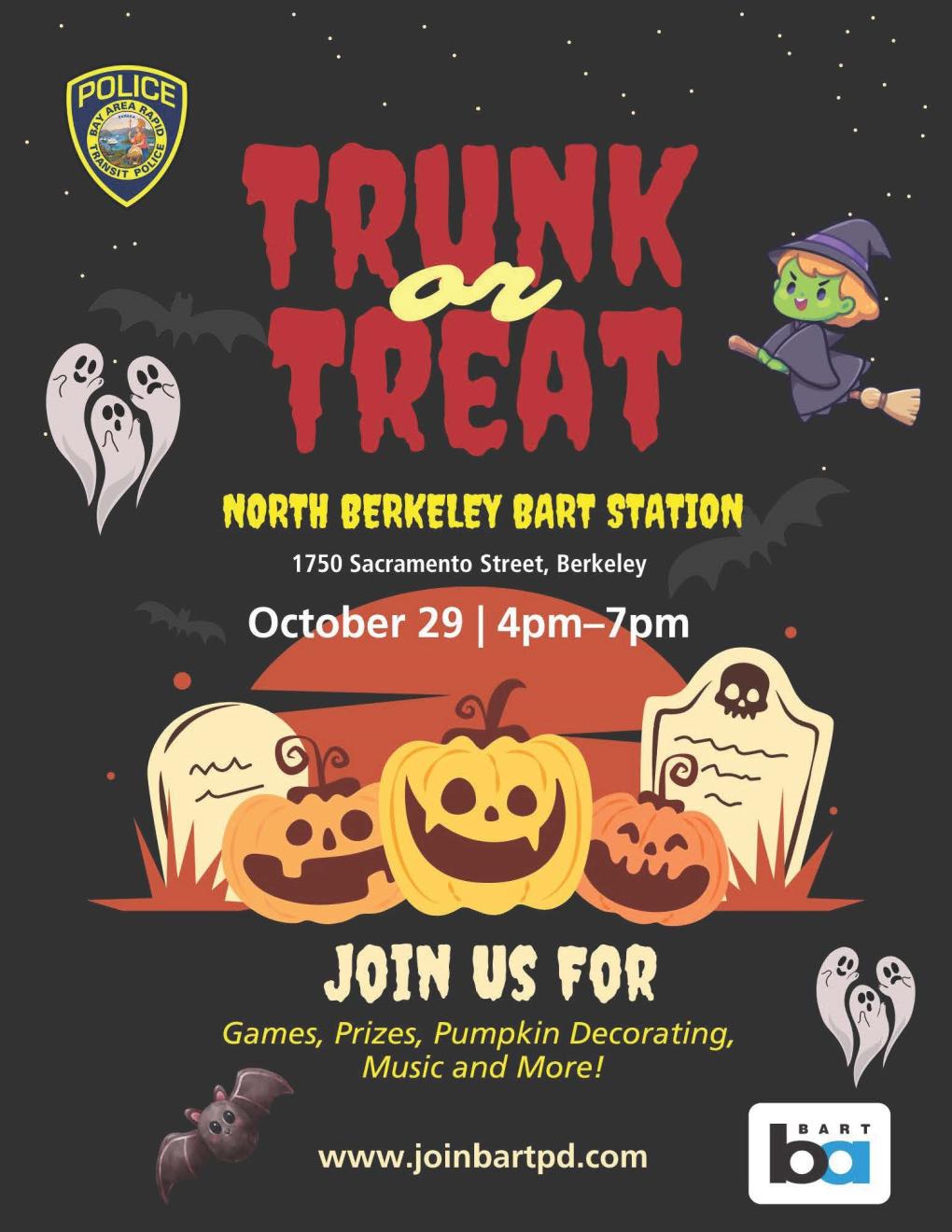
BART Police hosts Trunk or Treat at North Berkeley station on 10/29/24 from 4pm to 7pm
A spooky vibe is coming to the North Berkeley station!
The BART Police Department will be hosting its annual Trunk or Treat Halloween event there Tuesday October 29 from 4 pm to 7pm. There will be games, prizes, pumpkin decorating, music, and more ghoulish delights!
Children are invited to wear their Halloween costumes, but costumes are not mandatory. Kids will get to collect candy and non-candy treats, play games and win prizes.
The event is open to children under the age of 12 and entrance is free. Children must be accompanied by an adult.
*This article was originally posted on Oct 2, 2024.