Search Results
Hercules Park & Ride
Parking spot reductions and other access changes begin on Sept. 14 at West Oakland Station for affordable housing construction
BART’s development partners (Mandela Station Partners, LLC) are initiating construction of 240-affordable housing units at the West Oakland BART Station on September 14, 2026. This work impacts all station access amenities including buses, vehicle and bicycle parking, pick-up/drop-off, and circulation.
Vehicle Parking: Approximately 240 out of 440 parking spaces will be removed for this phase of construction, leaving 200 first-come, first-served Daily Parking spaces available, including 11 ADA spaces. Additional BART customer parking is available at most other BART stations with parking, including Fruitvale Station (5 miles from West Oakland).
Circulation: Vehicle, pedestrian, and bicycle circulation will remain open on the east and north sides of the station site. Access to the south from the entrance will be restricted.
Pick-up/Drop-off:
- Regular Pick-up/Drop-off will be moved to Southbound Chester at 7th St and Westbound 7th at Center Street.
- Accessible Pick-up/Drop will continue to be accommodated in the current location in front of the station.
- Ride App Pick-up: use Regular Pick-up/Drop-off locations
Bicycle Parking:
- All bike parking from the south (5th Street) side of the station has been relocated to the north (7th Street) side.
- Bicycle lockers are in two locations:
- Outside the NE corner of the station (16 spaces) ; and
- Just inside the BART parking lot west the main pedestrian entry from 7th Street (64 spaces).
- Bike racks (32 spaces) are located on the plaza directly outside the station on the east side of the entrance
- The shared Lyft Bikes (formerly Bay Wheels) are now located in the BART parking lot near 7th & Chester, west of the main pedestrian entry point.
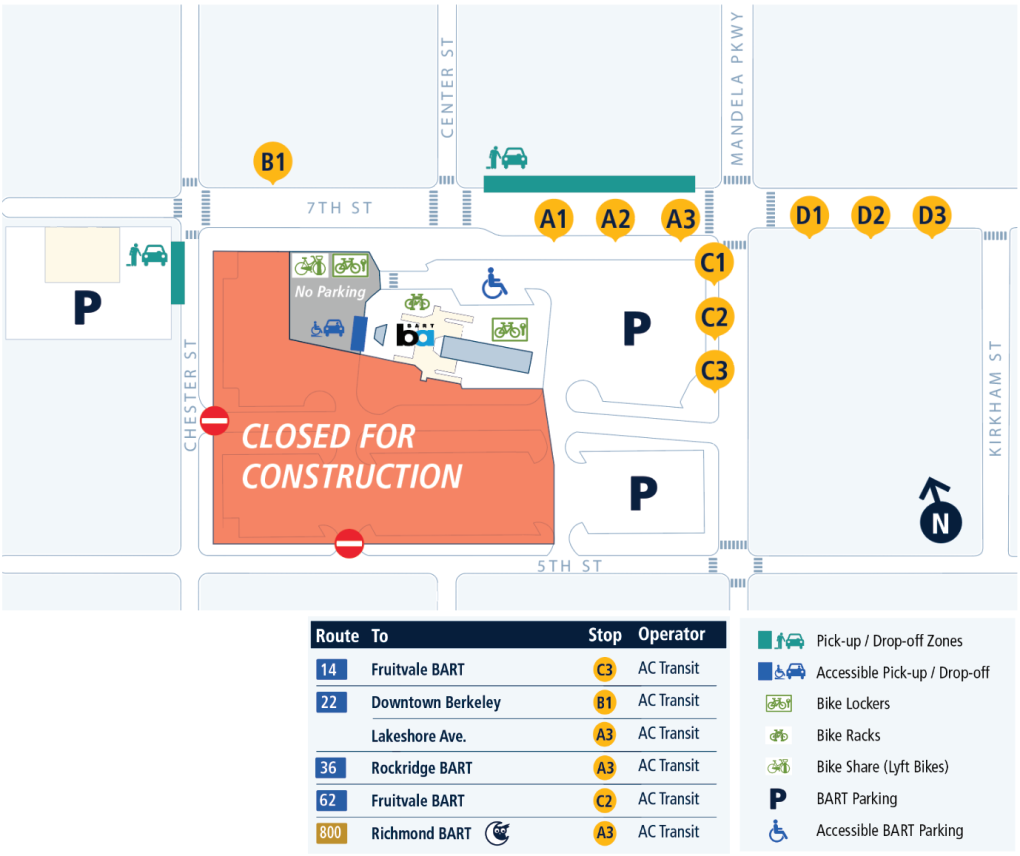
Buses: AC Transit buses have been moved to on-street locations on 7th St and Mandela. Below the table is a description of where each bus stop is located.
| Route | To | Stop | Operator |
| 14 | Fruitvale BART | C3 | AC Transit |
| 22 | Downtown Berkeley | B1 | AC Transit |
| 22 | Lakeshore Ave | A3 | AC Transit |
| 36 | Rockridge BART | A3 | AC Transit |
| 62 | Fruitvale BART | C2 | AC Transit |
| 800 | Richmond BART | A3 | AC Transit |
| Emery Shuttle | No change | ||
- Bus Stops A1 to A3 are on Eastbound 7th St, between Center and Mandela. A1 is closest to Center, A3 is closest to Mandela. When exiting the faregates, turn right and proceed to 7th St. Turn right. A1 is approximately 170 ft away.
- Bus Stop B1 is on Westbound 7th St. Between Center and Chester. When exiting the faregates, turn right and proceed to 7th St. Cross 7th St and turn left on the opposite side of 7th St. B1 is approximately 175 ft away
- Bus Stops C1 to C3 are Southbound Mandela between 7th St and the BART Station driveway, C1 is closest to Mandela, C3 is closest to the BART driveway. When exiting the faregates, turn right and proceed to 7th St. Turn right and proceed to Mandela. Turn right onto Mandela, C1 is approximately 60 ft away.
- Bus Stops D1 to D3 are on Eastbound 7th St on the opposite side of Mandela from the station, near the gas station. When exiting the faregates, turn right and proceed to 7th St. Turn right and proceed to Mandela. Cross Mandela, D1 is approximately 120 ft away. D2 is after the Gas Station driveway.
The following map depicts the changes. View a PDF of the map.
Learn more about this exciting Transit Oriented Development project that will ultimately include affordable and market rate homes and retail space located on both sides of the West Oakland BART Station at the City of Oakland’s website.
Once completed, the master plan will deliver:
Up to 762 new residential units, including 240 affordable units
Approximately 53,000 square feet of ground floor retail space
Approximately 300,000 square feet of office space
Improved bikeways on 7th Street and Mandela Parkway and a new bike station
Streetscape improvements on 5th Street, 7th Street, Mandela Parkway, and Chester Street
Enhanced pedestrian access to the station and a new BART plaza
Transit-Oriented Development projects at BART stations are fully financed by the private development teams. They are responsible for securing project financing — including grants and other funding sources — and constructing the housing and related improvements. BART does not pay for the development. BART’s role is as the landowner and long-term ground lessor, and these projects are structured to generate revenue for BART over time. Studies have shown Transit-Oriented Development increases BART revenue as people who live close to transit take more trips on transit. The developments also generate lease revenue to BART.
Hayward Station: bus route changes starting 3-25
Construction for the next phase of the Hayward Station Accessibility Improvements Project will begin on Monday, March 25, 2024 and last for approximately 3 weeks.
During this phase, five bus bays will be closed, and buses will move to new locations within the station area.
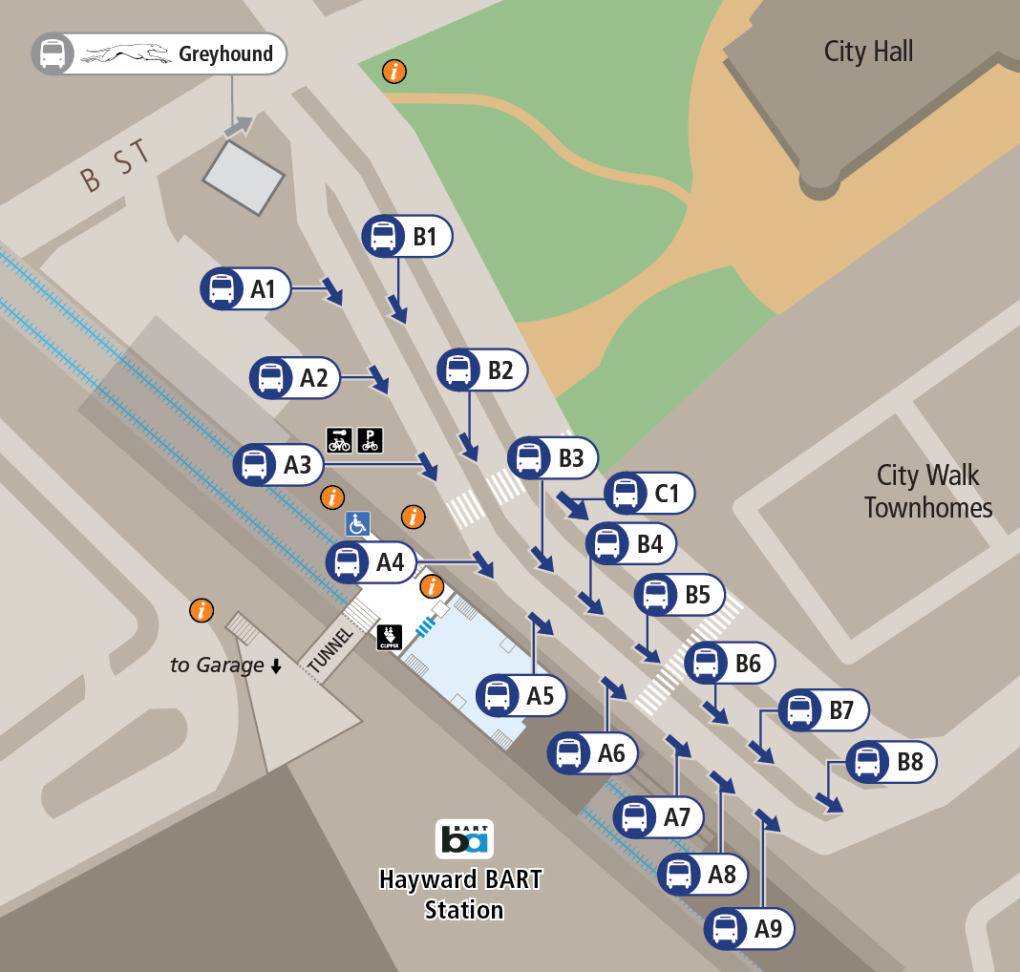
Buses will be located in the bus bays shown in the list below.
Bus bay numbers are shown in the map below and posted at each stop location.
Aisle A is closest to the station, Aisle B is the bus island, Aisle C is in the Passenger Loading area. Bus bays are numbered sequentially starting from the bays closest to B Street.
| Line | To | Bay # |
| 10 | San Leandro BART | A3 |
| 28 | San Leandro BART | A4 |
| 34 | Foothill Square | A1 |
| 41 | Union Landing Transit Ctr | B3 |
| 56 | Union Landing Transit Ctr | B3 |
| 60 | South Hayward BART | B7 |
| 60 | Cal State East Bay | B6 |
| 86 | South Hayward BART | B2 |
| 93 | Bay Fair BART | B6 |
| 93 | Castro Valley BART | B7 |
| 95 | Fairview District | B8 |
| 99 | Fremont BART | B5 |
| 801 | San Leandro BART | A3 |
| 801 | Fremont BART | A2 |
| Cal State East Bay Shuttle | B1 | |
| SFO Employee Shuttle | C1 |
Announcements recorded by local youth with autism playing in stations for Autism Acceptance Month
This April, listen closely to the PA announcements in BART stations; you might just hear the voice of one of BART’s biggest fans.
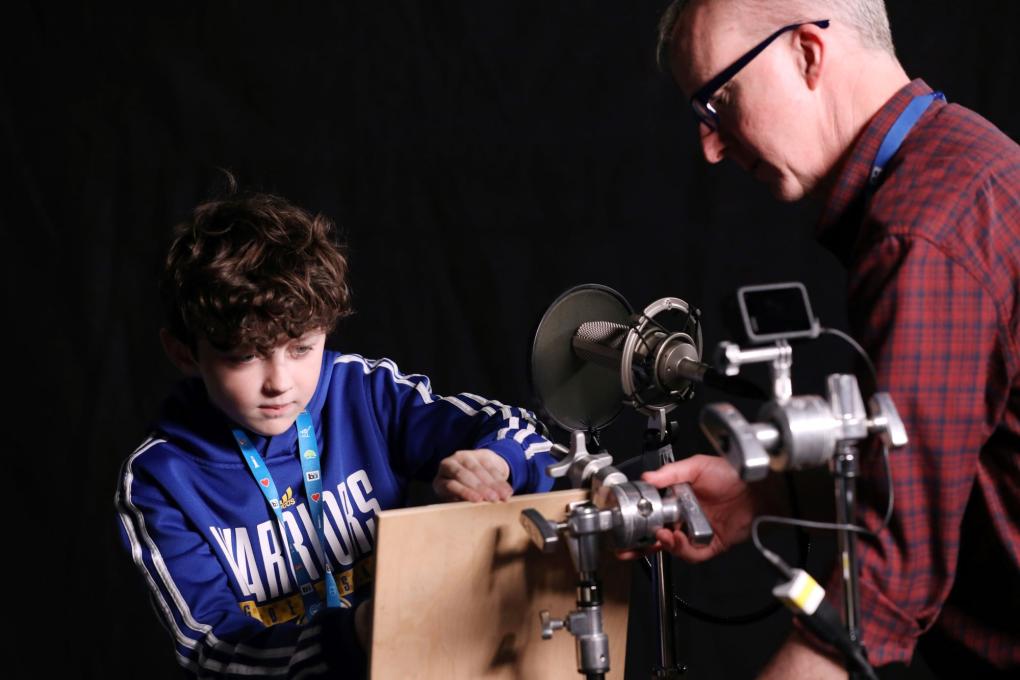
For Autism Acceptance Month in April, 12 local youth on the autism spectrum spent an afternoon at BART Headquarters to record the very special announcements, which will play every 15 minutes at stations through the end of the month.
The announcements go something like this: “Hi, BART riders. I’m Cameron Clay. I love BART because the trains are so fast. I like riding through the Transbay Tube. Happy Autism [Acceptance] Month.”
Participants like 19-year-old Cameron were invited to put their own spin on their announcements. 9-year-old Max Reese, for example, used his spot to encourage people to check out BART’s merch store, Railgoods.com -- “They’ve got everything!”
Max said his favorite part of the day was “basically everything.”
“The moment the school bell rang, I was dashing out of that school to go here,” he said. He appreciates BART because “I get to go on these amazing adventures with my family” and it helps people “go to work on time and not miss out on anything or get fired.”
Jonathan Trichter, the CEO of several schools for children with autism and related neurological differences, created the Autism Transit Project in 2022.
Children with autism sometimes have a special affinity for trains, he said.
“Frontline workers see it every day,” he said. “They see these kids who drag their parents onto trains for joy rides or who ask questions so detailed they stump your seasoned operators! Transit is a place where many of these children feel safe, engaged and understood.”
For some children on the autism spectrum, the first full sentence they ever speak is a transit announcement, Jonathan explained. "These messages hold a special meaning for them and their families. Keeping this project going honors that bond. It gives transit agencies a chance to celebrate a constituency that loves them like no other.”
In addition to BART, participating agencies this year include New Jersey Transit, the Washington Metropolitan Area Transit Authority, the Chicago Transit Authority, and the Massachusetts Bay Transportation Authority.
The project kicked off after a successful pilot with the Metropolitan Transportation Authority in New York, spurring Jonathan to reach out to other agencies to see if they’d like to participate.
“It was an immediate yes,” said BART Chief Communications Officer Alicia Trost, whose department has organized and hosted the event since 2023. “We know many of these families spend hours riding BART, and this is a special opportunity to hear directly from them and to experience transit through their eyes.”
During the annual event, participants and their families spent the entire afternoon at BART, not just to record the announcements, but to learn about the system directly from staff. Employees gave presentations and answered questions about the inner workings of the agency, while engineers and transportation staff set up booths around the room with cool equipment the kids could touch and explore.
Special appearances included BART Director Victor Flores and BART Deputy General Manager Michael Jones, as well as two animal celebrities: BART PD K9 Kygo and Pac-Man, the Harris hawk who helps BART with station pigeon abatement.
Let's close things out with a message from 8-year-old King Colon: “Hi BART riders, I’m King. I love BART because of the sound the train makes, the technology’s really cool, and it can take me to my favorite places.” We couldn’t have said it better ourselves!
To listen to participants’ announcements, click the blue hyperlinks below – or better yet, visit a station!
Performance and Innovation
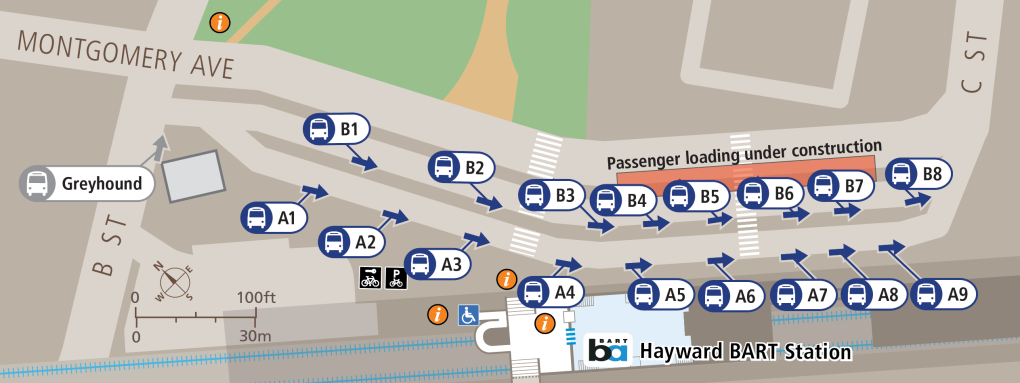
Hayward Station: Passenger loading impacts and bus stop changes starting 5/2
Construction for the next phase of the Hayward Station Accessibility Improvements Project will begin on Thursday, May 2, 2024 and last for approximately 3 weeks.
During this phase, the following changes will occur:
- About half of the passenger loading zone will close – the remaining portion will stay open with an accessible pedestrian path to the station entrance.
- Most bus bays will change locations within the station area.
Buses will be located in the bus bays shown in the list below.
Bus bay numbers are shown in the map below and posted at each stop location.
Aisle A is closest to the station, Aisle B is the bus island. Bus bays are numbered sequentially starting from the bays closest to B Street.
| Line | To | Bay # |
| 10 | San Leandro BART | A2 |
| 28 | San Leandro BART | A8 |
| 34 | Foothill Square | B6 |
| 41 | Union Landing Transit Ctr | B7 |
| 56 | Union Landing Transit Ctr | B8 |
| 60 | South Hayward BART | A6 |
| 60 | Cal State East Bay | A5 |
| 86 | South Hayward BART | A7 |
| 93 | Bay Fair BART | A5 |
| 93 | Castro Valley BART | A6 |
| 95 | Fairview District | A9 |
| 99 | Fremont BART | B5 |
| 801 | San Leandro BART | A2 |
| 801 | Fremont BART | A1 |
| Cal State East Bay Shuttle | B1 | |
| SFO Employee Shuttle | B2 | |
| Other Shuttles | B3 |
Installation work to begin week of December 11th on next generation fare gates at West Oakland Station
On December 28, 2023, BART opened the new fare gates at West Oakland station.
Installation of the prototypes of BART’s next generation fare gates is scheduled to begin the week of December 11 at West Oakland Station. The installation process is expected to take approximately two weeks to complete and the new fare gates will be open for use before Jan 1, 2024.
During those two weeks a construction barrier will be built around the existing station gate array. Riders will use two temporary accessible gates to enter and exit West Oakland Station. During peak hours, riders should expect lines to form. We advise people to arrive a few minutes early.
Both gates are located next to the Station Agent Booth, one on each side. When facing the booth from the non-paid area of the station, the fare gate to your right is used to enter the station and the fare gate to your left is used to exit.
Additionally, a carpet has been installed immediately before the entrance to each fare gate, to make these two gates easier to locate for riders with visual impairments. The removal of the old gates and installation of the prototypes will not impact train service.
The prototypes being installed at West Oakland will help us to test the new gates in a station environment with riders. These are not the final version of the fare gates that will be installed throughout the rest of the system. The development team is researching the latest door-braking technology and will add that enhanced capability to the fare gates in the coming months.
All BART stations will have new fare gates by the end of 2025. You can learn more about BART’s Next Generation Fare Gate project at bart.gov/about/projects/fare-gate. Riders can provide feedback about the new gates at bart.gov/comments.
BART General Manager Bob Powers released a statement on new fare gates:
“As a transportation system, we take tremendous pride in saying our riders are what runs BART. Among the world’s transit agencies, BART relies the most on rider fares; they are directly responsible for funding our operations. These new, state-of-the-art fare gates will protect against fare evasion, expand access to transit-dependent riders, and reduce system downtime due to maintenance, which helps boost investment in BART’s long-term growth.”
BART Police Chief Kevin Franklin also applauded the unveiling in a statement:
“We welcome the new fare gates starting at West Oakland and its future expansion to other stations. These stronger, higher gates will limit fare evasions through self-enforced fare payments, keep riders safe and engaged to return to BART, and have police officers focused on more serious situations that require emergency services.”
BART’s Safe and Clean Plan focuses on attracting riders to return to the system by introducing the transit system to the 21st century. BART is making dramatic improvements, from new payment method systems to infrastructure renovations, to guarantee customers a clean, safer ride.

Summer Guides
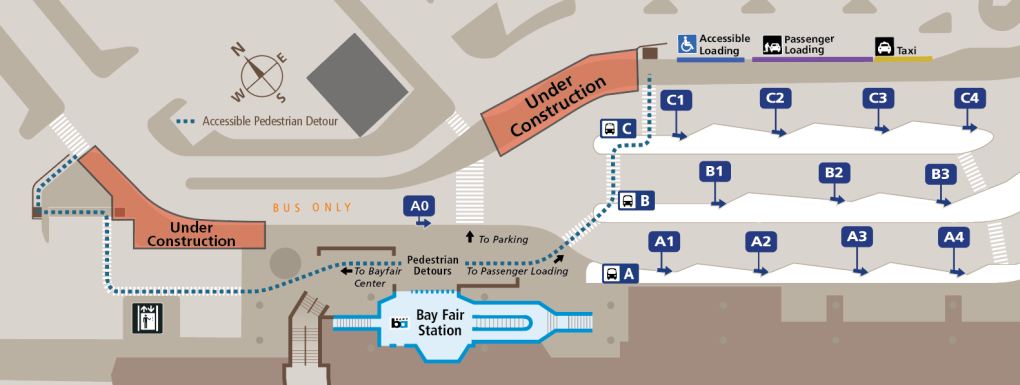
Bay Fair Station: Accessibility Improvements- 2023/2024
UPDATE December 29, 2023
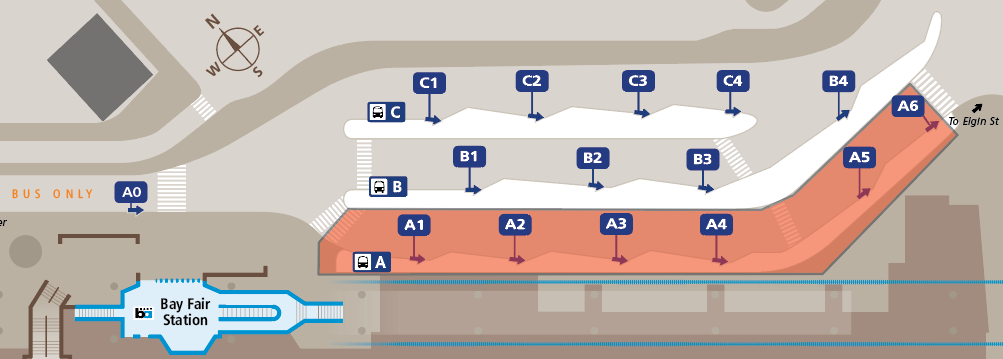
The next phase of work at Bay Fair will start on January 15th and will last 4 weeks. During construction, all pedestrian detours will be accessible. Construction will take place in two locations (see map below):
- In the passenger loading zone, the accessible loading zone will be replaced and the regular pathway to the passenger loading zone will be blocked by fencing. To get to the passenger loading walk through the bus area, towards Bus Bay C1. A temporary crosswalk will be provided from there to the passenger loading zone.
- On the pathway towards the Bayfair Center. A segment of sidewalk will be replaced between the station and the first crosswalk. A pedestrian detour will be provided from the station elevator, across a small parking area, and around a landscaped area to connect to the existing crosswalk.
No construction will take place in the bus area during this phase.
The Accessibility Improvement Program (AIP) will improve accessibility in and around BART stations to better meet the needs of people with disabilities, including replacement or upgrade of ramps, sidewalks and accessible paths, bus and passenger loading zones, as well as handrails, wall protrusion detection, wheelchair-accessible phones, TTY devices, courtesy phones, and elevator lobby lighting.
The entire project will be done in phases with full completion by Spring 2024. Thank you for your patience as we work to improve access to the BART Station.
UPDATE December 7, 2023:
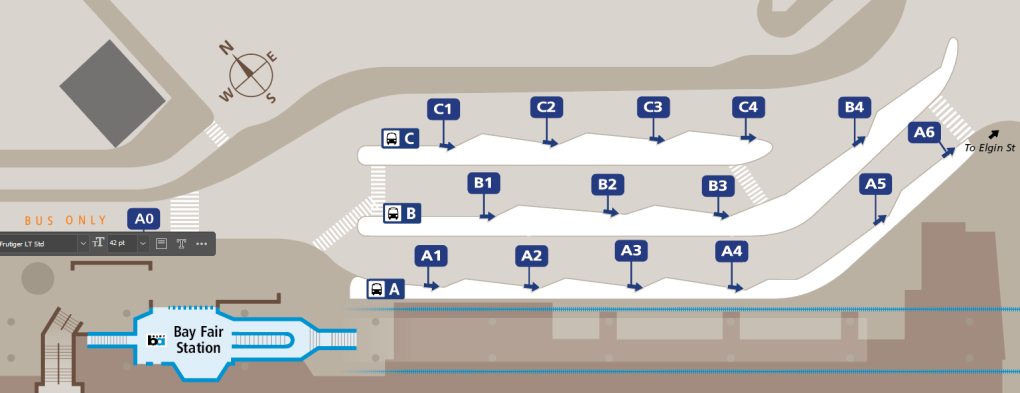
Construction for the next phase of the Bay Fair Station Accessibility Improvements Project will begin on Friday, December 8, 2023 and last for approximately 3 weeks.
During this phase, buses will return to their permanent locations (see list below for locations and map below). Construction will take place on sidewalks in the parking lot just south of the Police substation. All pedestrian detours will be ADA accessible.
AC Transit buses and shuttles will be located to the following bus bays.
- Line 10 to Hayward BART: A2
- Line 10 to San Leandro BART: A1
- Line 28 to Hayward BART: A4
- Line 28 to San Leandro BART: B3
- Line 35 to Juvenile Justice Center: C2
- Line 35 to Foothill Square: C3
- Line 40: B2
- Line 93: A3
- Line 97: A6
- Line 706: B1
- Line 801 to Fremont BART: A2
- Line 801 to San Leandro BART: A1
- Alameda County Sustainability Shuttle: C4
- San Leandro Flex Rides: C4
Temporary wayfinding signage will be posted to direct customers.
The Accessibility Improvement Program (AIP) will improve accessibility in and around BART stations to better meet the needs of people with disabilities, including replacement or upgrade of ramps, sidewalks and accessible paths, bus and passenger loading zones, as well as handrails, wall protrusion detection, wheelchair-accessible phones, TTY devices, courtesy phones, and elevator lobby lighting.
The entire project will be done in phases with full completion by Spring 2024. Thank you for your patience as we work to improve access to the BART Station.
UPDATE November 9, 2023:
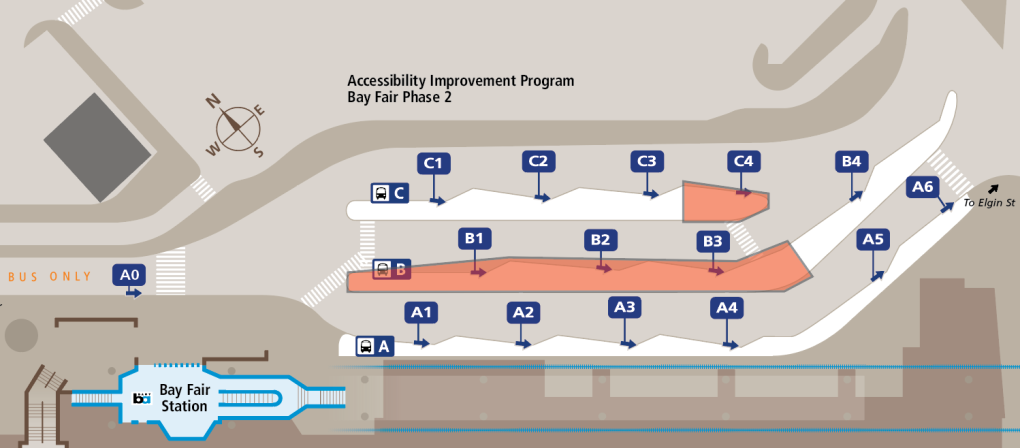
Construction for the next phase of work on the Bay Fair Station Accessibility Improvements Project will begin on Thursday, November 16, 2023 and last for approximately 3 weeks.
During this second phase, bus bays B1, B2, B3, and C4, will be closed. All pedestrian detours will be ADA accessible. AC Transit buses and shuttles will be relocated to Bus Aisle A and Bus Aisle C as follows:
- Line 10 to Hayward BART: A2
- Line 10 to San Leandro BART: A1
- Line 28: A4
- Line 35: C3
- Line 40: B4
- Line 93: A3
- Line 97: C1
- Line 706: A0
- Line 801 to Fremont BART: A2
- Line 801 to San Leandro BART: A1
- Alameda County Sustainability Shuttle: A0
- San Leandro Flex: A0
Temporary wayfinding signage will be posted to direct customers. All pedestrian detours will be accessible.
The Accessibility Improvement Program (AIP) will improve accessibility in and around BART stations to better meet the needs of people with disabilities, including replacement or upgrade of ramps, sidewalks and accessible paths, bus and passenger loading zones, as well as handrails, wall protrusion detection, wheelchair-accessible phones, TTY devices, courtesy phones, and elevator lobby lighting.
The entire project will be done in phases with full completion by Spring 2024. Thank you for your patience as we work to improve access to the BART Station.
NOTE: The information below was originally posted on October 6, 2023
Construction for the first phase of the Bay Fair Station Accessibility Improvements Project will begin on Monday, October 16, 2023 and last for approximately 5 weeks.
During this first phase, the first aisle of buses (shown in map as Aisle A), will be closed. Pedestrian access to Elgin Street, south of the station, will be available by walking down Bus Aisle B. The pedestrian detour will be ADA accessible. AC Transit buses will be relocated to the Bus Aisle B and Bus Aisle C as follows:
- Line 10 to Hayward BART: B3
- Line 10 to San Leandro BART: B2
- Line 28: B1
- Line 35: C3
- Line 40: B4
- Line 93: A0
- Line 97: C1
- Line 706: B1
- Line 801 to Fremont BART: B3
- Line 801 to San Leandro BART: B2
The Alameda County Sustainability Shuttle will remain in its current location of Bus Bay C4. Temporary wayfinding signage will be posted to direct customers.
The Accessibility Improvement Program (AIP) will improve accessibility in and around BART stations to better meet the needs of people with disabilities, including replacement or upgrade of ramps, sidewalks and accessible paths, bus and passenger loading zones, as well as handrails, wall protrusion detection, wheelchair-accessible phones, TTY devices, courtesy phones, and elevator lobby lighting.
The entire project will be done in phases with full completion by Spring 2024. Thank you for your patience as we work to improve access to the BART Station.