Search Results
Potential Transit-Oriented Development at Fremont Station
Successful Fall 2025 Open Houses about potential Transit-Oriented Development at Fremont Station
Update 11/3/25 - We want to thank the over 200 community members and riders who took time to provide thoughtful ideas for potential transit-oriented development (TOD) on a portion of Fremont Station’s surface parking lots. We enjoyed interacting with everyone at the two open houses in September and October (Open House Flyer - 說明會 - 公告 - Jornada de puertas abiertas - anuncio). The input received will help shape Fremont Station’s TOD by establishing goals and objectives to guide BART, the City, and the future developer.
Open House Boards - 說明會 - 展示板 - Jornada de puertas abiertas - tablero
What’s next? BART will pursue development in two phases. The first phase will consist of developing about 8 acres on the east side of the station near Mowry Avenue, which is currently being used for BART parking. The goal is to solicit developer interest in Spring 2026, analyze their responses through a competitive process, and obtain approval of the selected developer from BART’s Board of Directors about six months later. Once complete, the selected developer, BART, and the City of Fremont will engage with BART riders, community members, and other stakeholders throughout the TOD design and permitting process.
Sign Up for Project Email Updates
* denotes required field.
Questions? Email Principal Property Development Officer Matt Lewis at [email protected]
October saw highest average weekday ridership since the pandemic
BART ridership continued its steady recovery in October, posting the highest weekday average since the pandemic began.
Ridership was 10.7% higher than October 2024, with an average of nearly 200,000 weekday riders. In total, passengers took more than 5.3 million trips during the month. On Saturday, October 18, BART recorded 150,000 trips—the highest Saturday ridership since the pandemic.
Usage of the new Tap and Ride payment system continues to grow. Nearly 10% of all trips in October used Tap and Ride, which allows riders to pay directly at the fare gates with a contactless bank card. Tap and Ride is now the second most-used payment method after Clipper Adult, with usage up 23% from September.
Special fare programs are also expanding. Clipper START, which offers a 50% fare discount to qualifying low-income riders, saw a 40% increase in usage over last October. Meanwhile, usage of Clipper BayPass, the all-in-one Bay Area transit pass, rose 13.4% in October alone and 138% compared to a year ago.
BART has been investing in system improvements based on rider feedback, prioritizing safety, cleanliness, and customer experience enhancements. Earlier this year, BART completed installation of stronger, more secure fare gates at all 50 stations and became the first Tap and Ride agency—a system that will soon expand to other local transit agencies through the Next Generation Clipper program.
These enhancements are making a visible impact. Riders are noting cleaner trains and stations and an increased safety presence throughout the system.
Despite encouraging ridership gains, BART continues to face a $375 million budget deficit. To close that gap solely with fare revenue, current ridership would need to more than double. BART’s most recent budget forecast projects a 4% ridership increase in 2026.
BART’s gradual recovery is closely tied to work-from-home trends in the region. While more riders are returning to the system, they are generally taking fewer trips due to remote and hybrid work schedules.
Additional ridership information is publicly available and posted monthly at this location: https://www.bart.gov/about/reports/ridership
Tap and Ride
System Development Planning
Entrance closure alert: Montgomery St. Station entrance at Sutter and Sansome to close for canopy construction
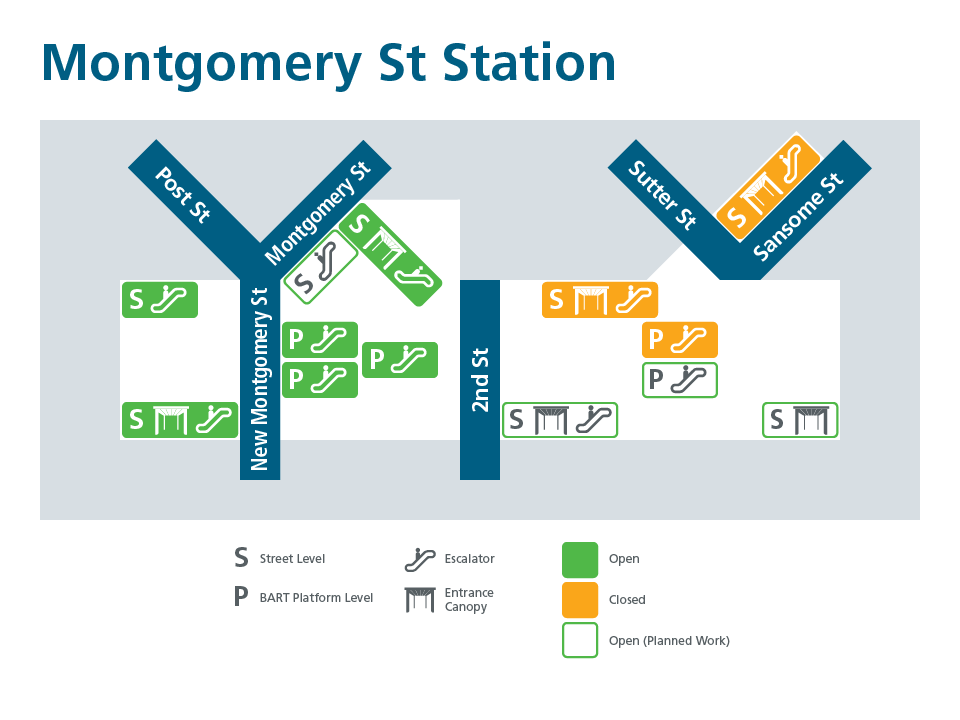
In late May / early June, the entrance to Montgomery Street Station at Sansome and Sutter Streets will be closed for the construction of a new canopy. The entrance is expected to remain closed until early 2025.
Six other entrances to Montgomery St. will remain open (please see the map below).
BART plans to construct a total of 21 street-level canopies over downtown station entrances. BART has completed construction of 10 units (including 2 pilot canopies) with 4 more canopies currently under construction and 7 additional canopies to be constructed through 2026. These entrance canopies will protect the new escalator equipment and reduce maintenance costs. In addition, canopies will include wayfinding, lighting, real-time information, and security cameras on Market Street.
Simultaneously, BART is replacing escalator units in the four downtown stations. These escalators are original to the BART system and have outlived their expected mechanical life, frequently requiring repairs. In 2020, BART began the escalator renovation project to replace 41 escalators at the four downtown stations on both platform and street levels. To date, BART has completed installation of 10 units, 4 are currently under construction, and there are 27 remaining escalator units to be completed through 2026.
Unified schedule changes will improve transit service in the Bay Area
Bay Area transit agencies are syncing schedules in a whole new way with a focus on improving transfers between systems and making schedule changes at the same time.
Most Bay Area transit agencies are rolling out new schedules next week in coordination with each other and are working to align the timing of schedule changes twice each year, once in summer and once in winter. There has been a 250% increase in the number of transit agencies changing their schedule concurrently twice each year, and six of seven major transit providers are syncing their schedule changes at least once a year.
Agencies convened a meeting in March 2024 to share planned changes for mid-August and to look for opportunities to improve transfers. Advancing schedule change alignment is a key priority for Bay Area transit general managers who meet on a weekly basis to make transit more rider-focused and efficient. The major agencies are already working on another iteration of a coordinated schedule change to go into effect in January 2025. These coordinated schedule changes will benefit current transit riders while attracting new riders.
Some key examples of improved coordination from the mid-August schedule changes:
- In the North Bay, a series of coordinated changes between SMART, Golden Gate Transit, and Marin Transit will improve service and connections along the congested Highway 101 corridor.
- The Napa Valley Transportation Authority is making changes to Route 29 from Redwood Park and Ride to the El Cerrito del Norte BART station to enhance the bus-to-train transfer timing. 71% of the trips will now have a 5- to 10-minute transfer time at El Cerrito del Norte, as opposed to 23% with the current schedule. The change will positively impact as many as 16,465 riders annually.
- AC Transit and Golden Gate Transit have improved schedules to be more coordinated at El Cerrito del Norte Station and along Cutting Boulevard west of the BART station. This alignment enhances reliability for riders traveling between Marin and West Contra Costa counties via the Richmond-San Rafael Bridge
- In San Francisco, Muni is making changes to improve regional connections, specifically, the 28 19th Avenue bus schedule serving Daly City BART station is changing to ensure East Bay riders can catch the last BART train to Oakland late at night.
- VTA is making changes to match upcoming BART and Caltrain schedule changes to ensure timed transfers are maintained at various locations across the South Bay and Peninsula.
- SamTrans is improving several bus routes that serve BART stations. One noteworthy change is to bus route 292, serving both Millbrae and SFO BART stations, with frequency (the time between bus arrivals) to be every 20 minutes from 6am- 6pm to match BART’s frequency.
- Both BART and Caltrain will make changes to improve some of the rail transfers at Millbrae Station that will go into effect when Caltrain launches its electric service on September 21. With BART’s schedule change on August 12 and Caltrain’s schedule change on September 21, ~85% of all weekday trains will have a transfer between 5 and 19 minutes at Millbrae Station. On the weekend, ~90% of trains will have a transfer between 5 and 19 minutes, allowing for both systems to be off schedule a bit but still provide a reliable connection. If trains were scheduled with less than a 5-minute wait, delays would frequently break the transfer and result in a longer wait.
Balancing Service Complexities
While all transit agencies are working to improve transfer timing for Bay Area transit riders, several challenges continue to exist making transfer timing difficult:
- A better transfer for one end of a route may create a worse transfer for other areas of the route.
- Adding service to allow frequencies to match each system requires new funding at a time transit agencies are facing significant budget challenges.
- Transfers between BART and Caltrain at Millbrae Station don’t always line up perfectly because Caltrain has four trains per peak hour and two trains per off-peak hour/weekends. BART has three trains per hour at all times. Both systems are also limited in flexibility due to key system timing points elsewhere.
Other Coordinated Improvements to Come
In addition to schedule coordination, Bay Area transit agencies are working together, along with the Metropolitan Transportation Commission, on significant regional projects that will transform the rider experience, such as unified transit maps and directional signs and fare integration and affordability programs such as the implementation of free and discounted transfers.
Green Line service restored as crews make additional repairs following Tuesday fire near Daly City
Update Friday, September 11, 5:00am:
BART is running trains on all five lines after BART crews worked overnight to make more repairs to equipment damaged by the Tuesday night fire at a traction power substation near Daly City Station. That includes restored Green Line service after the Green Line was unavailable all day Thursday.
Update Thursday, September 10, 2:15pm:
At this morning’s BART Board Meeting Assistant General Manager of Operations Sylvia Lamb provided an update on the Tuesday night fire at a traction power substation near Daly City Station. Lamb told BART Directors the leading cause of the fire appears to be extreme heat. The fire started after an HVAC unit in the substation room failed. She also said the substation is at least 40 years old, and the equipment’s age was likely a factor in the incident. The fire resulted in damage to the substation, train control equipment, and a traction power cable. Transbay service on Tuesday night was interrupted for approximately two hours.
BART has been running trains at reduced speeds between Daly City and Colma stations while crews continue to make repairs. Much of that work is happening in overnight hours when BART is not running service. BART has also been shortening service on some lines to reduce the number of trains travelling near Daly City, which is a complicated area of track interlockings and train movement. BART is reducing the number of trains that move through that area because the track switches currently can’t be moved remotely.
Currently, the Yellow, Red, Blue, and Orange lines are operating on normal schedules, while there is no Green Line service. The Green Line is not running to reduce train congestion near Daly City. BART has service to all 50 stations. Green Line riders can ride other lines and transfer to get to their destinations. That service plan is expected to remain in place for the rest of Thursday. A timeline for complete repairs and the return to five-line service is still unknown.
On Thursday afternoon there were minimal delays to the trains in service.
Update Thursday, September 10, 4:45am: BART crews continue to make repairs to train control equipment damaged by Tuesday night’s fire at a traction power substation near Daly City Station.
While there is service to all 50 stations and riders can travel everywhere in the system, there is currently no Green Line service to help reduce train congestion between Daly City and Colma. Regular Blue Line service is running. Riders should expect delays of 5 to 20 minutes through San Francisco in both directions.
Passengers who would normally take the Green Line from San Francisco can instead board a Blue Line train and transfer at Bay Fair to an Orange Line train to complete their trips to Berryessa. Passengers who would normally take the Green Line from Berryessa can instead take an Orange Line train and transfer at Bay Fair to complete their trips toward San Francisco.
BART service was disrupted last night, Tuesday, September 8, due to a fire at a power substation near Daly City. The cause of the fire is under investigation. While service was restored to all 50 stations by 11:30pm, there are additional repairs needed to be made to train control equipment impacting train speeds between Daly City and Colma stations and the number of trains running through that area. This is causing delays of 5-20 minutes to some trains near Daly City while others are running on time.
While all 50 stations are open and riders can get to all areas of the BART system, some lines are running a different service pattern to reduce train congestion through San Francisco and near Daly City. This means a transfer may be required to complete your trip.
- The Orange Line is running normal service Richmond to Berryessa.
- The Yellow Line is running normal service Antioch to SFO.
- The Red line is running normal service Richmond to Millbrae.
- The Blue Line is running Dublin to 24th St Mission.
- The Green Line is running Berryessa to MacArthur.
Riders should expect this service pattern all day and tonight with trains running at reduced speed between Daly City and Colma stations. The additional repairs will be made tonight when BART is closed.
At 8:15am, there was an unrelated fire near West Oakland that caused delays, as well as an unrelated medical emergency aboard an SFO bound train in the 9am hour that also caused some delays.
Suspect taken into custody in connection with September shooting onboard train that left victim with non-life-threatening injury
Update 10/15/25 10:00am: A 15-year-old male juvenile has been taken into custody in connection with the shooting that happened September 16 aboard a BART train that was approaching Fruitvale Station. A charging packet has been submitted to the Alameda County District Attorney’s Office. Charges include attempt murder, assault with a deadly weapon, and willful discharge of a firearm. The incident left a 16-year-old victim with non-life-threatening injuries. This remains an active investigation.
Update 09/17/25, 9:45am: BART PD continues to investigate and process evidence related to last night's shooting. The victim, a 15-year-old-male, sustained non-life-threatening injures. BART PD located a person of interest last night but determined the person was not involved in the incident.
BART PD is working with partner law enforcement agencies to identify and locate the suspect. If you have any information on this incident please call the BART PD Anonymous tip line at 510-464-7011.
09/16/25, 9:13pm: The BART Police Department is investigating a shooting with non-life-threatening injuries that occurred on a northbound train approaching Fruitvale Station at about 7:30pm Tuesday evening. The 15-year-old victim was transported to a local hospital and is reported to be in stable condition.
BART PD are actively searching for a suspect. Preliminary investigation indicates that the suspect and victim were likely known to each other. The incident caused minor delays to service and the incident train was taken out of service and moved to another location for evidence processing. The shooting remains the focus of an active investigation.
Service restored between Berryessa/North San Jose and Hayward
2:52pm update: BART service has been fully restored between Hayward and Berryessa/North San Jose stations. All 50 stations are open, and both the Orange and Green lines are running.
2:15 pm update: Orange Line service has been fully restored, and all 50 stations are open. Green Line trains are running between Daly City and South Hayward. Green Line riders can transfer to an Orange Line train to reach stations south of South Hayward Station.
11:18 am update: The cause of today's service disruption is an apparent act of vandalism that resulted in fiber being cut near BART's Hayward Yard. The fiber cut prevents BART from being able to safely run trains. Crews are on scene making repairs. There is no time estimate yet for restoration of normal service between Hayward and Berryessa/North San Jose.
AC Transit has sent some extra buses to help get people from impacted BART stations to Hayward BART where they can board a train.
BART service has temporarily stopped between Hayward and Berryessa/North San Jose stations due to suspected vandalism of wayside equipment. Passengers should seek alternate means of transportation in the area. Green Line trains are running from Daly City to Bay Fair. Orange Line trains are running from Richmond to Hayward. There is still transbay service.
There are multiple parallel bus lines that can help riders get to another BART station. Extra staff has been sent to help at the stations with no train service. There's currently no estimate for when regular service between Hayward and Berryessa/North San Jose will be restored.
Fruitvale Station: Passenger loading impacts and bus stop changes starting 7/8/2024
UPDATE: August 28
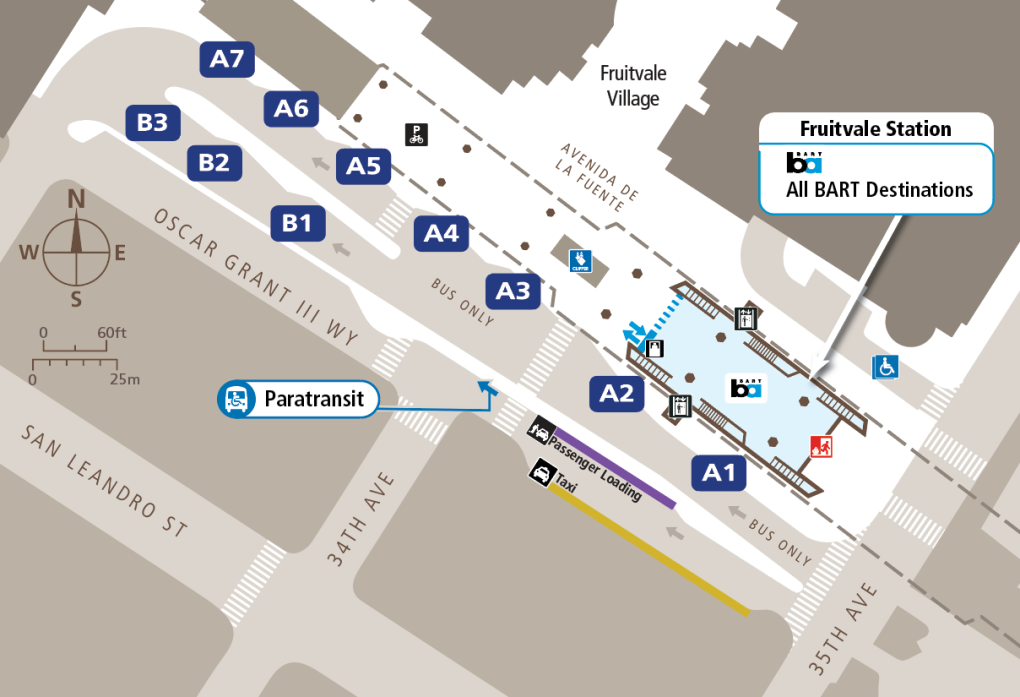
On Aug 29th, construction in the bus area for the Fruitvale Accessibility Improvement Project will be complete, and buses will return to their normal locations, as shown in the table and first map below using bus stop numbers. Bus stop numbers will also be posted at the bus stops.
Bus stops A1 to A7 are located along the west side of the station, with A1 closest to 35th Ave and A7 closest to the BART garage. Bus stops B1 to B3 are located on the bus island. Signs will be posted at each stop showing the Bus Stop number.
| Bus Line | Bus Stop # |
| 14 | A7 |
| 19 Downtown Oakland | A3 |
| 19 Seminary Ave | A5 |
| 20 Dimond District | A5 |
| 20 Downtown Oakland | A3 |
| 21 Dimond District | A5 |
| 21 Oakland Airport (OAK) | A3 |
| 39 | B2 |
| 51A | A2 |
| 54 | A4 |
| 62 | A6 |
| 648 | B2 |
| 654 | B2 |
| 655 | B2 |
| 703 | A6 |
| 851 | A2 |
| Shuttles | B3 |
UPDATE: August 8
On Aug 9th, the final construction phase of the Fruitvale Accessibility Improvement Project will begin and last for approximately 3 weeks.
Please note: There are two other projects that will take place at the same time at Fruitvale Station:
- New faregates will be installed, for more information see the following news item: https://www.bart.gov/news/articles/2024/news20240801
- And murals will be painted on trackway columns.
During this construction phase the following changes will occur:
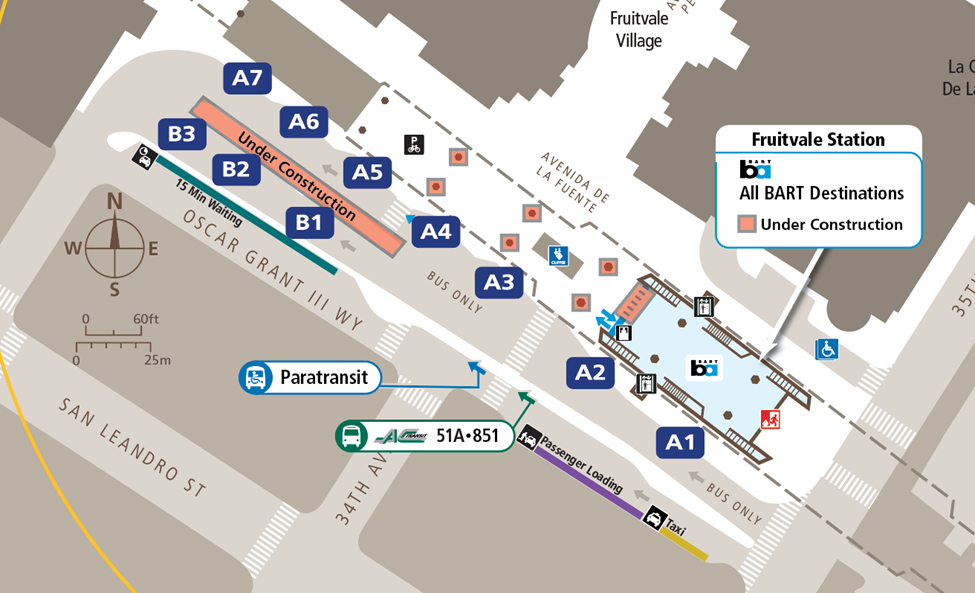
The passenger loading zone will move to the left side taxi area, and taxis will move back in the same lane. The diagonal parking to the north of the passenger loading zone will be reserved for 15 Minute Waiting.
Buses will move back into the station area from E. 12th Street and the bus island will remain closed for construction. Temporary bus locations for this phase are shown by Bus Stop number in the second map and table below.
Bus stops A1 to A7 are located along the west side of the station, with A1 closest to 35th Ave and A7 closest to the BART garage. Bus stops B1 to B3 are located on the bus island. Signs will be posted at each stop showing the Bus Stop number.
| AC Transit Line | Bus Stop # |
| 14 | A7 |
| 19 | A3 |
| 20 Dimond | A5 |
| 20 Downtown Oakland | A3 |
| 21 Dimond | A5 |
| 21 Oakland Airport (OAK) | A3 |
| 39 | A2 |
| 51A | Passenger Loading Zone |
| 54 | A4 |
| 62 | A6 |
| 703 | A6 |
| 706 | A4 |
| 851 | Passenger Loading Zone |
Note: the information below was originally published on July 3
Construction for the next phase of the Fruitvale Station Accessibility Improvements Project will begin on Monday, July 8, 2024 and last for approximately six weeks. The first phase will take place from July 8th to July 14th, and the second phase will take place from July 15th to August 9th.
During the first phase, the following temporary changes will occur:
- AC Transit Route 51A and 851 will move to the Passenger Loading Zone
- Passenger Loading will move to the taxi zone on the left side of Oscar Grant Way
- Taxis will move to the southern portion of the zone
During the second phase, the following temporary changes will occur:
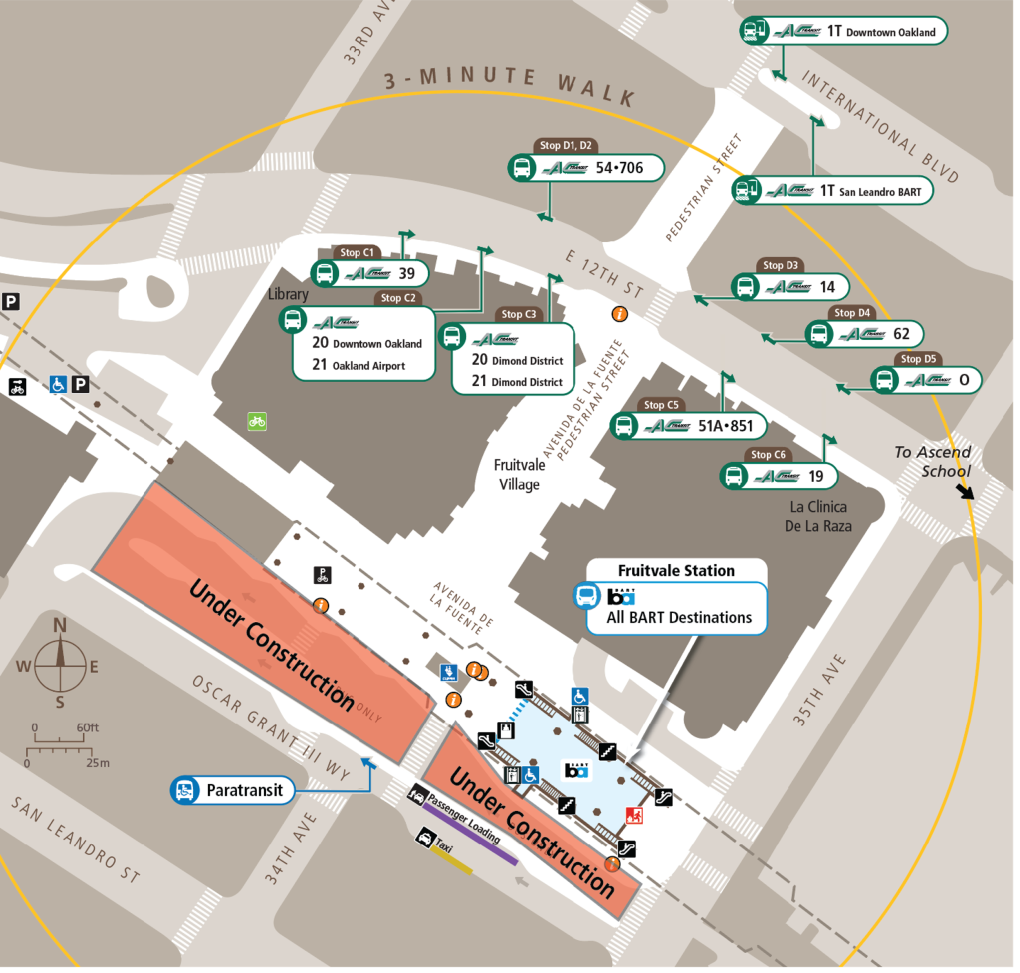
- All buses will move to E. 12th Street. Bus lines will be located as follows (see third map below):
| AC Transit Line | Bus Stop |
| 14 | D3 |
| 19 | C6 |
| 20 Dimond | C2 |
| 20 Downtown Oakland | C3 |
| 21 Dimond | C2 |
| 21 Oakland Airport (OAK) | C3 |
| 39 | C1 |
| 51A | C4 |
| 54 | D1,D2 |
| 62 | D4 |
| 706 | D2 |
| 851 | C5 |
Parking: BART parking is typically reserved for riders parking and using BART. However, since parking along E. 12th Street will be removed for buses during this phase, BART is offering non BART riders the ability to park at BART during the closure. Parking is only available in the Daily Fee area on Garage levels 3-5, and the surface lot north of Fruitvale Avenue. Daily Fee parking payment must be made via the BART Official App; payment should be made when the customer parks. . A Clipper Card number is required to buy Daily Fee parking on the app; learn more about how to obtain a free clipper card here: Clipper and Pay by Phone | Bay Area Rapid Transit (bart.gov). Daily Fee parking at Fruitvale is $3.55/day on weekdays and includes the City of Oakland parking tax. Customers who do not pay for parking may be subject to citation. Daily Fee parking is available on a first-come, first-served basis and at your own risk.
Map of Fruitvale parking locations:https://www.bart.gov/sites/default/files/2023-10/BART%20Parking%20Fruitvale.pdf
How to pay for parking on the BART Official App: https://www.bart.gov/guide/parking/payment
As shown in the second map below, to get to the Phase 2 temporary bus locations, exit the station and turn right. Walk through the pedestrian street to E. 12th St.
Bus stops C1 to C3 will be on E. 12th St to the left, C4 and C5 will be on the right.
Bus stops D1 and D2 will be on the opposite side of E.12th St to the left, and D3 to D5 will be to the right.
This construction is part of the Accessibility Improvement Program (AIP), which improves accessibility in and around BART stations to better meet the needs of people with disabilities, including replacement or upgrade of ramps, sidewalks and accessible paths, bus and passenger loading zones, as well as handrails, wall protrusion detection, wheelchair-accessible phones, TTY devices, courtesy phones, and elevator lobby lighting.