
Search Results
Seen & heard on BART this week: romance, Christmas ham, Mariachi band
BART riders are a busy bunch -- taking trains to work, to play, to meet friends and travel around the Bay Area. While they're on BART they're gaming, crocheting, listening to music, reading and people-watching. Here's a fresh batch of things people saw and talked about on BART this week. We'll update this
Second-generation BART employee works with trains – even on the weekends
On the outer edges of the Bay Area, surrounded by rolling green hills and fierce but slowly gyrating white wind turbines, a series of unassuming car barns set off from a beige main building sit idly. If you’re lucky, you may see a vibrantly colored train chugging a path along the greenery. And if you’re even
BART trains now deep-cleaned twice as often
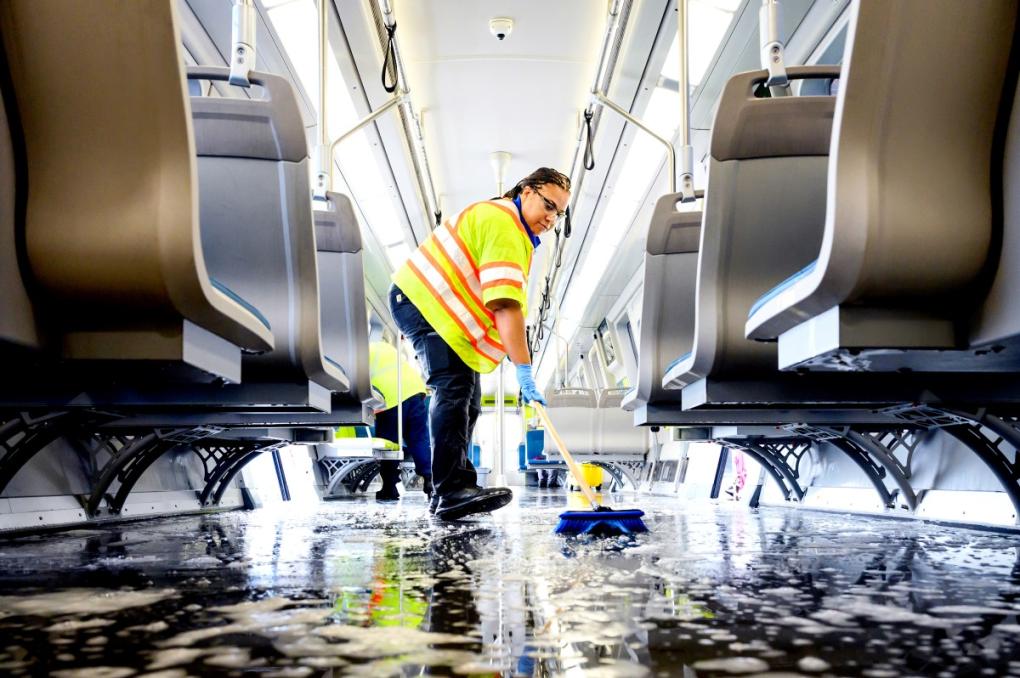
Train car cleaner Alyssa Barnes mops the floor of a BART car with disinfectant soap and steaming hot water during a train car thorough clean.
Glossary of BART Train Car Cleaning Terms
Thorough Clean | Standard Clean |
Litter Pickup
|
| A controlled multi-step clean that requires cleaners scrub every surface of a train car, from ceiling to baseboards. Thorough cleans take two cleaners about two hours to complete. They occur every 450 hours a car is in service. | If a car is not scheduled for a thorough clean on a given night, it will get a standard clean. Depending on time constraints, cleaners may sweep cars for debris, disinfect seats and poles, scrub graffiti, spray hanging straps with disinfectant, and mop the floor. | Between thorough and standard cleans, cleaners hop aboard train cars at the end of the line and sweep up litter and messes. If a car has a major mess, it will be removed from service and cleaned before it is returned to service. |
Note: It is impossible to Thorough Clean the 636 cars we require to run service every single night.
Rose Burditt, the foreworker who oversees overnight train car cleaning at Daly City Yard, inspects every single car that rolls into and out of her zone – up to 100 cars a shift. In just one night, she walks more than a mile in search of spots and stains that require some extra scrubbing from her team of skilled cleaners before she’s ready to release a car into passenger service.
Burditt, who started as a car cleaner herself 28 years ago, is her cleaning team’s “second set of eyes.” Her job is to ensure the cleaners scrub every surface of their assigned cars, from the ceiling to the baseboards, during one of their regular train car “thorough cleans” – the term we use to refer to a very, very deep clean not dissimilar from getting your automobile “detailed” at a car wash. A thorough clean takes a team of two around 120 minutes to complete, depending on the mess they face. Across the system each night, BART cleaners perform 15 to 20 thorough cleans – upwards of 30 hours of deep cleaning a night!
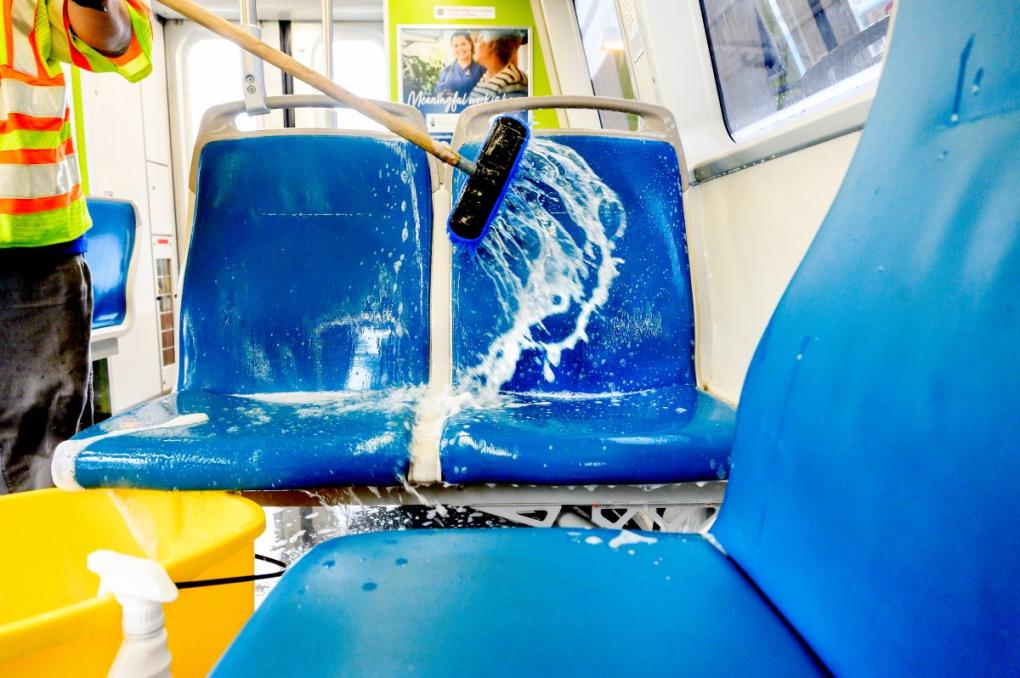
Seats are scrubbed with hot water and disinfectant soap during a thorough clean.
BART recently increased the frequency of thorough cleans from every 900 hours of train car service to every 450 hours, meaning we’ve doubled the number of times the cars in our system undergo a deep clean. You could say our train cars are now twice as clean.
They don’t make giant Roombas for our trains; cleaning our vehicles requires trained, dexterous, and highly skilled cleaners with close attention to detail. We’ve been able to increase our cleaning hours recently thanks to emergency federal funding and the knowledge that we’ll be receiving additional funds from the new state budget. This funding enables us to hire additional cleaners; the more cleaners on staff the more trains we can scrub at a greater frequency.
BART’s Rolling Stock and Shops department – the group that oversees train cleaning – has been ISO 9001:2015 certified since 2018, meaning our quality management system for maintaining cars lives up to the International Standards Organization’s high bar. We are one of the few transit agencies to have this prestigious certification and are sometimes surprise-audited by quality assurance officers who ensure our cleaning crews are following the required procedures.
No international standard could possibly be higher than Burditt’s own, however. If a car isn’t clean, it will not pass her eagle-eyed inspection.
“I don’t just work here, I ride the trains, too,” she said. “And I want a clean ride for passengers and myself.”
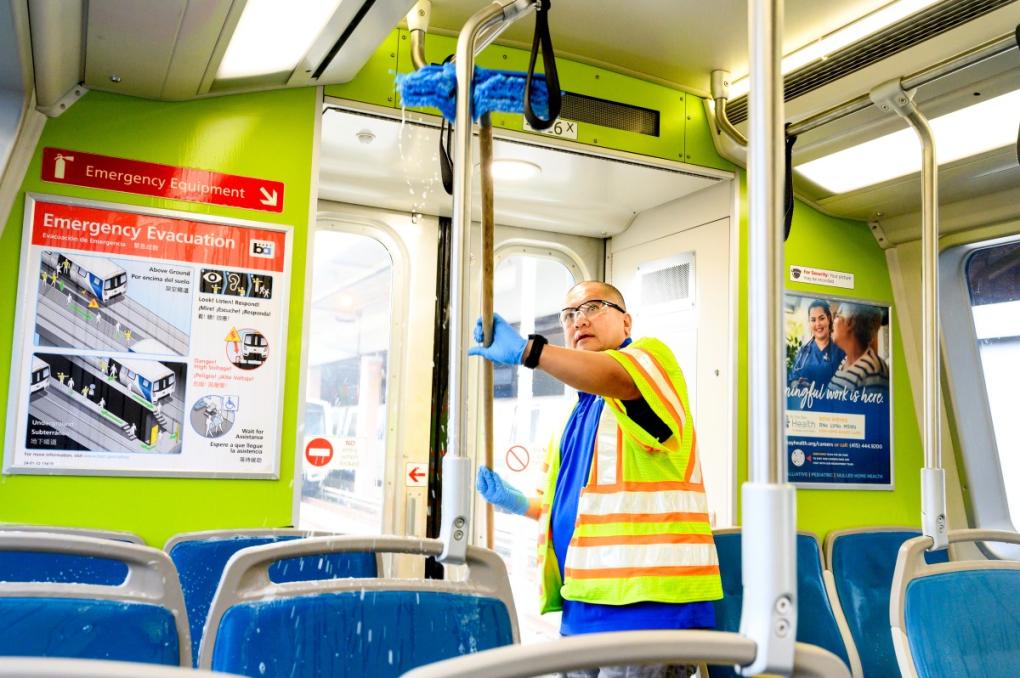
Train car cleaner Rodelio Correa scrubs the ceiling and poles with hot water and disinfectant soap during a thorough clean.
Trains are cleaned after every single trip they take, multiple times a day; at the end of each line, crews hop aboard to remove litter and messes. If a car is not scheduled for a thorough clean on a given night – it’s impossible to spend two hours cleaning the 636 cars we require to run service every single night – the car will undergo a “standard clean.”
The standard clean procedure varies depending on the car’s needs and time constraints. Often, two cleaners will sweep the car for debris, disinfect seats and poles, scrub away graffiti, spray hanging straps with disinfectant, and mop the floor. Cleaners use hospital-grade disinfectant that’s safe for humans but tough on germs (it smells nice, too).
To complete a thorough clean – and pass a foreworker's tough inspection – every scrub team must follow a 12-step, 34-page controlled procedure that is regularly updated and revised.
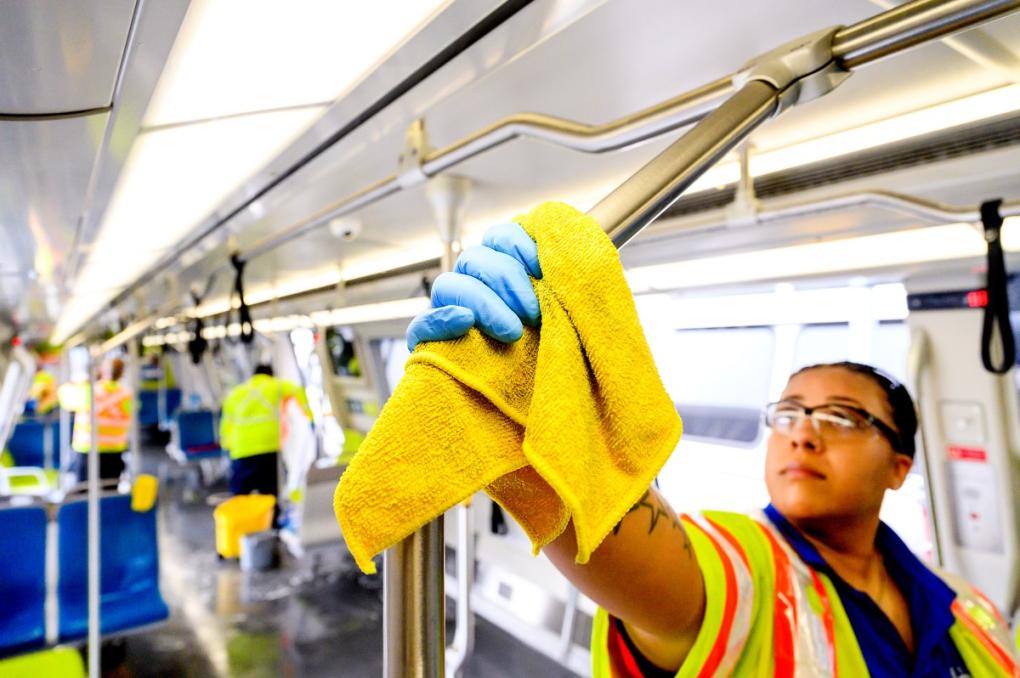
Train car cleaner Alyssa Barnes wipes down a pole on a BART car with disinfectant during a thorough clean.
Cleaning teams ferry their supplies with them from car to car on carts, which are outfitted with everything they might need – from water barrels and pic-sticks to gum and graffiti removers.
BART’s train car cleaners undergo regular trainings. In addition to a weeklong Roadway Worker Protection (RWP) course, cleaners receive training on how to handle nuanced situations, including the removal of biohazards. They also take courses on Arc flash safety, personal protective wear, and the proper procedures for working with certain cleaning products. Biohazards are an unfortunate reality on our trains, and cleaners are trained to never pick up litter with their hands but to always use pic-sticks.
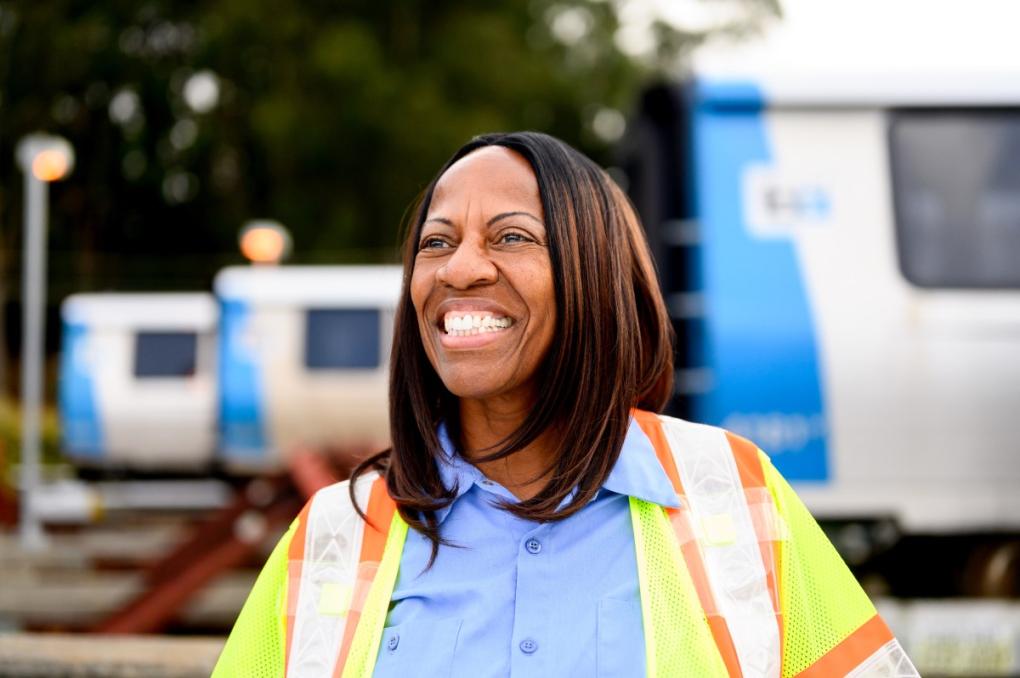
Rose Burditt, pictured above, started at BART 28 years ago as a train car cleaner. She now oversees the cleaning teams on the overnight shift at Daly City Yard as a foreworker.
“There’s more that goes into cleaning these trains than you might think,” said Burditt.
Most of all, Burditt wants riders to understand that when they leave a mess behind, there is a human being at the end of the line who has to take care of it.
“When you’re riding the trains, please consider the rider who’s taking the train after you,” Burditt said.
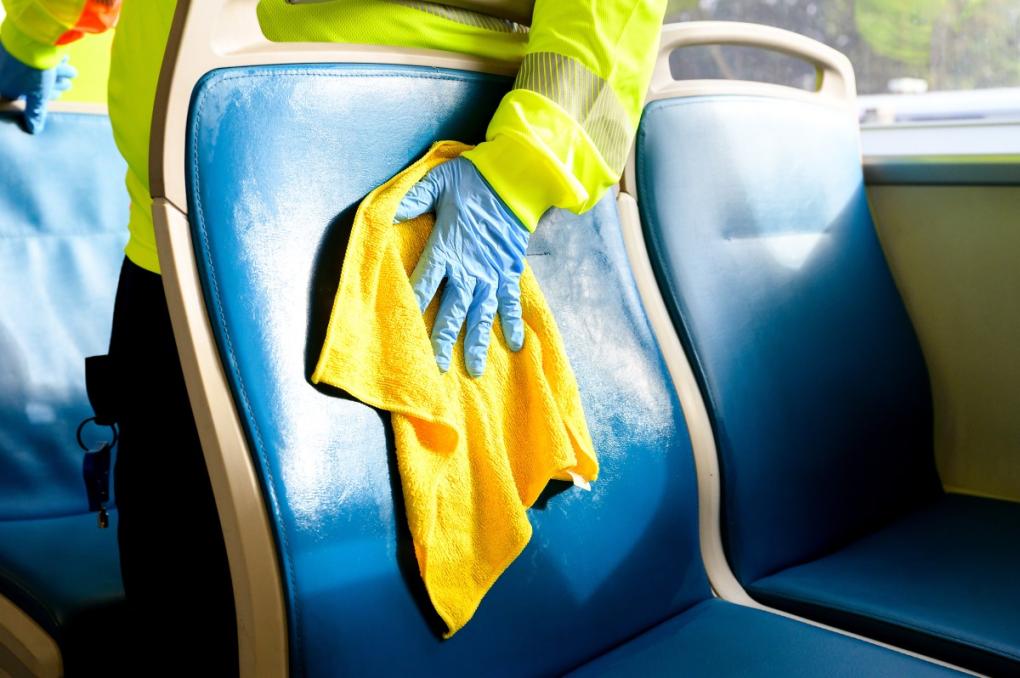
A seat is dried after being scrubbed with disinfectant soap and hot water during a thorough clean.
Our riders can help keep BART clean. At the end of your ride, pick up your trash and toss it in one of our station receptacles. Leaving junk on BART is littering and subject to fines.
Notice a biohazard on a train or in a station? Report it at bart.gov/biohazard.
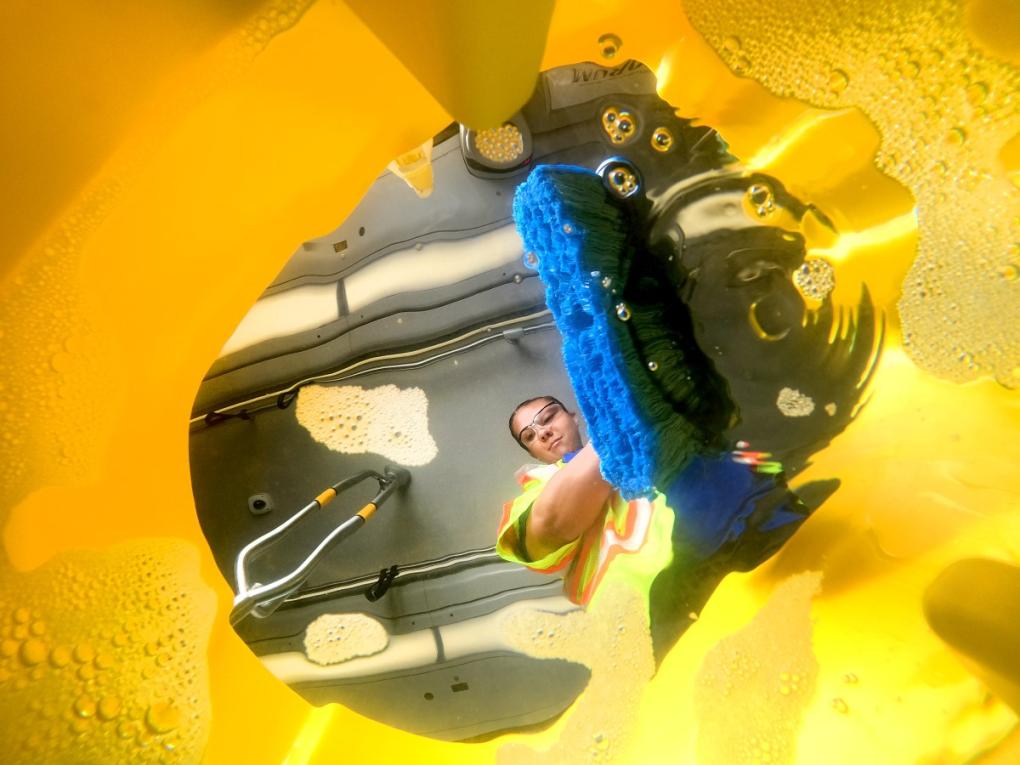
Train car cleaner Alyssa Barnes is pictured through a bucket of soapy water during a thorough clean.
To learn the story of BART, look to its system maps
08.05.22 A map can tell a person where to go, where not to go, and how to get there. It orients the viewer in physical space – but also geographic time, chronicling the shifting landscape and the patterns of human motion. The BART System Map is one of the most iconic maps to grace the modern Bay Area. To
Roll With Us: Train Car Electricians are the neurosurgeons of BART
BART is currently hiring for Train Car Electricians. Salaries start at $38 an hour and go up to $50 and include premier benefits. For more information, visit bart.gov/jobs and search for “Transit Vehicle Electronics Technician.” To his coworkers at Concord Maintenance Yard, Michael Thomas is known for a
In wake of Moscow bombings, BART officers remain on high vigilance
BART reminds riders to serve as extra eyes and ears for suspicious activity In the wake of the Moscow bombings, BART officials held a news conference on Monday to both reassure the public that officers remain on high alert and to reengage riders to be the agency’s extra eyes and ears when it comes to
Get a summary of all the BART holiday schedule and service plans
Here is a summary of BART schedule and service plans for the holiday period beginning with Christmas Eve on Friday, December 24, 2010, and continuing until New Year's Day, Saturday, January 1, 2011. BART to run longer midday trains on Christmas Eve With the exception of modified peak-commute service on the
New law will help achieve BART energy goals and save money
BART’s commitment to 100% clean, renewable electric supply by 2045 took a major step forward thanks to a bill signed into law September 20th by Governor Gavin Newsom. AB 923, authored by East Bay Assemblymember Buffy Wicks, grants BART unrestricted access to California’s wholesale energy markets, as well as
BART opens up extra long-term parking spaces for holiday travelers
BART is opening up extra Airport/Long-Term parking spaces this holiday season and is urging the public to purchase their parking permits early as the agency expects a heavy demand from people who are getting ready to fly out of town. Permits are available now, but only online at www.bart.gov/parking . BART
Public hearing on BART-to-Bus Paper Discount Transfer Ticket
Updated on September 25, 2020 The AC Transit Board approved the proposal to eliminate the paper BART-to-Bus transfer on September 23, 2020. The AC Transit Board of Directors will hold a public hearing on Wednesday, September 23, 2020 at 6:00 p.m. to receive input on the proposed elimination of the paper