
Search Results
Race for Space: BART hosts Twitter Town Hall on crowding June 20
It’s crowded out there. We know it can feel like a sardine can sometimes. BART’s got a plan to help – but we need your help, too. Join our Race for Space Twitter Town Hall, scheduled for Thursday, June 20 from noon – 1 pm. We’ll be discussing our Transbay Corridor Core Capacity Project that will let us
Parking, drop-off area changes at Union City BART Station due to construction
Beginning Monday, Sept. 15th, BART will relocate reserved, bike and motorcycle parking, the patron drop-off/pick-up area and taxi and shuttle stops at the Union City Station to accommodate transit village construction. During this phase of the construction, BART will close the North “Reserved Parking Lot” and
Dispatchers are the “behind-the-scenes heroes” of BART Police
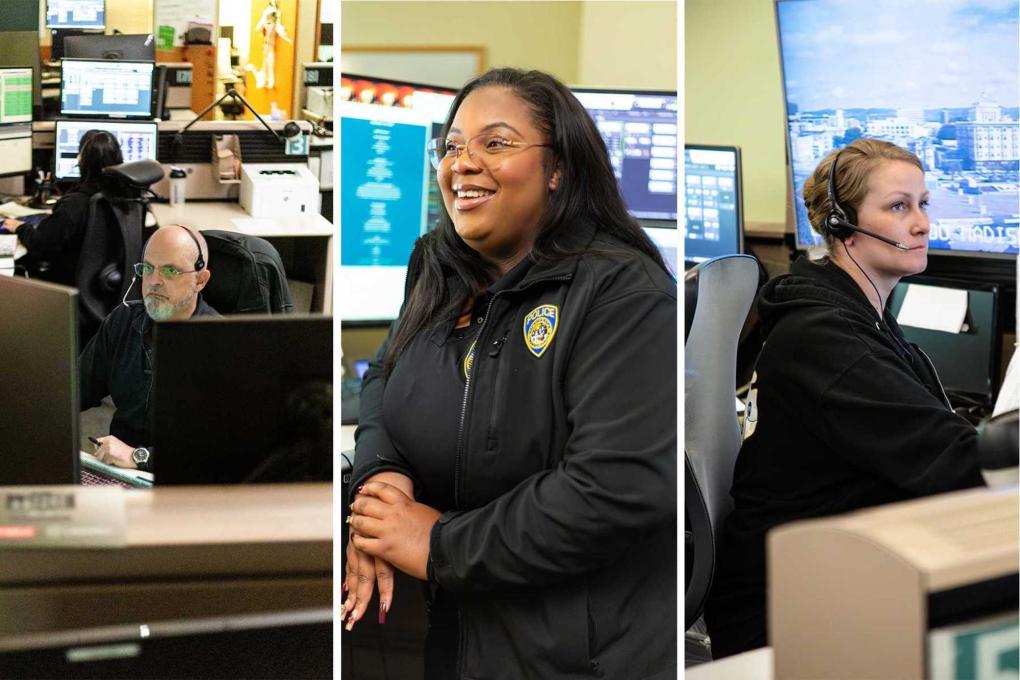
BART is currently hiring entry-level and lateral dispatchers. Salaries start at $81,000 - $99,000 annually, and BART Police is offering a $15,000 hiring incentive. The role include premier benefits, including enrollment in the CalPERS pension retirement program. To be considered, applicants must possess a high school diploma, GED, or recognized equivalent.
For more information, download the recruitment flyer and visit joinbartpd.com/police-dispatcher.
(Pictured above: Dispatchers Robert Lowell, Taylor Fulmore, and Kasey Frost at work.)
You won’t hear a phone ring for long in the BART Police Dispatch Center.
“We answer the phone after two or three rings almost always,” said BART Police Dispatcher Taylor Fulmore. “You are going to get a real human on the phone very quickly."
BART Police has one of the fastest response times in the nation for major incidents, averaging 4 minutes and 25 seconds for Priority-One emergencies. BART’s skilled dispatchers play an essential role in makin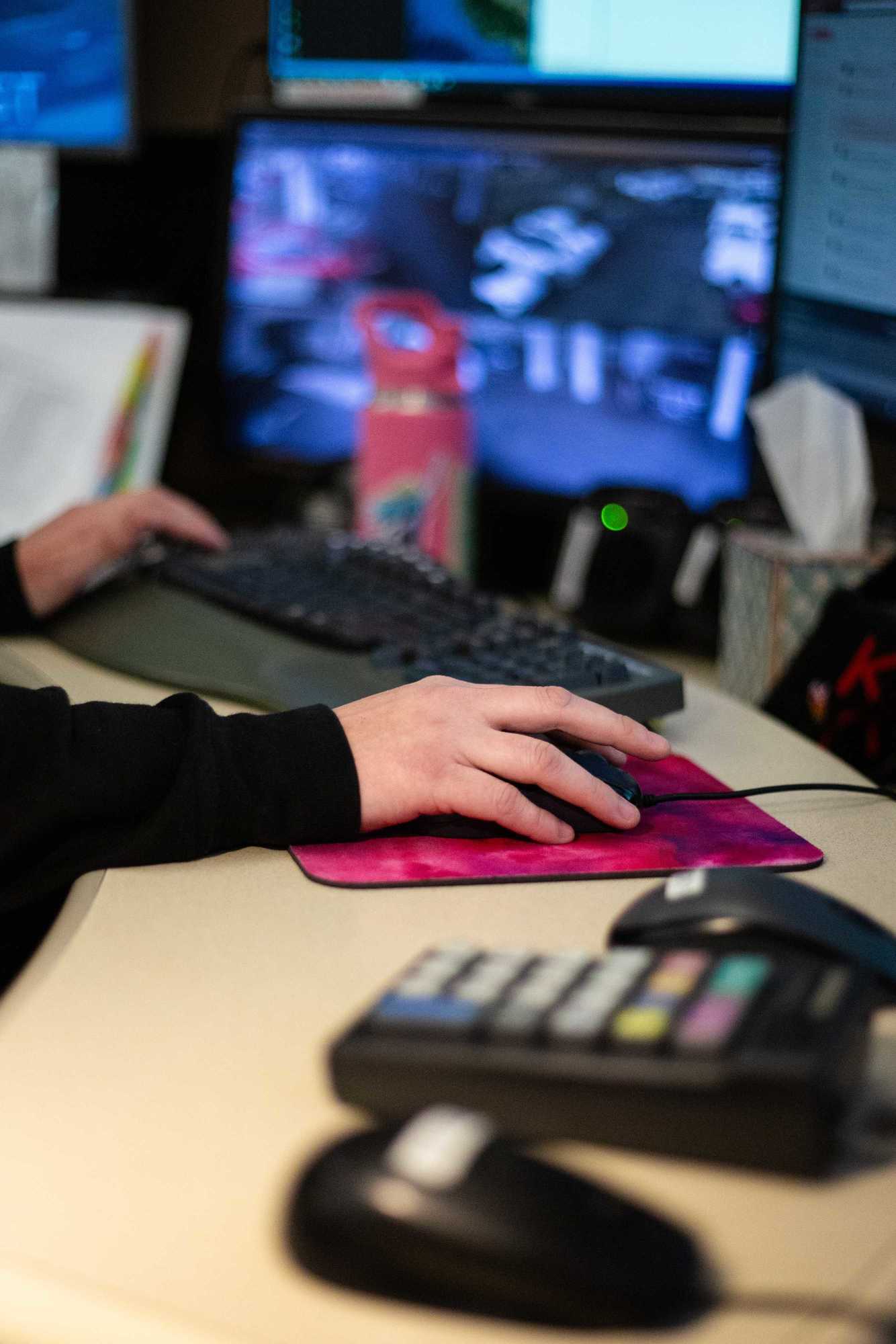 g that rapid response happen.
“We’re like orchestra conductors,” said Senior Dispatcher Robert Lowell, who’s worked BART dispatch for 21 years. “You’re telling the officer units where to go, when, and why. We’re the gateway that makes the department flow.”
When you consider jobs at a police department, you probably think of the obvious one: police officer. But there are a multitude of non-sworn, civilian roles that are crucial to the functioning of a well-oiled police department.
Dispatchers are the first conduit in a network of fast actions triggered by a 911 call. They’re staffing the phones 24 hours a day to connect those who may be witnessing or experiencing a crime with safety services. And they do it with impressive speed and dexterity.
“Staffing the phones” is a bit misleading. Dispatchers don’t simply answer calls; they’re also responding to texts from the non-emergency line and fielding messages from the BART Watch App. That’s not all. At any given moment, a dispatcher will have upwards of 10 computer tabs and programs open, each with a different but important purpose. They’re scanning camera feeds, analyzing a real-time map of every train in the system, and managing a program that collates active calls and available units. Each dispatcher’s desk has five monitors, three mice, two keyboards (one for the computer, one for the phone), and a foot pedal for the dispatch radio so they can call for units while typing information.
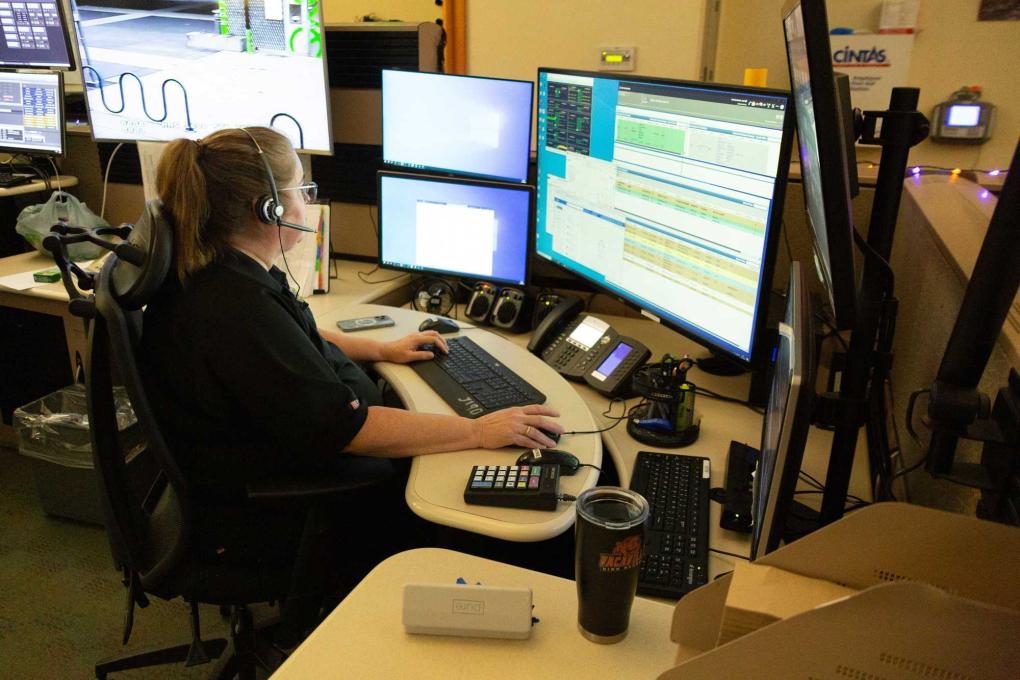
Communications Supervisor Patty McPeak pictured at her desk. McPeak has worked for BART for 29 years.
“Dispatchers have to multitask and must possess a lot of common sense,” said Communications Supervisor Patty McPeak, who’s been with BART for 29 years. “We need people with street smarts, not just book smarts. You have to use your entire brain in this job and juggle multiple things at once.”
The work of dispatchers intersects with multiple expertise: law enforcement, customer service, public health and social services, and even some behavioral psychology.
“We’re all really good at anticipating what suspects will do,” Dispatcher Fulmore said. “For example, if we get a call that someone just had a phone stolen on the concourse, we know the suspect will run to the platform to get on a train, so we stop the next train from entering the station. We have a lot of techniques to set officers up for success.”
Dispatchers do detective work, too, added Dispatcher Stacie Richardson, an 18-year veteran of the department who was essential in the arrest of Nia Wilson's convicted killer in 2018.
“I remember that day well,” she said. “I got a call from a guy, saying, ‘Hey, I got off the train at Fruitvale five minutes ago, and I think I saw the suspect onboard. It was going toward downtown Oakland.’” It wasn’t much info to work with, but his description of the suspect matched the warrant, so Dispatcher Richardson leapt into investigative mode.
“There were so many trains running at that time, but based off that little bit of info, I was able to track the right one down,” Dispatcher Richardson said. “I found the suspect on the security camera feed and was pretty certain it was him. I followed him on the cameras until he disembarked at MacArthur Station to board a Pittsburg-bound train. I held that train, alerted the nearest police unit, and within minutes, they arrested him.”
"Getting the guy doesn’t make it any easier for the family,” Dispatcher Richardson added. “But I know it gave them a sense of relief.”
(Note: To get help as fast as possible on a train, it’s important to take note of the car number, which tells dispatchers exactly what train you are on and where it is going. The car number is located above the doors on the inside of each end of the train car.)
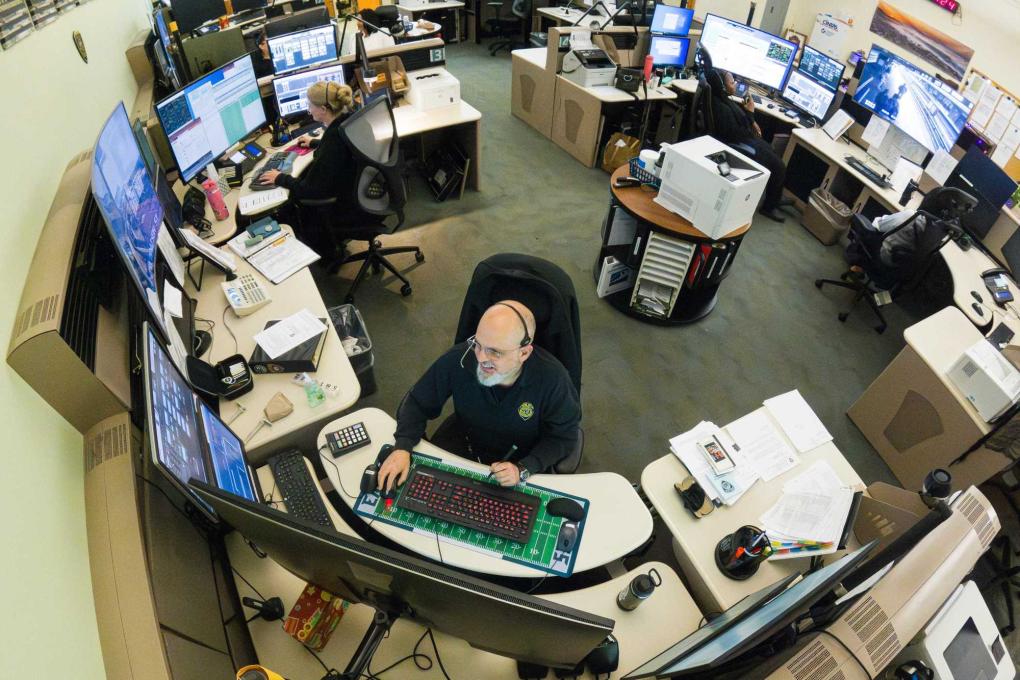
Dispatcher Robert Lowell smiles at his desk. Lowell has been deemed the team DJ.
Every BART dispatcher works the police radio channel for a few hours a shift. On the radio, they have the responsibility of prioritizing calls and dispatching units in a timely fashion, all while taking into account the availability of officers.
“Dispatchers are often coordinating train holds, assigning calls to units on the field, relaying real-time updates, and gathering information,” said Communications Supervisor Sabrina Castro. “The radio dispatcher is often interacting with Officers, Ambassadors, Crisis Intervention Specialists, Community Service Officers, Fare Inspectors, Amtrak Officers, Detectives, Deputy Chiefs, and Watch Commanders at any given time.”
Said Dispatcher Fulmore, “We can stop someone’s commute with just four numbers on a keyboard, so prioritization is critical.” Dispatchers don’t want to hold a train unless they absolutely must.
Dispatcher Fulmore said she never imagined she’d be working in a police department. She studied communications in college and figured she’d work in media.
“I’m still using that communications knowledge, just in a different way,” she said. “We need people from a variety of personal and professional backgrounds to accomplish what we’re trying to do in the dispatch center. There are very few jobs you can come into at the entry level.”
Dispatcher Patsy Hernandez said her previous career as a dental assistant helped prepare her for the job.
“In the dental office, I learned customer service, how to deal with different types of people, how to problem solve,” she said. “All of those skills prepared me for this work."
Newly hired dispatchers receive thorough training that lasts around a year. Training starts in the classroom followed by a three-week academy course for general policing knowledge, geography training in the field, phone training, and lastly, radio training. Those who are already familiar with BART tend to finish training earlier. You must know the BART map inside and out, how the railway operates, and understand the complex dance of trains moving through the system.
You might think the BART Police Dispatch Center is full of people shouting into phones and rushing to and fro. To the contrary, the room is dimly lit and peaceful – calmer than many open-floor offices. A mini waterfall bubbles peacefully in supervisor McPeak’s and Castro’s office against a sonic backdrop of clacking keys, low voices, and sometimes cackles as the dispatch partners lob jokes at each other across the room.
Dispatcher Lowell has been deemed the team DJ. During his shift, he spins his favorite tunes for the group – some Rolling Stones here, some Eric Burdon and the Animals there. He said it helps keep the good energy flowing and builds camaraderie.
With some training, dispatchers learn to let tough calls go, to talk them out with their partners, and to reach out to the peer support team when they need extra support. And supervisors Castro and McPeak are always looking for stress management techniques for their team; around Halloween, for example, they hosted a coloring contest with a $50 gift card for the best work.
“We decorate for the holidays, throw lots of baby showers, and you’ll find balloons all over the place for birthdays,” said Dispatcher Fulmore. “We’ve made this place a home.”
That’s part of the reason BART’s dispatch team has low turnover. Nearly half the team has worked at BART for more than twenty years. The most senior dispatcher, Evelyn Hammer, has 31 years at BART under her belt.
“We stay here,” said Dispatcher Richardson. “You look forward to your shift. It doesn’t feel like work a lot of the time, though it is definitely work.”
"But it’s meaningful work,” Dispatcher Fulmore added. “We’re part of the culture of community care in the Bay Area. We’re behind-the-scenes heroes.”
BART staff available to speak at offices to promote transit
Heading back to office for work or sick of sitting in traffic?
BART staff will come to your office building and present about all the ways BART is improving service and safety.
We will take your questions and share insider tips.
Encourage your leadership to invite BART to your building. It can be a brown bag lunch, an all-hands meeting, or any format.
Remote presentations are also an option.
Please email [email protected] if you would like to arrange something.
Resources for sharing:
One page hand out about our Safe and Clean Plan.
View our sample presentation.
Solar energy from parking lot canopy system to help power Lafayette BART Station
A rendering of what the Lafayette canopies could look like A solar energy project is taking shape at the sun-drenched Lafayette BART Station -- the latest example of BART's commitment to sustainability. The BART system already has the lowest greenhouse gas emissions per passenger of any large transit system
Transit Oriented Development plans at BART stations get state boost
California Governor Gavin Newsom has announced new support for plans to develop climate-friendly homes near two East Bay BART stations. The Catalytic Infill Infrastructure Grant investments target plans at West Oakland and El Cerrito Plaza. The funding will go to affordable-housing developers as well as the cities of Oakland and El Cerrito. BART’s TOD program leverages outside housing and infrastructure funding to advance development at and around BART stations in support of the District’s ridership, affordability, and climate goals.
A $20 million grant to the City of El Cerrito will support transit-oriented development (TOD) by funding preparation for the affordable housing structured parking, bringing in site utilities, and enhancing an existing bike and pedestrian trail. Funding will also support landscaping and green space, a bike station, and bus shelters. BART hopes to bring as many as 800 housing units, a new public open space, and potentially a public library to El Cerrito Plaza.
The City of Oakland is getting $40 million to support site preparation work including clearing, grubbing, and erosion control. Money will also go towards utility improvements, resurfacing of roads, and various capital improvements. The TOD plan for West Oakland calls for 762 residential units including 240 that qualify as affordable housing. There will also be 382,000 square feet of office space and 75,000 square feet of retail on approximately five acres.
The funding comes out of $239 million announced by Governor Newsom to help launch housing projects across the state. The funding is meant to help underserved neighborhoods build greener, more walkable communities and allow Californians to live closer to work and other key amenities such as public transit.
BART has 13 completed TOD projects at its stations. Another four are under construction and seven approved projects are in the pipeline. Completed TOD projects at BART have created more than 3,200 housing units including 900 that are affordable.
Earth Week 2026: How BART helps keep the Bay clean
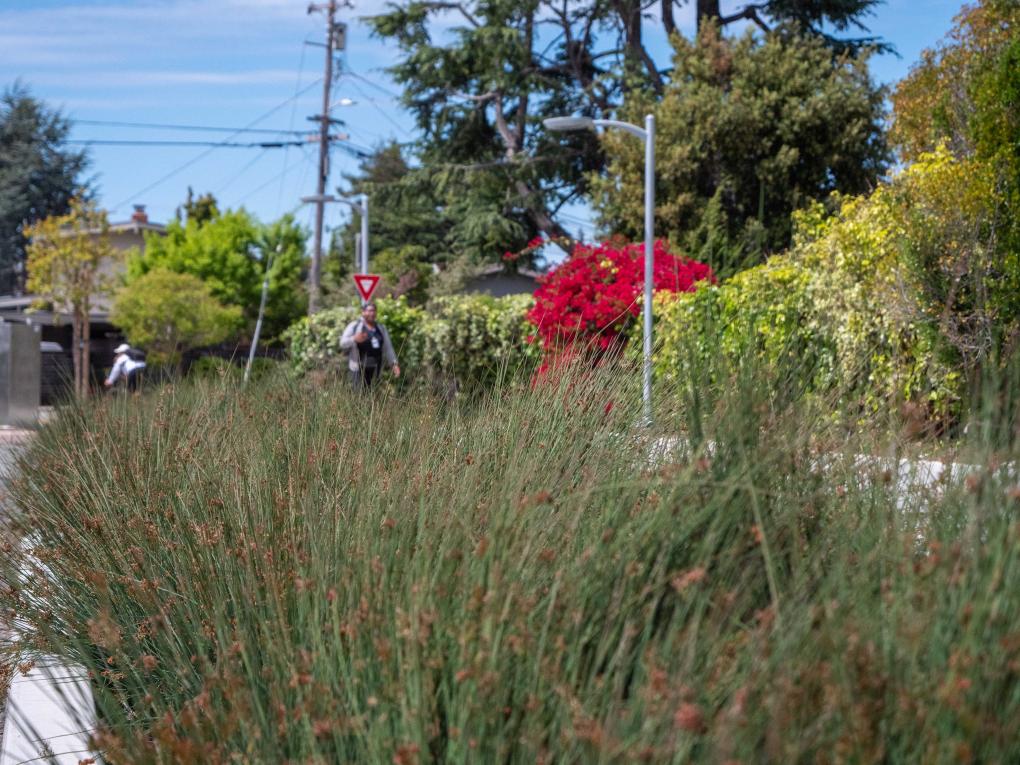
Juncus patens, a perennial herb native to California, is pictured in the bioretention area at North Berkeley Station.
California brown pelicans, salt marsh harvest mice, leopard sharks, flounder; a range of endangered species call the San Francisco Bay home. And like all of us, they depend on a habitat that is safe, clean, and resilient.
But the waterways these species rely on are increasingly at risk from climate change, development, and pollution, much of it originating from human activity.
At BART, sustainability is a core priority. Our stations aren’t just transit hubs; they are part of a larger ecosystem with the potential to improve environmental health across the Bay Area for people and wildlife alike.
One area of focus is stormwater. When rain falls on parking lots, roads, and plazas, it picks up pollutants like oil, trash, metals, and sediment, carrying them into local creeks and ultimately the Bay. This runoff can degrade water quality and trigger ripple effects throughout the ecosystem.
To help address this regional issue, BART has been installing bioretention areas, often called “rain gardens,” at stations across the system. You'll find them at Richmond, Warm Springs, Lafayette, El Cerrito del Norte, Concord, Millbrae, Balboa Park, San Bruno, and Antioch, among others.
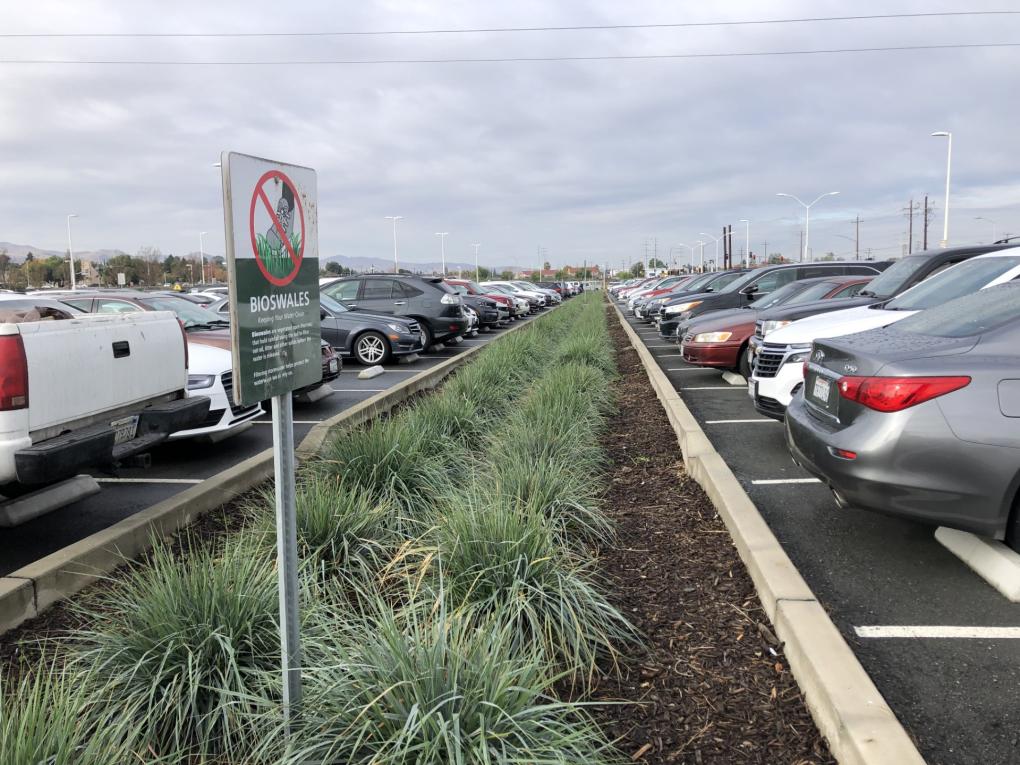
A bioretention planter at Antioch Station.
These landscaped areas are designed to slow, capture, and naturally filter stormwater before it enters waterways. Using layers of soil and climate-adapted plants, bioretention areas remove pollutants like harmful hydrocarbons, heavy metals, and debris.
They also deliver measurable benefits: bioretention systems can absorb significantly more stormwater than traditional landscaping and remove a large share of pollutants from runoff. By reducing the volume of water entering storm drains, they also help prevent flooding.
“Bioretention planters utilize natural processes to clean stormwater runoff. The plants work together with beneficial microorganisms in the soil to remove pollutants,” explained Cynthia Greenberg, BART Principal Landscape Architect.
These systems also help manage excess nutrients like phosphorus and nitrogen, which can fuel harmful algal blooms that deplete oxygen in the water and harm fish and other creatures.
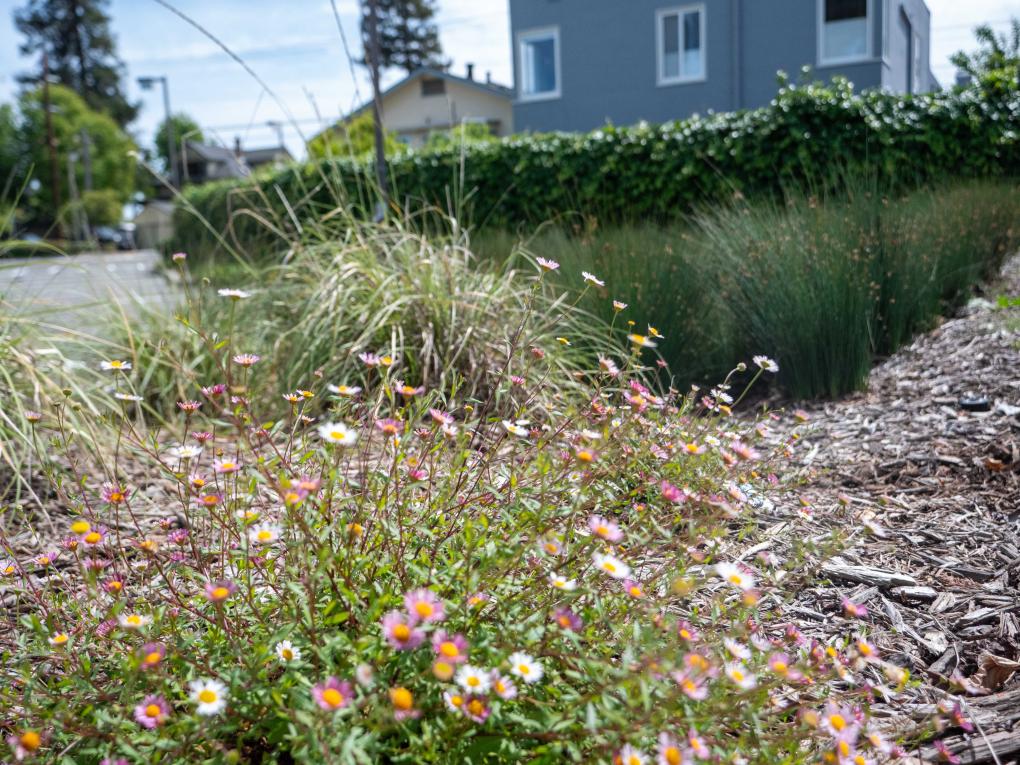
A bioretention planter at North Berkeley Station.
Most recently, new bioretention planters were added at North Berkeley Station as part of a broader effort to improve bicycle and pedestrian access. Runoff from the parking lot and nearby bike path is now directed into these planters, where it is filtered before flowing into Schoolhouse Creek and eventually the Bay near the Berkeley Marina.
The planters also support native plant species that enhance the station environment. Riders might spot California gray rush, a hard worker when it comes to filtering stormwater, as well as showy milkweed that attracts Monarch butterflies, and Douglas iris that supports pollinators like bees.
Beyond their environmental function, these green spaces create more welcoming, attractive station areas for riders and the surrounding community.
Next time you pass through one of these stations, take a moment to stop and smell the flowers and appreciate these landscapes that quietly help keep our beloved bay blue and beautiful.
What's in the North Berkeley planters?
| Scientific name | Common name |
| Muhlenbergia rigens | Deer grass |
| Juncus patens | California rush |
| Iris douglasiana | Douglis iris |
| Baccharis Pilularis 'Pigeon Point' | Dwarf coyote brush |
| Eriogonum fasciculatum | California buckwheat |
| Artemisia 'Powis Castle' | California sagebrush |
| Eriophyllum lanatum 'Siskiyou' | Common Wolly sunflower |
| Ceanothus griseus var. horizontalis 'Yankee Point' | Yankee Point caenothus |
| Erigeron karvinskianus | Santa Barbara daisy |
| Asclepias speciosa | Showy milkweed |
| Lagerstroemia indica 'Muskogee' | Muskogee crape myrtle |
What riders can do
- Put litter in its place: Dispose of trash into garbage and recycling receptacles provided by BART in our stations and parking lots.
- Use reusables: You can prevent litter by using reusable containers like travel mugs.
- Decline the printed receipt at BART ticket and parking machines if you can.
- Car maintenance: You may not be polluting but your car may be. If you drive to BART, please ensure your car isn’t leaking. Regular tune ups and leak inspections can prevent leaks or fix them if you have one.
- Car wash: The grime on your car that includes residue from gasoline, motor oil, and other chemicals can get washed off during a rainstorm if your car is parked in one of our outdoor lots. Help prevent this runoff by taking your car to a commercial or coin operated self-service car wash where all wash water is recycled and properly disposed of.
What BART is doing
- BART has installed storm drain markers to inform the public that what goes down that drain flows to the bay.
- BART cleans parking lots and plazas and landscape to remove trash and pollutants.
- BART has moved towards low-impact development (LID) as a standard practice, which is an approach to land development that works with nature to manage storm water as close to the source as possible.
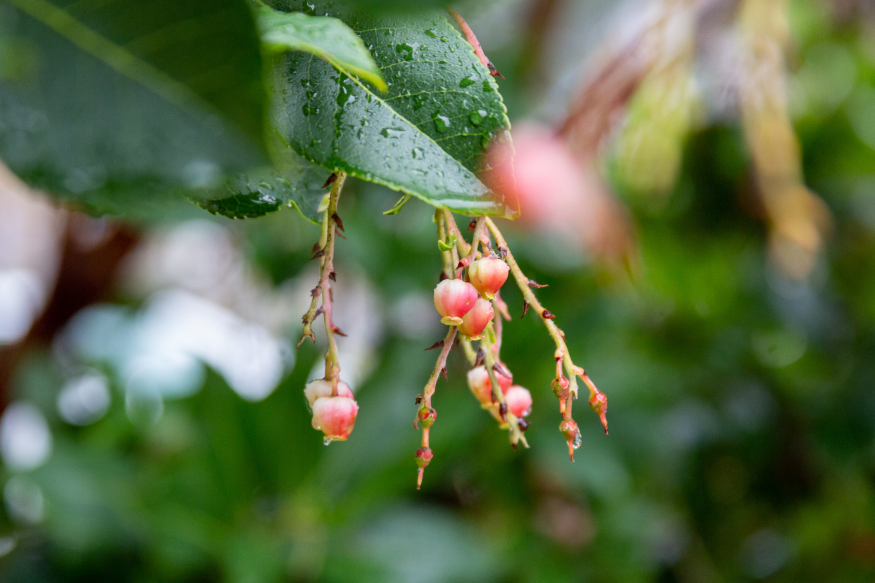
Rain drips from a strawberry tree at Lafayette Station during a storm.
Union City Police credit BART officer for the arrest of registered sex offender
BART Police Officer Kory Frost The Union City Police Department is publicly crediting 53-year-old BART Police officer Kory Frost for arresting the registered sex offender accused of molesting a 2-year-old girl in the aisles of a Dollar Tree store on Wednesday, December 1. According to the Union City Police
BART to open early and run long, extra trains for 2016 SF Pride
Download the 2016 Pride timetable BART will be opening early at 7:00 am on Sunday, June 26th to accommodate revelers attending San Francisco’s annual LGBTQ Pride parade. We strongly encourage customers to take advantage of this pilot opening time to beat the crowds and take one of the early trains downtown