
Search Results
Bay Area teen's ode to BART propels team to national slam poetry win
Corner seat, headphones on, notebook out. Eyes drift between the window and the page. Pen scratches paper as the train slides beneath the bay and into San Francisco.
By the time the train hums into 16th St. Station, high school senior Sehinne has scribbled some solid one-liners. Nothing's concrete, but she’s got the first rumblings of a concept or idea or phrase that could blossom from a wisp on the page into a poem.
the Bay is my siren
it pulls me in towards murky waters of Lake Merritt
and tells me I am in a spring
how can I leave the Bay when every good idea I've come up with was made on BART?
i jot down one-liners whispered to me upon my train stopping at 19th St.
Sehinne wrote these lines on BART. The poem that grew from them, titled “BART,” was the first to “break the nine barrier” at the 2025 Brave New Voices slam poetry festival, meaning every judge scored Sehinne's piece a nine or above. Sehinne’s group, Team Youth Speaks Bay Area, took home first place.
BART takes Sehinne from San Leandro to 16th St. Mission every week for her internship at Youth Speaks, a nonprofit in the Mission that gives young people space to unearth, develop, and amplify their voices. It’s not the destination, it’s the journey, and for Sehinne, the journey is where much of the work happens.
“Transit became something I started writing about when I realized I was always writing on it," she said. "BART has always given me a safe space to write and be inspired and be creative."
BART has been part of Sehinne’s life since she was young, riding into San Francisco to see family or to wander around the big Macy’s store downtown. In time, her BART trips became avenues to something more than a physical location.
Once she started high school, Sehinne began riding BART almost every day – to school, to thrifting in Berkeley, to her favorite museums in Oakland and San Francisco. Riding BART solo is a rite of passage for Bay Area kids like her, she said.
“The first time I took BART by myself was when I really knew I was starting to grow up,” she explained. “There are so many good life lessons you can learn just traveling around your region by yourself. It’s almost like a sense of pride you’re able to figure it all out.”
Besides, "Do you want all your plans to happen on your parents’ time, or do you want to get places on your own?” Sehinne chooses the latter. Always.
It wasn't until sophomore year that Sehinne began writing poetry, spurred by a class assignment asking: what does social justice mean to you? Her pen didn’t stop until the page was filled.
“My teacher was like, ‘Dang, you’re a poet,’ and I was like, meeee?” she recalled.

The many poems that followed this first piece consistently explores activism and social justice. It turns out writing is one of the best ways to release your frustration with the state of the world, Sehinne discovered.
The “BART” poem expresses some of those frustrations, centering her experience as a “lower middle class” kid in a region with staggering income inequality:
we are the protectors of a misrepresented region
BART is my protector
he picks me up at almost any type of night because he knows I am broker than a joker
and that $16 Uber is $15 above my price range
BART is misrepresented
people who claim they’re from the Bay but have never gone further east into Oakland than Los Pericos
and don't even imagine what the streets of the hundreds look like
try to tell me BART is dirty, BART is dangerous. ‘My son is 16 and hasn't rode on BART once.’
first of all, mmm, f--- you, do you think that your son is better than me because I've been riding BART since the 6th grade?
i'm sorry that my mother of four and nurse to 400,000 of Oakland does not have time to be my chauffeur
In the poem, Sehinne personifies BART as her “second uncle twice removed on my city’s side.” He’s reliable, a little eccentric, and always there for her.
“BART was made for people like me who were raised by their city,” she writes. “...he shows up late and he shows up loud, but he shows up for me always, and that just might be the most Bay thing about him.”
Bijou McDaniel, Youth Speaks Director of Narrative Change and Communications, said many Youth Speaks poets rely on public transit and, like Sehinne, have a strong emotional attachment to the transit systems that carry them.
“BART is such a literal connecting vehicle for our young people, especially as we’ve seen the demographics of San Francisco change and young people being pushed out to the different corners and edges of the Bay Area,” she said. “They’re still able to attend our programs and events...and I know without BART that wouldn’t be possible.”
Many Bay Area arts organizations believe it is critical to locate near public transit to ensure their spaces are accessible to artists and regionwide audiences, and many partner with BART through our BARTable program to co-promote riding transit to their venues.
In 2024, Youth Speaks served as a partner and judge for the BART Lines Teen Poetry Contest, which solicited works from local youth to appear in BART’s free Short Edition Story Dispensers. Through arts programming, BART’s Art Program and Communications department are working to amplify the voices of Bay Area young people. We understand that the words and ideas of young artists like Sehinne are building a roadmap for the future, one that is informed by lived experiences and culturally specific histories.
The “BART” poem came to Sehinne when she was in the planning stages for Brave New Voices, which was held this year in Wisconsin. She wanted to bring the Bay with her, and writing about her “second home” BART just made sense.
One of her favorite moments from the trip was finding out Team Bay Area made it to the finals while the group was eating in a local restaurant.
“We were screaming, and people were looking at us like we were crazy, you know, bringing that hyphy to Wisconsin,” she remembered. “They’re not used to it out there.”
Now in her last year of high school, Sehinne’s starting to think about life beyond the Bay. She’s found herself paying closer attention to those everyday scenes that stream by in the train windows.
“It being my senior year and all and not really knowing where I’ll end up, whenever I ride BART now it’s really just trying to capture a memory of everything see so I can take it with me everywhere I go,” she said.
"I hope you all start riding BART more often,” she said, addressing the region. “Maybe you’ll get inspired, too.”
Read more BART poems by young writers in BART’s short story dispensers and online at bart.gov/bartlines.
Statement from BART General Manager about man cited for eating on the platform
BART General Manager Bob Powers issued the following statement: "Moving 415,000 riders each day comes with complexities and there are laws in place to keep our system safe, welcoming, and clean. I’ve seen the video of the incident involving a man eating on our platform and our police response. Eating in the
Join BART for Oakland Ballers Public Transit Night (Friday, June 20) + new merch!
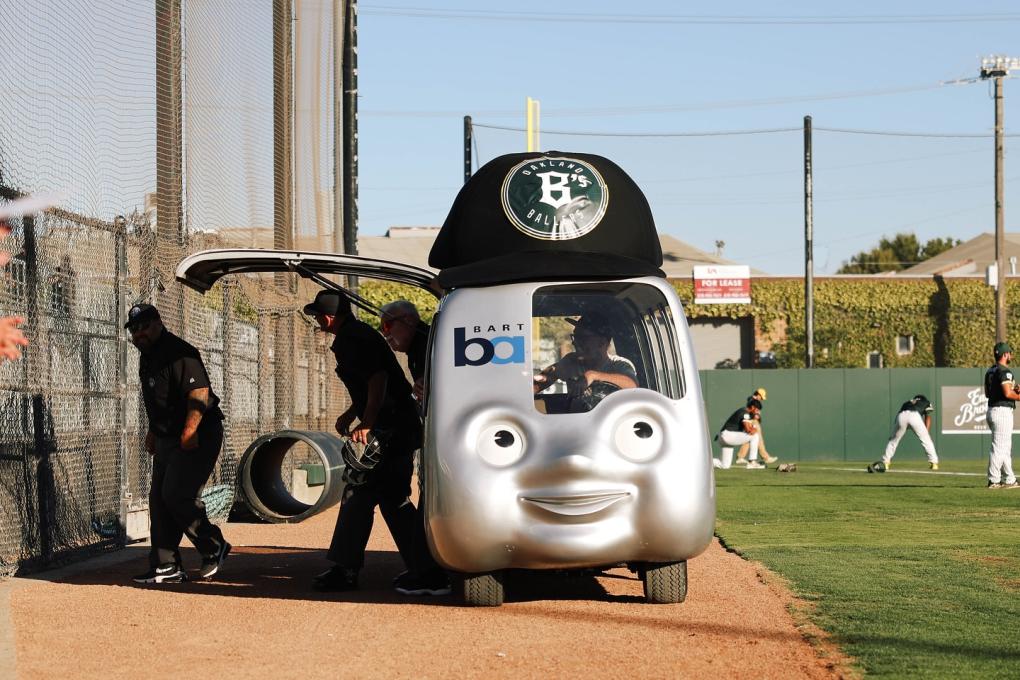
BART is partnering with the Oakland Ballers, the Town’s favorite professional baseball team, for a a special night at the ballpark. Take me out to the BART game!
On Friday, June 20, the Ballers, BART, and AC Transit are hosting Public Transit Night, a celebration of public transportation – the best way to get to the ballgame! Buy your tickets here. The game starts at 6:35pm.
Transit takes center stage for the night with giveaways, an appearance by the BARTmobile, a special BART guest throwing the first pitch, a BART race on the jumbotron, and the children of BART employees serving as ball/bat kid and starting things off with the “Play Ball!” shout.
BART also created new BARTy Ballers t-shirts and stickers to celebrate the occasion, which Railgoods will be selling at the game.
New BARTy Ballers stickers are available to order now on Railgoods here and here.

Railgoods is currently taking preorders for t-shirts (expected to ship by Friday, June 20):
This game is celebrating the role public transportation plays in making sure fans can watch their favorite teams play. BART, AC Transit, and organizations like the Ballers are natural partners – transit helps you get there, and the Ballers give you a place to go.
Oakland Ballers Public Transit Night Details
Date: Friday, June 20
Time: 6:35pm
Location: Raimondi Park, 1800 Wood St, Oakland, CA 94607

How to get to Raimondi Park
West Oakland BART station is 0.9 miles (about a 15–20 minute walk) from Raimondi Park. Free shuttle buses run between the ballpark and BART station every 20 minutes starting 1.5 hours before game time and a half hour after the game ends. Or take AC Transit Line 29 to the park.
See AC Transit, biking and parking information here.
BART and Oakland Ballers partner for second season
BART and the Ballers entered into a partnership last year ahead of the team’s inaugural season, with the Ballers hosting BART Night at the park in August 2024. The team jerseys prominently display the BART logo.

News: Oakland Ballers step up to the plate to save legacy BART car
In April 2024, the Ballers received a decommissioned legacy BART car that they plan to transform into a park concessions stand, to be unveiled next season.
This same car was initially reserved for the Athletics, the professional baseball team that departed the Bay Area in 2024. Team officials emailed BART in 2023 to inform them they would no longer be accepting the car. The Ballers jumped at the opportunity to receive the car – the team was responsible for the cost of transporting the vehicle – and refurbish the emblem of Bay Area history that carries tremendous sentimental value for riders.
Read more about the car delivery and BART’s legacy car decommissioning program.

BART fares increase 6.2% on January 1, 2026, to help pay for service
BART fares will increase January 1, 2026, to keep pace with inflation so the agency is able to pay for continued operations and to work toward restoring financial stability. BART's current funding model relies on passenger fares to pay for operations, and fares continue to be an important funding source to meet the needs of riders who rely on BART and to attract new riders.
Fares will increase 6.2 % on New Year’s Day based upon actual inflation in 2023 and 2024. The average fare will increase $0.30, from $4.88 to $5.18. For a short trip like Downtown Berkeley to 19th St./Oakland, the regular fare will increase by $0.15, and for a longer trip, such as the 45-mile journey between Antioch to Montgomery, it’s a $0.55 increase.
The fare increase is expected to raise $15.6 million for Calendar Year 2026.
BART's fare calculator and Trip Planner have been updated with the new fares for trips with the date 1/1/26 and beyond. Riders can learn how the increase will affect their travels by entering a 2026 date for their trip.
BART is also changing parking prices effective January 1, 2026.
Outdated funding model
BART needs a reliable, long-term source of operating funding. The agency’s current funding model relies on passenger fares to pay for operations, an outdated model that is no longer feasible due to remote work. Even with the fare increase, BART faces a deficit of $376 million in FY27. The agency must modernize its funding sources to better align with other transit systems in the country that receive larger amounts of public funding.
“As we ask the region for greater investments and support for BART while also making internal cuts to reduce costs, we also must ask our riders to contribute more towards their trips,” said BART Board President Mark Foley. “We will continue our commitment to enhance efficiencies and implement strict cost controls.”
BART costs have grown at a rate lower than inflation, demonstrating we have held the line on spending, and BART balanced the FY26 budget with $35 million in ongoing cuts and strict cost controls. In the FY27 budget which begins July 1, 2026, BART will institute cost savings and deferrals of $108 million to maintain current service levels and produce a balanced budget. In addition, we are running shorter trains to save millions of dollars on energy costs, and our service schedule better matches ridership. We have implemented a strategic hiring freeze, targeted reductions to operating costs across departments, renegotiated with unions to reduce near-term retiree healthcare costs, and locked in low energy costs through long-term contracts.
BART embraces independent oversight
A recent review by the Federal Transit Administration (FTA) found BART is meeting standards in nearly two dozen categories, including financial management, its ability to utilize federal grants, and project implementation. BART is also subject to review by the independent Office of the Inspector General (OIG). The OIG conducts performance audits and investigates allegations of waste, fraud, and abuse. BART has accepted 92% of the OIG’s recommendations and already implemented 64%. BART is the only transit agency in the Bay Area with an OIG.
BART is improving and innovating
BART has seen progress in its efforts to improve the customer experience. In 2025, customer satisfaction increased to 88%; the number of riders who say they’ve witnessed fare evasion dropped by more than 50%; and crimes against persons on BART dropped by 59%. This year BART also installed new fare gates systemwide four months early and was the first transit agency in the Bay Area to roll out Tap and Ride, offering contactless bank card payment options.
BART offers the following fare discount programs:
- Low-income adults earning 200% or less of the federal poverty level get 50% off through the regional Clipper START program.
- Youth 5-18 years old get 50% off with a Youth Clipper card. Children four years and younger ride free.
- Seniors 65 and over get 62.5% off with a Senior Clipper card.
- The RTC Clipper card is a version of Clipper created for passengers under 65 with qualifying disabilities to provide 62.5% off.
- BART offers a “High-value Discount.” Adult Clipper cards get a 6.25% discount on cash value rides by buying $48 worth of value for $45 or $64 worth of value for $60 when autoload is set up with your registered Clipper card.
- Monthly “A” Adult Fast Pass + BART within San Francisco: Unlimited rides on all Muni vehicles and on BART within San Francisco (trips outside of these stations are charged full fare). Available for sale from the 17th of the prior month through the 16th of the month.
- Students on a school-sponsored field trip for an educational purpose are eligible for a 62.5% discount fare when purchased in advance through Group Sales.
The Next Generation of Clipper offers automatic transfer discounts beginning December 10, 2025. Riders will receive a discount of up to the highest local single ride fare on Clipper, currently $2.85, when transferring between agencies. The discount will be automatically applied to an unlimited number of transfers within 120 minutes of the first tap.
This article was originally published on December 2, 2025.
First person: Website intern learns the ups and downs of bicycles on BART in her first ride
BART Intern Xuan Lam By Xuan Lam BART Website Intern I didn’t think it would be a big deal. I thought it would be simple to take my new sleek road bike on BART for the first time, riding from my home station in Fremont to Berkeley. I was wrong. Upon buying my ticket, I proceeded to walk toward the faregate
BART eliminates multi-million-dollar FY26 budget deficit through cuts and efficiencies
BART has eliminated what was projected to be a $35 million budget deficit for the next fiscal year through various cuts and strict cost control efficiencies. The upcoming Fiscal Year 2026 Preliminary Budget Memo, to be released at the end of the month, will now show a balanced budget for the fiscal year beginning July 1st, but structural deficits of $350 million to $400 million loom in following years unless long term, stable funding sources can be identified.
“We’re getting our budget in order to the extent that we can,” said BART Board President Mark Foley. “Closing a $35 million gap is no easy task. Now that we’ve overcome the first hurdle, we’ll focus on the bigger picture of restructuring BART’s funding model for long term sustainability.”
BART was able to close the projected $35 million dollar deficit through a combination of cost controls and revenue generation. Examples include:
Cost Controls
- A strategic hiring freeze while protecting safety and service quality
- Labor savings from reducing near term retiree healthcare costs
- Non-labor budget reductions across all departments
- Running shorter trains
- Locked-in low renewable electricity rates
- Implementation of Inspector General’s recommendations for efficiencies
Revenue Generation
- Installation of Next Generation Fare Gates to reduce fare evasion and increase ridership
- Maintaining inflation-based fare increases
- Offering new fare products like Clipper BayPass which is now revenue positive
- Improving transit coordination
- Growing ridership through station activations and events
- Negotiating new agreements for telecommunications revenues
Total operating expense growth in the FY26 budget is only 1% compared to inflation in the Bay Area at 2.7% over the past year and the size of workforce has been reduced from the current year due to the strategic hiring freeze. In fact, even before the recent cost cutting, BART has been able to keep its operating costs below the rate of inflation since 2019.
While BART is prioritizing high-quality and frequent service to attract more riders, overall, BART is running 100 fewer trains per week than before the pandemic.
BART is one of the most cost-efficient rail operators in the nation despite operating in a very high-cost region. By one measure, the cost per vehicle revenue hour, BART is significantly more efficient than similar systems like Washington, D.C.’s WMATA and Atlanta’s MARTA (Vehicle rail hour rates: BART - $283, MARTA $370, WMATA $466).
BART cannot close structural deficits with service cuts
As ridership continues to slowly grow, BART’s historical reliance on passenger fares to pay for operations, long seen as very effective, is outdated and no longer sustainable. New sources of funding are needed to avoid significant service cuts.
Even with belt-tightening, BART can’t cut its way out of the crisis without causing a transit death spiral. That is because rail has high fixed costs to maintain infrastructure and low marginal costs driven by changes in service. For example, when BART closed at 9pm and reduced frequencies during the height of the pandemic, it represented a 40% cut in service, but it only reduced operating costs by 12%. Even a 90% cut in service (9pm closure, one-hour frequencies, and running only three of the five BART lines) would close less than half of the FY27 $376 million deficit.
Next steps for the BART budget
The soon-to-be-released 2026 Preliminary Budget Memo will mark the beginning of the final stretch of BART’s budget activity for the year. A series of presentations at Board meetings will culminate in a Board of Directors vote in June to adopt a two-year budget for fiscal years 2026 and 2027.
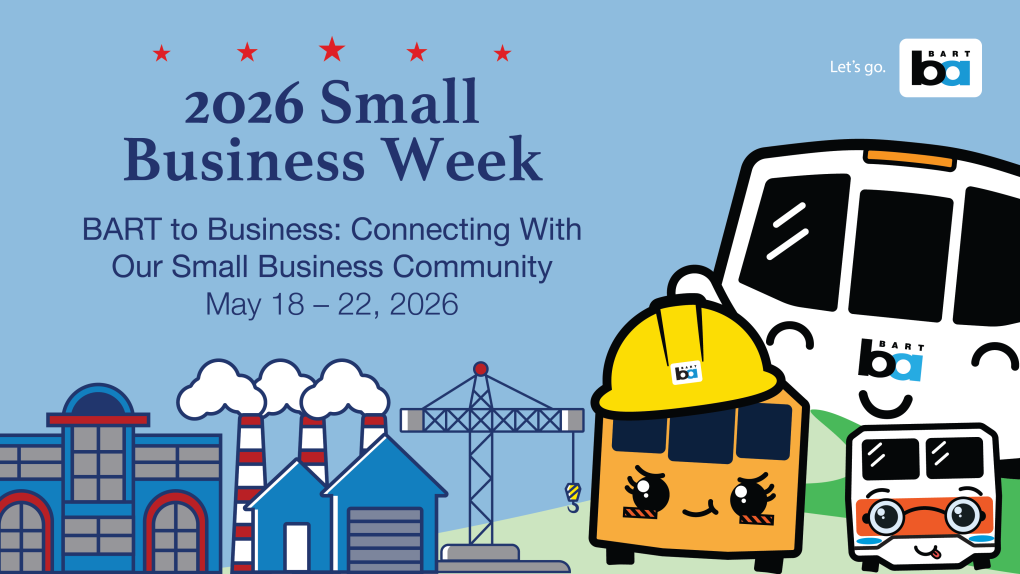
May 21: BART invites small business owners to its 2026 Small Business Summit
Register on Eventbrite
Small Business Summit event flyer [pdf]
BART’s Office of Civil Rights is hosting a free, in-person Small Business Summit on Thursday, May 21, from 8:30am to noon, on the first floor of BART HQ (2150 Webster St., Oakland, near 19th St. Oakland Station). The event will be held during BART’s Small Business Week, beginning May 19, and will include a Disadvantaged Business Enterprise and Small Business certification workshop in light of the significant changes to certification requirements under the recent Interim Final Rule (IFR).
In light of recent changes to the Disadvantaged Business Enterprise Program, BART recognizes that small businesses may be navigating new requirements and uncertainties. While that process plays out, BART remains committed to actively supporting and connecting small businesses with opportunities. This event is a reflection of that commitment.
Attendees will have the opportunity to meet BART buyers, prime contractors, discover small purchase opportunities, connect with other small businesses, and access valuable resources. You’ll also hear directly from small business owners who have successfully been awarded BART contracts!
Participating BART departments include the Office of Civil Rights, Infrastructure Delivery, Procurement, Planning and Development, BART Police Department, and System Safety.
Schedule
- 8:30am to 9am: Registration
- 9am to 9:30am: Opening remarks
- 9:30am to 10:30am: Small business workshops
- 10:30am to noon: Networking with BART buyers, prime contractors, and small business resources
BART running special late-night service for 9pm match on June 16
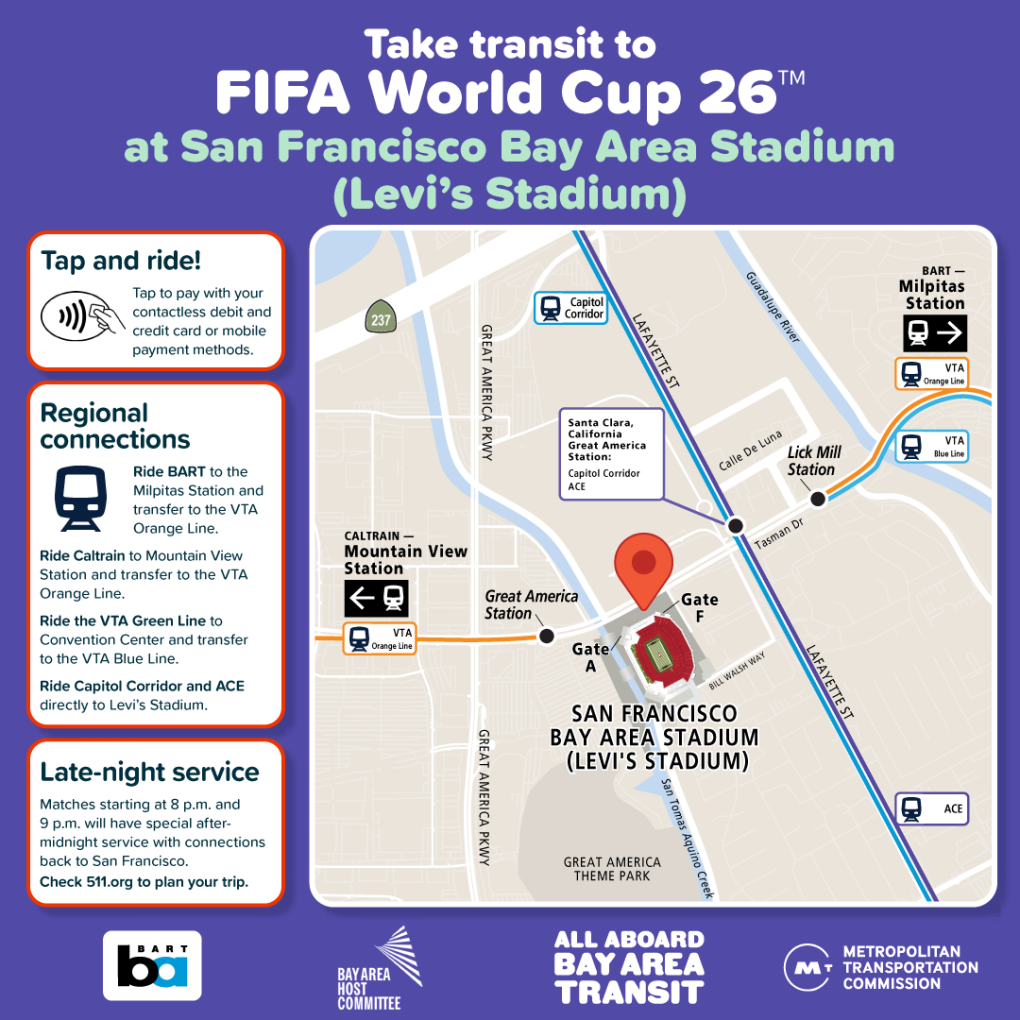
For the 9pm FIFA World Cup match on Tuesday, June 16, BART is offering fans special late-night service after midnight to get riders home. These late-night matches will put fans onto trains during a time BART is usually closed.
BART is also offering this additional late-night service for the 8pm matches on Friday, June 19, and Monday, June 22.
These special event trains will not stop at all BART stations. Fans who plan to park at BART should leave their cars at these key Easy Bay stations for the return trip: Bay Fair, Dublin, MacArthur, El Cerrito del Norte, and Pleasant Hill. Note: Powell St. Station in Downtown San Francisco will be served but does not have parking.
Bay Area transit agencies are coordinating efforts and scheduling to ensure a world-class transportation experience and to have service available for all fans regardless of when matches end.
Unlike many rail systems around the country, BART will not be implementing surge pricing for FIFA. Riders will pay the regular fare. Use Tap and Ride to pay directly at the fare gate by tapping your credit/debit card or mobile payment. Each person needs their own phone/card. No transit card/ticket is required.
BART is bolstering our staff and security presence and running longer trains. BART will also deploy extra lighting at key station parking lots to enhance safety for fans returning from evening matches.
Find BART’s comprehensive guide to FIFA World Cup 2026 transportation, including directions for taking transit to fan zones, watch parties, and other events, at bart.gov/fifa
Special limited-express, late-night service for 8pm (June 19 and 22) and 9pm (June 16) matches
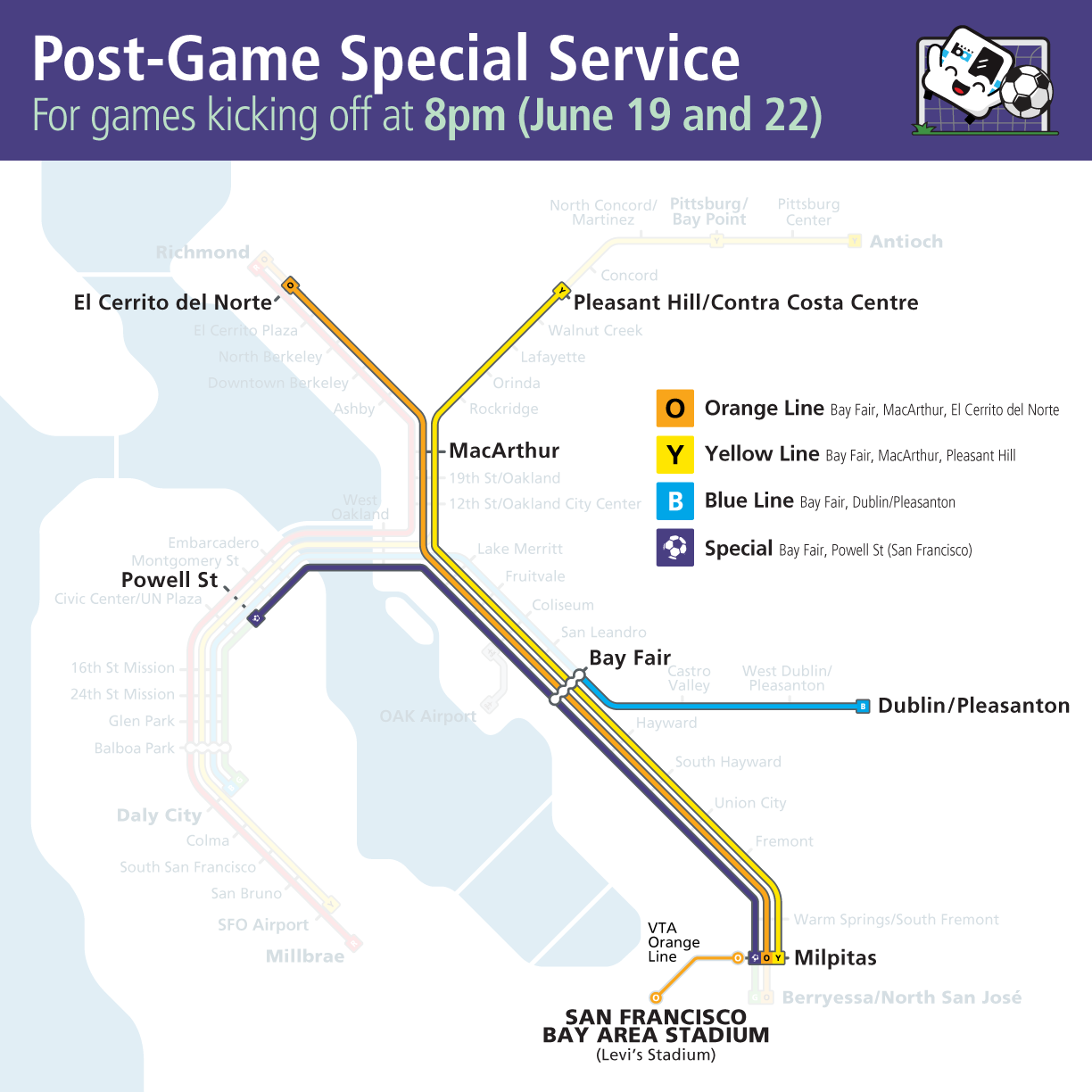
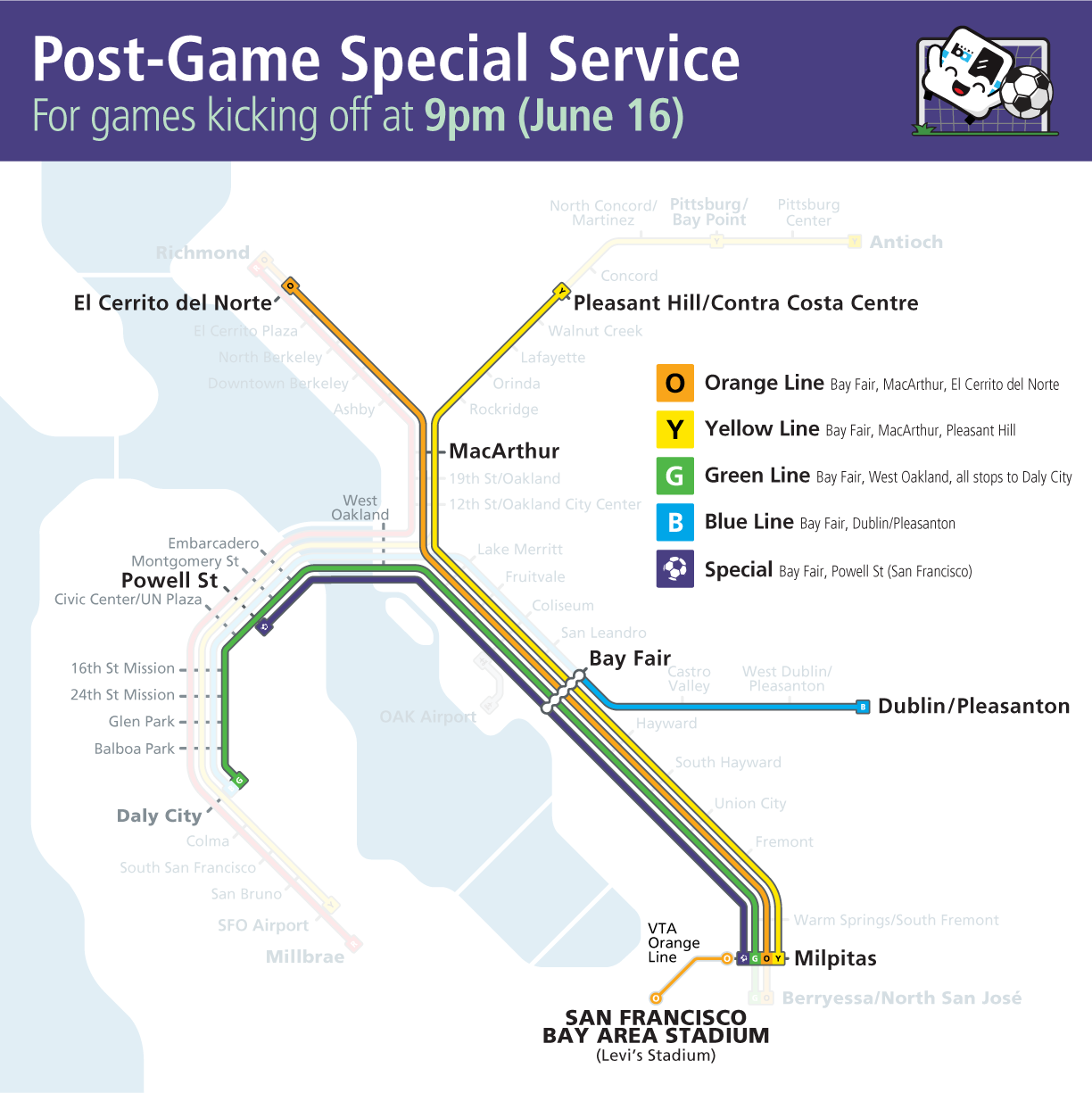
The last scheduled BART train that stops at all stations systemwide leaves Milpitas at 11:53pm towards the East Bay and San Francisco. The last scheduled BART train to Berryessa Station is 1:47am.
BART will add the following special event trains after midnight that will be timed with the last VTA trains coming from the stadium. There is not a timetable for these departure times because it depends on how long it takes to clear the stadium and get to BART on VTA. But overall, they will likely depart Milpitas every 30 minutes between 12:30am-1:40am.
These special event trains WILL NOT STOP AT ALL BART STATIONS. The trains will only serve Bay Fair, Dublin, MacArthur, El Cerrito del Norte, Pleasant Hill and Powell St stations.
People taking BART to the stadium and driving to park at BART must leave their cars at these key Easy Bay stations for the return trip: Bay Fair, Dublin, MacArthur, El Cerrito del Norte and Pleasant Hill. Note, Powell St Station in downtown San Francisco does not have parking.
Specific service of the special limited-express trains:
El Cerrito del Norte- and Dublin-Bound Trains
Two limited-stop-express Orange Line trains for 8pm matches and three trains for 9pm matches will be bound for El Cerrito del Norte. They will leave Milpitas and will stop at Bay Fair, where riders can exit the station, and Dublin-bound riders can transfer to another train to Dublin. The train will then stop at MacArthur where riders can exit. And then the last stop is El Cerrito del Norte.
Pleasant Hill- and Dublin-Bound Trains
Two limited-stop-express Yellow Line trains for 8pm matches and three trains for 9pm matches will be bound for Pleasant Hill. They will leave Milpitas and will stop at Bay Fair, where riders can exit the station and Dublin-bound riders can transfer to another train to Dublin. The train will then stop at MacArthur where riders can exit. And then the last stop is Pleasant Hill.
The above trains will run back-to-back. If you accidently board the wrong train, there will be chance at MacArthur Station to transfer to the other train for El Cerrito del Norte or Pleasant Hill. There will be signs and staff at Milpitas to help you board the right train.
Express Trains to San Francisco (Primarily Powell St Station)
BART will offer limited-stop-express trains from Milpitas into San Francisco for the 8pm and 9pm matches. Specifically:
8pm matches (June 19 and 22)
One special event train will depart Milpitas and run without stopping until Bay Fair (where riders can exit or transfer to a Dublin train), then run without stopping until Powell Street Station (the last stop). This train will depart Milpitas after the final VTA train connects riders to BART (this may be as late as 1:40am).
9pm match (June 16)
One Green Line train will depart Milpitas and run without stopping until Bay Fair (where riders can exit at Bay Fair or transfer to a Dublin train), then run without stopping until West Oakland where it will then make all stops between West Oakland and Daly City. This train will be in front of the final regularly scheduled Yellow Line train to Millbrae (this train does not stop at SFO). Anyone needing to reach stops between Daly City and Millbrae (except SFO) can transfer to that Millbrae train.
A second and final special event train will depart Milpitas after the final VTA train connects riders to BART (this may be as late as 1:40am) and will run without stopping to Powell St Station.
San Mateo County riders should take Caltrain home.
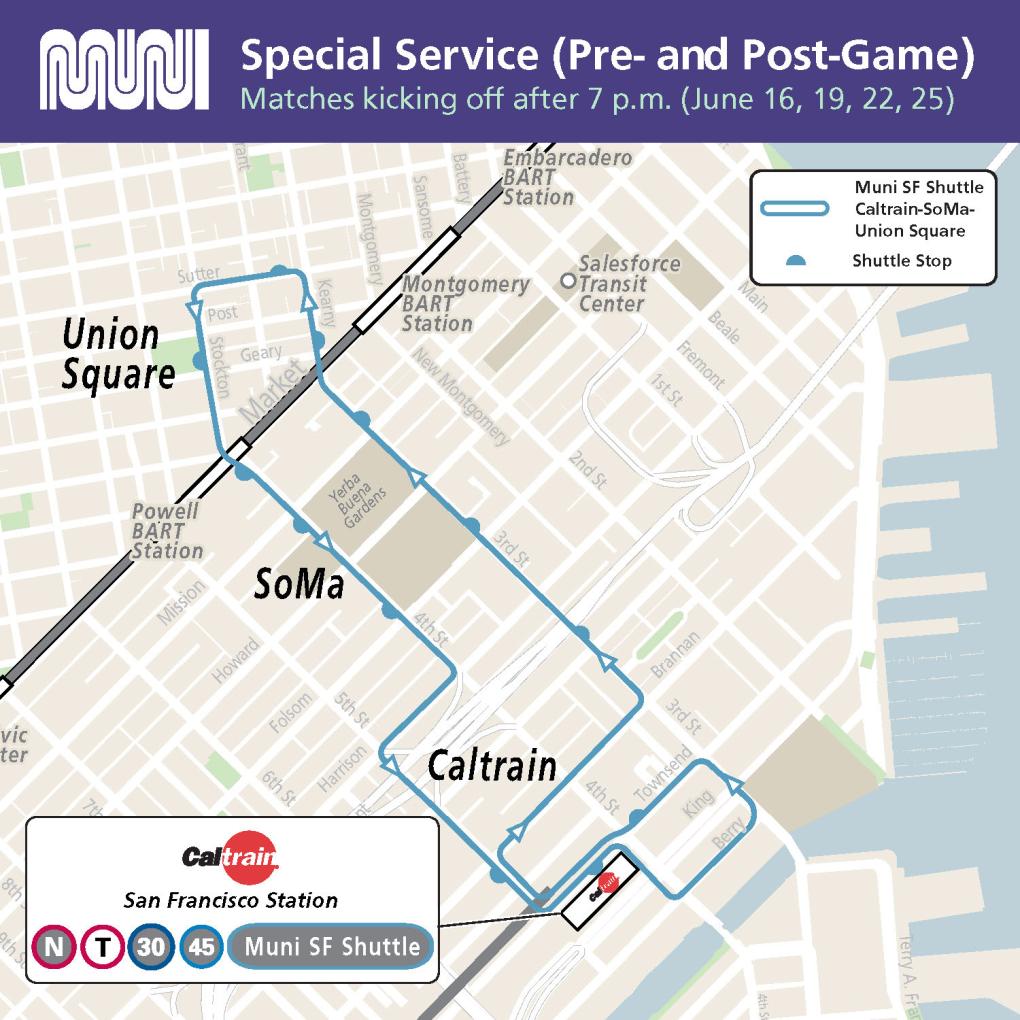
Muni in San Francisco will be providing supplemental service after normal transit operating hours to ensure reliable transportation options for the late-night matches. The Muni special bus shuttle service will circulate between Union Square, SoMA, BART and Caltrain.
BART Resources
Real Time Departures from each station
Tap and Ride contactless payment
Text BART Police to report concerns at 510-200-0992
BART extends Yellow Line extra commute trains to Pittsburg/Bay Point as ridership continues to tick upward
Beginning Monday, June 22, BART is extending its 3 extra commute trains on the Yellow Line from Pleasant Hill to/from Daly City to Pittsburg/Bay Point to/from Daly City, as recent ridership data showed the need to extend the train service. On June 8, BART added 3 trains on the Yellow Line -- its current
BART tests fare gate advertisements at nine stations to explore new revenue opportunity
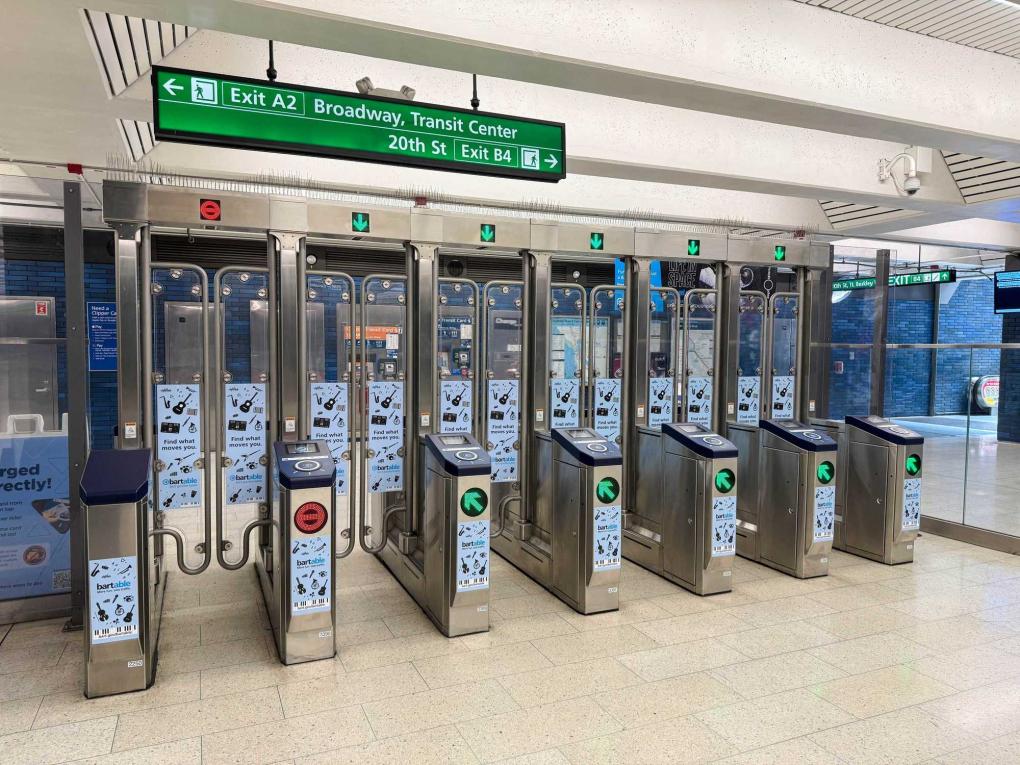
BART is testing a new look on fare gates at nine stations as part of an ongoing effort to explore new and creative revenue opportunities as the agency faces a structural deficit starting in Fiscal Year 2027.
The fare gate advertising pilot will see fare gates at nine stations wrapped with advertising on their clear plexiglass doors and metal consoles to understand how the wrap material will perform in real-world conditions. The wraps have already undergone testing at BART’s fare gate lab to assess the material’s impact on the the surface of the gates.
This pilot follows the testing of train car wrapping earlier this year, when BART Marketing covered a train car in cheerful BARTy mascots. These pilots will provide BART with a potential new revenue source as BART continues to implement significant cost-cutting measures that have reduced expenses by hundreds of millions of dollars.
The fare gate advertising pilot is rolling out at nine stations this week: 19th St Oakland, Downtown Berkeley, Dublin/Pleasanton, Concord, Fremont, 16th St Mission, and Daly City stations. Additional wraps will be installed at SFO and OAK stations ahead of the FIFA World Cup, starting June 13. Wraps at Downtown Berkeley will be removed after a month, while others will be left on for varied amounts of time.
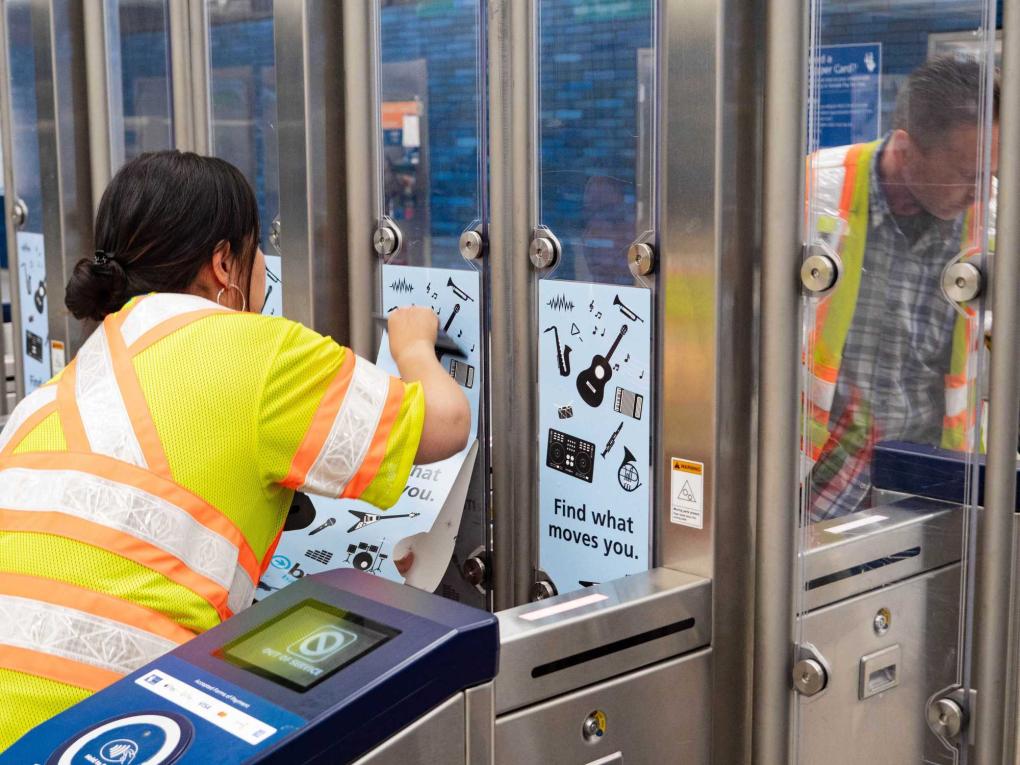
"Fare gate wraps give us a new advertising canvas to work with, and we're excited to see how this pilot performs and potentially expand it throughout the system,” said BART Director of Marketing and Research David Martindale.
The wraps are designed to allow clear sightlines through the fare gates so BART Police and staff can still see across the fare gate line. BART Marketing also worked closely with BART Police and other internal stakeholders during the planning process to make sure the placement and materials met their standards.
This will be the first time BART has wrapped fare gates with advertising. In 2025, BART completed installation of new fare gates at all 50 stations, replacing the 50-plus-year-old system's original gates.
Early indications suggest that due to reduced fare evasion the new fare gates are responsible for BART revenue growing by about $10 million annually. Additionally, crime on BART plummeted 41% in 2025 compared to the previous year, despite the fare gate project being completed in August of that year and a steady increase in ridership. There was also a 961-hour reduction in corrective maintenance hours related to unwanted behavior in the 6 months post-installation.