
Search Results
BART will run a Sunday schedule for 4th of July 2022 with extra trains for fireworks
On Monday, July 4th, 2022, BART will be running a Sunday schedule (8am-midnight). We will run five-line service until 8pm and then three-line service after 8pm. Five-line service means all lines will be running including the Green and Red lines which provide direct service into San Francisco. Extra trains
BART fares increase 6.2% on January 1, 2026, to help pay for service
BART fares will increase January 1, 2026, to keep pace with inflation so the agency is able to pay for continued operations and to work toward restoring financial stability. BART's current funding model relies on passenger fares to pay for operations, and fares continue to be an important funding source to meet the needs of riders who rely on BART and to attract new riders.
Fares will increase 6.2 % on New Year’s Day based upon actual inflation in 2023 and 2024. The average fare will increase $0.30, from $4.88 to $5.18. For a short trip like Downtown Berkeley to 19th St./Oakland, the regular fare will increase by $0.15, and for a longer trip, such as the 45-mile journey between Antioch to Montgomery, it’s a $0.55 increase.
The fare increase is expected to raise $15.6 million for Calendar Year 2026.
BART's fare calculator and Trip Planner have been updated with the new fares for trips with the date 1/1/26 and beyond. Riders can learn how the increase will affect their travels by entering a 2026 date for their trip.
BART is also changing parking prices effective January 1, 2026.
Outdated funding model
BART needs a reliable, long-term source of operating funding. The agency’s current funding model relies on passenger fares to pay for operations, an outdated model that is no longer feasible due to remote work. Even with the fare increase, BART faces a deficit of $376 million in FY27. The agency must modernize its funding sources to better align with other transit systems in the country that receive larger amounts of public funding.
“As we ask the region for greater investments and support for BART while also making internal cuts to reduce costs, we also must ask our riders to contribute more towards their trips,” said BART Board President Mark Foley. “We will continue our commitment to enhance efficiencies and implement strict cost controls.”
BART costs have grown at a rate lower than inflation, demonstrating we have held the line on spending, and BART balanced the FY26 budget with $35 million in ongoing cuts and strict cost controls. In the FY27 budget which begins July 1, 2026, BART will institute cost savings and deferrals of $108 million to maintain current service levels and produce a balanced budget. In addition, we are running shorter trains to save millions of dollars on energy costs, and our service schedule better matches ridership. We have implemented a strategic hiring freeze, targeted reductions to operating costs across departments, renegotiated with unions to reduce near-term retiree healthcare costs, and locked in low energy costs through long-term contracts.
BART embraces independent oversight
A recent review by the Federal Transit Administration (FTA) found BART is meeting standards in nearly two dozen categories, including financial management, its ability to utilize federal grants, and project implementation. BART is also subject to review by the independent Office of the Inspector General (OIG). The OIG conducts performance audits and investigates allegations of waste, fraud, and abuse. BART has accepted 92% of the OIG’s recommendations and already implemented 64%. BART is the only transit agency in the Bay Area with an OIG.
BART is improving and innovating
BART has seen progress in its efforts to improve the customer experience. In 2025, customer satisfaction increased to 88%; the number of riders who say they’ve witnessed fare evasion dropped by more than 50%; and crimes against persons on BART dropped by 59%. This year BART also installed new fare gates systemwide four months early and was the first transit agency in the Bay Area to roll out Tap and Ride, offering contactless bank card payment options.
BART offers the following fare discount programs:
- Low-income adults earning 200% or less of the federal poverty level get 50% off through the regional Clipper START program.
- Youth 5-18 years old get 50% off with a Youth Clipper card. Children four years and younger ride free.
- Seniors 65 and over get 62.5% off with a Senior Clipper card.
- The RTC Clipper card is a version of Clipper created for passengers under 65 with qualifying disabilities to provide 62.5% off.
- BART offers a “High-value Discount.” Adult Clipper cards get a 6.25% discount on cash value rides by buying $48 worth of value for $45 or $64 worth of value for $60 when autoload is set up with your registered Clipper card.
- Monthly “A” Adult Fast Pass + BART within San Francisco: Unlimited rides on all Muni vehicles and on BART within San Francisco (trips outside of these stations are charged full fare). Available for sale from the 17th of the prior month through the 16th of the month.
- Students on a school-sponsored field trip for an educational purpose are eligible for a 62.5% discount fare when purchased in advance through Group Sales.
The Next Generation of Clipper offers automatic transfer discounts beginning December 10, 2025. Riders will receive a discount of up to the highest local single ride fare on Clipper, currently $2.85, when transferring between agencies. The discount will be automatically applied to an unlimited number of transfers within 120 minutes of the first tap.
This article was originally published on December 2, 2025.
BART eliminates multi-million-dollar FY26 budget deficit through cuts and efficiencies
BART has eliminated what was projected to be a $35 million budget deficit for the next fiscal year through various cuts and strict cost control efficiencies. The upcoming Fiscal Year 2026 Preliminary Budget Memo, to be released at the end of the month, will now show a balanced budget for the fiscal year beginning July 1st, but structural deficits of $350 million to $400 million loom in following years unless long term, stable funding sources can be identified.
“We’re getting our budget in order to the extent that we can,” said BART Board President Mark Foley. “Closing a $35 million gap is no easy task. Now that we’ve overcome the first hurdle, we’ll focus on the bigger picture of restructuring BART’s funding model for long term sustainability.”
BART was able to close the projected $35 million dollar deficit through a combination of cost controls and revenue generation. Examples include:
Cost Controls
- A strategic hiring freeze while protecting safety and service quality
- Labor savings from reducing near term retiree healthcare costs
- Non-labor budget reductions across all departments
- Running shorter trains
- Locked-in low renewable electricity rates
- Implementation of Inspector General’s recommendations for efficiencies
Revenue Generation
- Installation of Next Generation Fare Gates to reduce fare evasion and increase ridership
- Maintaining inflation-based fare increases
- Offering new fare products like Clipper BayPass which is now revenue positive
- Improving transit coordination
- Growing ridership through station activations and events
- Negotiating new agreements for telecommunications revenues
Total operating expense growth in the FY26 budget is only 1% compared to inflation in the Bay Area at 2.7% over the past year and the size of workforce has been reduced from the current year due to the strategic hiring freeze. In fact, even before the recent cost cutting, BART has been able to keep its operating costs below the rate of inflation since 2019.
While BART is prioritizing high-quality and frequent service to attract more riders, overall, BART is running 100 fewer trains per week than before the pandemic.
BART is one of the most cost-efficient rail operators in the nation despite operating in a very high-cost region. By one measure, the cost per vehicle revenue hour, BART is significantly more efficient than similar systems like Washington, D.C.’s WMATA and Atlanta’s MARTA (Vehicle rail hour rates: BART - $283, MARTA $370, WMATA $466).
BART cannot close structural deficits with service cuts
As ridership continues to slowly grow, BART’s historical reliance on passenger fares to pay for operations, long seen as very effective, is outdated and no longer sustainable. New sources of funding are needed to avoid significant service cuts.
Even with belt-tightening, BART can’t cut its way out of the crisis without causing a transit death spiral. That is because rail has high fixed costs to maintain infrastructure and low marginal costs driven by changes in service. For example, when BART closed at 9pm and reduced frequencies during the height of the pandemic, it represented a 40% cut in service, but it only reduced operating costs by 12%. Even a 90% cut in service (9pm closure, one-hour frequencies, and running only three of the five BART lines) would close less than half of the FY27 $376 million deficit.
Next steps for the BART budget
The soon-to-be-released 2026 Preliminary Budget Memo will mark the beginning of the final stretch of BART’s budget activity for the year. A series of presentations at Board meetings will culminate in a Board of Directors vote in June to adopt a two-year budget for fiscal years 2026 and 2027.
BART launches second online open house for El Cerrito-Berkeley Corridor Access Plan through 5/18/22
BART is launching its second online open house and survey to seek community feedback for future access strategies to and from BART along the corridor between El Cerrito Plaza and Ashby stations. This event opens Wednesday, April 20 at https://bartberkeleyelcerritocap.participate.online/. This is an important
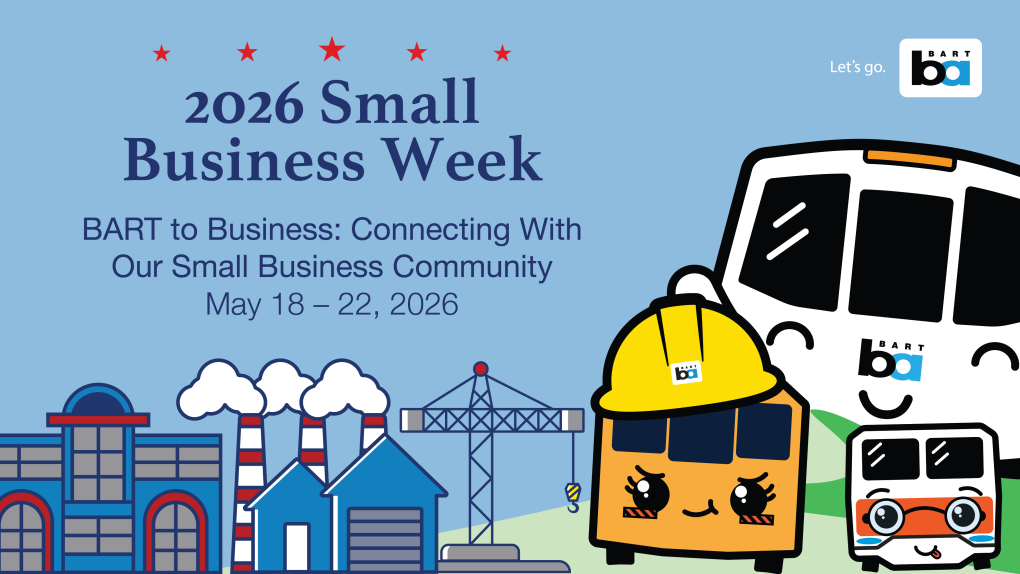
May 21: BART invites small business owners to its 2026 Small Business Summit
Register on Eventbrite
Small Business Summit event flyer [pdf]
BART’s Office of Civil Rights is hosting a free, in-person Small Business Summit on Thursday, May 21, from 8:30am to noon, on the first floor of BART HQ (2150 Webster St., Oakland, near 19th St. Oakland Station). The event will be held during BART’s Small Business Week, beginning May 19, and will include a Disadvantaged Business Enterprise and Small Business certification workshop in light of the significant changes to certification requirements under the recent Interim Final Rule (IFR).
In light of recent changes to the Disadvantaged Business Enterprise Program, BART recognizes that small businesses may be navigating new requirements and uncertainties. While that process plays out, BART remains committed to actively supporting and connecting small businesses with opportunities. This event is a reflection of that commitment.
Attendees will have the opportunity to meet BART buyers, prime contractors, discover small purchase opportunities, connect with other small businesses, and access valuable resources. You’ll also hear directly from small business owners who have successfully been awarded BART contracts!
Participating BART departments include the Office of Civil Rights, Infrastructure Delivery, Procurement, Planning and Development, BART Police Department, and System Safety.
Schedule
- 8:30am to 9am: Registration
- 9am to 9:30am: Opening remarks
- 9:30am to 10:30am: Small business workshops
- 10:30am to noon: Networking with BART buyers, prime contractors, and small business resources
BART running special late-night service for 9pm match on June 16
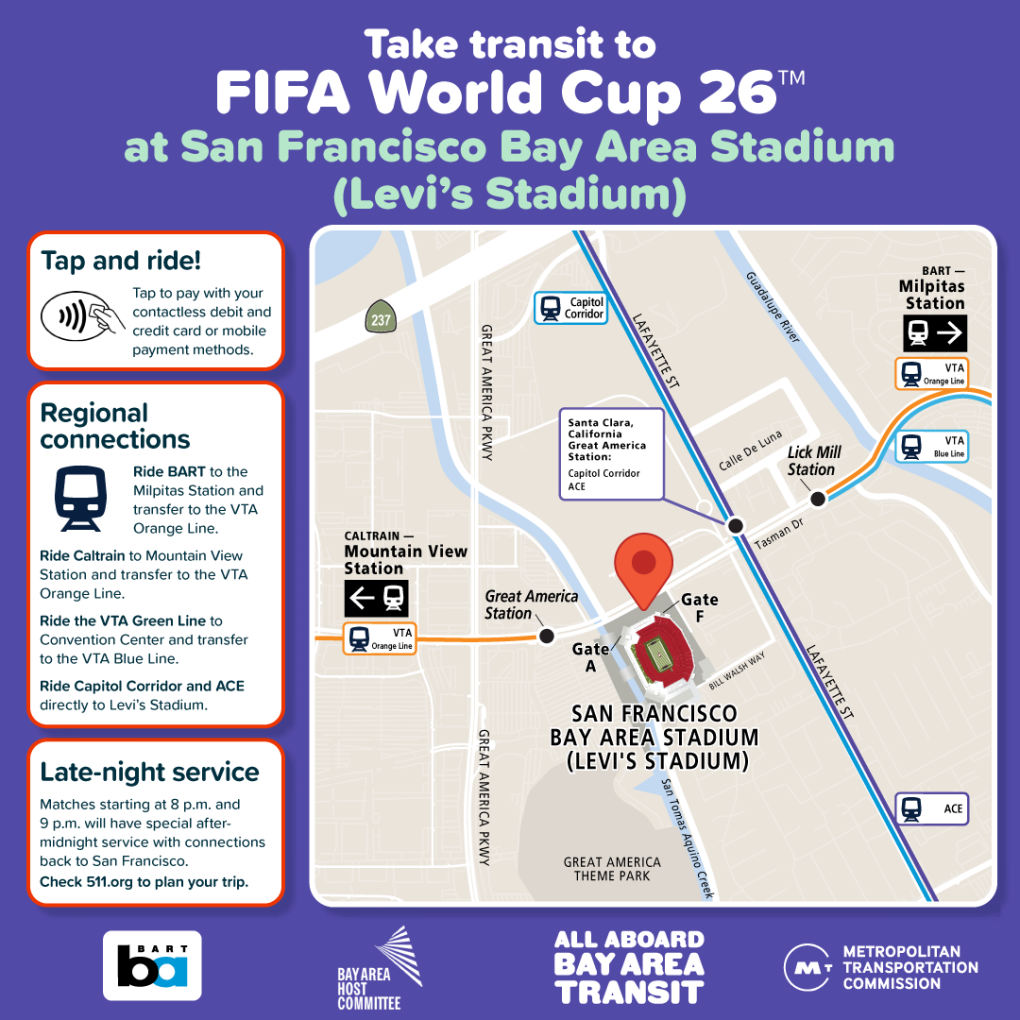
For the 9pm FIFA World Cup match on Tuesday, June 16, BART is offering fans special late-night service after midnight to get riders home. These late-night matches will put fans onto trains during a time BART is usually closed.
BART is also offering this additional late-night service for the 8pm matches on Friday, June 19, and Monday, June 22.
These special event trains will not stop at all BART stations. Fans who plan to park at BART should leave their cars at these key Easy Bay stations for the return trip: Bay Fair, Dublin, MacArthur, El Cerrito del Norte, and Pleasant Hill. Note: Powell St. Station in Downtown San Francisco will be served but does not have parking.
Bay Area transit agencies are coordinating efforts and scheduling to ensure a world-class transportation experience and to have service available for all fans regardless of when matches end.
Unlike many rail systems around the country, BART will not be implementing surge pricing for FIFA. Riders will pay the regular fare. Use Tap and Ride to pay directly at the fare gate by tapping your credit/debit card or mobile payment. Each person needs their own phone/card. No transit card/ticket is required.
BART is bolstering our staff and security presence and running longer trains. BART will also deploy extra lighting at key station parking lots to enhance safety for fans returning from evening matches.
Find BART’s comprehensive guide to FIFA World Cup 2026 transportation, including directions for taking transit to fan zones, watch parties, and other events, at bart.gov/fifa
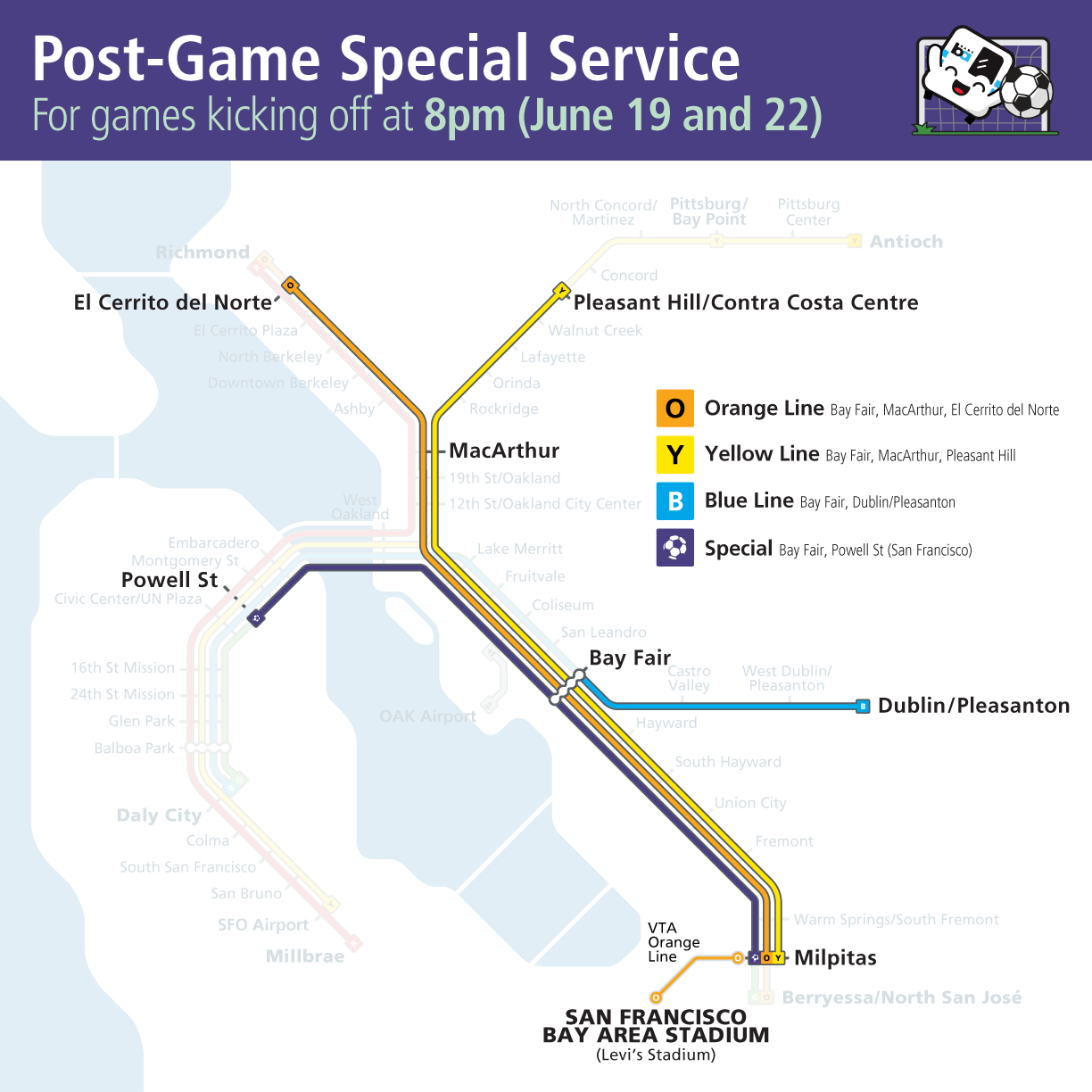
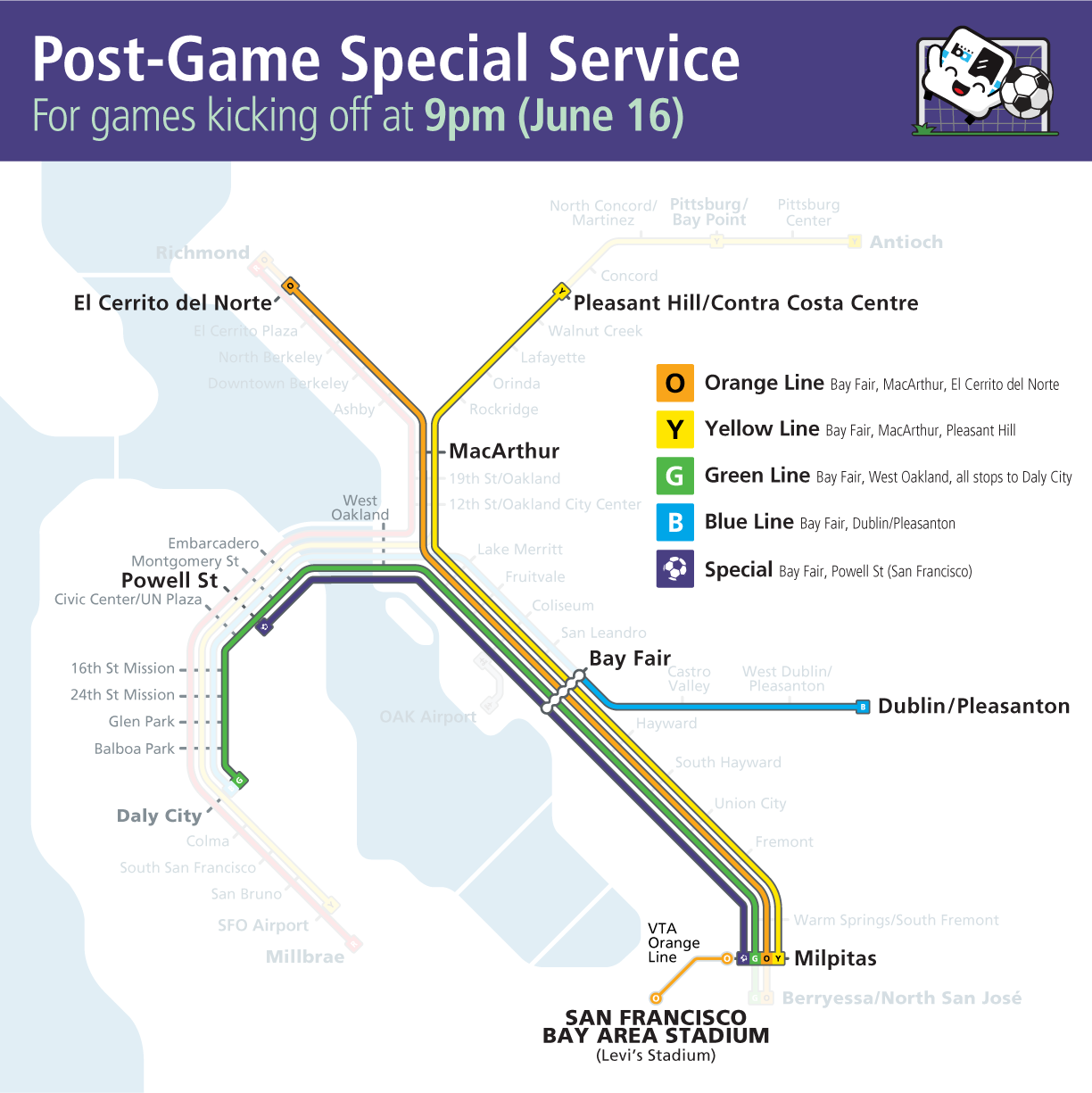
Special limited-express, late-night service for 8pm (June 19 and 22) and 9pm (June 16) matches
The last scheduled BART train that stops at all stations systemwide leaves Milpitas at 11:53pm towards the East Bay and San Francisco. The last scheduled BART train to Berryessa Station is 1:47am.
BART will add the following special event trains after midnight that will be timed with the last VTA trains coming from the stadium. There is not a timetable for these departure times because it depends on how long it takes to clear the stadium and get to BART on VTA. But overall, they will likely depart Milpitas every 30 minutes between 12:30am-1:40am.
These special event trains WILL NOT STOP AT ALL BART STATIONS. The trains will only serve Bay Fair, Dublin, MacArthur, El Cerrito del Norte, Pleasant Hill and Powell St stations.
People taking BART to the stadium and driving to park at BART must leave their cars at these key Easy Bay stations for the return trip: Bay Fair, Dublin, MacArthur, El Cerrito del Norte and Pleasant Hill. Note, Powell St Station in downtown San Francisco does not have parking.
Specific service of the special limited-express trains:
El Cerrito del Norte- and Dublin-Bound Trains
Two limited-stop-express Orange Line trains for 8pm matches and three trains for 9pm matches will be bound for El Cerrito del Norte. They will leave Milpitas and will stop at Bay Fair, where riders can exit the station, and Dublin-bound riders can transfer to another train to Dublin. The train will then stop at MacArthur where riders can exit. And then the last stop is El Cerrito del Norte.
Pleasant Hill- and Dublin-Bound Trains
Two limited-stop-express Yellow Line trains for 8pm matches and three trains for 9pm matches will be bound for Pleasant Hill. They will leave Milpitas and will stop at Bay Fair, where riders can exit the station and Dublin-bound riders can transfer to another train to Dublin. The train will then stop at MacArthur where riders can exit. And then the last stop is Pleasant Hill.
The above trains will run back-to-back. If you accidently board the wrong train, there will be chance at MacArthur Station to transfer to the other train for El Cerrito del Norte or Pleasant Hill. There will be signs and staff at Milpitas to help you board the right train.
Express Trains to San Francisco (Primarily Powell St Station)
BART will offer limited-stop-express trains from Milpitas into San Francisco for the 8pm and 9pm matches. Specifically:
8pm matches (June 19 and 22)
One special event train will depart Milpitas and run without stopping until Bay Fair (where riders can exit or transfer to a Dublin train), then run without stopping until Powell Street Station (the last stop). This train will depart Milpitas after the final VTA train connects riders to BART (this may be as late as 1:40am).
9pm match (June 16)
One Green Line train will depart Milpitas and run without stopping until Bay Fair (where riders can exit at Bay Fair or transfer to a Dublin train), then run without stopping until West Oakland where it will then make all stops between West Oakland and Daly City. This train will be in front of the final regularly scheduled Yellow Line train to Millbrae (this train does not stop at SFO). Anyone needing to reach stops between Daly City and Millbrae (except SFO) can transfer to that Millbrae train.
A second and final special event train will depart Milpitas after the final VTA train connects riders to BART (this may be as late as 1:40am) and will run without stopping to Powell St Station.
San Mateo County riders should take Caltrain home.
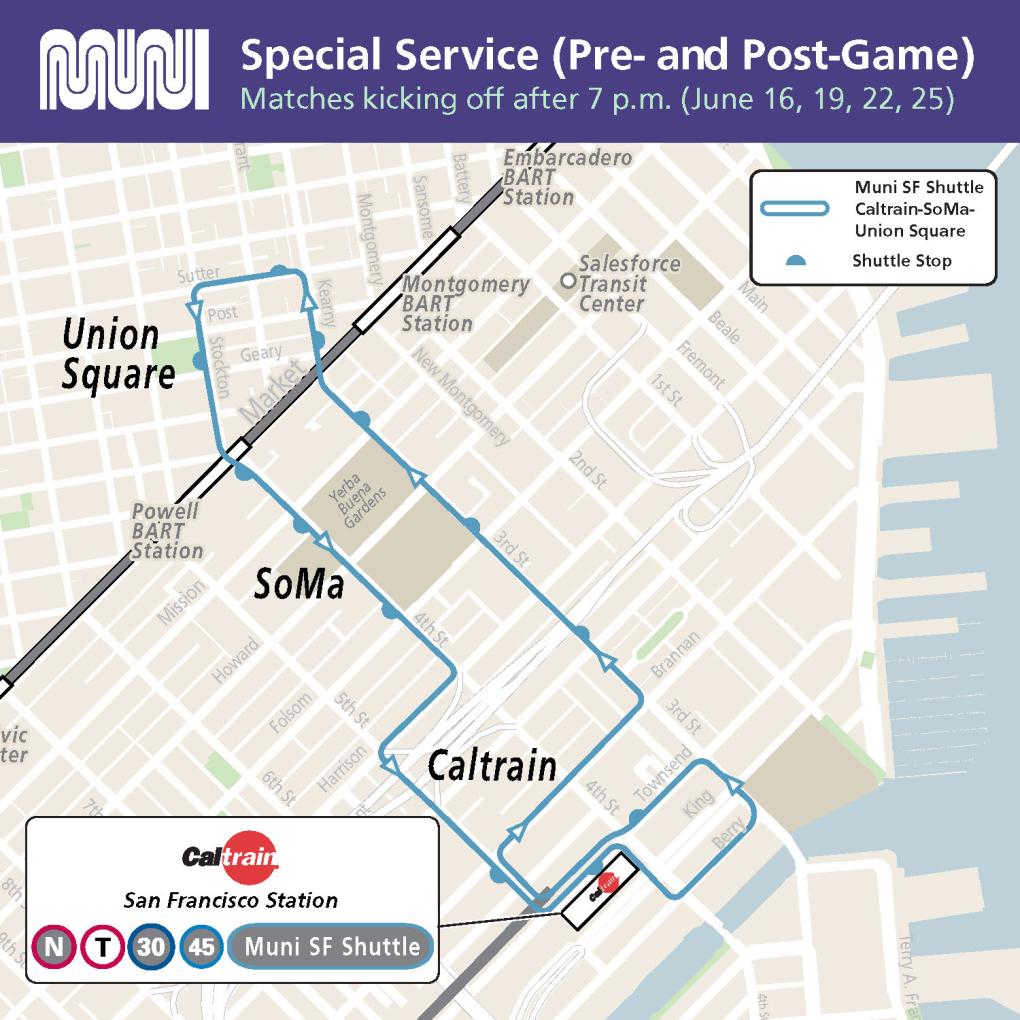
Muni in San Francisco will be providing supplemental service after normal transit operating hours to ensure reliable transportation options for the late-night matches. The Muni special bus shuttle service will circulate between Union Square, SoMA, BART and Caltrain.
BART Resources
Real Time Departures from each station
Tap and Ride contactless payment
Text BART Police to report concerns at 510-200-0992
BART tests fare gate advertisements at nine stations to explore new revenue opportunity
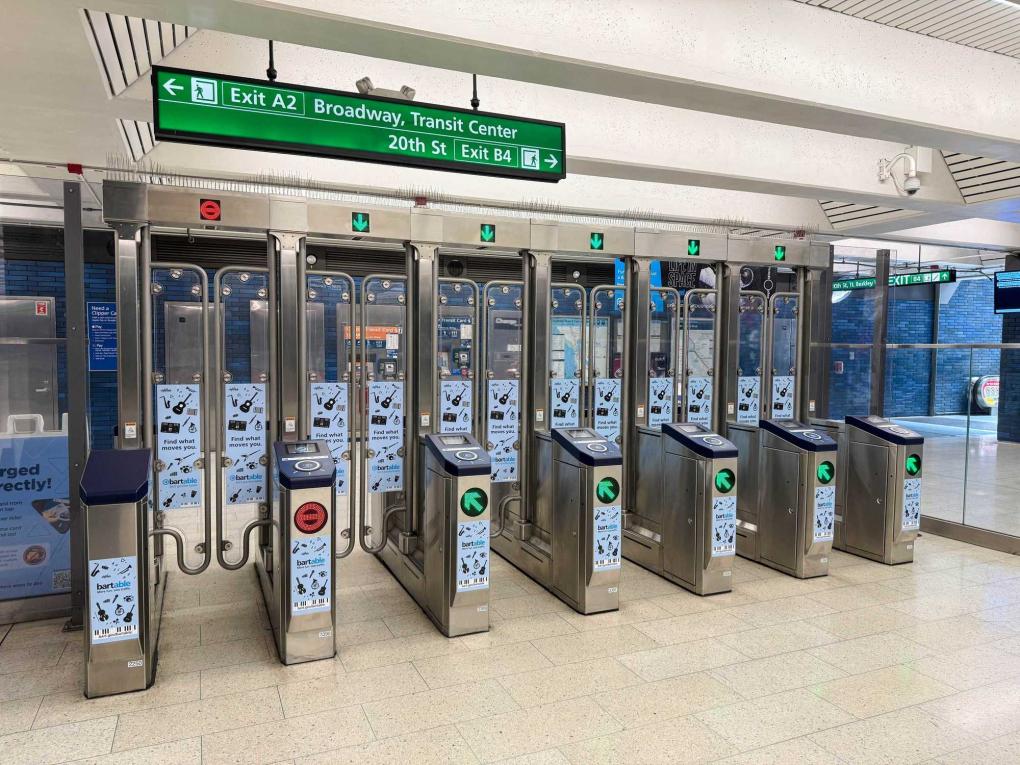
BART is testing a new look on fare gates at nine stations as part of an ongoing effort to explore new and creative revenue opportunities as the agency faces a structural deficit starting in Fiscal Year 2027.
The fare gate advertising pilot will see fare gates at nine stations wrapped with advertising on their clear plexiglass doors and metal consoles to understand how the wrap material will perform in real-world conditions. The wraps have already undergone testing at BART’s fare gate lab to assess the material’s impact on the the surface of the gates.
This pilot follows the testing of train car wrapping earlier this year, when BART Marketing covered a train car in cheerful BARTy mascots. These pilots will provide BART with a potential new revenue source as BART continues to implement significant cost-cutting measures that have reduced expenses by hundreds of millions of dollars.
The fare gate advertising pilot is rolling out at nine stations this week: 19th St Oakland, Downtown Berkeley, Dublin/Pleasanton, Concord, Fremont, 16th St Mission, and Daly City stations. Additional wraps will be installed at SFO and OAK stations ahead of the FIFA World Cup, starting June 13. Wraps at Downtown Berkeley will be removed after a month, while others will be left on for varied amounts of time.
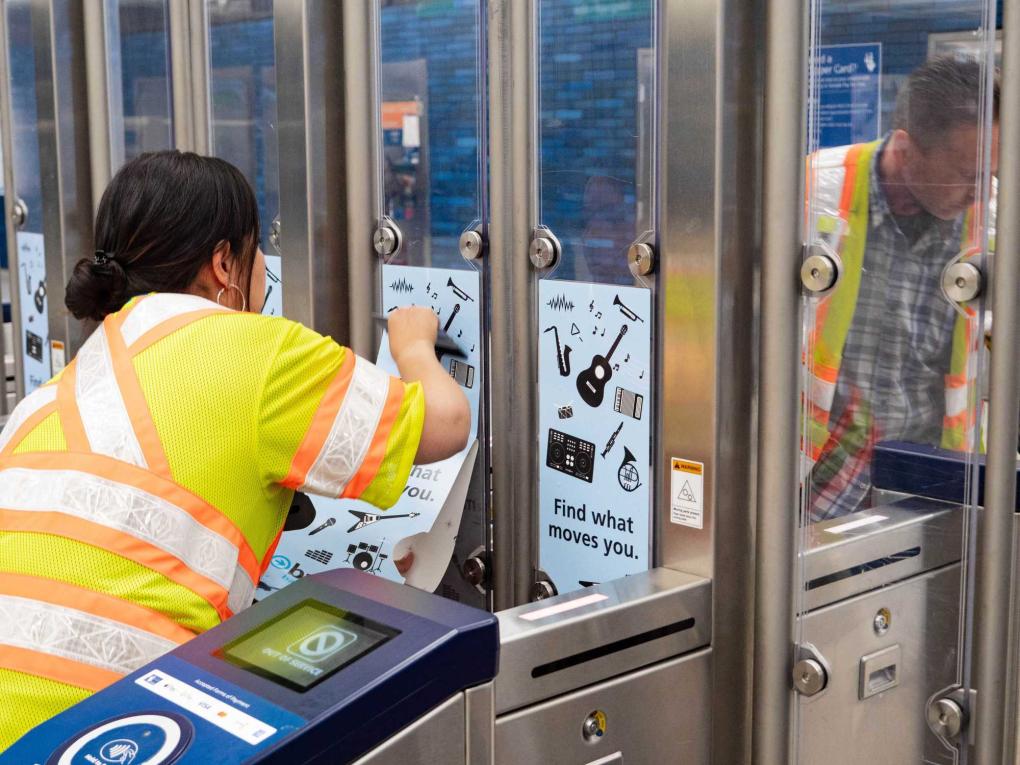
"Fare gate wraps give us a new advertising canvas to work with, and we're excited to see how this pilot performs and potentially expand it throughout the system,” said BART Director of Marketing and Research David Martindale.
The wraps are designed to allow clear sightlines through the fare gates so BART Police and staff can still see across the fare gate line. BART Marketing also worked closely with BART Police and other internal stakeholders during the planning process to make sure the placement and materials met their standards.
This will be the first time BART has wrapped fare gates with advertising. In 2025, BART completed installation of new fare gates at all 50 stations, replacing the 50-plus-year-old system's original gates.
Early indications suggest that due to reduced fare evasion the new fare gates are responsible for BART revenue growing by about $10 million annually. Additionally, crime on BART plummeted 41% in 2025 compared to the previous year, despite the fare gate project being completed in August of that year and a steady increase in ridership. There was also a 961-hour reduction in corrective maintenance hours related to unwanted behavior in the 6 months post-installation.
BART brings three new traction power substations online, strengthening reliability across the system
BART has energized three newly constructed substations that are providing tangible benefits to BART riders in the core of the system. The added redundancy helps minimize service disruptions while improving operational flexibility throughout the core of the system.
New substations at Civic Center/UN Plaza Station, Montgomery St. Station, and near the Oakland entrance to the Transbay Tube, entered service between January and June 2026 as part of BART's Transbay Corridor Core Capacity Program.
This comes as BART's ridership has been increasing and passenger on-time performance has been on the rise. In the latest quarter, BART's Passenger On-time Performance Rate was 94.4%, the best result in more than 10 years outside of the COVID period.
"Traction power substations are the backbone of the BART system," said Myat San, BART's Chief Infrastructure Officer. "Every train depends on them to receive the power needed to operate safely and reliably. The recently energized substations increase capacity, improve redundancy, and makes our electrical network more resilient, which helps us provide dependable service now and prepare the system for the future."
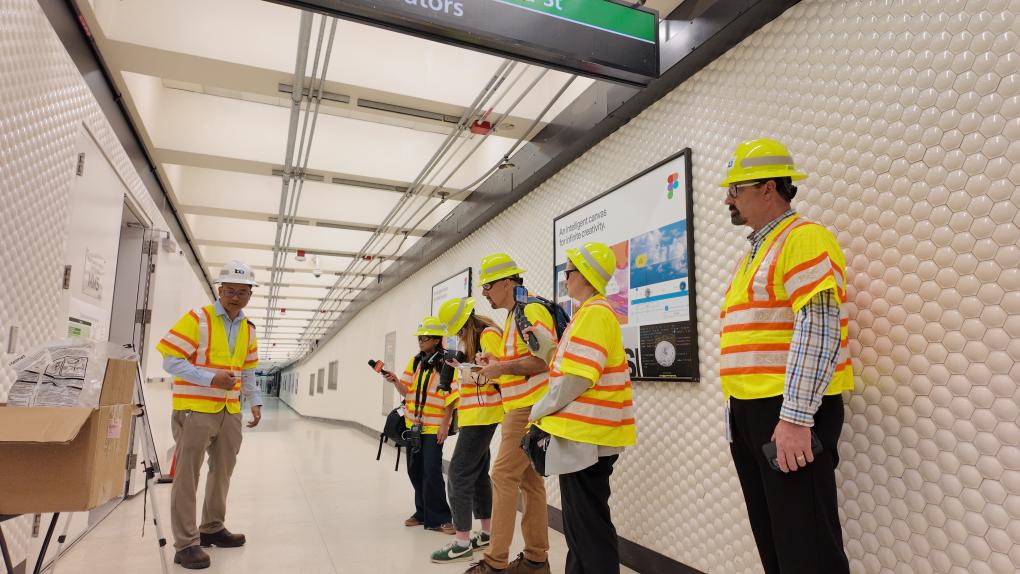
The new facilities allow power to be supplied from multiple locations if another substation is taken out of service for planned maintenance or an unexpected outage.
The substations also increase available power capacity by approximately 20 percent over the baseline capacity on the M-Line through the system's core, improve voltage performance, and reduce stress on older electrical equipment during periods of heavy demand.
The increase in available power from the new substations will also give BART the future capability to run additional trains through the Transbay Tube as part of BART’s Transbay Corridor Core Capacity Program (TCCCP). TCCCP will see the construction of a total of six substations, including the downtown San Francisco substations. These will provide the energy needed to power additional trains, with the objective of running up to thirty ten-car trains per hour in both directions of the Transbay Tube.
"Modernizing our traction power system gives us greater flexibility to operate under a wide range of conditions," said Gordon Wong, BART Principal Electrical Engineer. "With additional capacity and redundancy built into the network, we can better maintain reliable service while supporting growth in ridership for decades to come."
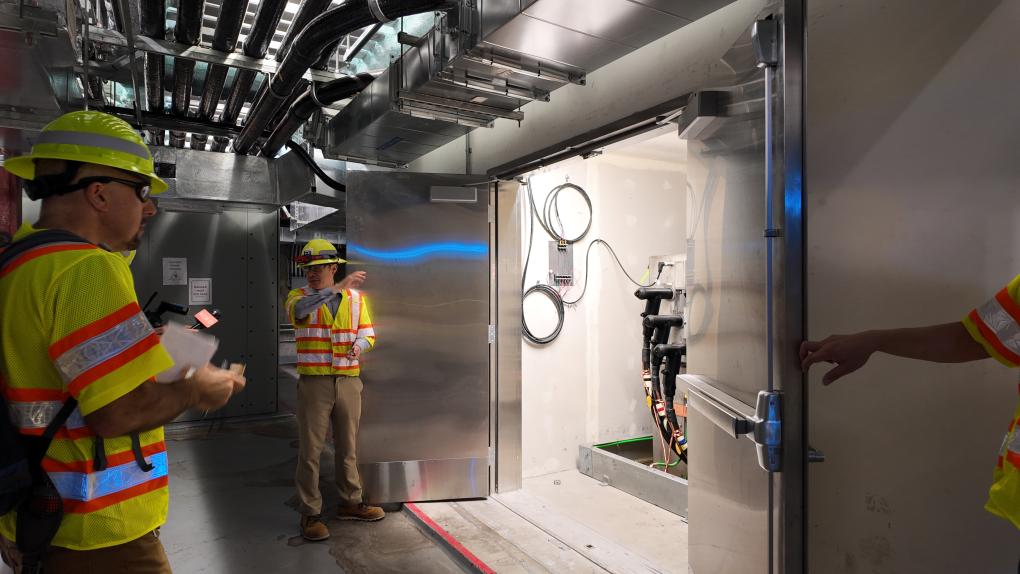
BART currently operates 136 traction power facilities throughout its system. Construction on three additional substations (one in Richmond, one in Concord, and one in Oakland) is expected to begin within the next year.
The majority of the funding for BART’s Traction Power Substation project comes from Measure RR funds, as well as contributions from TCCCP, the Federal Transit Administration and BART funds.
BART Holiday Merch available for preorder or purchase at Railgoods popup shops + SweaterFest

UPDATE: BART Holiday Merch is so popular, we have sold out of our current inventory.
Fear not: You can still purchase all BART holiday merch -- sweaters, vests, beanies, and scarves -- at an upcoming Railgoods holiday popup shop at select BART stations, which will have limited inventory on hand (see dates and locations below). You also have the option to preorder holiday merch on Railgoods.com here (more info below).
Railgoods Holiday Popups:
Wednesday, Nov. 6, 3pm to 6pm, Daly City Station
Wednesday, Nov. 13, 3pm to 6pm, Pleasant Hill Station
Wednesday, Nov. 20, 3pm to 6pm, El Cerrito del Norte Station
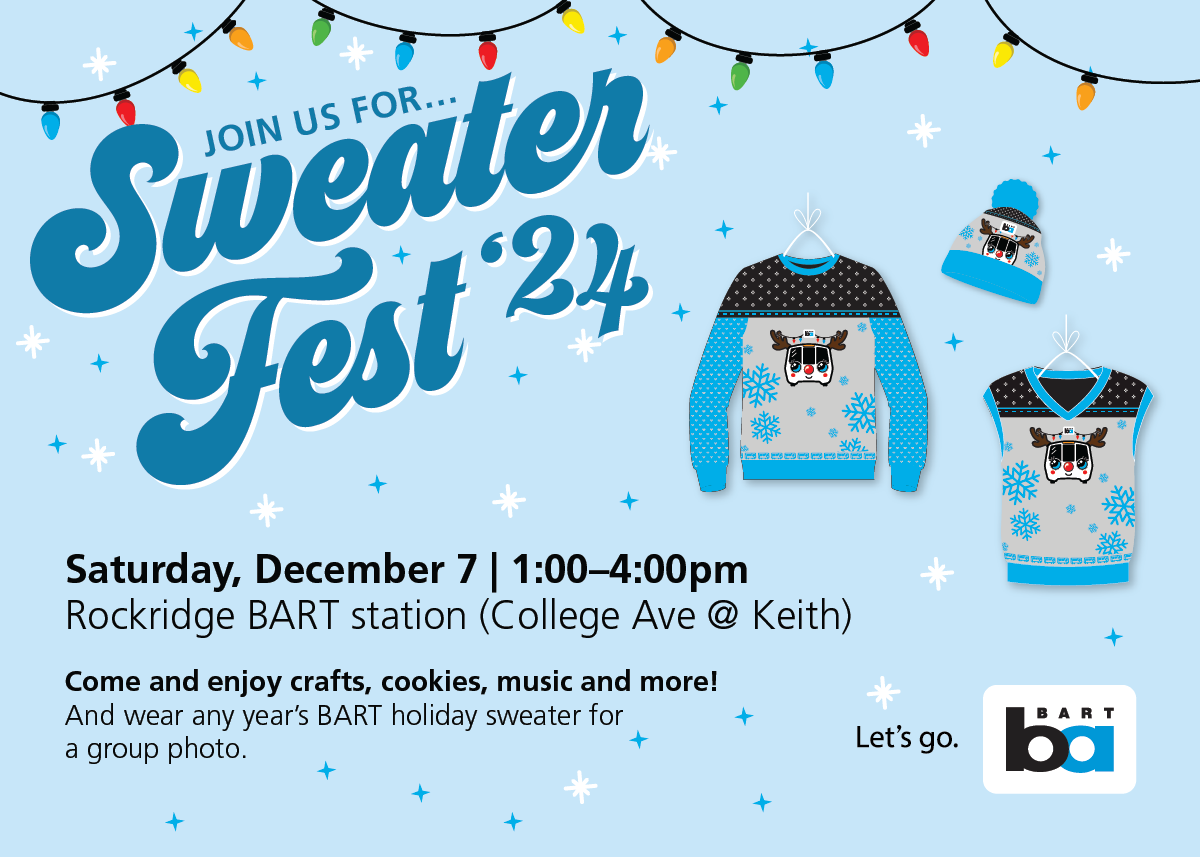
Saturday, Dec. 7, 1pm to 4pm, Sweaterfest at Rockridge Station
Thursday, Dec. 12, 3pm to 6pm, Dublin/Pleasanton Station
If you preorder your items on Railgoods.com, at checkout you will have the option to:
Pick up your order at SweaterFest on Saturday, Dec. 7, 1pm-4pm, at Rockridge Station. More info below.
Ship your order for a fee. Items will begin shipping the week of December 9.
Pick up your sweater at BART's Customer Services Center at Lake Merritt Station (hours: M-F 8:30am to 4:45pm). If you select this option, you will receive an email when your order is ready. Orders should be available for pickup the week of December 9.
SweaterFest is back!
Mark your calendars for Saturday, Dec 7, 1pm to 4pm, at Rockridge Station (College Ave. @ Keith). Wear your BART holiday sweater from any year and enjoy crafts, cookies, music, and more. 2024 BART holiday merch will be on sale at the event. There will also be a booth to pickup preordered holiday merch.
If you preordered a sweater this summer...
If you preordered your holiday merch this summer, your order will arrive shortly. Those who selected the in-store pickup option during the presale should keep an eye out for an alert that their order is ready for pickup.
You can also win holiday merch from BARTable! Sign up for the BARTable This Week newsletter on bart.gov/bartable to enter holiday sweepstakes and to hear about fun holiday events by BART stations.
2024 BART Holiday Merch Prices
Shipping costs vary by weight and location.
Sweater - $49.99 (limit to 2 sweaters per order)
Vest - $39.99
Beanie - $15.99
Scarf - $19.99
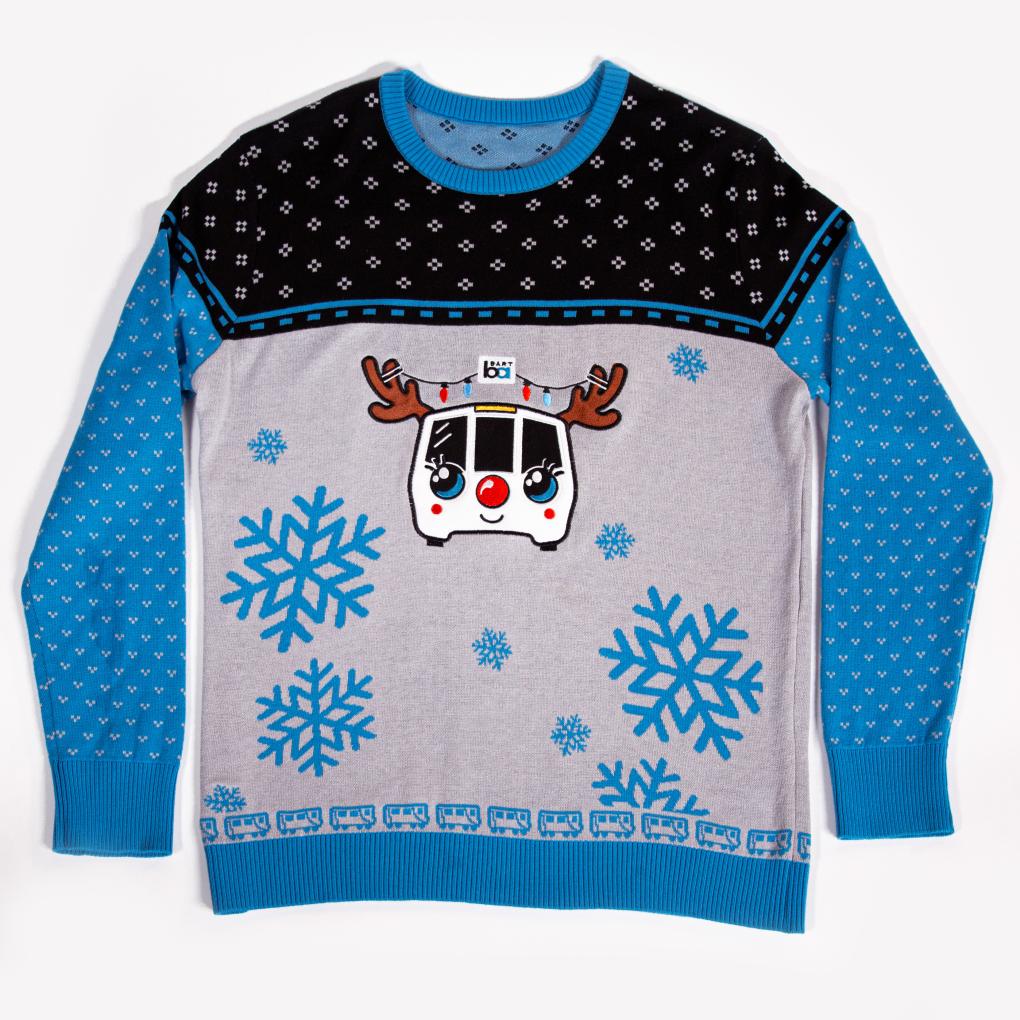
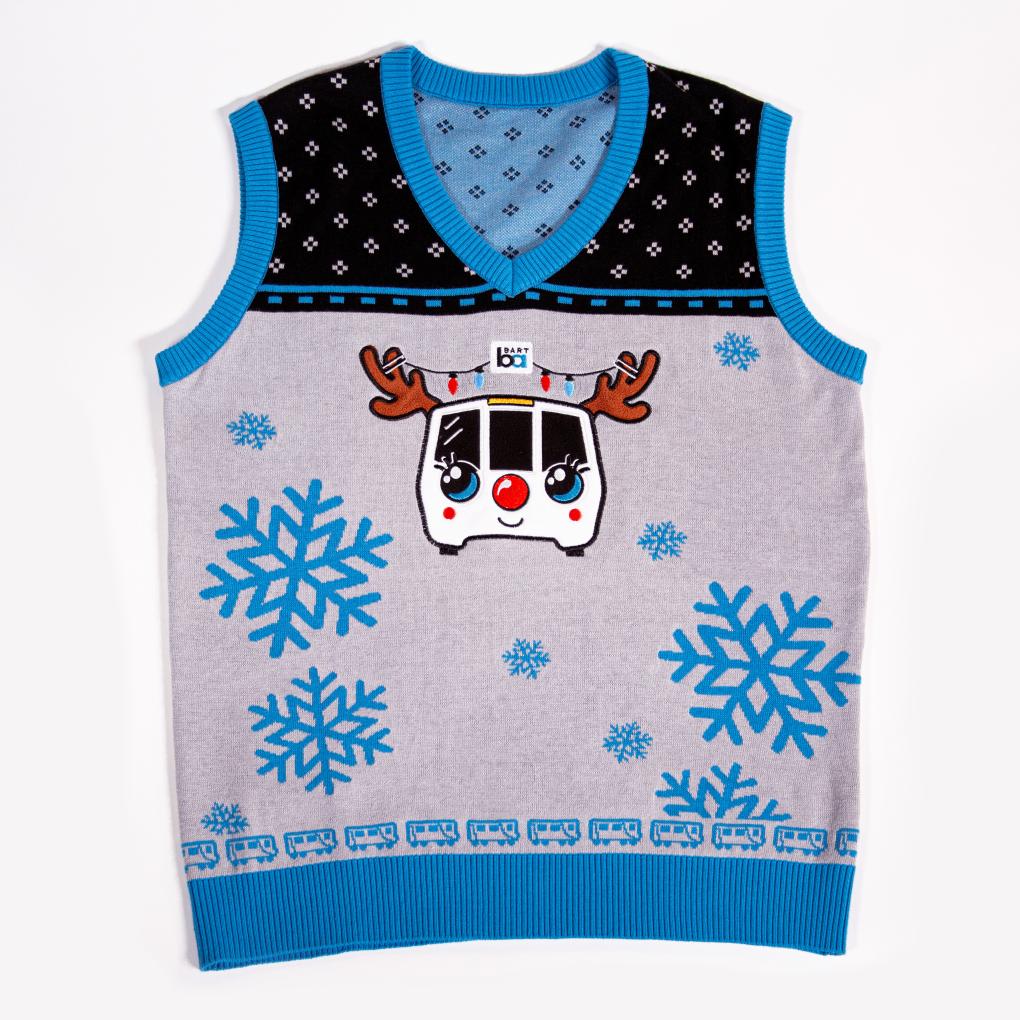

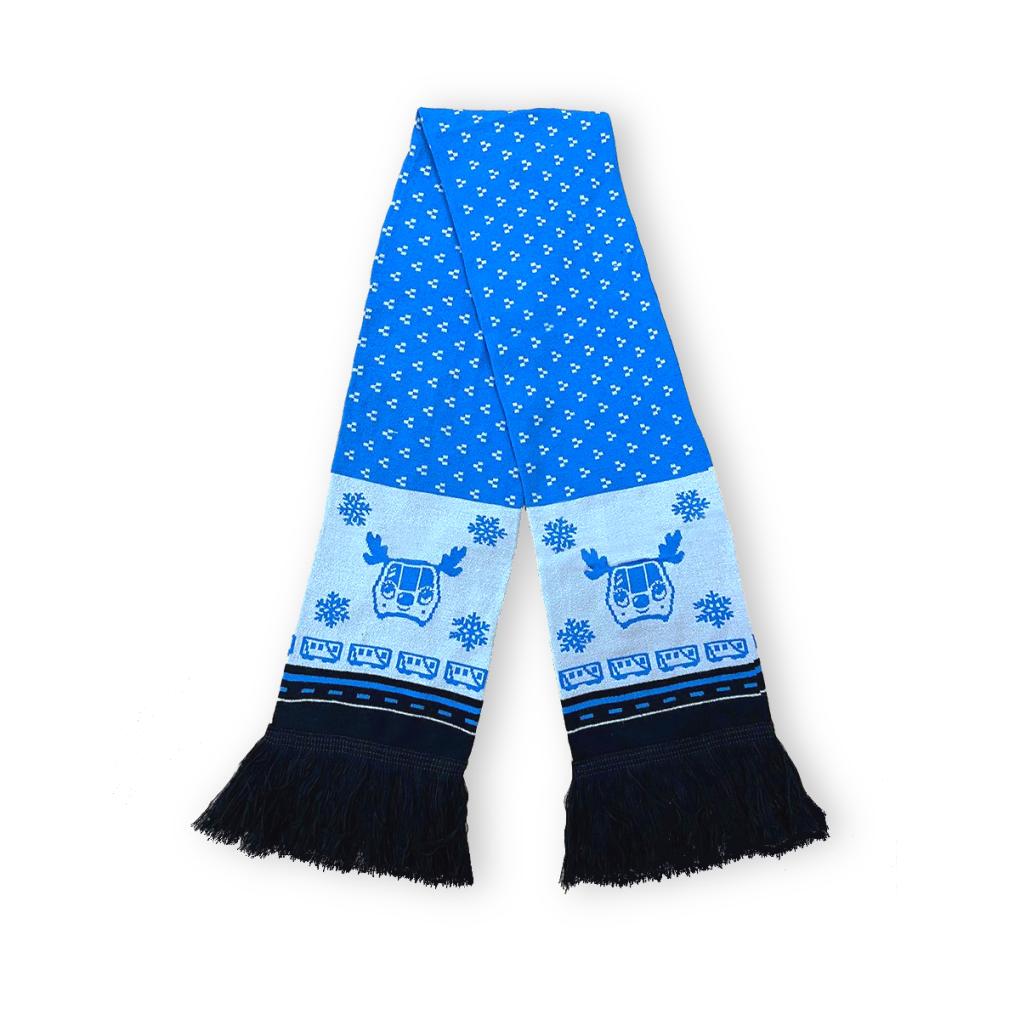
BART is at the heart of the Bay Area, and we should be proud of the public institutions that make our region merry and bright. Buy some merch and rep your love for BART and the Bay – the ugly sweater way.
This is the fourth year BART has sold holiday sweaters. Last year, we sold our entire inventory of 3,000 sweaters. Sales exceeded $100,000.
BART is one of the first transit agencies to sell holiday sweaters. We designed the first sweater in 2021 as a BARTable contest giveaway and ordered just five for the contests. Our inventory proved insufficient after General Manager Bob Powers wore one of the sweaters during a media event about BART’s air filters. People wanted them...badly. A week later, we held a sale for the public, and the sweaters sold out in under an hour.
Every year since, despite increasing our inventory into the thousands, the sweaters have sold out.
BART General Manager to hold special Listening Tour with San Francisco State students to boost transit ridership
BART General Manager Bob Powers will be meeting with students at San Francisco State University on Thursday, November 4 from 1:30-3pm on campus about their transit needs and to hear their ideas to encourage more young people to ride BART. The visit to the San Francisco State campus will allow Powers the