
Search Results
BART reports 69% reduction in greenhouse gas emissions over past decade
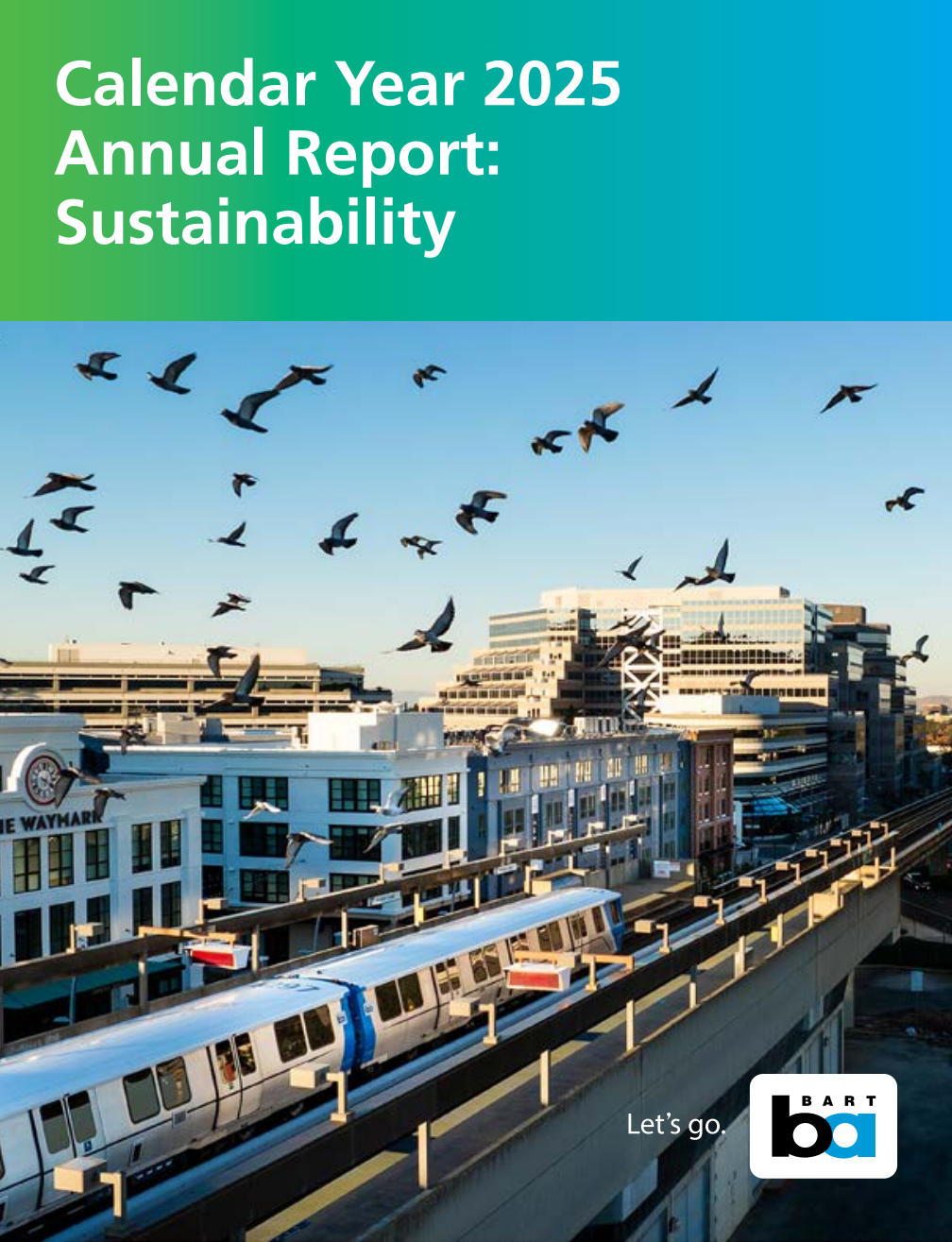
BART has reduced its total greenhouse gas emissions by 69% over the past decade, even as the system expanded by five stations and increased annual train miles by about 11%.
The milestone is highlighted in BART’s newly released 2025 Sustainability Report, which marks the final report under the agency’s 2015-2025 Sustainability Action Plan. The plan identified 120 sustainability projects across BART, and 80 have now been completed or incorporated into ongoing operations.
“Providing access to clean, reliable transit is one of the most powerful climate actions available to our region,” said BART General Manager Bob Powers. “We owe it to this region, and the people who will inherit it, to get this right.”
The report highlights sustainability work completed in 2025 as well as progress made throughout the 10-year plan. Among the highlights:
More than 90,000 LED lights have been installed at BART stations and parking facilities over the past three years, improving energy efficiency while reducing maintenance needs.
BART was awarded and signed an agreement to install EV chargers at all BART-managed parking facilities.
Energy use by BART’s non-revenue fleet declined 32% in 2025, helped by a new vehicle pool program that allows employees to share vehicles rather than assigning cars to individual departments.
Electric water heaters were installed at five out of six BART shops.
BART purchased 32 electric trucks and vans.
BART launched a new cross-departmental effort to define what resilience means for the agency and identify future initiatives to prepare the system for hazards and disruptions.
BART continued improvements that make stations easier to reach by walking, biking, and other forms of transit.
The report also highlights BART’s role in reducing regional greenhouse gas emissions by providing an electric alternative to driving. Each average BART round trip avoids an estimated 24.4 pounds of carbon dioxide emissions, according to the report.
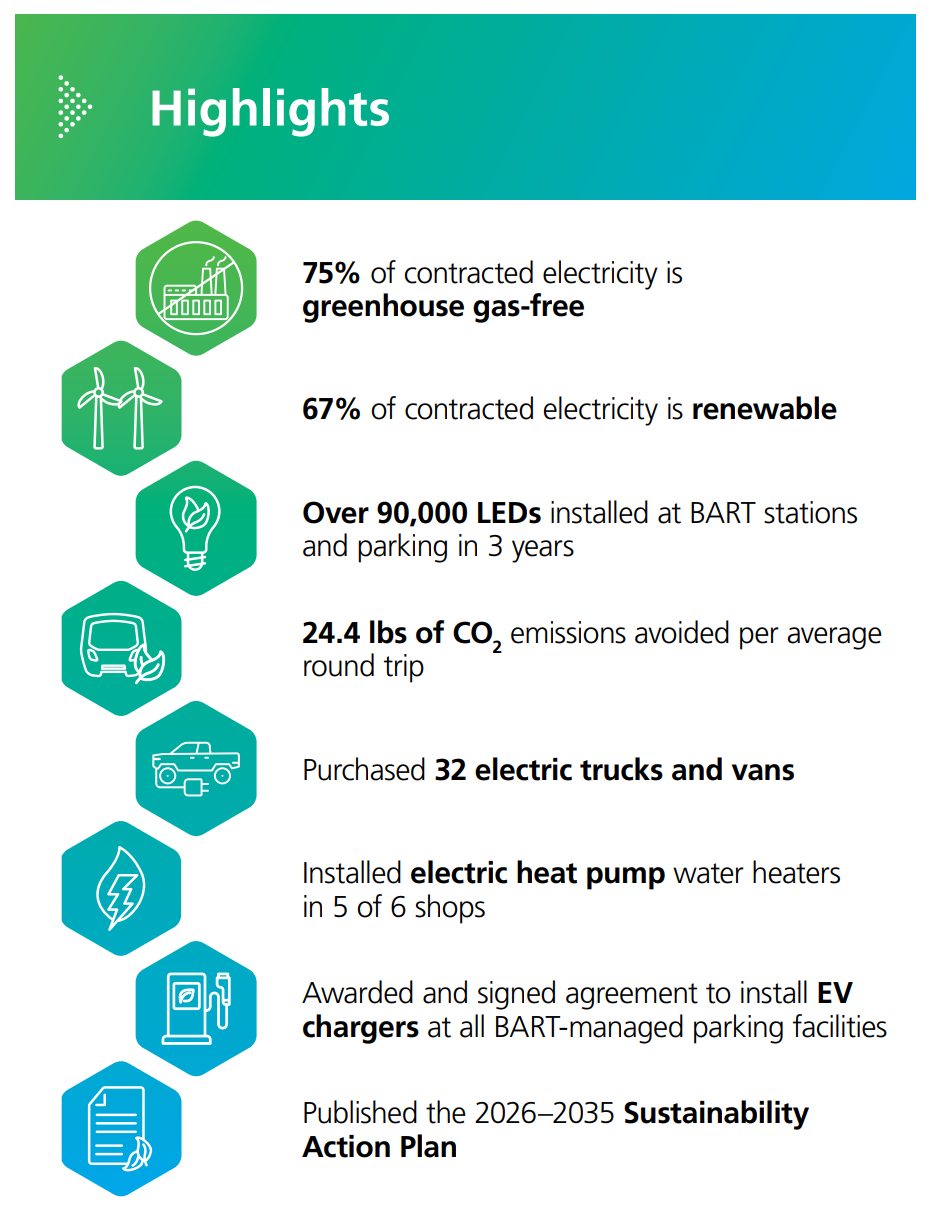
BART's electricity supply is largely renewable and greenhouse gas-free, thanks to several long-term power purchase agreements with wind, solar, and hydroelectric facilities across the state.
The 2025 report marks the end of BART’s first 10-year sustainability action plan. The agency has since released its new 2026-2035 Sustainability Action Plan, which includes 72 action items through 2035 and performance targets through 2030. The plan includes goals to procure 100% renewable power for BART’s electricity, conserve water, expand recycling & composting, adopt a Green Procurement Policy, assess climate risks, and expand Transit-Oriented Development at BART stations.
“Out and Proud” BART Directors lead virtual panel on LGBTQ issues for Pride Month
By MELISSA JORDANBART Senior Web ProducerMore than 100 BART employees joined a noon-hour virtual Pride celebration this week, reflecting on BART’s leadership for LGBTQ equality with hope and optimism on the same day California reopened and lifted most pandemic restrictions.The “Covid coming out party” of
Podcast: A trailblazing woman who brought inclusion and reform to BART calls it a career
Transcript below: HOST: "There are few people who can claim a career path like the one followed by Tamar Allen. Over a span that stretches across four decades Allen has worn many hats ranging from police officer to Assistant General Manager. Allen has played a critical role in some of the largest projects in
BART PD reports surge in arrests as more officers patrol trains
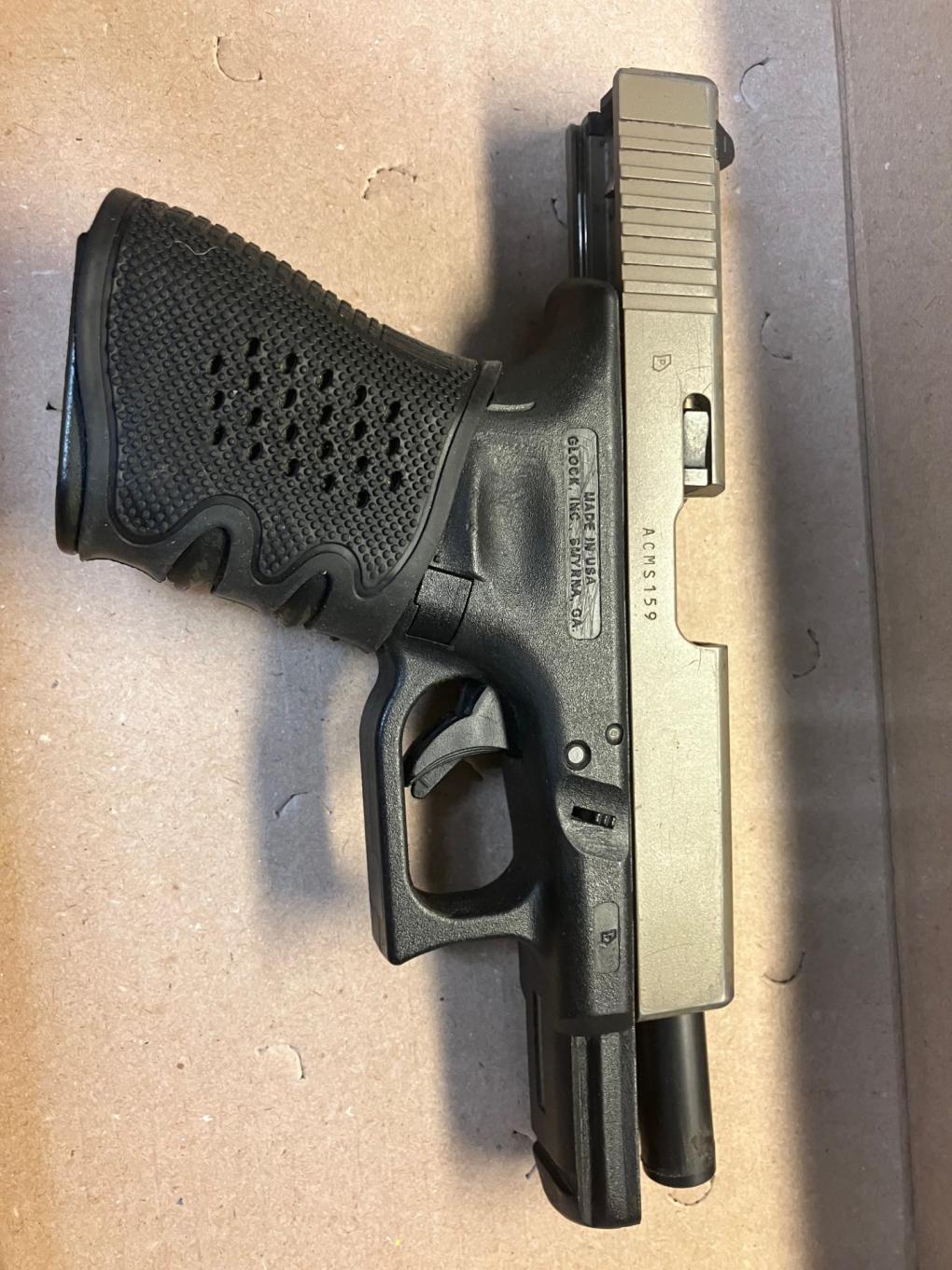
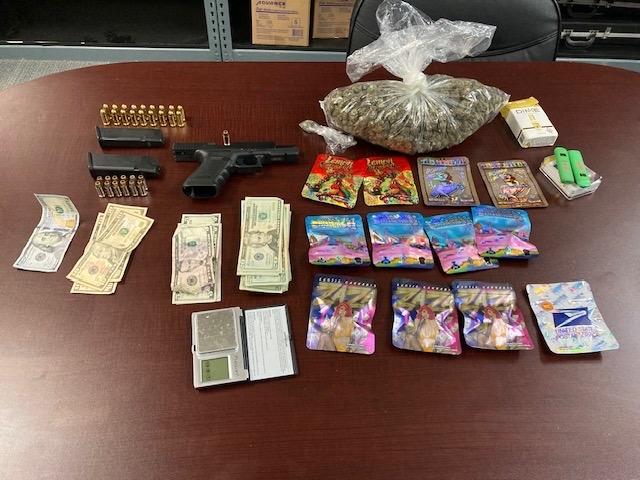
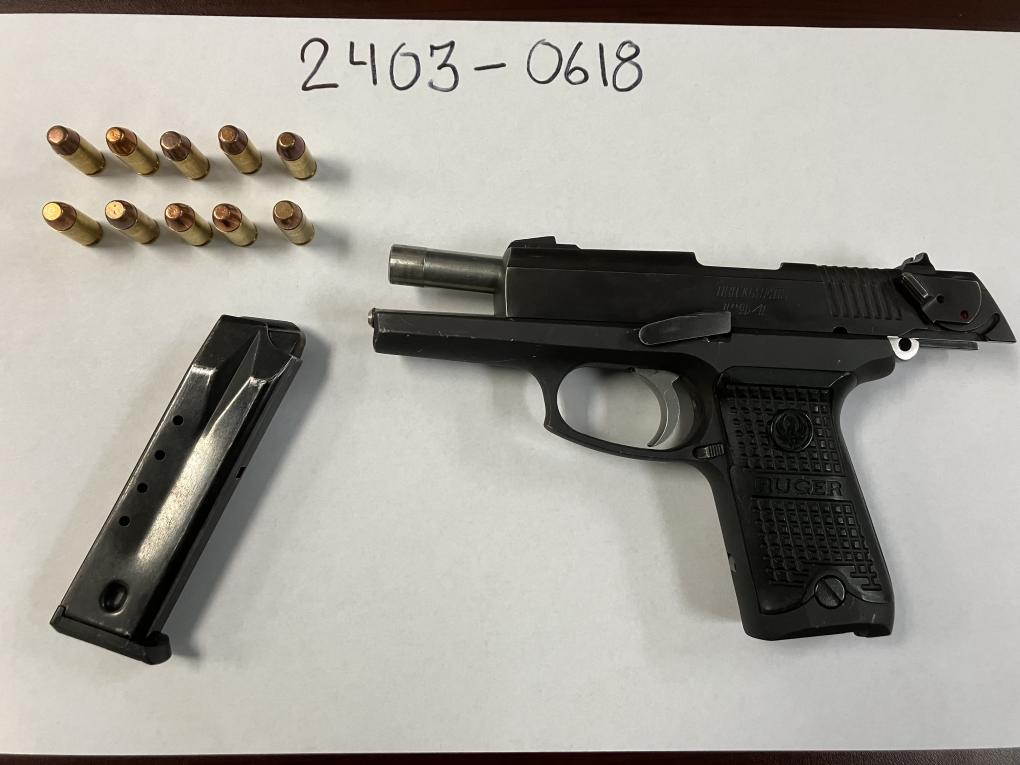
Felony arrests on BART increased 62% last year compared with 2022. The jump comes as BART PD has been aggressively recruiting new officers and ensuring safety staff are riding more trains to increase their visible safety presence. BART officers recorded 726 felony arrests in 2023 compared with 448 for 2022. Along with those arrests 49 illegal firearms were seized in 2023 compared with 40 the previous year. It’s the most guns BART PD has recovered in a year since at least 2003. BART PD has already recovered a dozen firearms so far this year.
“These latest arrest and gun seizure numbers are a credit to all the hard work of our officers,” said BART Police Chief Kevin Franklin. “Since we started deploying more patrol officers to ride trains we have seen an impact, and our riders are telling us they notice the difference.”
In the latest Quarterly Performance Review the percentage of riders who reported seeing BART PD on their trip reached a record high of 20%. That’s up from the previous record of 17% the previous quarter. The last two quarters have been the first in BART’s history where the percentage of riders who reported seeing BART PD exceed the department’s official goal of 12%.
BART has been working to implement its Safe and Clean Plan which focuses on boosting the visible safety presence in the system and increasing staffing to clean trains and stations.
BART PD has also been advancing an aggressive officer recruitment campaign to fill its remaining vacancies. This effort has been boosted by a 22% salary increase for officers, which was approved by the BART Board to ensure BART PD remains competitive with other law enforcement agencies in the Bay Area. Anyone interested in joining BART PD can learn more at joinbartpd.com.
(Examples of recently seized guns)
Mask mandate and labor agreements part of BART Board night meeting on 7/28
The BART Board of Directors on Thursday, July 28 will hold its third night meeting of the year. The Board this year is prioritizing holding several evening meetings to encourage greater public participation with virtual public comment as an ongoing option. The public portion of the July 28 meeting will begin
BART PD holds Black Friday safety events at Bay Fair and West Oakland stations
On Friday, Nov. 25 -- the busy Black Friday shopping day -- BART Police and partners will hold safety awareness events at Bay Fair and West Oakland stations. At Bay Fair, tables will be set up with safety information, focusing on particular crimes that tend to increase during the holiday season, when
BART board approves new financial organizational structure recommended by Inspector General
BART is moving forward with changes to its financial operations to improve efficiency and transparency with the creation of a Chief Financial Officer (CFO) reporting to the General Manager.
This new financial structure brings together the functions from the Office of the Controller-Treasurer, who has traditionally reported to the BART Board of Directors, and the Performance & Budget Office, who reports to the General Manager, into one group, reporting to a new CFO position.
The CFO will have the authority to implement strategic business changes to streamline BART’s financial forecasting, budgeting, and reporting of financial data. The new structure will create greater accountability under the General Manager to realize long-term cost savings. Creating a CFO position requires state legislation to amend the BART Act.
“This is a significant reform to show we are committed to using our limited financial resources in the most efficient manner possible,” said BART Board President Janice Li. “A new CFO will help drive a culture of financial discipline as we navigate economic uncertainty.”
Last year, the Board of Directors, at the recommendation of the Office of the Inspector General, approved modifying BART’s organizational structure in an effort to focus on improving efficiency and financial operations.
“This is a tremendous step for BART and reflects how well the OIG recommendation for a CFO structure was embraced,” said Claudette Biemeret, BART’s Inspector General. “I applaud the BART Board and Executive Leadership for taking on this change. CFO leadership is crucial to transparency and accountability in the use of public funds.”
In response, BART’s General Manager hired a consulting team to develop a roadmap for implementing the financial organization structure. The BART Board of Directors approved the new structure at its December 7 meeting and BART will move quickly to identify and onboard a new CFO role.
New train posters emphasize unruly behavior is not welcome on BART
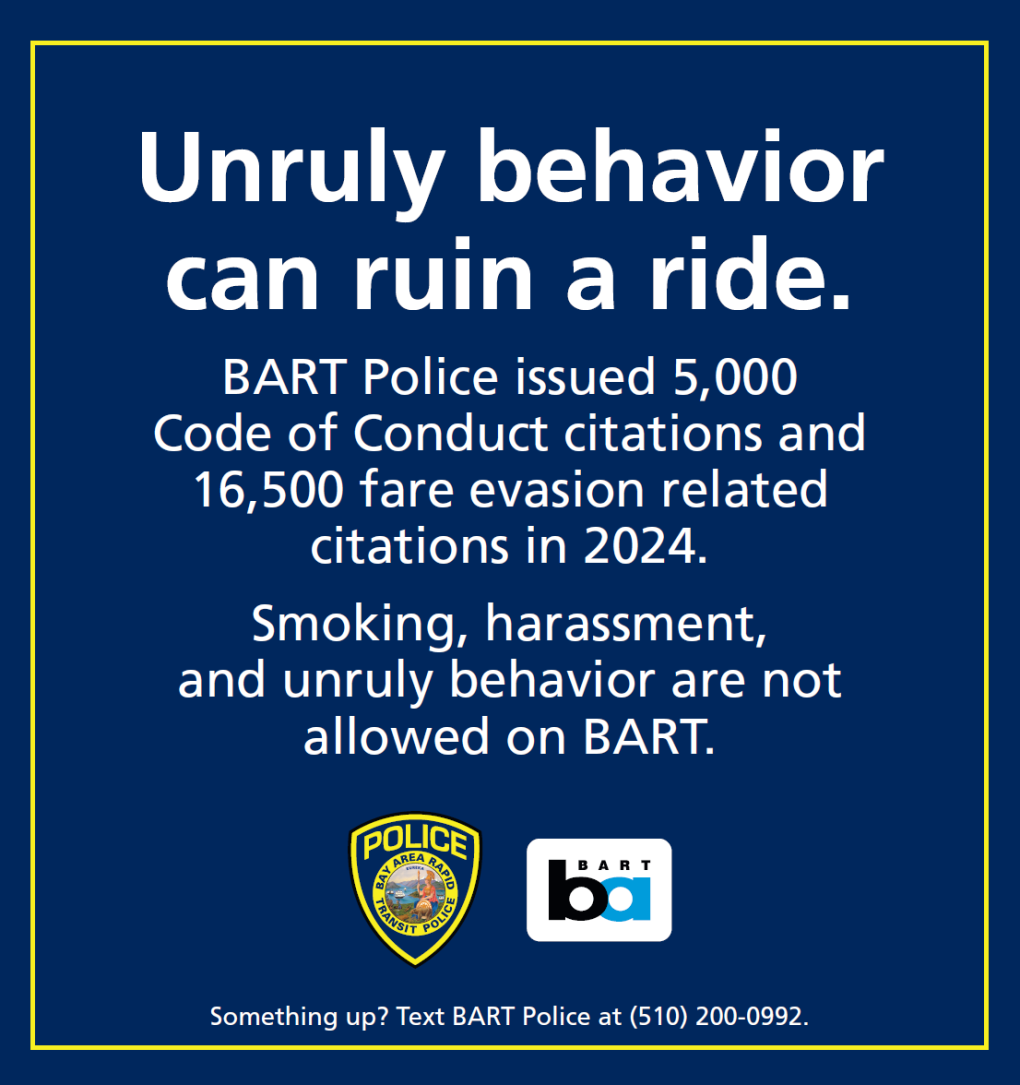
Amid an overall decline in crime and an increase in BART PD’s visible safety presence BART is posting 400 posters inside its Fleet of the Future train cars targeting unwanted activities such as harassment, smoking, and unruly behavior. The new signs proclaim, “Unruly behavior can ruin a ride.” They back up BART’s commitment to a safe ride by emphasizing BART PD in 2024 issued 5,000 Code of Conduct citations and 16,500 fare evasion-related citations.
“These new posters are a way for us to tell our riders that we hear their concerns about safety and are enforcing the Code of Conduct,” said BART Police Chief Kevin Franklin. “The posters are helpful, but the real work in making BART safer is being done on a daily basis by both our sworn and non-sworn staff who are helping us deliver on our pledge to double our visible presence in the system.”
BART is continuing to implement its Safe and Clean Plan as it continues to welcome riders back to the system. Crime was down 17% in 2024 even as BART ridership increased by 2.6 million trips from the previous year.
BART’s commitment to rider safety includes the installation of Next Generation Fare Gates at all 50 stations by the end of this year. The new gates have already been installed at 27 stations and are making a difference in deterring fare evasion. The public is noticing the difference already with a nearly one-third decline in the number of riders who report seeing fare evasion during their trip.
Anyone who sees unruly behavior on BART can text BART PD at 510-200-0992. You can also download the free BART Watch app, which allows you to send a discreet text description of what you’re seeing along with a photo.
San Mateo County BART stations get $12 million dollar glow-up
The BART Board of Directors has approved nearly $12 million in capital investments for San Mateo County BART stations to improve the customer experience and to ensure the station infrastructure remains welcoming and in a state of good repair. The package of upgrades is part of BART’s Station Glow-Up Strategy, focused on sprucing up stations and parking lots to improve ambience and enhance safety.
The San Mateo County effort includes new LED lighting to improve safety and brightness; roof replacement and gutter work to address water intrusion that impacts employees, riders, and BART equipment; deep cleaning to scrub away bird droppings; landscaping; the removal of metal framed bus shelters with panels that were prone to continuous vandalism and graffiti; and other work that will improve conditions and the appearance of BART property.
This past year, BART has taken additional action to improve San Mateo County stations with deep cleaning and permanently adding two additional janitorial staff to increase cleaning in the county. BART crews repaired floors, benches, and gutters, added fresh paint to key areas, and removed obsolete equipment such as old phone booths and aging artwork at Colma Station that could not be repaired or salvaged following a review by a conservation specialists and structural engineers. Millbrae Station is currently getting new LED lighting with the work to be completed this month. In September, BART celebrated the installation of new fare gates at all San Mateo County stations, marking a major milestone in ongoing investments at the county's six stations.
Details of the upcoming $12 million in planned improvements:
- Colma Station will get new LED lighting, roof upgrades, and dated bus shelter removal.
- South San Francisco Station will get LED lighting, roof upgrades and cleaning, gutter replacement, refurbished landscaping, and dated bus shelter removal.
- San Bruno Station will get new LED lighting, roof upgrades, specialized deep cleaning of hard-to-reach areas, and safety netting replacement to protect people from falling debris.
- Millbrae Station will get gutter and downspout repairs that will address water leaking in various areas such as the concourse and platform.
Work will begin in early 2026 and will be completed by the end of the year.
“Revitalizing these stations is part of what we like to call the new BART,” said BART Board President Mark Foley. “These upgrades will improve the functional use and aesthetics of our important San Mateo County stations while demonstrating our gratitude and commitment to our continued partnership with the county.”
BART is a critical piece of the transit network in San Mateo County, and San Mateo County riders are a key part of the BART system. BART carries approximately 25 percent of transit boardings among all operators in San Mateo County and 10 percent of all day boardings for BART originate in San Mateo County. On a typical weekday, BART runs 520 trains into and out of San Mateo County.
BART achieves highest quarterly Passenger On-Time Performance since early 2014
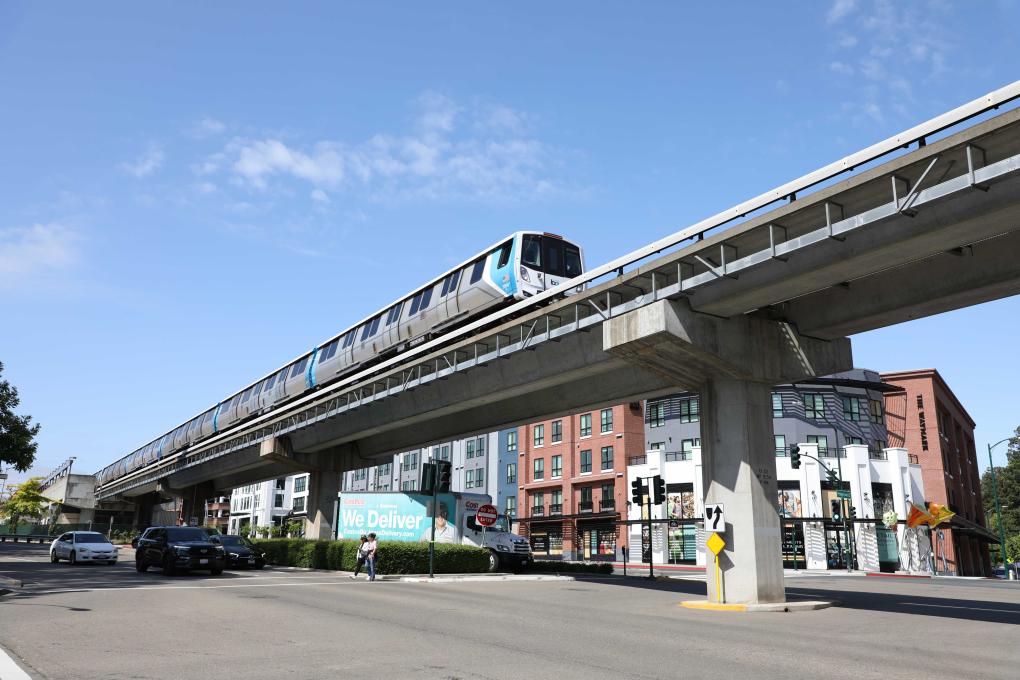
BART’s latest quarterly performance analysis finds BART achieved its highest quarterly Passenger On-Time Performance (94.4%) since early 2014, a significant milestone reflecting broad-based improvements across the system for several key indicators, including reliability, safety, and cleanliness. The report also shows March 2026 recorded the highest monthly Passenger On-Time Performance since August 2013. This metric measures the percentage of riders who reach their destination within a short time threshold of their expected arrival.
The Quarterly Performance Report (QPR) for the third quarter of Fiscal Year 2026 (January 1 to March 31, 2026) underlines BART’s tremendous improvements in service reliability, with March 2026 a standout month for overall performance. The month recorded BART’s lowest monthly delay count since late 2018 as well as the fewest train delays for any March since 2014, excluding the pandemic years when service was reduced (2020-2022).
These gains come as ridership grew 15% year-over-year to 14.6 million trips this past quarter, demonstrating BART's ongoing efforts are increasing rider confidence and strengthening the system financially.
BART’s QPRs are posted quarterly and track a number of performance indicators, such as operational metrics, passenger environment indicators, customer feedback, and crime. 2023 is used frequently for comparison in this article as BART's Safe and Clean Plan was enacted that year. The substantial improvements over the past three years are testament to its effectiveness.
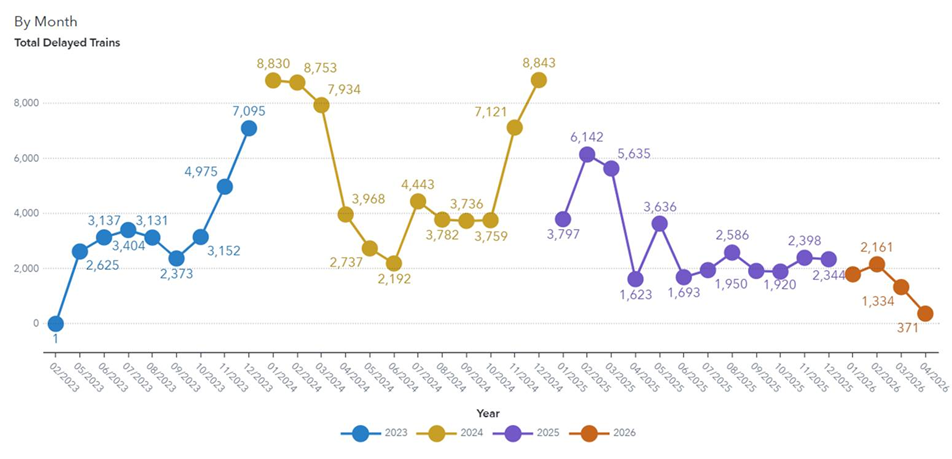
Graph demonstrating the significant decline in train delays for March 2026.
Customer On-Time Performance and Satisfaction
Customer On-Time Performance for FY26 Q3 was 94.4%. For comparison, in the third quarter of FY23, Customer On-Time performance was 81.2%.
Customer Satisfaction increased to 90% in FY26 Q3. In FY23 Q3, that metric was 70%. Customer complaints for FY26 Q3 dropped by nearly 26% from the previous quarter.
Station and train experience
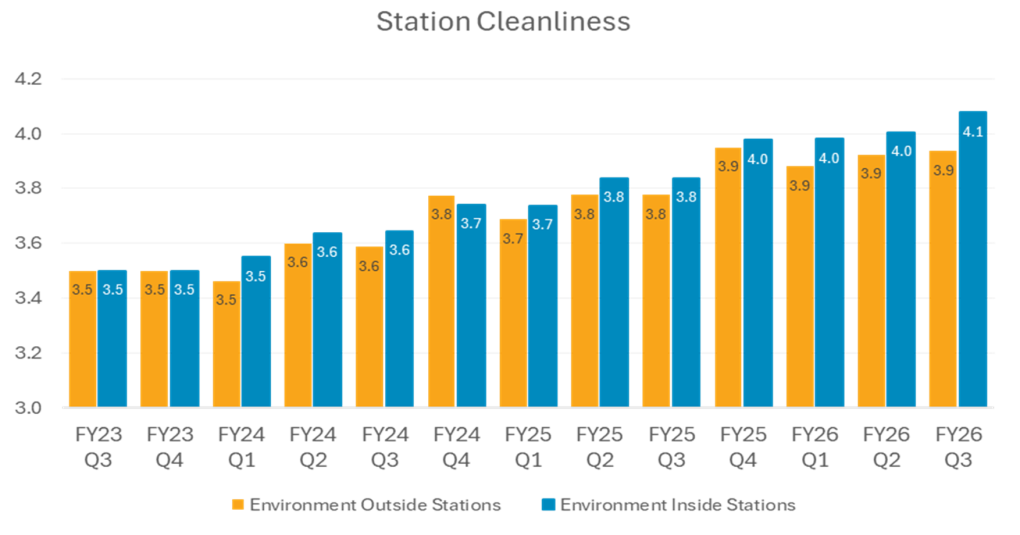
BART’s emphasis on enhancing system cleanliness and the overall customer experience is paying dividends. Passengers scored the experience onboard trains and inside stations 4.2 and 4.1 respectively (out of 5), the highest scores since BART updated its scoring metrics and scale in FY23 Q2.
BART’s new trains continue to be a major contributor to on-time performance and onboard experience. The new trains were designed to be easier and faster to clean and experience mechanical failures at a fraction of the rate of the retired legacy fleet, reducing disruptions and improving service consistency. Maintenance is more efficient and reliable on the new trains as well due to predictive diagnostics and standardized parts that are easier to procure than those of the five-decades-old legacy fleet. The legacy fleet was removed from the base schedule in September 2023.
Safety
Crime on BART dropped 42% in the past quarter over the previous year. Electronic robberies were down 90% in the past quarter, electronic thefts 68%, and auto burglaries 47%. Average response time to Priority-one incidents was just over 5 minutes, one of the fastest response times in the nation.
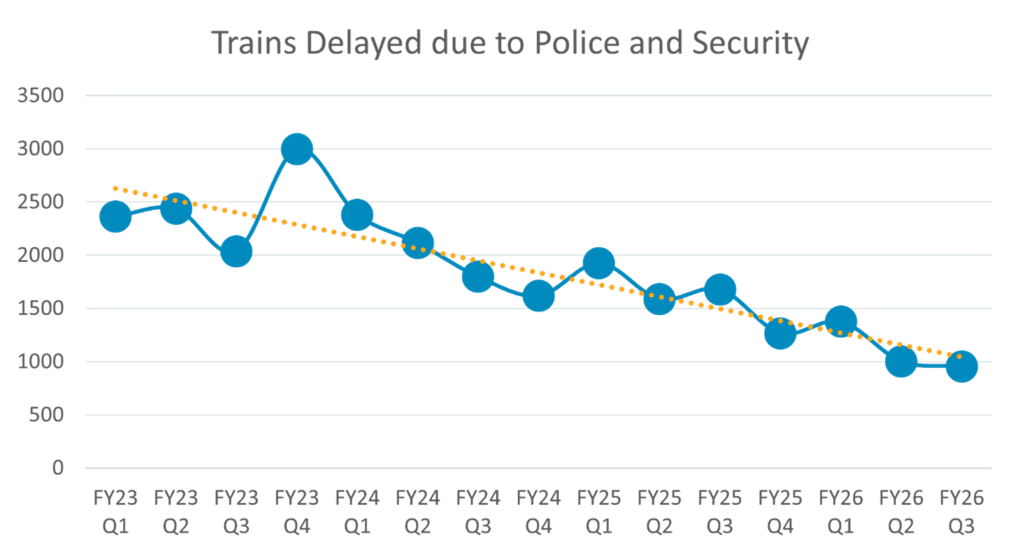
A decrease in crime leads to fewer delays due to police- and security-related incidents, which dropped to 955, compared to nearly 3,000 in 2023.
These improvements are testament to the hard work of BART PD and the effectiveness of BART's investment in initiatives and infrastructure that both increase safety and enhance the customer experience, including doubling the visible police presence on trains and in stations in 2023.
Sexual harassment on BART has also declined considerably. The percentage of riders who said they had experienced sexual harassment, a BART Code of Conduct violation, dropped by more than half – from 8% between October and December 2023 to 3.9% in January through March 2026. The timeline of the decline correlates with the installation of BART’s new fare gates.
Fare evasion
Fare evasion has dramatically decreased in the system. The percentage of riders who said they witnessed fare evasion was 10% in the last quarter, compared to a high of 25% in Fiscal Year 2024.
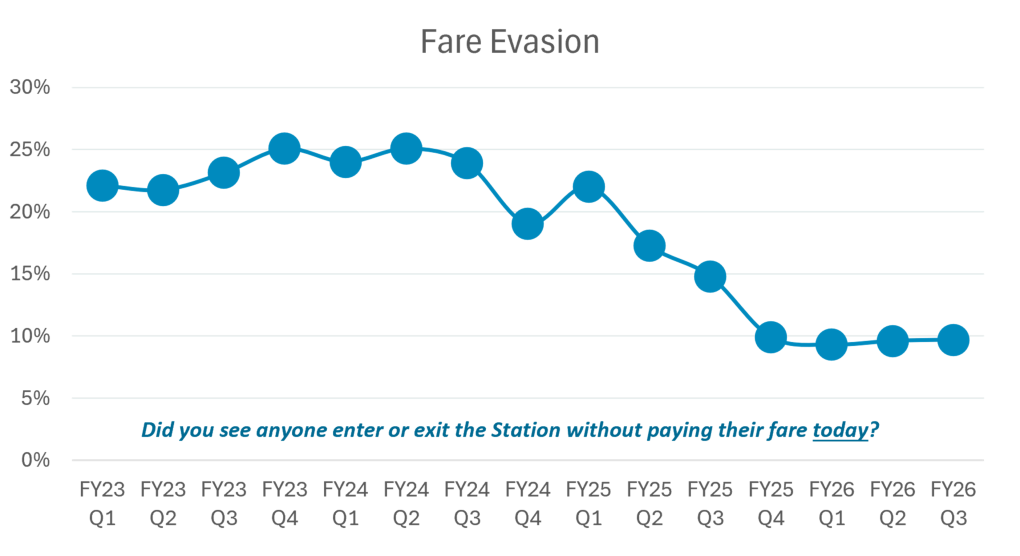
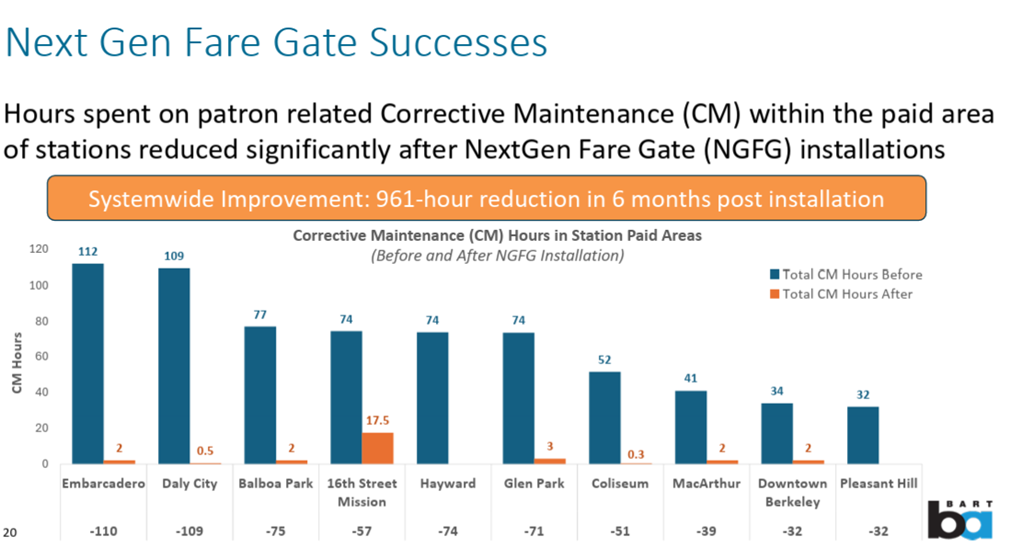
This drop follows the installation of 715 new fare gates systemwide, which have tall swing barriers that make it difficult for people to push through, hurdle over, or maneuver under. Early indications are that gates are responsible for revenue growing by about $10 million annually through reduced fare evasion. As the chart below shows, there was a 961-hour reduction in corrective maintenance hours (vandalism, graffiti, large clean-ups, broken things) in the six months post-installation.
Weather
BART has also seen major progress reducing weather-related delays – previously one of the biggest sources of delayed trains – thanks to smart engineering fixes.
By updating train car braking profile software and making slight changes to train speeds at some locations, BART no longer needs to run trains at reduced speeds when it rains, save for a few select locations near the ends of lines. As you can see in the below chart, weather-related slowdowns spiked during previous rainy seasons, but continue to decline with the updated software now in place.
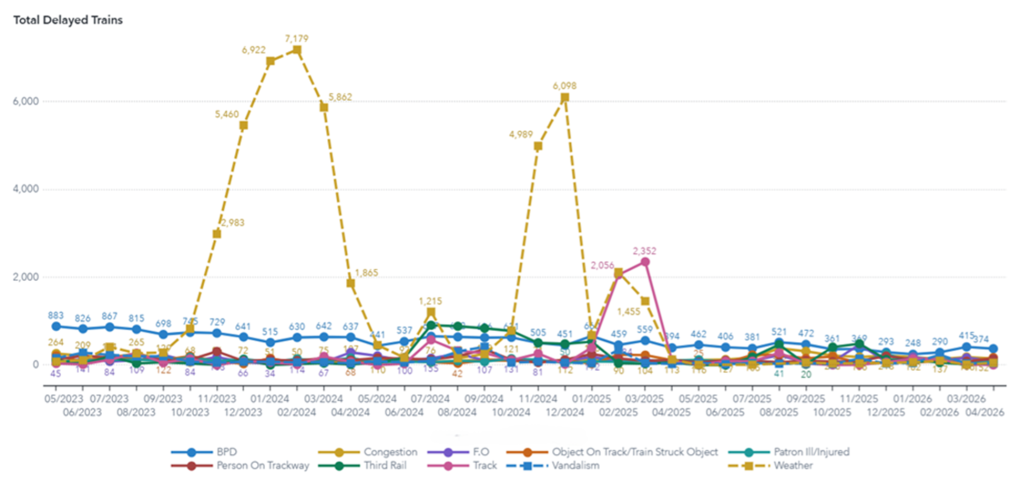
Graph showing total delayed trains and causes. Dashed yellow line represents weather-related delays.
Conclusion
These improvements are supporting rider confidence and strengthening the system financially.
“These big things aren’t just statistics; they are the foundation of our ridership recovery,” said BART Manager of Operations Reliability Ryan Rod, who analyzes and develops BART’s Quarterly Performance Reports and on-time performance data. “Because our riders are seeing a system that is cleaner, safer, and on time, they are coming back, proving that when we deliver on our promises, the region responds.”
At the same time, BART is investing in trackside upgrades, track replacement, and modern train control technology to make the system even more resilient. Future improvements, like the currently underway Communications-Based Train Control project, will contribute further reductions to the customer impact of disruptions, even when incidents occur.
Despite record post-pandemic ridership, fare revenue still falls short of what is needed to sustain BART operations. Even with continued growth, ridership alone is not enough to close the funding gap, and a new funding source is needed.
BART faces a structural deficit of $350M to $400M, driven by long-term shifts in commute patterns, including remote and hybrid work. BART balanced the FY26 budget with $35M in ongoing cuts and cost controls. The FY27 deficit is $376M. BART is taking a number of actions to reduce the shortfall, including more expense reductions, but will need help to completely close the gap. More on BART’s financial deficit here.