
Search Results
New data shows crimes against riders plummeted as BART celebrates one year since the arrival of Next Generation Fare Gates
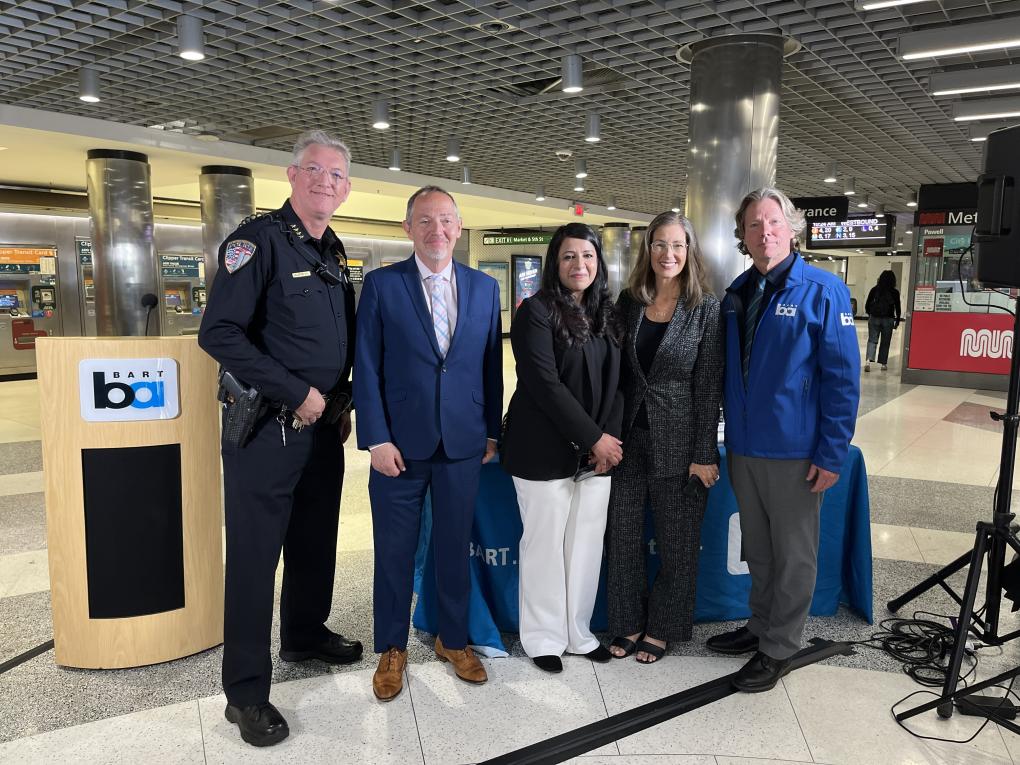
The number of crimes against riders per million trips has fallen 67% from the end of 2024 to the latest quarter. The crime rate is falling even as more people are riding BART. Over that same period the number of BART PD and safety-related delays fell 47% as police had to respond to fewer reported incidents.
“We knew updated, modern gates would improve the rider experience. They have been a real game changer,” said BART General Manager Bob Powers. “The new fare gates are at the core of what I call the ‘New BART.’ We are offering our riders a safer, cleaner, and more reliable experience than even just a year ago.”
"The data speaks loud and clear: BART's new fare gates prove without a doubt that investing to improve and modernize our public transit infrastructure pays off big time," said Libby Schaaf, President and CEO of the Bay Area Council. "BART riders want and deserve nothing less than a safe, convenient and clean system and BART has delivered. The Bay Area Council is proud of our advocacy in support of these new fare gates and our partnership with BART to help get this done.”
September marks one year since BART completed the successful installation of Next Generation Fare Gates at all 50 stations. The work was completed several months ahead of BART’s deadline to have new gates fully installed by the end of 2025.
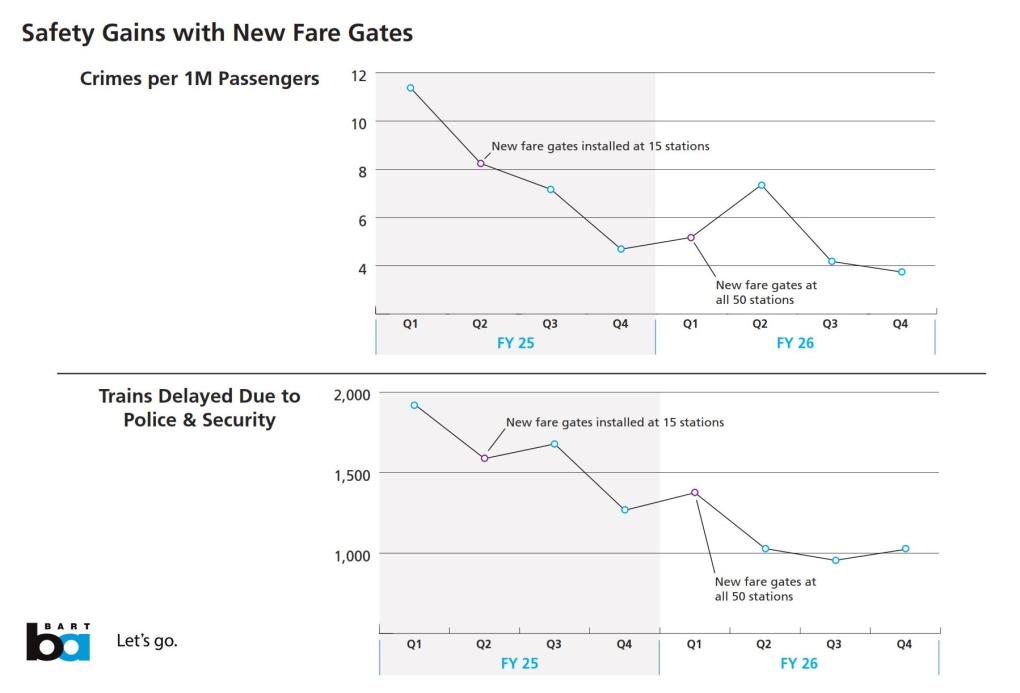
Riders report seeing fewer instances of fare evasion. The percentage of riders who say they witnessed fare evasion during their trip is down 60%. Early indications are the gates are responsible for BART revenue growing by about $10 million annually through reduced fare evasion.
“New gates and our high-visibility patrols on trains and in stations are providing layers of security for our riders,” said BART Police Chief Kevin Franklin. “As reports of fare evasion drop, it frees up members of my team to respond more rapidly to emergencies in the system.”
The new gates have clear swing barriers that are very difficult to be pushed through, jumped over, or crawled under. The overall fare gate array forms a tall barrier of a minimum of 72 inches to deter fare evasion.
Making already highly effective gates even stronger
BART is doing ongoing work to make the new gates even more resilient against fare evaders and those who try to damage them. BART is piloting an advanced motor gear system which is designed to strengthen the gates’ resistance to repeated impacts. Gates outfitted with the new motors have been able to withstand 10,000 repeated impacts of around 926 pounds. The new motors are being tested right now at Coliseum and Pittsburg Center stations.
BART hosts inaugural Girls in Motion Fall 2023 Summit to inspire young people to explore careers in the transportation industry
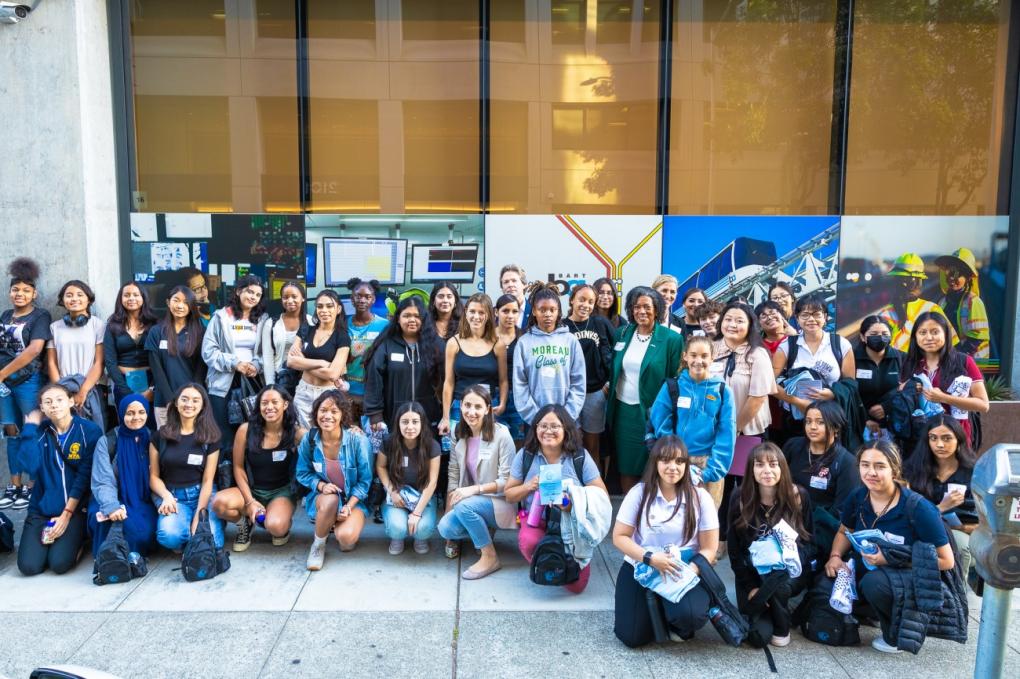
A photo of the attendees who participated in the Girls in Motion Fall 2023 Summit, hosted at BART Headquarters on Thursday, Oct. 19, 2023. Photo courtesy of Conner L’Hommedieu of Kimley-Horn.
Transportation leaders from across the Bay Area came together recently to share their passion for transit and inspire young people to explore the industry as a potential career.
On Thursday, Oct. 19, BART hosted the inaugural Girls in Motion Fall 2023 Summit, organized by the American Council of Engineering Companies (ACEC), California, Bay Bridge Chapter, and WTS San Fransico Bay Area Chapter, an international organization for women in transportation.
“The summit was a great opportunity to collaborate with our external partners and provide a platform of exposure for high school girls and specifically those from marginalized communities,” said Cynthia Fields, Supervisor of Workforce Development at BART and a member of the summit planning committee. “We want Gen Z to have this level of awareness as they consider their futures. It’s important for our girls to see people who look like them in the workplace, especially powerful women.”
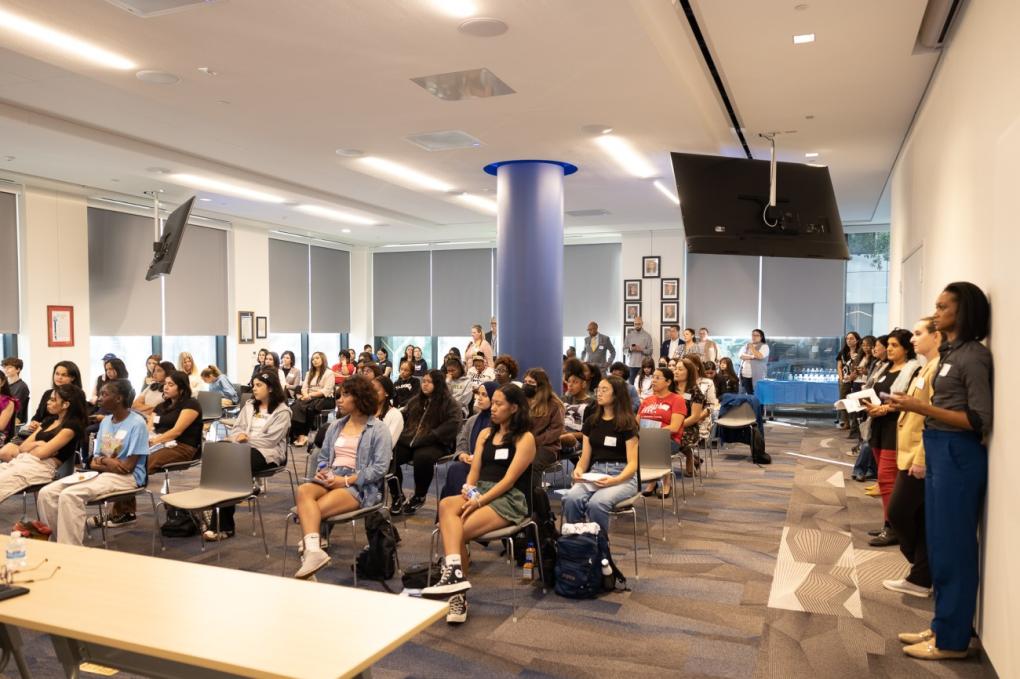
The standing-room only audience during the Girls in Motion Fall 2023 Summit, hosted at BART Headquarters on Thursday, Oct. 19, 2023. Photo courtesy of Conner L’Hommedieu of Kimley-Horn.
Dozens of young women, mostly high school students, attended the rousing summit in BART’s boardroom. Many attendees are participants of Girls Inc of Alameda County, located just a few blocks down the street from BART HQ. Girls Inc. previously visited BART in March of this year to learn about engineering on International Women’s Day.
The focus for this event was even broader in scope, and many of the transportation leaders who spoke noted the expansiveness of the transit industry and how its workers come from a surprising diversity of professional backgrounds.
“There are so many different fields in transportation,” said Tess Lengyel, Executive Director of the Alameda County Transportation Commission. “Transportation is not just one thing; there are attorneys, communications professionals, planners. The list goes on.”
Lengyel spoke during the opening session, a panel with fellow transit executives Bob Powers, the General Manager of BART, and Beverly Greene, Executive Director of External Affairs, Marketing and Communications at AC Transit. Michele DiFrancia, President of ACEC-CA, Bay Bridge Chapter, moderated the inspiring conversation.
Each executive espoused their passion for transit and some of the surprising delights of working in the industry.
At the opening of the session, Powers cited some data points to get the girls fired up. Thirty-four percent of BART staff are eligible to retire, he said, stressing the need for more young people with fresh perspectives and ideas to join the industry. He also noted that 25% of the BART workforce are women or nonbinary.
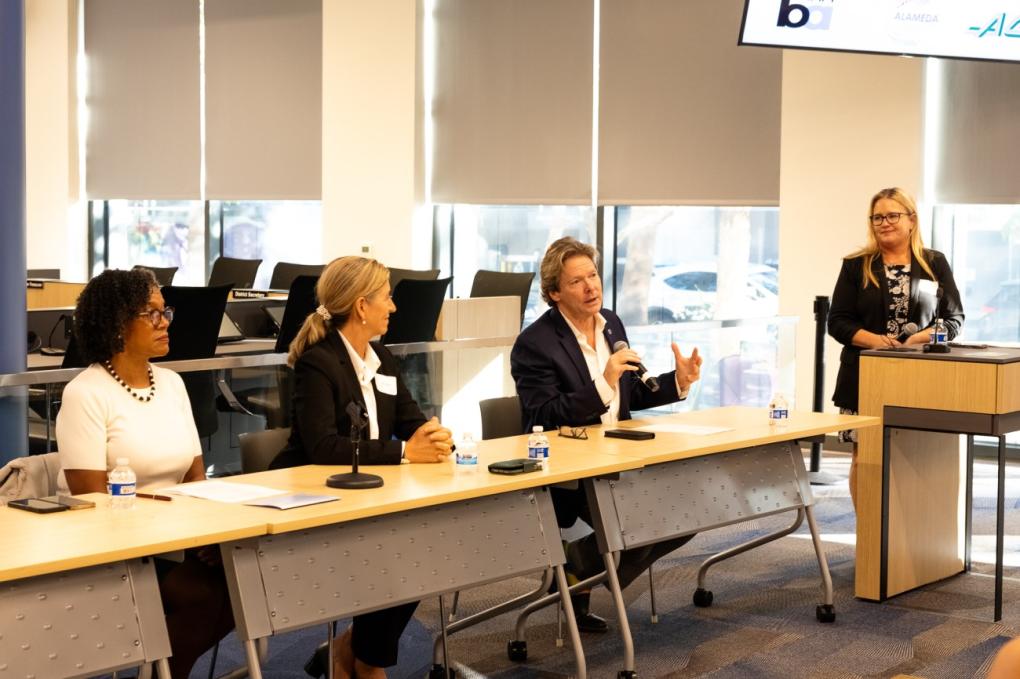
(From left to right): Beverly Greene, Executive Director of External Affairs, Marketing and Communications at AC Transit, Tess Lengyel, Executive Director of the Alameda County Transportation Commission, Bob Powers, General Manager of BART, and Michele DiFrancia, President of ACEC-CA, Bay Bridge Chapter, photographed during the Girls in Motion Fall 2023 Summit, hosted at BART Headquarters on Thursday, Oct. 19, 2023. Photo courtesy of Conner L’Hommedieu of Kimley-Horn.
“We have to do better as an agency to get that number up,” he said. “A job in transit pays well, has good benefits, and means something to the community. There’s so much opportunity in transit.”
He also stressed the stability of the industry, which is often insulated from fluctuations in the economy. Layoffs, he pointed out, are rare in transportation compared to many other industries.
Greene said she wasn’t even aware of transit as a career when she was in high school. Her advice to aspiring transit professionals was practical: Meet with your college counselor at least every other week and get involved with extracurriculars. She also shouted out the many women she’s had the opportunity to work with and learn from throughout her career. “And these women are running the agencies!” she said.
A career tracks panel followed the discussion, featuring transportation professionals from a mix of fields, including, from BART, Alicia Trost (Chief Communications Officer), Sadie Graham (Director of Link21), Phoebe Cheng (Group Manager for Civil, Structural, and Track Engineering), and Ni Lee (Group Manager for Integration Engineering). Sarah Hersom, Vice President of HNTB and Jon Porterfield, Executive Vice President of Anser Advisory, also joined the discussion.
“Working at BART is so exciting,” said Cheng. “You see it all, and it takes all kind of skillsets.
Graham shared her unique background – she studied landscape architecture in college – and how her diverse experiences have served her in career. She also pointed out that after ten years of public service, your college loans are taken away. Graham herself said her loans were recently erased.
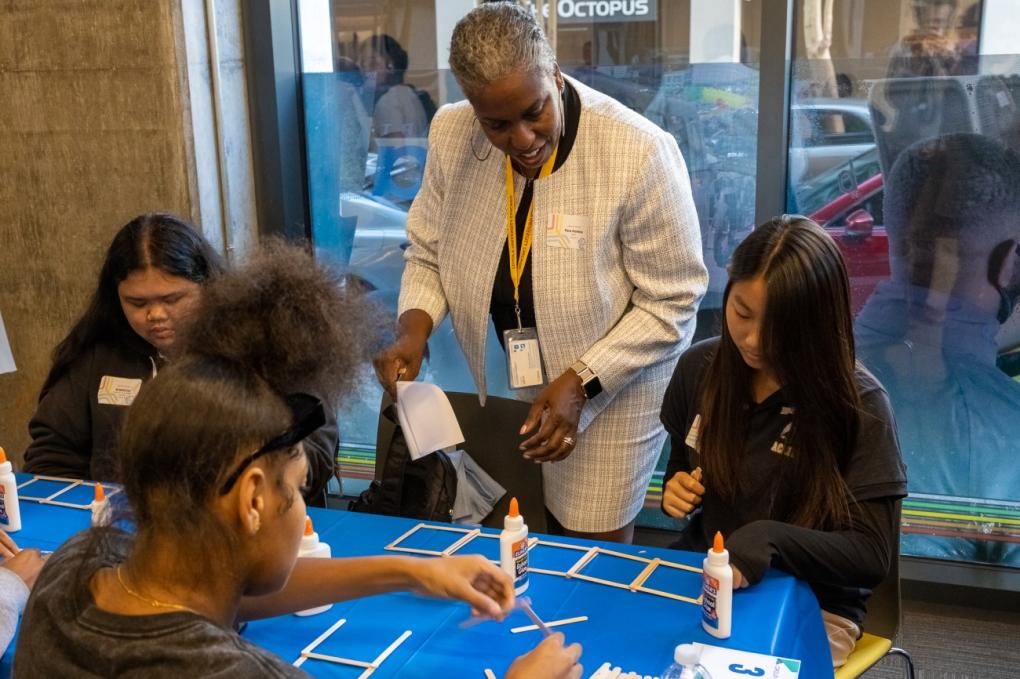
Tera Stokes-Hankins, Chief Transportation Officer at BART, assists attendees in building popsicle stick bridges during the Girls in Motion Fall 2023 Summit, hosted at BART Headquarters on Thursday, Oct. 19, 2023. Photo courtesy of Conner L’Hommedieu of Kimley-Horn.
At the end of the discussion, the young women engaged in a team STEM bridge-building activity with popsicle sticks that put their science, technology, engineering, and math skills to the test.
Arden Sorensen-Waod, a tenth grader at Piedmont High School, said she learned a lot of surprising facts at the summit.
“I’m interested in urban planning and community service. Maybe transit, too?” she said. Her biggest takeaway was realizing that “you can start in one field and end up in another one.” She was also excited that so many efforts were being made in the industry to connect with a younger audience.
As Powers noted during the panel: “Youth are the future of public transit. We want to hear your ideas – and we are listening and implementing them.”
BART has many opportunities for young people to learn about the transportation industry, including a robust Summer Internship Program (info flyer here) and youth tours, a program that is slated to relaunch in the late fall of this year. For more information, email [email protected].
Engineers Week 2025: BART engineers on the year’s big projects and why they’re proud to be a part of them

Every year, BART celebrates Engineers Week in recognition of the more than 180 engineers who are committed to imagining and executing the future of the BART system. BART is the Bay Area, and the future of our transportation system is deeply entwined with the future of this region. Our engineers provide us a roadmap for the fast-approaching horizon, reshaping how we experience and interact with our world.
BART is unique in that it’s home to many different engineering disciplines – construction, computer systems, electrical, mechanical, traction power, corrosion, and more! The projects our engineers undertake are like puzzles with hundreds of thousands of pieces, all of which must fit together just right to make a functioning whole. Our engineers’ ingenuity, creativity, and resourcefulness get this tough work done.
The theme of Engineers Week 2025 is Design Your Future – “both a call to action and a celebration of the limitless possibilities in engineering,” writes DiscoverE, which established Engineers Week more than 70 years ago. How far we’ve come!
In 2025, BART engineers are not just “designing” the future, but implementing it. It’s going to be a big year for BART, and so we reached out to the engineers themselves to tell you about some of the exciting projects BART has in store for 2025 and why they’re proud to be a part of it.
And speaking of the future – we're now looking for our 2025 class of engineering interns! Since 2018, BART has hired 15 internship participants as junior engineers, including four from last year’s program – it's a great way to get your foot in the door and gain hands-on, practical engineering experience.
Visit bart.gov/internships for information on eligibility and how to apply.
Next-Generation Fare Gates Project
BART has made the historic purchase of brand-new fare gates to be installed systemwide as part of its latest effort to improve the customer experience and overhaul safety in the system. The new fare gates bring a new look and improved experience, offering state-of-the-art technology that will boost safety by reducing fare evasion, enhancing access for people in wheelchairs and those who bring bikes and strollers on BART, and optimizing the reliability and maintenance needs of the fare gates.
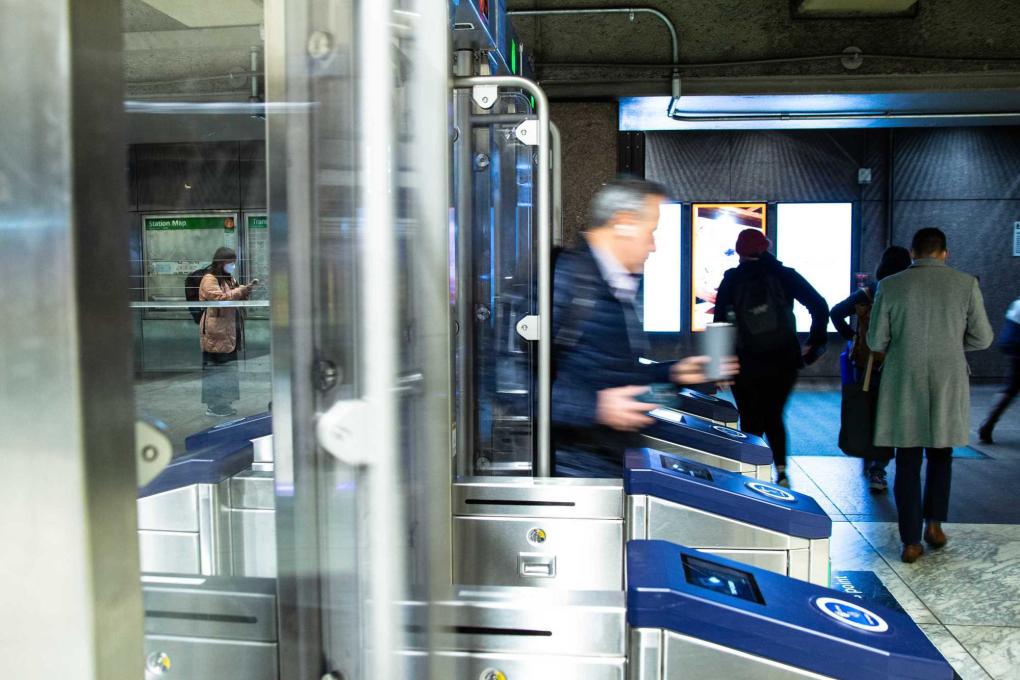
A photo of the new fare gates at Embarcadero Station.
Michael Gerbracht, Senior Manager of Engineering Programs
"Creating an environment where passengers feel safe, comfortable, and are happy to ride our trains is crucial. The fare gates are something that riders from across the Bay Area have been excited to see implemented for years, and it is great to be able to deliver for them.
I am so proud of the way the team – and really the entire District - has stepped up to the challenge of delivering the new fare gates."
John Yen, Manager of Computer Systems Engineering
"The part I am personally proud of is our staff’s ability to stay flexible and adapt to changing project conditions and project complexity. There are a lot of varying site conditions and prep work by multiple disciplines (electrical, communications, buildings, etc.) before the new fare gates can be installed. This project effectively is rolling three projects into one!"
San Francisco Station Escalator and Canopy Project
The San Francisco Station Canopy Project will not only protect new escalators being installed from the wear-and-tear of elements like rain and wind-swept debris, but they will provide an added layer of station security and cleanliness through motorized gates that allow the entrances to be locked at street level when stations are closed. At present, 14 canopies have been completed, and three canopies are under construction, with an additional four canopies to be constructed in the future. The project is happening in concurrence with the San Francisco Station Escalator Replacement Project, which is installing and replacing a total of 45 escalators at Downtown San Francisco stations.
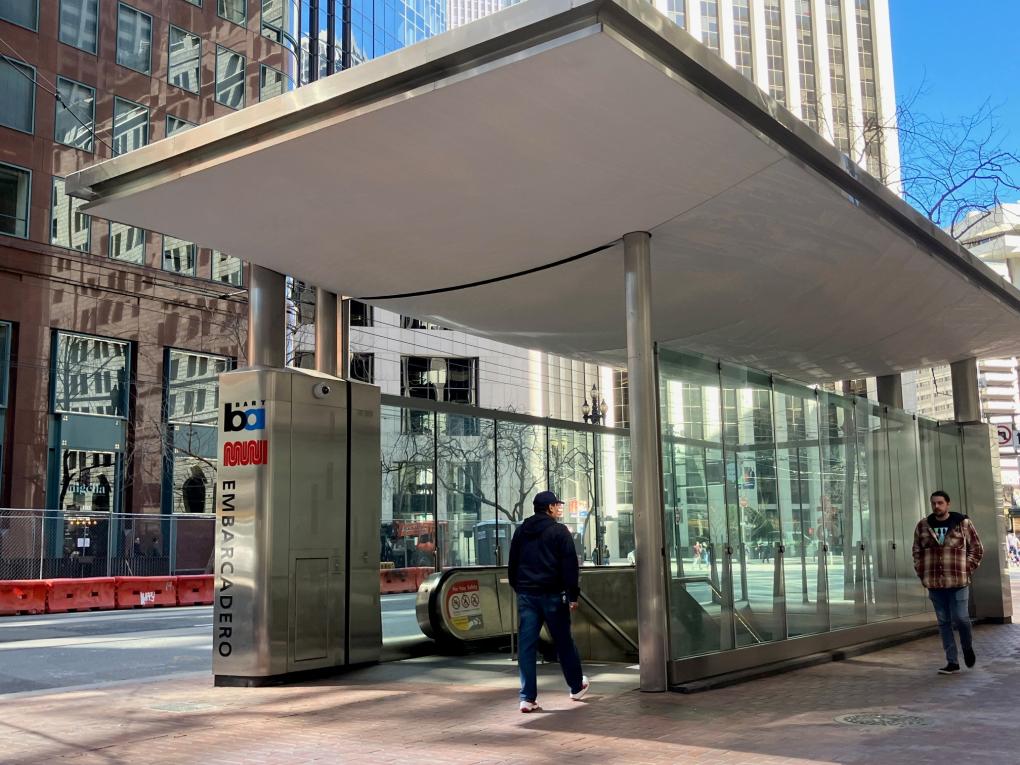
A photo of the new canopy at Embarcadero Station.
David Silva, Project Manager for the Market Street Canopies Project
"In addition to providing weather protection for patrons and escalators, the canopies assist with placemaking, providing easily recognizable entrances to the stations. They also feature real-time displays to provide patrons with train and bus schedule information as well as security features such as improved lighting, cameras, and grilles that secure the entrances at street level at night.
This project requires an enormous amount of coordination. I am very proud of how the entire project team has come together with the invaluable assistance of BART Government and Community Relations to keep the community, including neighboring businesses, rideshare companies, and other stakeholders informed about the project while working to understand and address their concerns."
Elliott Kolto, Principal Mechanical Engineer
"To date, the project has successfully completed the replacement of 17 escalators, with 24 remaining and three to six undergoing replacement at any given time. The new escalators are more modern and reliable with updated safety features, technology, and maintainability.
I am proud to be a part of this project and work with the team of engineers, maintenance, project management, and construction management, who are working so hard together to make this project successful and improve the customer experience."
Traction Power Substation Restoration and Construction
Traction power facilities take incoming power from PG&E and convert it to 1,000 Volts (V) Direct Current (DC) power for BART’s third-rail system. The facilities also monitor, regulate, and ensure safe distribution of power throughout the system. Two new power substations by Civic Center and Montgomery St. Stations will be coming online this year, and another substation east of the Transbay Tube is currently undergoing full renovation. BART is also upgrading and restoring substations, including the Oakland facility mentioned below.
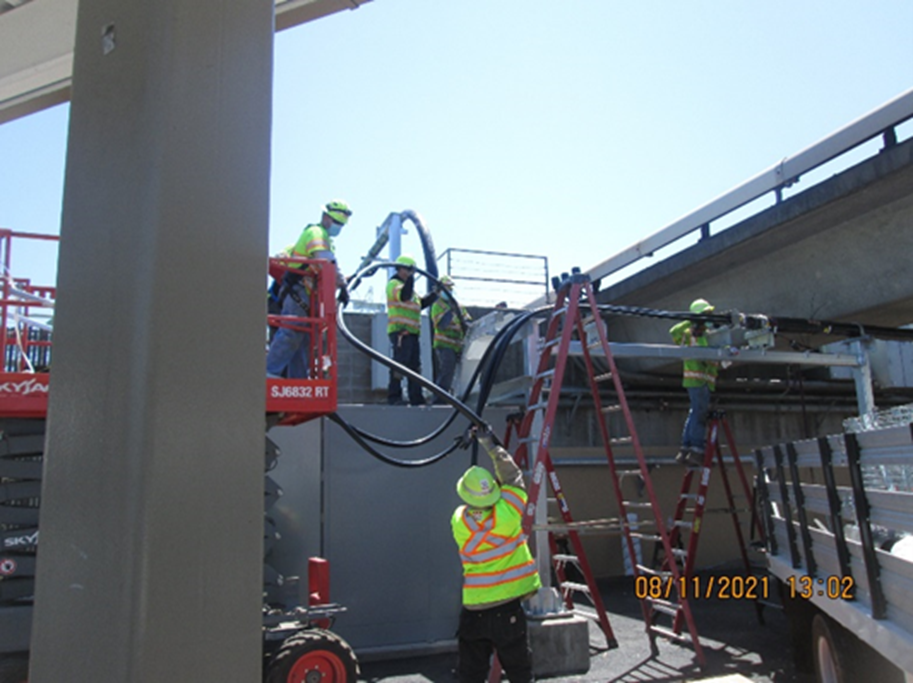
A photo of 34.5kV cable replacement and fiber optic installation between the Coliseum and Union City.
Gordon Wong, Principal Electrical Engineer
"The restoration of Downtown Oakland’s KTT substation, which failed last year after experiencing a fault, allows trains to operate at full speed, reducing delay and transfer times at MacArthur and 19th Street Station.
Having the substation back in service allows for redundancy in the network; there are now multiple substations able to supply power to the area, meaning customers will have a faster, more streamlined experience.
I am proud to work with the dedicated members of engineering and maintenance, who share the common goal of making sure BART is working for those who rely on us."
East Bay Rail Replacement
BART is replacing aging track, among other rebuilding projects that impact reliability, with funding from voter-approved bond Measure RR. The equipment being replaced is decades-old and has outlived its design life.
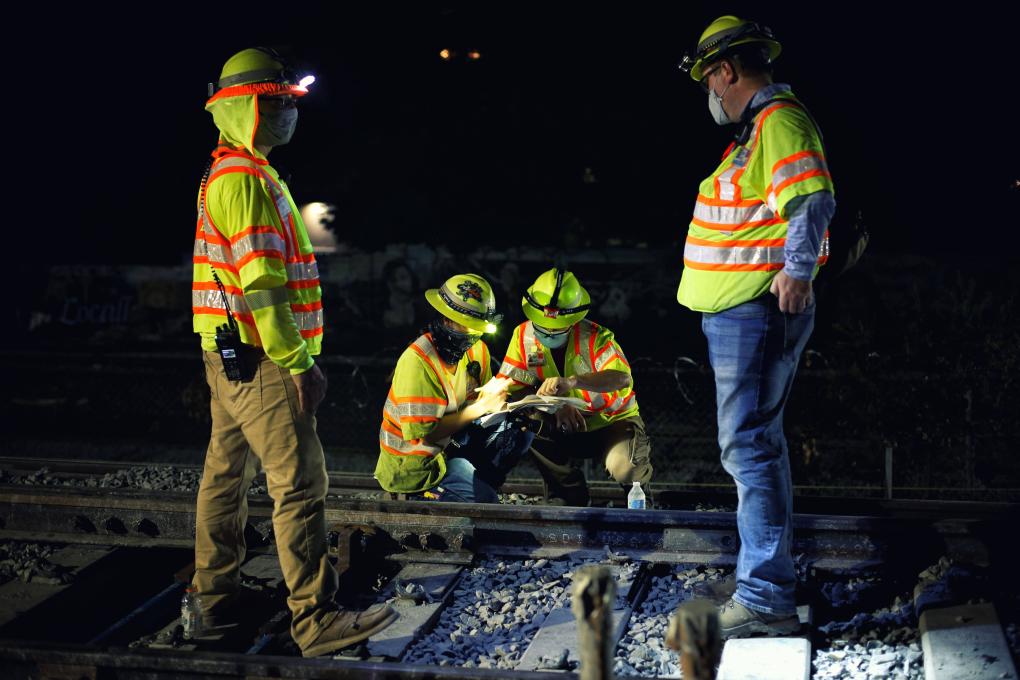
Engineers on the Yellow Line trackway between Pleasant Hill and Concord stations.
Girish Koli, Senior Manager of Engineering Programs
"I am proud to be part of this project as it improves safety for BART staff and reduces the maintenance burden. It will also enhance customer experience by providing patrons with a smoother and quieter ride.
This project was added to my portfolio last year, and I’ve been amazed to see how much hard work, coordination, and dedication many staff members have devoted to ensuring this is a successful project for BART."
Zeeshan Ali, Division Manager Traction Power Engineering (Interim)
"Traction Power Engineering recently completed several projects that significantly enhance the reliability and safety of BART’s electrical infrastructure. These upgrades offer a more dependable, faster, and safer transit experience for riders across the Bay Area.
I am proud of myself and my team for the contributions we’ve made and continue to make in connecting Bay Area communities."
BART invites the public to “ride into history” at a legacy car retirement ceremony and final ride on 4/20/24
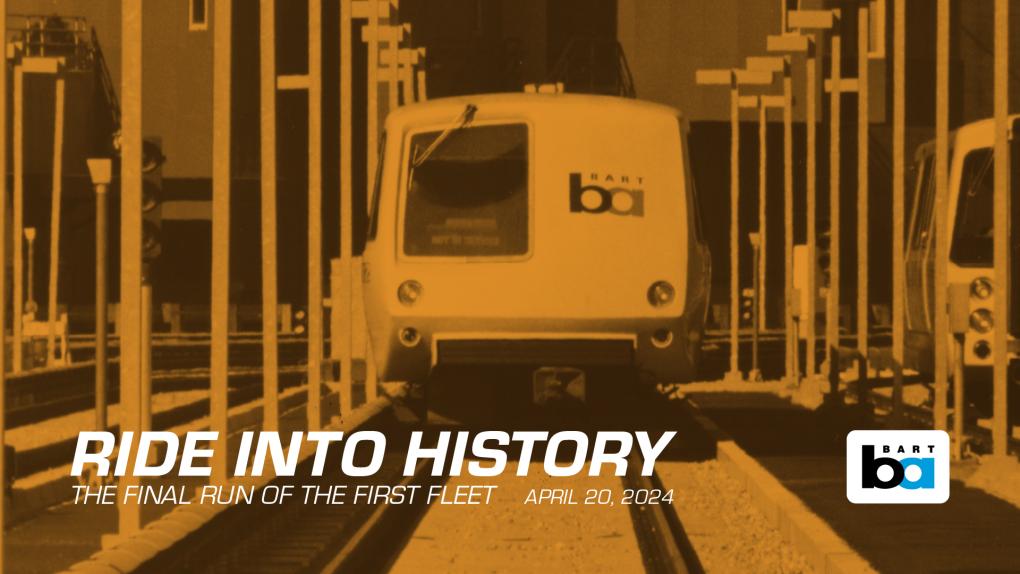
BART invites the public to join us to mark and celebrate the end of an era: the last run of BART’s legacy trains composed of rail cars that have been serving the Bay Area for more than half a century. We’re calling the event “Riding into History: Final Run of the First Fleet.”
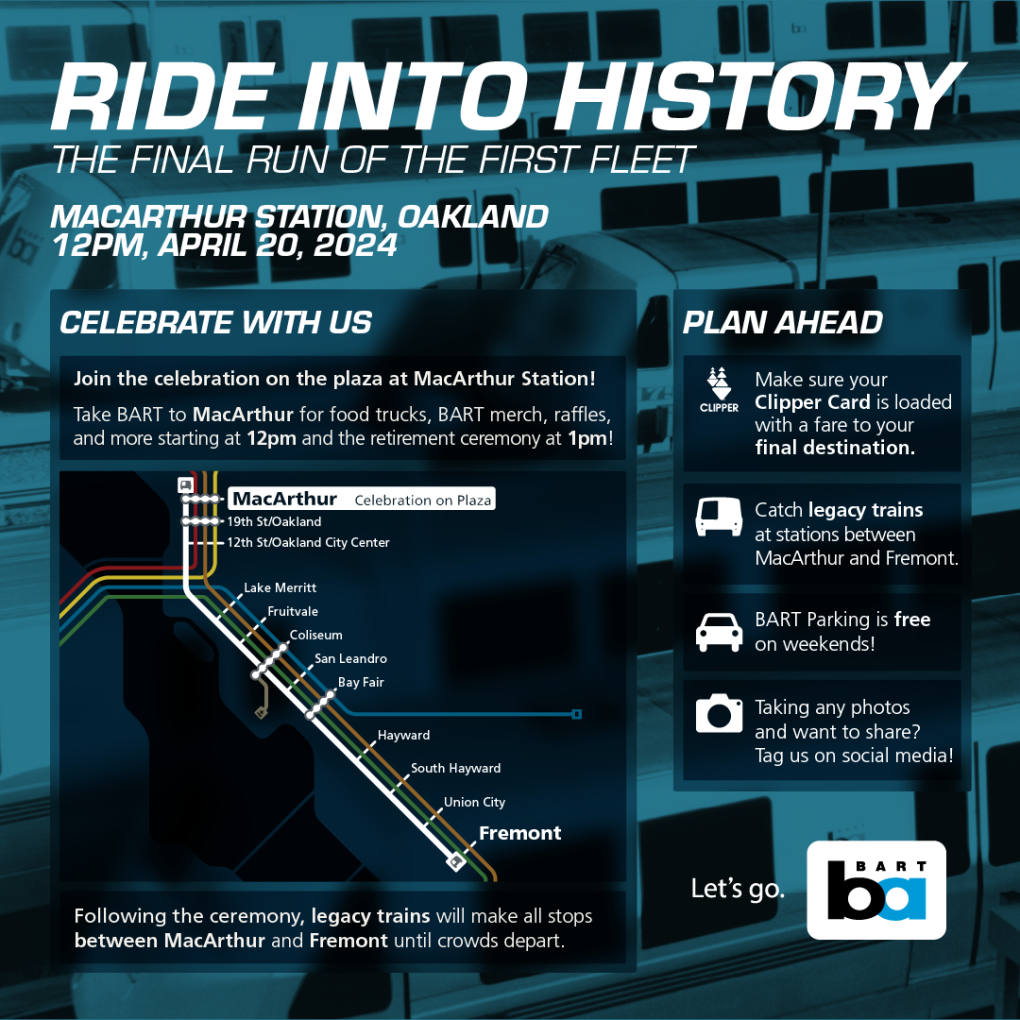
The retirement ceremony will begin at 1pm on Saturday, April 20, 2024 at Oakland’s MacArthur Station with the and final dispatch of legacy trains happening after the speeches.
We recommend arriving around noon to enjoy the food trucks and activities we have planned.
The ceremony will take place in the plaza (free area) of the MacArthur station and will include food trucks (bayareamunchiez.com and noodle-cone.com), activity tables, a raffle for legacy car number plates, a pop-up merch store, and a stamp rally. Bring your stamp rally passport if you have one. Many of the groups who are repurposing old BART cars for new uses will be in attendance to share information about their projects.
Following the ceremony, the public will line up in the plaza and then board a legacy train and ride from MacArthur to Fremont Station, mirroring the initial service BART provided when it opened September 11, 1972. It’s a 45-minute trip that travels along approximately 24 miles of the original section of tracks. There will be more than one legacy train for the event. The trains will make all station stops and may turn around at Bay Fair depending on the number of attendees waiting to ride.
Every rider will need to pay for the ride with their Clipper card. The fare depends on where each rider is going after the ride.
“These train cars are part of the history of the Bay Area,” said Bob Powers, BART General Manager. “While we are excited to modernize the system, we recognize the profound cultural importance of these cars, and we want to celebrate their rich history and give them a proper send off.”
BART is able to completely retire the legacy fleet thanks to the success of the Fleet of the Future project. Seven hundred six new Fleet of the Future train cars are now certified for service – that’s 30 more cars than the legacy fleet inventory. A total of 720 new cars are on BART property as of April 1, 2024, and twenty cars a month are now being delivered to BART – twice as many as when the new cars first began to be delivered to the Hayward test track in 2016.
While the April 20 trip will be the final time the public will be able to ride the legacy fleet cars, it won’t be the last opportunity to spend time with the historic vehicles.
Three legacy cars will be headed to the Western Railway Museum in Suisun City for preservation and to provide a space for transit enthusiasts, researchers, and museum guests to enjoy and study for years to come. The three cars, including an iconic sloped-front A car, will be the only cars from the legacy fleet to be displayed at a museum.
A handful of other legacy cars will be transferred to those who successfully submitted proposals to repurpose the cars for short-term rentals, entertainment venues, and training facilities.
Most of the legacy cars, however, have been recycled, so April 20 is the last chance to ride these historic cars.
BART is turning unused parking into a new source of revenue by renting spots out to local businesses with new online tool
BART has generated $6 million in new revenue since the pandemic by leasing its underutilized parking lots to companies looking to rent parking spaces for daytime use. BART began offering select parking lots to non-BART riders to generate new revenue to help address its FY27 $376M operating budget deficit brought on by remote work. To streamline the process and attract more business, BART recently launched a new online portal for those looking to rent at least 25 spaces for six months or more. Interest to date has come from local businesses looking for employee and fleet vehicle parking.
BART is leasing portions of its parking lots at all stations offering parking except for the six stations which fill up with BART parkers on weekdays (Glen Park, MacArthur, Orinda, Rockridge, Walnut Creek, and West Oakland). Restrictions to this new program include, but are not limited to, long-term parking storage, nearby residence parking, or conducting any kinds of commercial activity such as car rentals. Limited exceptions can be made related to these restrictions for those who accept all maintenance and operations responsibilities for the permitted areas.
BART also offers special event permits to allow others to use parking lots or plazas for community events at a rate of about $2,000 per day in addition to operational costs. Some events that have recently taken place include the 2025 Bizerkeley Food Fest at North Berkeley BART Station parking lot, as well as The Wardrobe Project (a Vintage & Makers Market) at Rockridge Station on the third Saturday of the month.
“BART is looking to generate new revenue in creative ways,” said Chief Communications Officer Alicia Trost. “While demand at some of our lots exceed supply on weekdays, many of them have capacity we can offer to others to generate new revenue. Our parking lots are also a great venue to hold outdoor events on the weekends, offering easy access to transit and parking spaces.”
Long term, BART has active Transit-Oriented Development projects to build housing on BART’s parking lots and land to increase both ridership and lease revenue. Projects in the planning or development phase include Ashby, El Cerrito Plaza, Fremont, Lake Merritt, North Berkeley, Richmond Transit Village, Walnut Creek, West Dublin and West Oakland.
During the height of the pandemic, BART reimagined its parking lots as COVID testing sites, farmers markets, vaccination sites, and even rented parts of the Castro Valley Station parking lot to display model accessory dwelling units, or ADUs, which interested parties could tour ahead of purchasing a home.
BART has also hosted sold-out events in its parking lots to increase ridership. Last year the Concord BART Station was transformed into an outdoor movie night and the BART Sound Tracks Jazz Festival was held at the North Berkeley Station complete with BART themed mocktails.
BART continues to explore revenue generating ideas utilizing our existing resources.
Holiday schedule: BART will run Sunday service (8am-midnight) on Christmas Day and extended service on NYE (5am-1am)
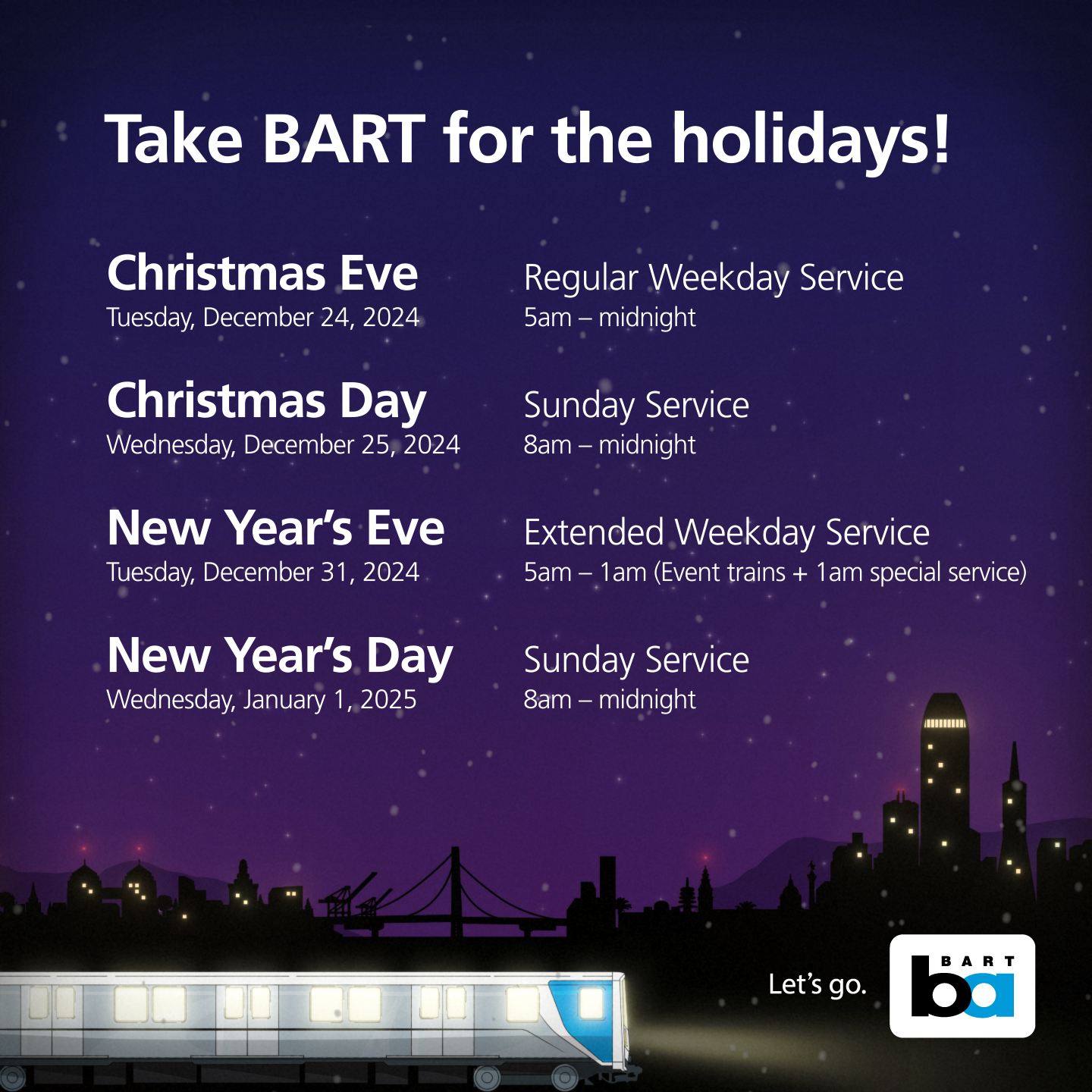
BART will be running special service on Christmas Day, New Year's Eve, and New Year's Day. Plan your trip using BART's Trip Planner.
Holiday Schedule
Christmas Eve, Tuesday, December 24: Regular weekday service (5am-midnight)
Christmas Day, Wednesday, December 25: Sunday service (8am-midnight)
New Year's Eve, Tuesday, December 31: Regular weekday service (5am opening) with extended late-night service, extra staffing, and additional event trains as needed. BART will be providing extended service until 1am for late-night riders coming back from fireworks shows and celebrations. More on this below.
New Year's Day, Wednesday, January 1: Sunday service (8am-midnight)
New Year's Eve 1am Extended Service - More Info
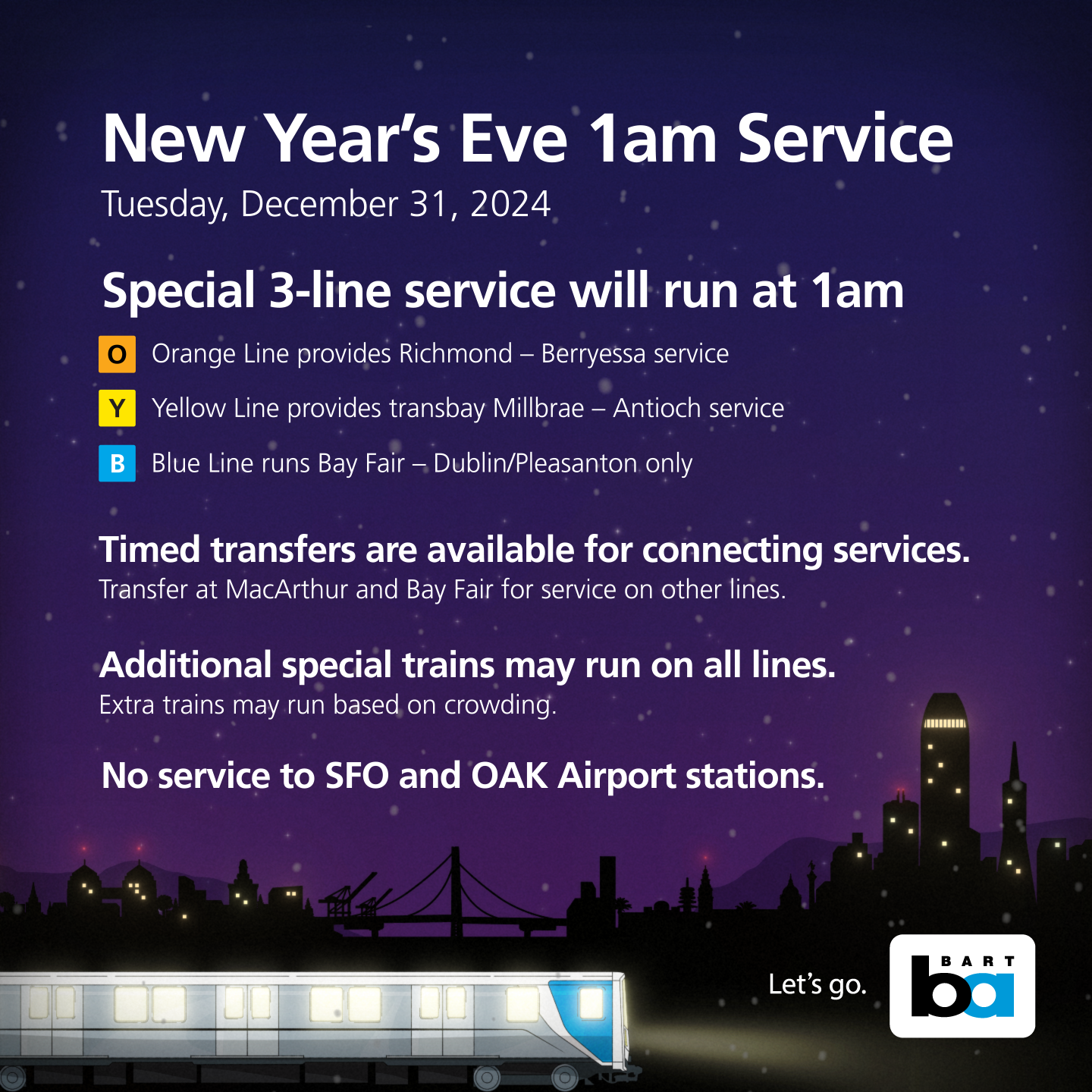
Our 1am extended service will be as follows:
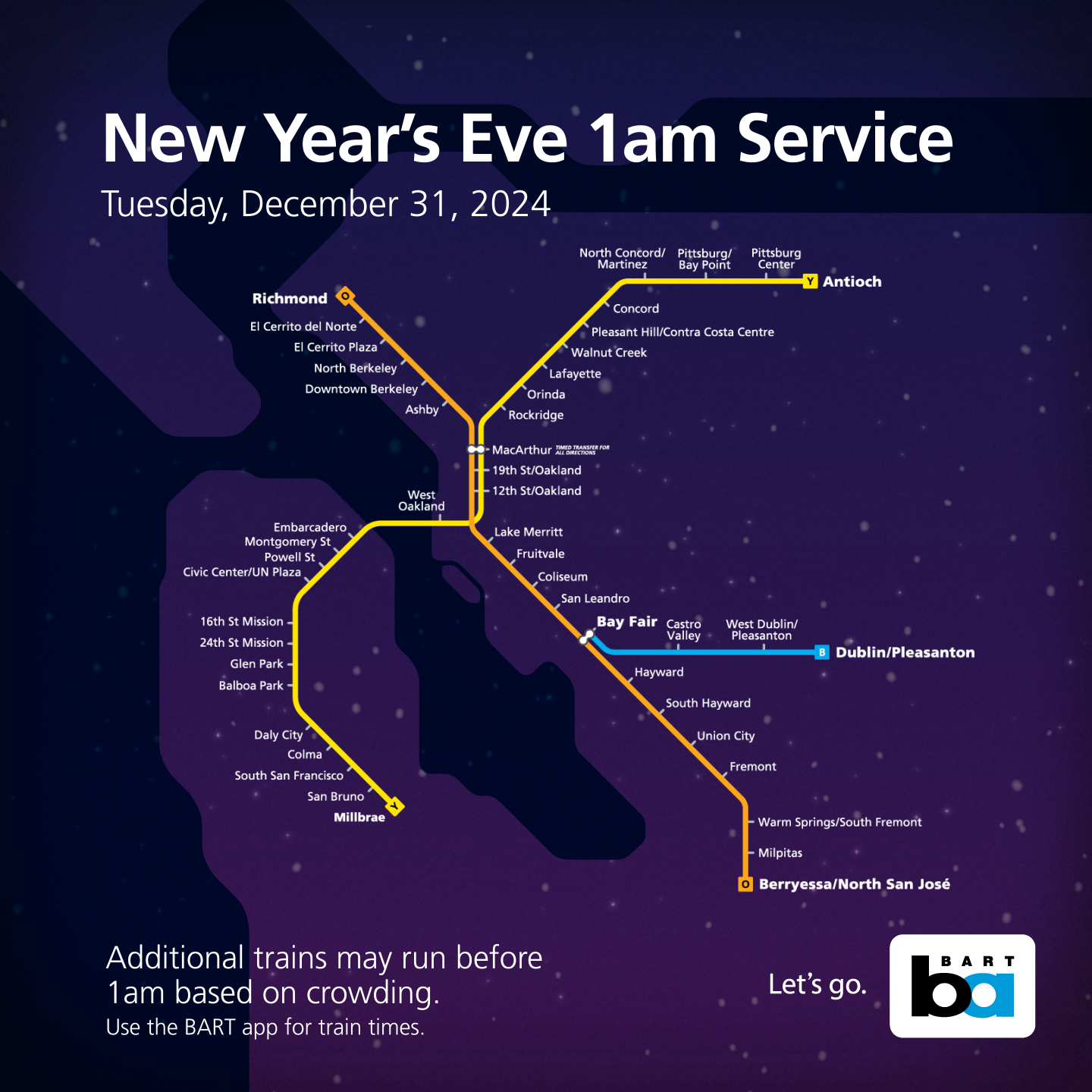
- Three-line special service (Yellow, Blue and Orange only in both directions, for total of six trains for 1am extended service). Yellow Line will be the only line running in San Francisco and Peninsula. Blue Line will run between Bay Fair and Dublin/Pleasanton.
- Trains will be waiting at MacArthur and Bay Fair to complete timed transfers.
- Yellow Line and Orange Line trains in all directions will be timed to meet at MacArthur Station at 1:47am in a "grand meet." This is the transfer point for riders coming from San Francisco heading toward Richmond or Berryessa or riders coming from the East Bay heading toward San Francisco.
- Orange Line and Blue Line trains will be timed to meet at Bay Fair Station at 2:16am. Dublin-bound riders can take the Berryessa-bound Orange Line train and transfer at Bay Fair Station.
- SFO and OAK airport stations will NOT be served.
- Last East Bay-bound train running through downtown San Francisco will be at around 1:30am.
- Last southbound train heading toward Millbrae will run through downtown San Francisco at 2:10am.
- The regular last trains of the evening (Yellow, Blue, and Orange lines) will be dispatched from the end of their lines at midnight and then at 1:00am, we will run another set of last trains of the evening to serve 48 out of our 50 stations. The 1am trains will not serve SFO and OAK airport stations.
BART’s Trip Planner has been updated to include the extended service trains.
Parking at BART on Holidays
Parking is always free after 3pm and on weekends. Parking will also be free on Christmas Day and New Year's Day. This applies to all BART stations except for Milpitas and Berryessa/North San Jose, as they are operated by VTA.
All other parking rules will be enforced.
Parking at BART for Holiday Travel
Airport parking can be a hassle and is always expensive, except at BART stations. We offer inexpensive multi-day parking (see options below) at many stations with easy online reservations. Purchase parking on the Official BART App or pay by website.
To accommodate the increased demand for Reserved Parking at Millbrae Station during the holidays, Reserved Parking is allowed on any level of the garage for reservations with a start date between December 23, 2024 – January 10, 2025. Reserved Parking at San Bruno Station is also allowed on all levels of the garage during the holiday season.
Single/Multi-Day Reserved parking is for consecutive overnight stays of up to 20 weekdays. You will need to provide the license plate of the car you plan to drive and a phone number. Reference our guide for paying for Single/Multi-Day Reserved parking here.
Monthly Reserved parking is for stays of up to 24 hours at a time, charged on a recurring monthly basis, and provides a guaranteed space until 10am. This is not to be used while travelling for several days in a row.
Reserved parking signs are blue + white or yellow. During the holidays we experience a higher demand in Reserved parking; if there is not a reserved spot available when you arrive, park in the Daily Fee area and you will not be cited. Daily Fee parking is only allowed in the Daily Fee area.
Find an overview of parking at BART at bart.gov/parking.
Taking BART to SFO or OAK
Traveling by plane for the holiday? It’s easy to ride BART to the airport. You can take the train directly to San Francisco International Airport (SFO) and Oakland International Airport (OAK). Plan your trip and find fares by using BART’s online Trip Planner and read our comprehensive guide on riding BART to the airport.
Another option for travel to SFO via BART is to purchase Multi-Day Reserved parking on the Official BART App or website and drive to Millbrae Station or San Bruno Station, then take a quick ride to SFO Airport.
Stay Safe
Save these numbers in your phone:
- 510-200-0992 to text BART Police dispatch to discreetly report criminal activity
- 510-464-7000 to call BART Police in an emergency (It’s faster than calling 911)
We also offer the BART Watch App--a free mobile app available on the App Store and Google Play that allows you to quickly and discreetly report criminal or suspicious activity directly to BART Police.
You can reach the Train Operator using call buttons in each car located by the side doors on the new trains.
Note your train car number when contacting police or the Train Operator. The train number is located above the doors on the inside of each end of the train car.
BART will have extra safety staff working on New Year’s Eve.
Holiday Fun
Low-cost e-bike lending program for Oakland residents launches at Fruitvale BART Bike Station with discounts for Clipper START users
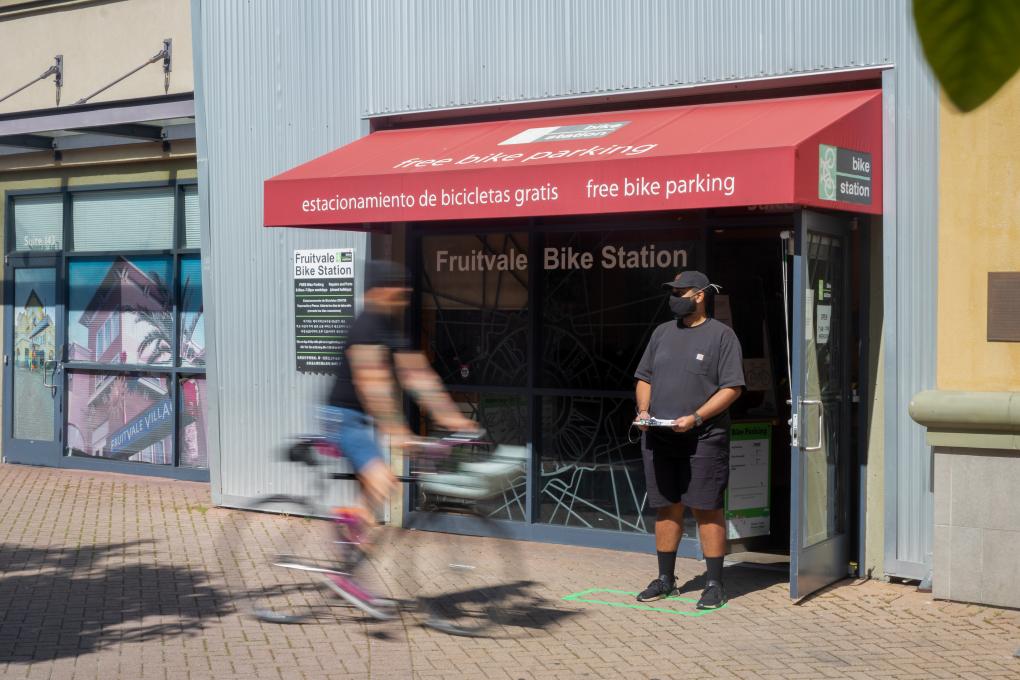
The Fruitvale BART Bike Station is now home to a fleet of electric bicycles Oakland residents can borrow for a very low fee.
The City of Oakland selected the station to launch its new e-bike lending program, which allows Oakland residents 18 and up to borrow an e-bike for four weeks for $120. Qualifying low-income residents, including those signed up for Clipper START, pay just $20. Visit oaklandca.gov/ebike for more detailed information as well as qualifications for the low-income discount. The program is funded by a $1.8 million, five-year grant from the Clean Mobility Options (CMO) voucher program.
The initiative helps advance BART’s mission to provide affordable and environmentally friendly transportation to the region while leveraging the existing capacity of BART’s Fruitvale Bike Station, which offers free valet bike parking, bike repairs, parts, and gear. BikeHub operates the Bike Station for BART and contracted separately with the city to offer the lending service. Lent bikes can be serviced at Fruitvale as well as the Uptown Oakland BART Bike Station at 19th St. Station.
“BART is thrilled to be the first location for Oakland’s new e-bike lending program,” said Heath Maddox, BART Manager of Bike Access. “BART’s bike stations aren’t just for securely storing bikes; they serve as a community resource to support and promote bicycling as a clean, affordable, and fun mode of transportation that can get you to and from BART and beyond."
E-bikes help riders travel long distances and climb hills with greater ease than traditional bikes, and BART has embraced them in the system. Like regular bikes, e-bikes are allowed on most BART escalators and in every train car but the first. To assist cyclists with big bikes, BART created this Elevator Dimension Guide that outlines the dimensions of every elevator in the system. BART also recently completed installation of modern bike stairway channels that make it easy to roll your bike up and down stairs at 19th Street/Oakland, 12th Street/Oakland, Lake Merritt, Coliseum, Walnut Creek, Embarcadero, and 24th Street Mission.
As many bike shops and the bicycle industry at large suffer in the post-pandemic bike boom contraction, BART offering full-service bike stations is an important community resource.
“It can be hard to find a shop to fix your bike without the ability to drive it across town,” Maddox said. “As full-service local bike shops, our bike stations are filling a real community need.”
E-bikes are in high-demand right now, he added, and many people on a budget naturally gravitate towards less expensive online models, “which are often not built to last and can have dangerous electronics.”
The e-bike available for lending is the Gazelle Medeo T-9 City, a high quality, Class I e-bike selected specifically for its quality, durability at a low-cost, and easy riding position for riders of all sizes. BikeHub is also encouraging people interested in purchasing their own bike to the Ava Bike Electric program, an incentive offering $400 to $1,500 off new e-bikes.
Learn more about Bikes on BART at bart.gov/bikes.
Win big prizes, including a $250 Clipper card, when you download BART’s Digital Holiday Passport and explore places and adventures near stations
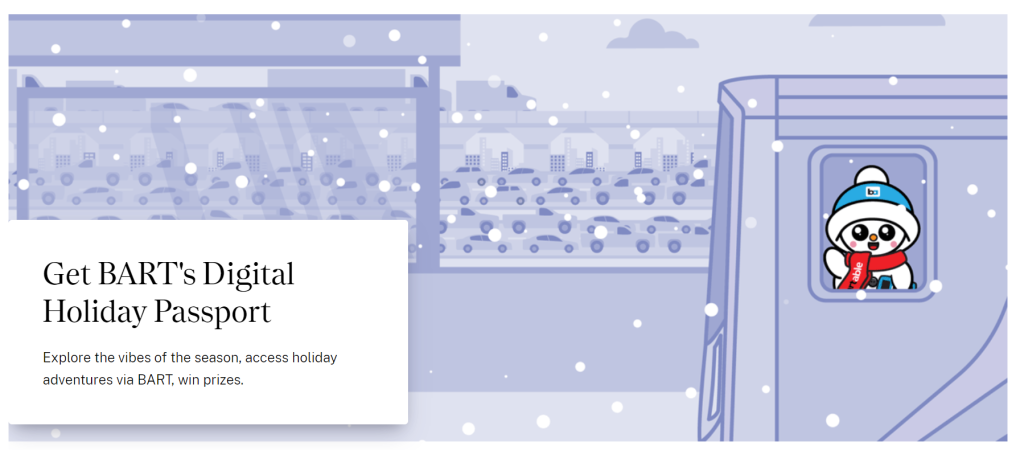
On Thursday, Dec. 7, BART launched a Digital Holiday Passport to encourage riding BART to explore the region and access holiday fun and adventures. Participants can win big prizes, including a $250 Clipper card and a 2023 Ugly Holiday Sweater and Holiday Beanie.
BART created the Digital Holiday Passport in partnership with Vibemap, a city discovery app that uses “vibes” to connect users to places, events, and experiences. Vibemap will join BART at SweaterFest ‘23 on Sunday, Dec. 10, 2pm to 3pm, at Rockridge Station, to promote the challenge and answer questions. Members of the public who attend SweaterFest ‘23 will also be the first to receive the brand-new BART Stamp Passports for the BART Stamp Rally.
The Digital Holiday Passport challenge will run from Thursday, Dec. 7, 2023, to Monday, Jan. 1, 2024. Seven stations will serve as check-in locations:
- Downtown Berkeley
- Fruitvale
- Montgomery
- MacArthur
- Lake Merritt
- West Dublin/Pleasanton
- Walnut Creek
To participate, download Vibemap on the iOS App Store or the Google Play Store. After downloading, travel within 0.5 miles of one of the seven stations listed above, and you’ll receive a notification to unlock the Digital Holiday Passport. The passport is geofenced so you can’t participate unless you’re physically in the area.
Participants will earn “Challenge Points” for every nearby activity they do – from checking-in at stations and places around BART, to adding “vibes” and tips to the app. The more points you have, the higher your chances of winning prizes, such as:
- $250 Clipper card
- 2023 Ugly Holiday Sweater (Size Large), Holiday Beanie
- $50 Clipper card
- $11 Clipper cards + BART swag bag
After the challenge concludes, Vibemap will host an IRL event for participants to meet and mingle. Date and location TBD. At the event, you can get a special holiday stamp as part of the BART Stamp Rally.
To learn more about the Digital BART Holiday Passport visit bartable.bart.gov/vibemap.
“If you see me on a train, ignore my dog”: How to treat service dogs and their handlers with respect on BART
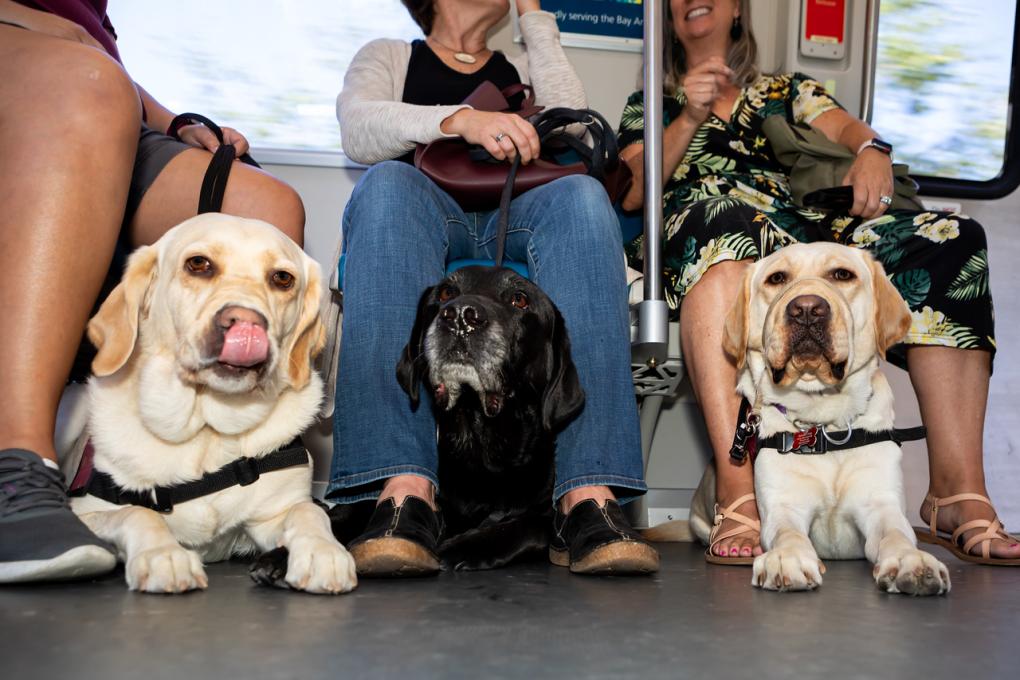
Early Alert Canines service dogs on BART, from left to right: Scarlett with handler Alysia Santos, Handsome Ransom with handler Kathleen Fraser, Sheldon with puppy trainer Suzie Scher.
See our DOs and DON’Ts for pets on BART below.
TLDR: You may only bring a pet onboard and in stations if it is secured in an enclosed carrier made for the transport of animals. Animals on leashes are prohibited with the exception of trained service dogs. Service dogs are allowed off leash if their owners are unable to hold a leash and the animal is under voice command of their owner. Please contact BART's Access and Accessibility Department for more information.
Service animals are defined by the American Disabilities Act as any guide dog, signal dog, or other animal individually trained to work or perform tasks for an individual with a disability. Emotional support animals are not service animals and must be in a carrier when on BART.
BART offers free BART rides for those training service animals on the system. Arrangements must be made with BART’s Customer Access Department beforehand.
Read more about our pets on BART rules at bart.gov/pets.
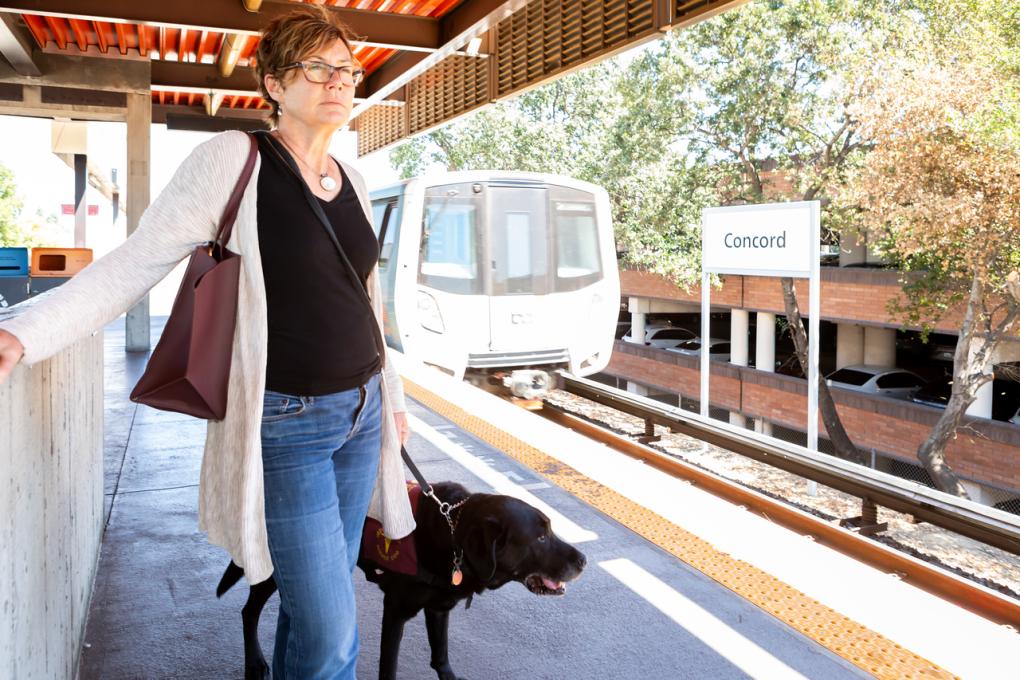
Kathleen Fraser and her service dog, Handsome Ransom, on the platform at Concord Station.
Dogs are cute. But some dogs have jobs to do, including when they’re riding BART.
Handsome Ransom is San Francisco resident Kathleen Fraser’s dog. He's got a big, goofy smile and soft black fur. Over that smooth coat, he wears a dark red vest with yellow embroidered text that reads: “Medical Alert Service Dog.”
Many of us see a dog out in the world and our brains scream, CUTE CUTE CUTE, MUST PET PET PET. Ransom, like all dogs, can be distracted however, and unlike all dogs, he’s specially trained to save his handler’s life.
“If you see me on a train, please ignore my dog,” Fraser said as a PSA to her fellow BART riders.
Fraser has type 1 diabetes, a lifelong condition where her pancreas doesn’t make any insulin, leading to high blood sugar levels. This can lead to a series of complications, including but not limited to nerve damage, heart attack, stroke, seizures, and in the most tragic cases, death.
In 2016 after a series of close calls, Fraser reached out to the Concord-based nonprofit Early Alert Canines in search of a service dog that would alert her when her blood sugar was dropping. The organization is one of a handful that trains medical alert dogs and connects them to people with type 1 diabetes.
Early Alert paired Fraser with Handsome Ransom, who quickly became her best friend and most steadfast companion. Wherever Fraser goes, Handsome Ransom comes too, including on BART rides. He has to; without Ransom by her side, Fraser's blood sugar could fall, and she might not even realize it. Ransom can detect blood sugar crashes sooner than any modern medical device and often before the person recognizes the signs of an oncoming drop, such as sweating, shakiness, dizziness, anxiety, intense fatigue, etc.
“Trained dogs pick up the scent of the chemicals your body releases when your blood sugar is dropping,” said Carol Edwards, the Executive Director of Early Alert Canines.
“As soon as they smell those particles, they go, ‘There it is!’ and they alert their handler with a simple lift of their paw,” Edwards said. When a dog gives the alert, their handler can pause, look at the number on their glucose monitor, “and make an informed decision on what to do next before they get to that low state where one of the first things to go is cognitive ability."
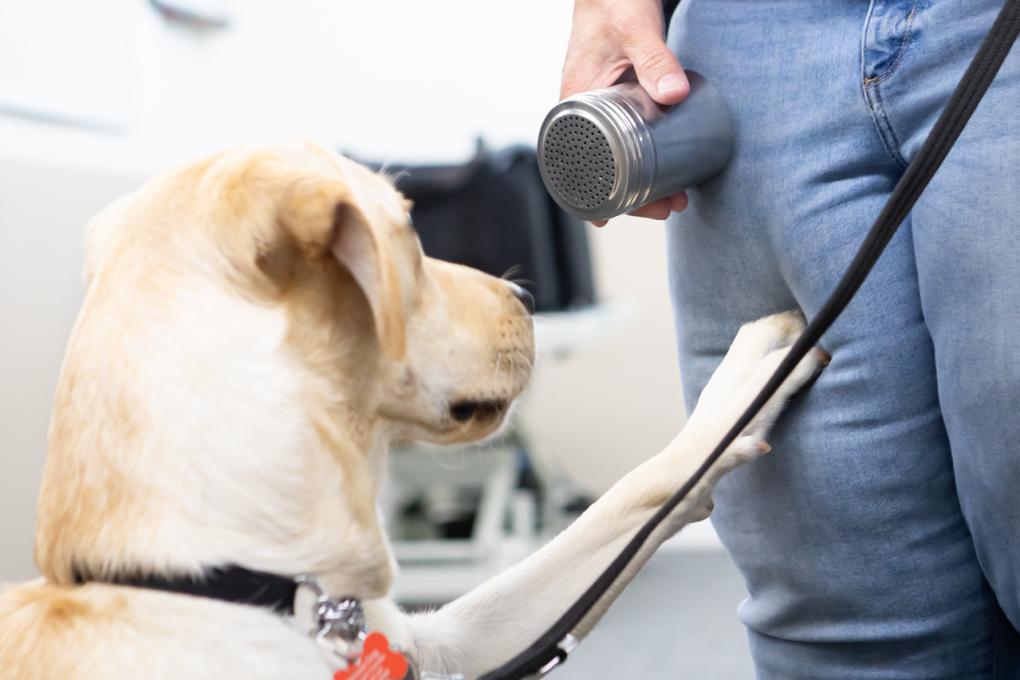
Service dog Scarlett correctly identifying a canister containing scent samples with a blood sugar level of 70mg/dL or lower at Early Alert Canines in Concord.
The dogs are scent trained for around six weeks using a 12-arm scent wheel, with each arm ending with a small canister with a perforated lid (think spice shaker). The scent samples within are collected from individuals with type 1 diabetes experiencing a blood sugar level of 70 mg/dL or lower. Once the dogs are familiar with searching the scent wheel, they undergo a series of 500 double-blind trials. In these trials, neither the trainer nor the dog knows which canister contains the target scent. In all, the process takes around six weeks.
Fraser said Ransom has alerted her thousands of times since they were first matched eight years ago. Sometimes, Ransom will give the alert more than a dozen times a day.
“What I wish people would realize is that service dogs provide medical support that is just as important as a wheelchair or a white cane or hearing aid," Fraser said. "Yes, they are adorable, and yes, we all want to go up and squish them and all of that. But when they're out, they’re in work mode, and they need to be attending to their person.”
Many don’t realize this because they just don’t know. And that’s exactly why Fraser is sharing her experiences, including some that are painful to remember.
Fraser used to take transit to work in San Francisco all the time. But things became too challenging – and terrifying – when fellow passengers would consistently scold her for bringing a dog on transit or for using a seat reserved for disabled people in the front. Fraser often uses one of these seats as a safety measure for the dog because sitting against a wall limits the chances of someone trampling or stepping on him, thereby preventing him from doing his job. If the dog gets distracted or injured, it puts Fraser’s safety at risk.
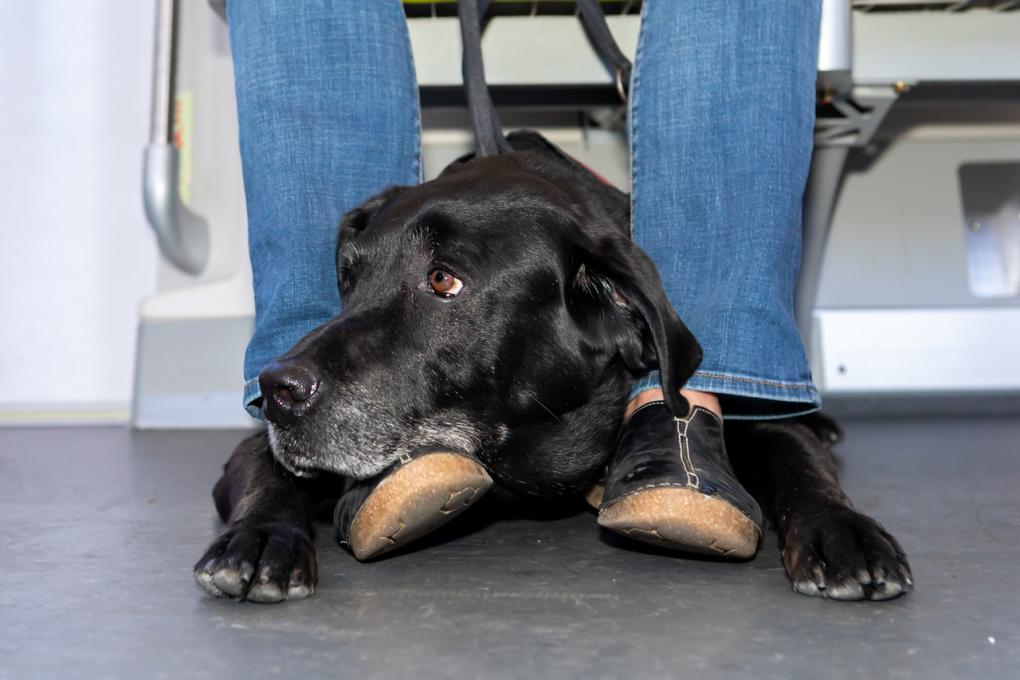
Handsome Ransom on BART between Kathleen Fraser’s legs in a seat against the wall.
"There have been many times where I'm sitting in one of the reserved seats and the public, for one reason or another, starts yelling at me about ‘How dare I sit in that seat, when XYZ person should have that seat,’” she said.
These encounters, on more than one occasion, spiraled into an “angry mob” situation, with people asking Fraser questions like: “What’s wrong with you? Why do you get to bring a dog on transit?”
“We live in a world now where there are many ‘fake’ service dogs,” Fraser said. “People are sensitive about it in San Francisco because we have strong laws around emotional support animals and renting apartments.”
"It's also complicated by the fact that my disability is somewhat invisible,” she added. “People say to me, ‘Well, you don’t look disabled,’ and I say, ‘What does disabled look like to you?’ Most people think ‘disabled’ refers to those with visible physical disabilities, but that’s not the case. And it’s caused me a heck of a lot of trouble.” According to multiple sources, the vast majority of disabilities are “invisible.”
Type 1 diabetes is a protected class under the Americans with Disabilities Act (ADA), which prohibits discrimination against those with disabilities in all areas of public life, including transportation. ADA defines service animals as any guide dog, signal dog, or other animal individually trained to work or perform tasks for an individual with a disability.
Dogs whose sole functions are to provide comfort or emotional support do not qualify as service animals under the ADA, and Fraser wants to be very clear: Ransom's job is not providing emotional support. That's an added bonus. People with diabetes are two to three times more likely to have depression than those without diabetes, and “having a dog who loves you unconditionally helps with that,” Fraser said.
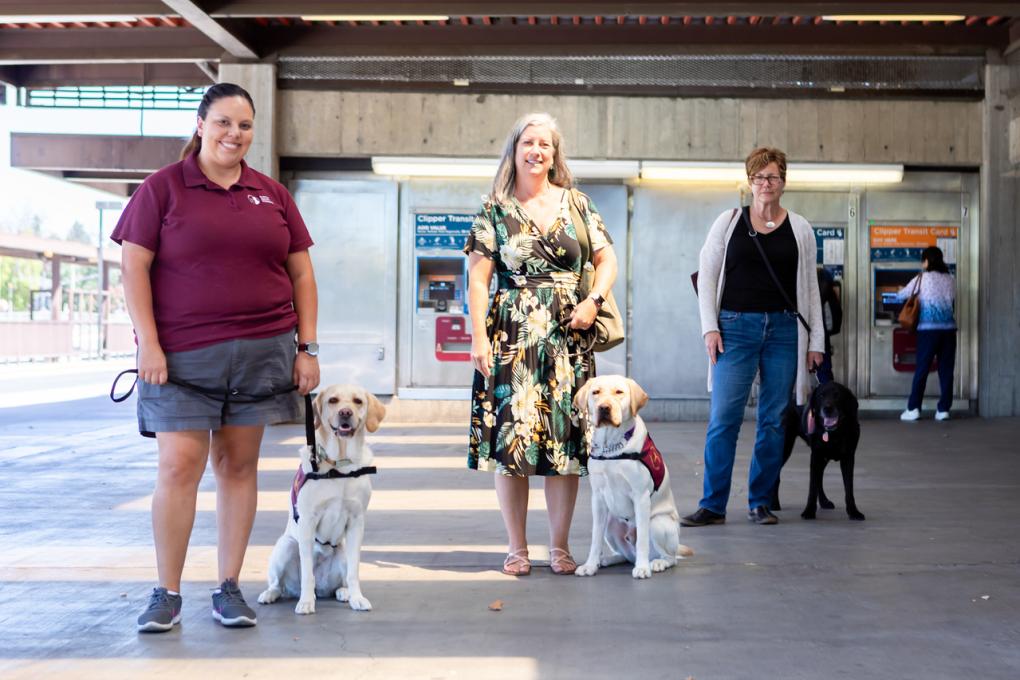
From left to right: Scarlett with handler Alysia Santos, Sheldon with handler Suzie Scher, Handsome Ransom with handler Kathleen Fraser. Pictured in the unpaid area of Concord Station.
When you encounter a person with a service dog, there are two questions you can ask. One, is the dog a service animal required because of a disability? And two, what work or task has the animal been trained to perform? People with service dogs do not have to disclose their disability.
Because of her traumatic experiences, Fraser no longer takes transit, instead opting to drive three miles to her office and pay for an expensive parking spot. Sometimes, that’s the way it is when you’re maneuvering around a world that is not designed with a diverse spectrum of disabilities in mind.
"This disability is vicious, it's volatile, it's unforgiving, it's cruel, and completely unpredictable,” Fraser said of type 1 diabetes. "There is research that says people with type 1 diabetes have to make 300 additional decisions a day just to stay alive.”
Early Alert Canines makes a point to train their dogs on public transportation because the animals’ future handlers may use it back home. 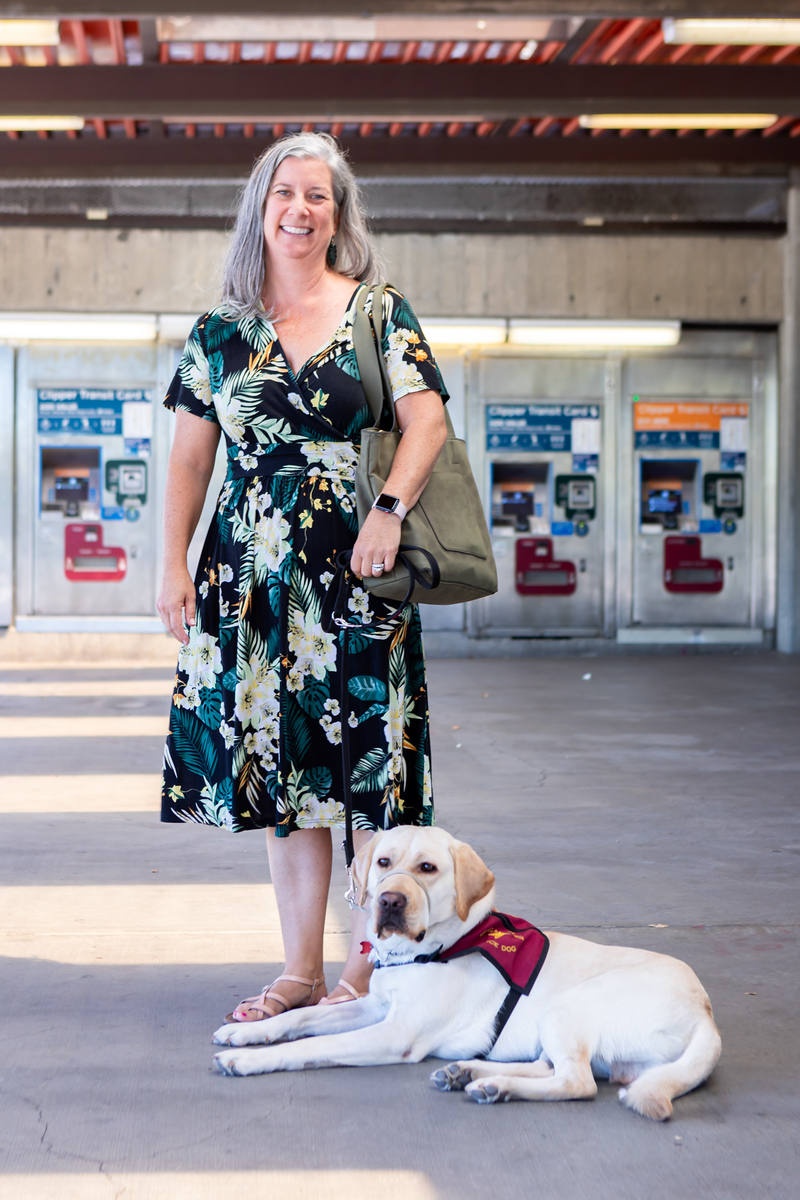
Suzie Scher (pictured on the right with Sheldon) is a volunteer puppy raiser, and she made sure her trainee pup, Sheldon, got some experience riding the trains. She recently took BART to Downtown Berkeley Station for a visit to the Ed Roberts Campus, a universally designed, transit-oriented campus that was created by disability organizations that share a common history in the Independent Living Movement of People with Disabilities.
“I wanted to make sure he's been on BART before he’s paired with his handler,” she said. “These dogs can be placed with people anywhere in the country – they could be riding the Chicago L or the New York subway, and they need to be prepared.”
There are many stimulants in a transit space – the click of the fare gates, the whoosh of a train pulling into the station – and puppy raisers like Scher ensure their dogs know what they’re getting into before they’re sent off to live with their owners.
Fraser said Ransom is a “champ on BART.” On a recent visit to Concord Station, Ransom serenely followed Fraser through the fare gate, walked up the stairs, and waited on the platform beside her until they got on a train. Onboard, Fraser found a seat against the wall, and Ransom deftly maneuvered himself underneath the seat, poking his head between the protective barrier of Fraser’s legs. He sat there serenely for the entirety of the ride.
Fraser has a few asks for her fellow passengers. As mentioned earlier, do your best to ignore Handsome Ransom – that includes not making eye contact with him. She also asks that you consider giving up your seat for her and Ransom on a crowded train.
“When we’re standing,” she said, “we have to put the dog between our legs and make sure the tail is not stepped on. We’re doing all this while holding onto the handrail, maybe holding onto a shopping bag or purse. It’s a lot to handle.”
It’s also important to not eat on the train and in the paid area of the station, and not just because it's against BART’s rules. Even miniscule crumbs can pull a service dog away from his task. Afterall, they’re dogs, and when they’re paying attention to food on the floor, it means they’re not working.
“I want him to have his full attention on his person, so if their levels change, he can alert them right away,” Edwards said. “I don’t want him distracted by a piece of dropped hamburger.”
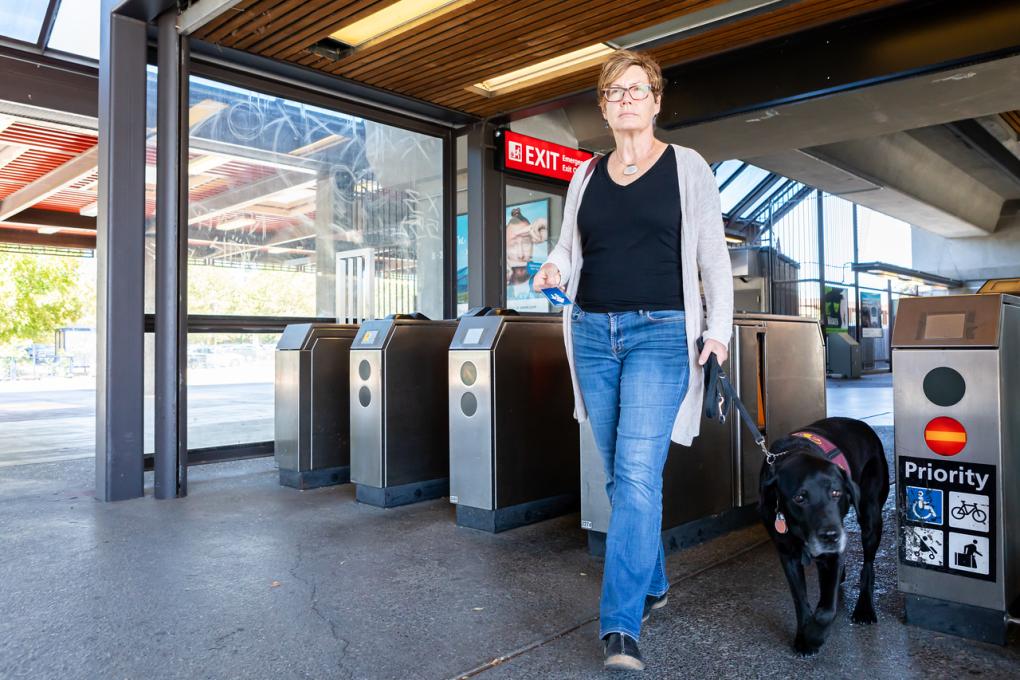
Kathleen Fraser and Handsome Ransom walk through the fare gates at Concord Station.
Most importantly, Fraser asks that you follow BART’s pet policy. Pets are allowed on BART, but they must be properly secured in an enclosed carrier manufactured for pet transportation. In turn, that carrier must be kept off the seats and cleared from the aisle (keep service animals off the seats and out of the aisles, too). Pets on leashes are prohibited.
If these policies are not followed, it puts people with disabilities in danger, as well as their fellow passengers. Bringing your pet on BART without a carrier is inviting interactions with potentially life-threatening consequences, whether it’s Ransom failing to alert Fraser of a blood sugar crash or a poorly behaved dog biting a passenger. A person found to be in violation of BART’s pet policy could be issued a citation and/or ejected from the system.
So far, Fraser hasn’t had any problems on BART, but that doesn’t mean she’s not constantly calculating what could happen when she steps on a BART train or anywhere out in public for that matter.
“If you bring your dog on BART and it behaves badly, people remember that bad experience. Then, when I get on BART with my service dog, they take it out on me,” she said. “It makes everything harder.”
Added Scher: “Follow the rules, and if you won’t do it for humans, do it for the service dogs."
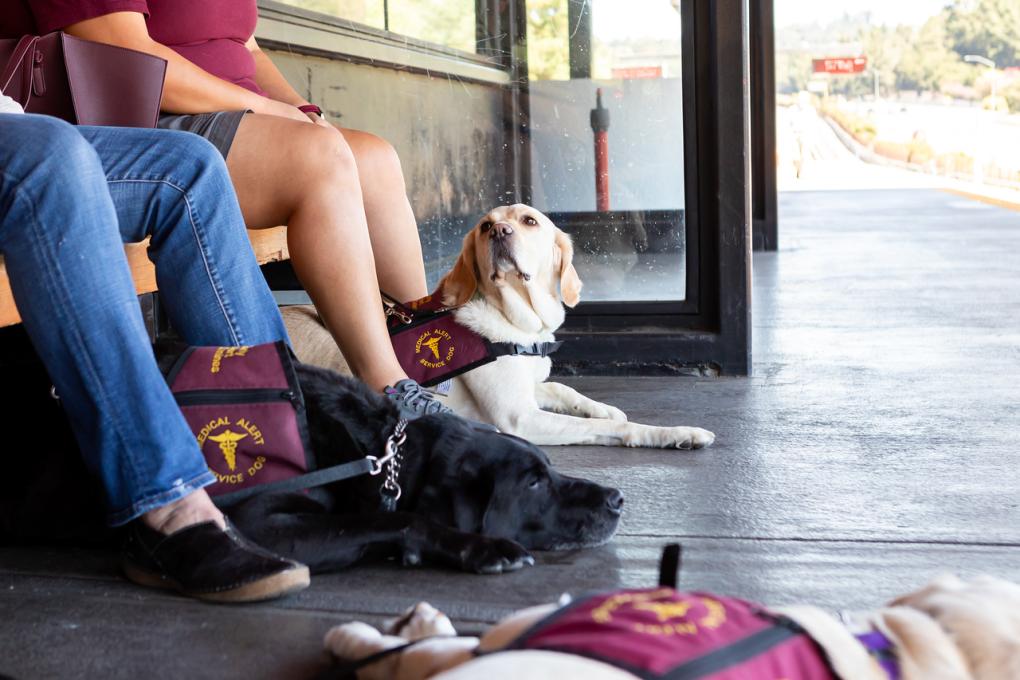
Service dogs reposing on the platform as they wait for a train at Concord Station.
The DOs and DONT’s of Pets on BART
DO bring your non-service animal on BART in an enclosed carrier made for transporting pets. This includes not just trains, but stations as well.
DON’T put the carrier on a seat or in the aisle and keep your service animal off the seats and out of the walkways.
DO be considerate of fellow patrons who may have allergies or fears around certain animals.
DON’T bring a leashed pet onboard (with the exception of trained service animals). Service dogs are allowed off leash if their owners are unable to hold a leash and the animal is under voice command of their owner.
DO remember that not all disabilities are as visible as others.
DON’T pet a service dog, offer it a treat, or distract it in other ways. Try not to acknowledge the animal at all (we know it’s hard).
DO be aware that Station Agents can advise owners that their service animals may not enter a station if the animal is behaving in a way that may threaten other passengers.
DON’T forget that BART Police may issue a citation and/or eject a person from BART if they are found to be in violation of BART’s pet rules.
DO remove all food and trash from trains and deposit it in station receptacles to ensure service animals like Ransom don’t get distracted.
DON’T ask a person what disability they have that enables them to have a service animal. Stick to these two questions: “Is this a service animal?” and “Is this animal working for you?”
DO consider giving up your seat to a person with a service animal to make things easier for them.
DON’T take service dogs on escalators, which could potentially pinch their paws. We recommend using the stairs or elevators. (This is a BART recommendation; California law does allow service dogs on escalators.)
DO be aware that service dogs in training may accompany their disabled owners or authorized trainers on BART. No service animals in training, other than dogs, are allowed on BART on leash or harness.
DON’T bring an emotional support pet on BART unless it is in an enclosed carrier. Emotional support pets are not service animals, per the ADA.
DO reach out to BART’s Customer Access Department, which can arrange free BART rides for those training service animals on the system.