
Search Results
BART running special late-night service for 8pm matches on June 19 and June 22
Updated 6/18/26
For the 8pm FIFA World Cup matches on Friday, June 19, and Monday, June 22, BART is offering fans special late-night service after midnight to get riders home. These late-night matches will put fans onto trains during a time BART is usually closed.
Fans must begin their trips at Bay Fair, Dublin, MacArthur, El Cerrito del Norte, Fremont, Hayward, Pleasant Hill, Powell Street, South Hayward, Union City, or Warm Springs/South Fremont stations. All other stations are closed after midnight.
Bay Area transit agencies are coordinating efforts and scheduling to ensure a world-class transportation experience and to have service available for all fans regardless of when matches end.
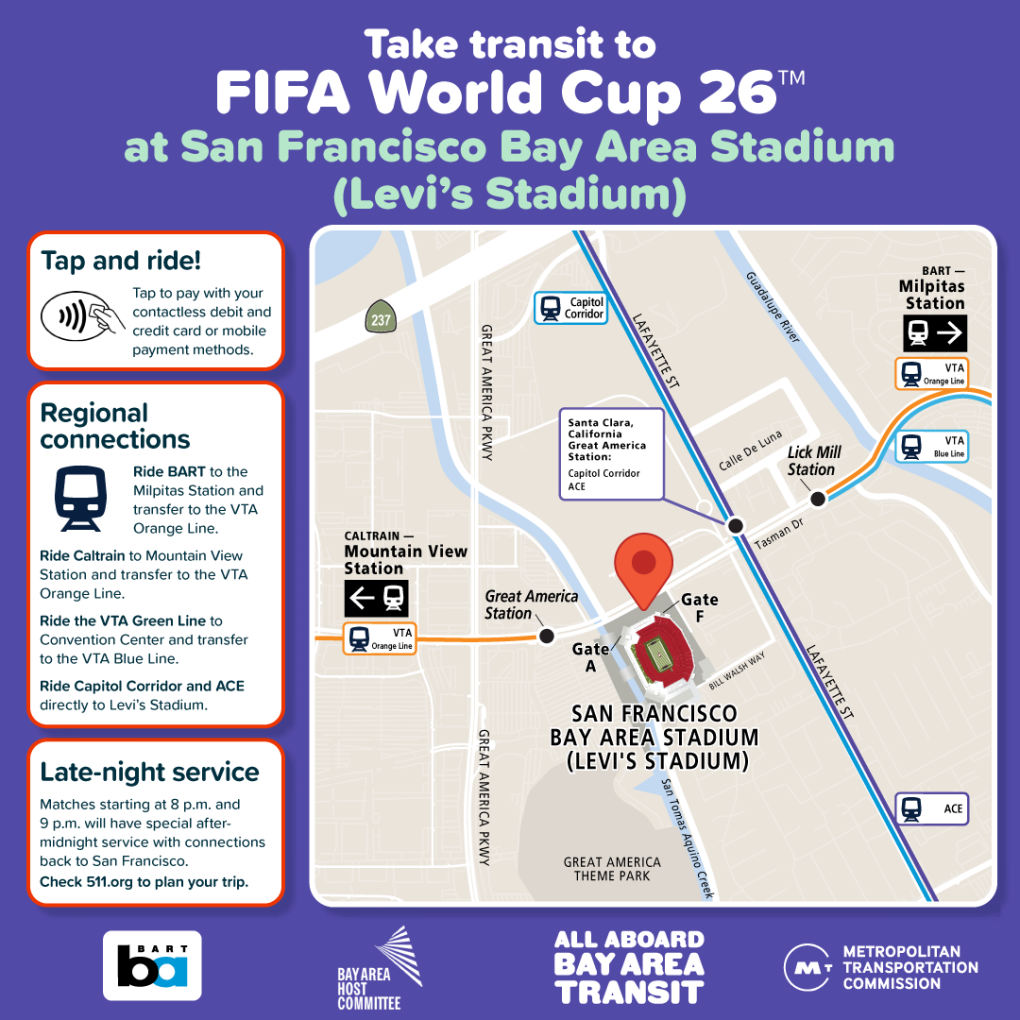
Unlike many rail systems around the country, BART will not be implementing surge pricing for FIFA. Riders will pay the regular fare. Use Tap and Ride to pay directly at the fare gate by tapping your credit/debit card or mobile payment. Each person needs their own phone/card. No transit card/ticket is required.
BART is bolstering our staff and security presence and running longer trains. BART will also deploy extra lighting at key station parking lots to enhance safety for fans returning from evening matches.
BART also offered extra service for previous late-night matches.
Find BART’s comprehensive guide to FIFA World Cup 2026 transportation, including directions for taking transit to fan zones, watch parties, and other events, at bart.gov/fifa
Special limited-express, late-night service for 8pm matches (June 19 and 22)
The last scheduled BART train that stops at all stations systemwide leaves Milpitas at 11:53pm towards the East Bay and San Francisco. The last scheduled BART train to Berryessa Station is 1:47am.
BART will add the following special event trains after midnight that will be timed with the last VTA trains coming from the stadium. There is not a timetable for these departure times because it depends on how long it takes to clear the stadium and get to BART on VTA. But overall, they will likely depart Milpitas every 30 minutes between 12:30am-1:40am.
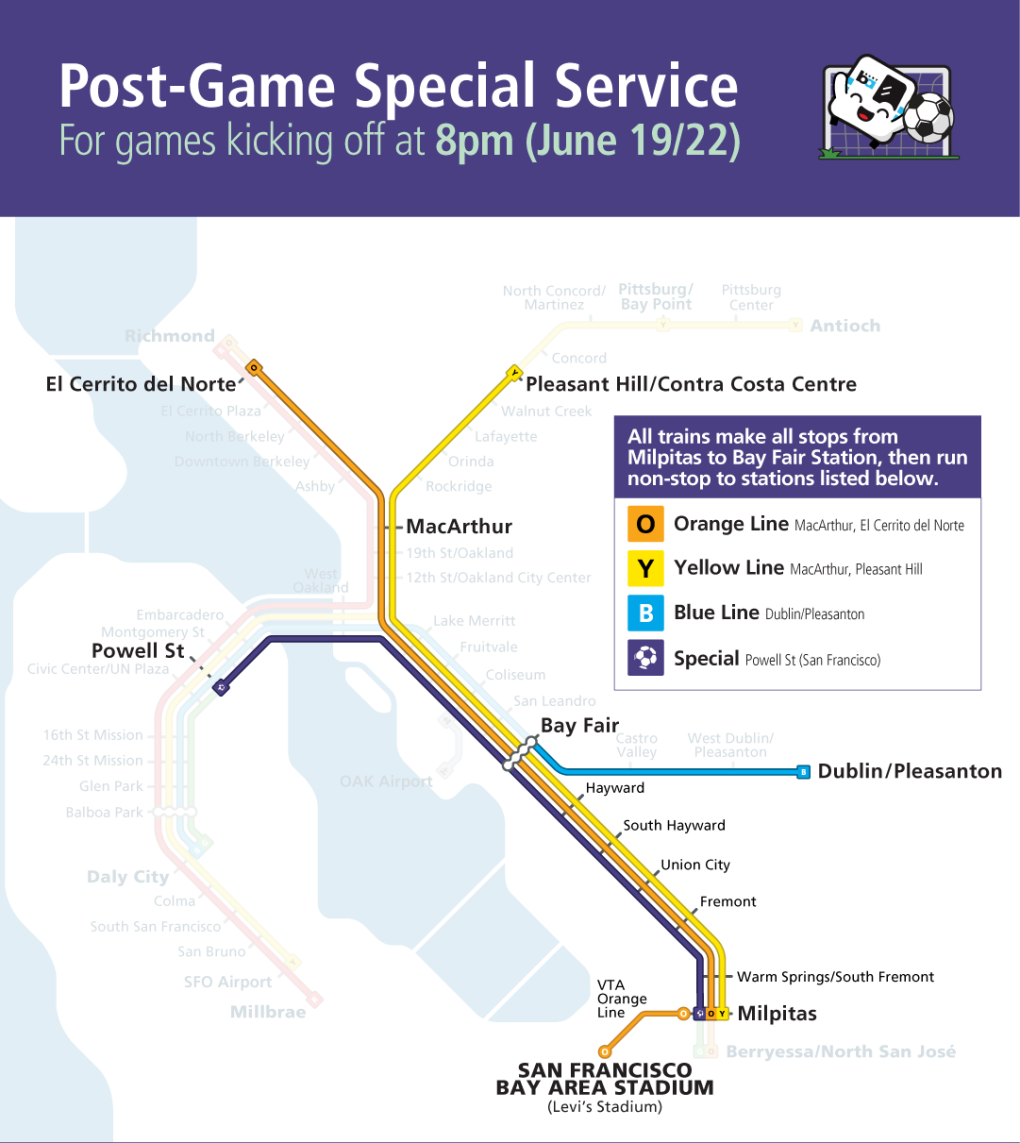
These special event trains WILL NOT STOP AT ALL BART STATIONS. The trains will only serve Bay Fair, Dublin/Pleasanton, MacArthur, El Cerrito del Norte, Fremont, Hayward, Pleasant Hill, Powell Street, South Hayward, Union City, and Warm Springs/South Fremont stations.
People taking BART to the stadium and driving to park at BART must leave their cars at these key Easy Bay stations for the return trip: Bay Fair, Dublin/Pleasanton, MacArthur, El Cerrito del Norte, Fremont, Hayward, Pleasant Hill, South Hayward, Union City, or Warm Springs/South Fremont. Note: Powell St Station in downtown San Francisco does not have parking.
San Mateo County riders should take Caltrain home.
Specific service of the special limited-express trains:
El Cerrito del Norte- and Dublin/Pleasanton-Bound Trains
Two limited-stop-express Orange Line trains for 8pm matches will be bound for El Cerrito del Norte. They will leave Milpitas and will stop at Warm Springs/South Fremont, Fremont, Union City, South Hayward, Hayward, Bay Fair, and MacArthur. At Bay Fair, riders can exit the station, and Dublin-bound riders can transfer to another train to Dublin/Pleasanton. The last stop is El Cerrito del Norte.
Pleasant Hill- and Dublin/Pleasanton-Bound Trains
Two limited-stop-express Yellow Line trains for 8pm matches will be bound for Pleasant Hill Station. They will leave Milpitas and will stop at Warm Springs/South Fremont, Fremont, Union City, South Hayward, Hayward, Bay Fair, MacArthur, and finally Pleasant Hill, which will be the final stop. At Bay Fair, riders can exit the station, and Dublin-bound riders can transfer to another train to Dublin/Pleasanton. The last stop is El Cerrito del Norte.
The above trains will run back-to-back. If you accidently board the wrong train, there will be a chance at MacArthur Station to transfer to the other train for El Cerrito del Norte or Pleasant Hill. There will be signs and staff at Milpitas to help you board the right train.
Express Trains to San Francisco
BART will offer limited-stop, express trains from Milpitas into San Francisco for the 8pm matches. Specifically: One special event train will depart Milpitas and stop at Warm Springs/South Fremont, Fremont, Union City, South Hayward, Hayward, and Bay Fair (where riders can exit or transfer to a Dublin train), then run without stopping until Powell St. Station (the last stop). This train will depart Milpitas after the final VTA train connects riders to BART (this may be as late as 1:40am).
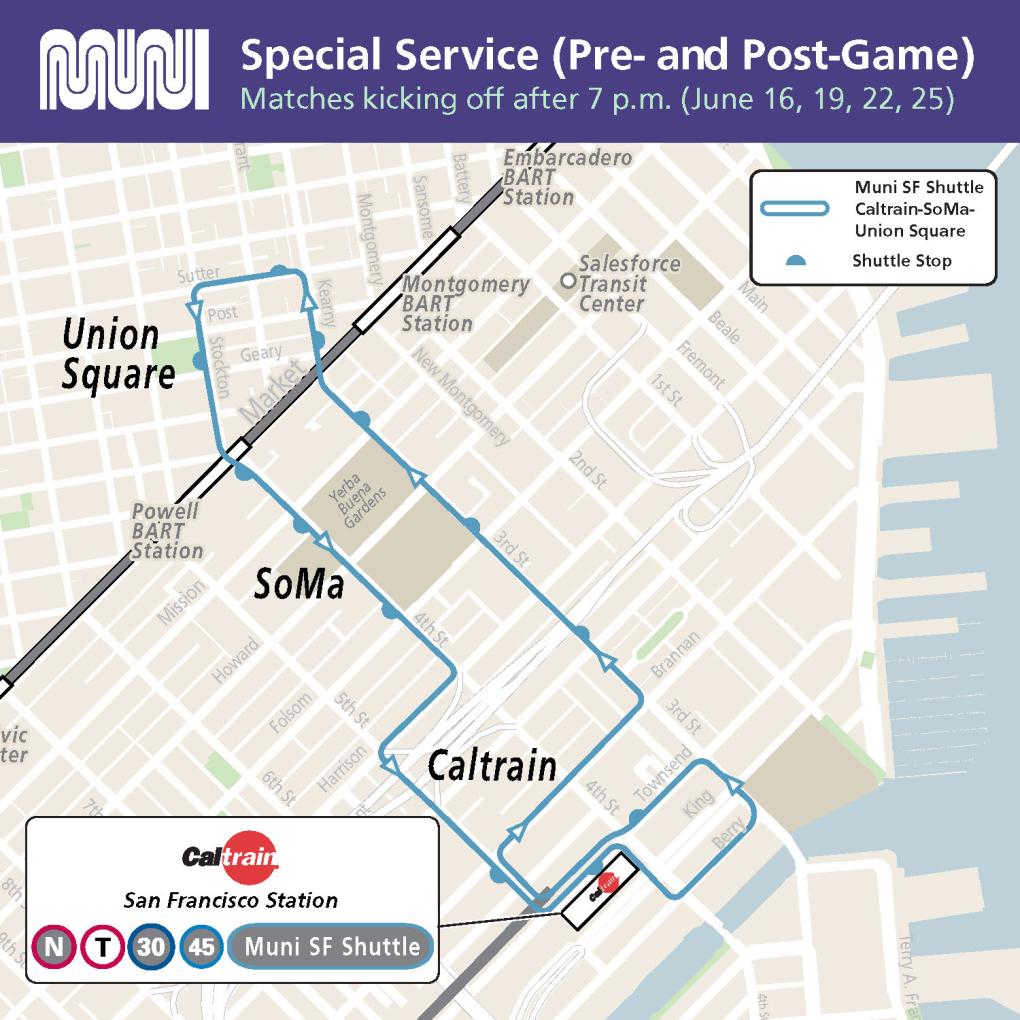
Muni in San Francisco will be providing supplemental service after normal transit operating hours to ensure reliable transportation options for the late-night matches. The Muni special bus shuttle service will circulate between Union Square, SoMA, BART and Caltrain.
BART Resources
Real Time Departures from each station
Tap and Ride contactless payment
Text BART Police to report concerns at 510-200-0992
Tougher new fare gates greet travelers at BART's SFO station in time for busy travel season
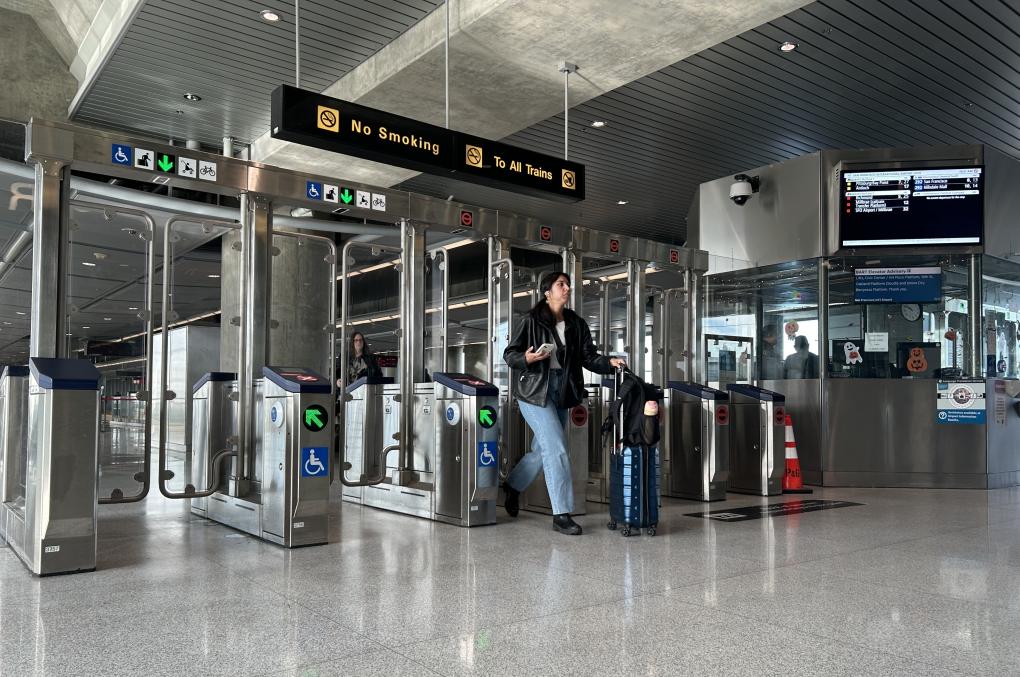
BART has equipped its state-of-the-art Next Generation Fare Gates at its showcase San Francisco International Airport Station just in time for the busy holiday travel season.
SFO Station is now the ninth in the BART system to be outfitted with the more formidable fare gates as part of BART’s highest priority capital project.
“As a transportation system, we take tremendous pride in saying our community is what runs BART," said BART General Manager Bob Powers. "Among the world’s transit agencies, BART relies the most on rider fares; they are directly responsible for funding our operations. These new fare gates will protect against fare evasion, expand access to transit-dependent riders, and reduce system downtime due to maintenance, which helps boost investment in BART’s long-term growth.”
“BART is making great progress on this initiative, which is increasing the sense of safety and security of riders while also bringing in more revenue,” said Bay Area Council President and CEO Jim Wunderman. “We applaud BART’s commitment to making the system safer and working so hard to install these new modern fare gates as quickly as possible.”
The new gates bring an exciting new look to BART. They feature clear swing barriers with a one-of-a-kind door locking mechanism to deter fare evasion. The gates include advanced 3D sensors that can detect if someone is in a wheelchair or has a bike, stroller, or luggage with them, allowing for more time before the swing barrier closes. They feature LED lighting on the swing barriers and pathway through the gate to help visually impaired riders.
“These gates at San Francisco International Airport are an important improvement for travelers and employees at the Bay Area’s premiere airport,” said SFO Airport Director Ivar C. Satero. “The sensors that allow riders with luggage additional time to get through the gates is just one of the game-changing features of the new fare gates.”
BART is moving rapidly to install Next Generation Fare Gates at more stations. Work is currently underway at Coliseum with plan to begin the installation process at Montgomery Street, Powell Street, Warm Springs, and 12th Street/Oakland City Center stations in November.
By the end of February 2025, BART will have installed new fare gates at more than half its 50 stations.
Full deployment systemwide will be completed by the end of 2025. Learn more about the project here. Riders can provide feedback about the new gates at bart.gov/comments.

REQUEST FOR QUALIFICATIONS FOR A MOSAIC MURAL AT NORTH BERKELEY BART SUBSTATION - application closes May 17, 2026
Original artworks by local artist Obi Kaufmann to be featured in ad spaces at BART stations
Click here to sign up for the One Book One BART mailing list.
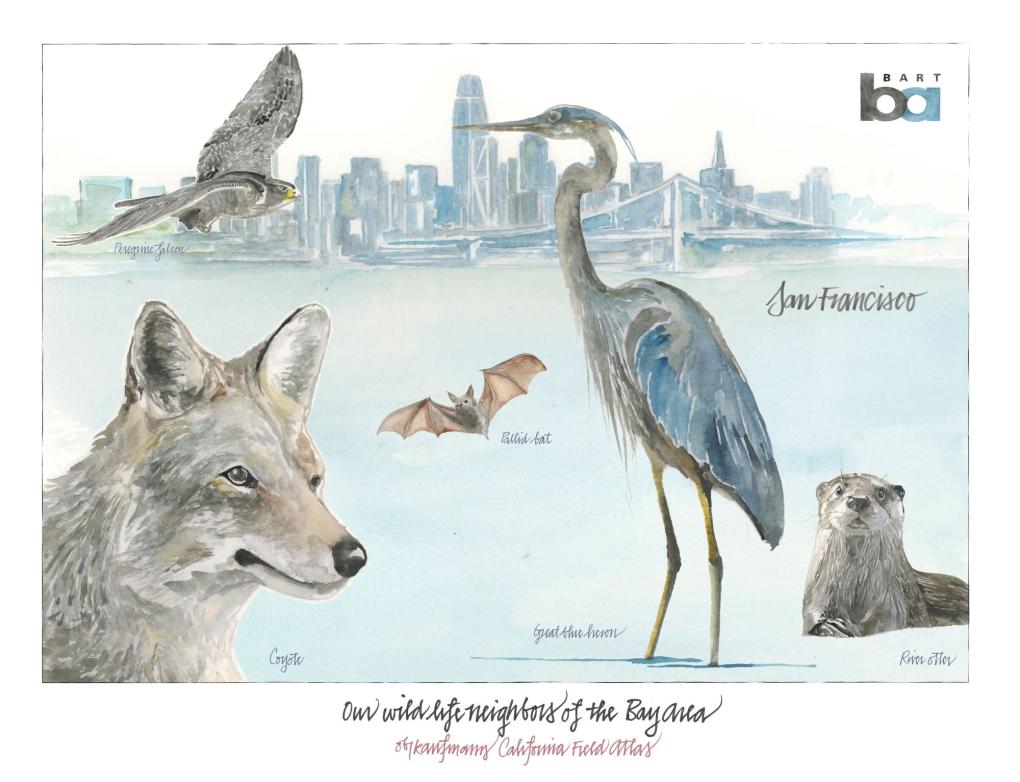
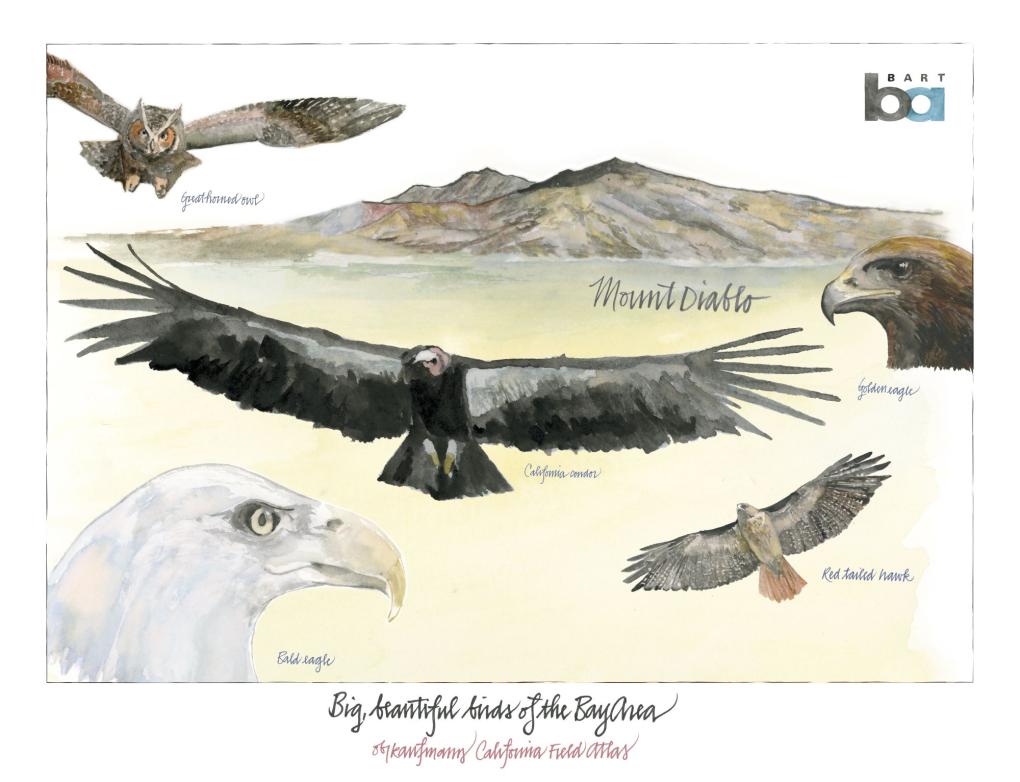
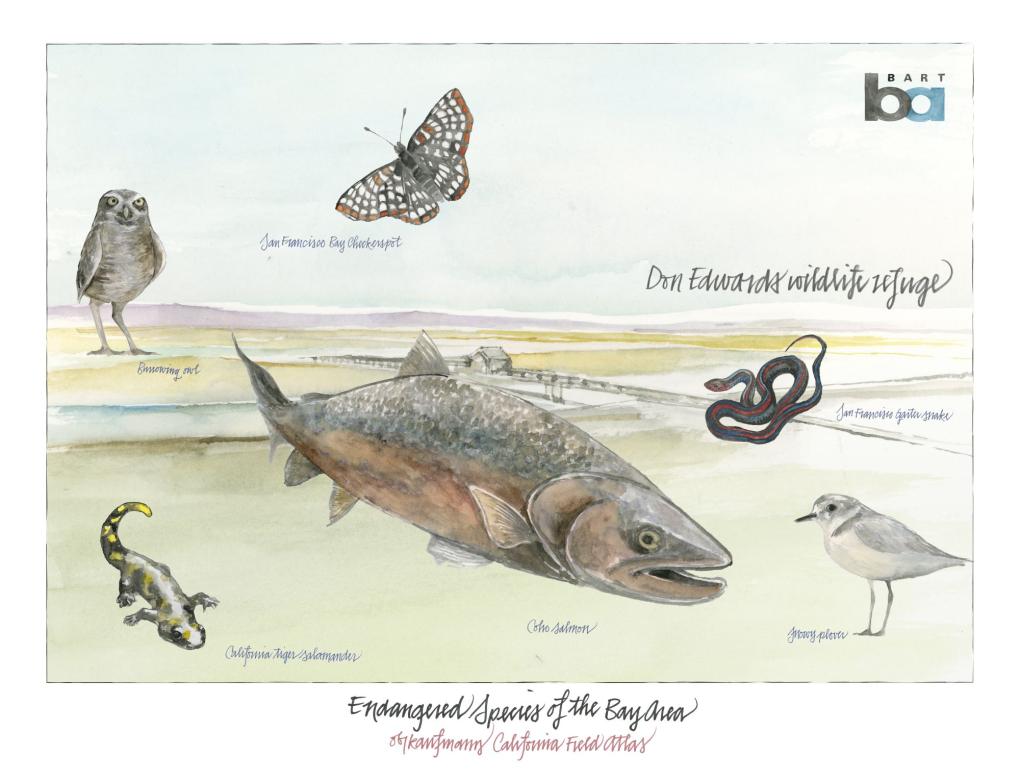
Three original watercolor paintings by celebrated poet-artist-naturalist Obi Kaufmann are now enlivening BART stations by taking over ad spaces across the system. The artworks are being released in tandem with the launch of the spring 2025 One Book One BART book club. The club’s official selection is Bay Area Wildlife: An Irreverent Guide by Jeff Miller, which was illustrated by Kaufmann.
The unveiling of Kaufmann’s artworks marks the relaunch of BART’s Poster Art Program. The goal of the program, which has featured original works by Miwako Nishizawa, Monico Chavez, Josh Ellingson, and Owen Smith, is to enhance the physical environment of BART stations and celebrate the wealth of artistic talent in the Bay Area. The program is a joint effort between BART Communications, BART Marketing, and the BART Art Program.
Kaufmann’s original paintings feature some of the local species found in the natural and urban spaces accessible by transit, including San Francisco, Don Edwards Wildlife Refuge, and Mount Diablo. Each panel is themed around a different group of wildlife: “Big, beautiful birds of the Bay Area,” “Our wildlife neighbors of the Bay Area,” and “Endangered species of the Bay Area.”
“Transportation agencies throughout the United States and internationally have seen the importance to community and customers in bringing art and culture into transit spaces,” said BART Chief Communications Officer Alicia Trost. "Bringing art to our system also builds a sense of safety and belonging, as we have repeatedly heard from our Not One More Girl initiative outreach."
“Artworks enhance the travel experience with education, joy, information about, and celebration of a particular location and its unique characteristics," added BART Art Program Manager Jennifer Easton. "Obi’s artwork demonstrates his deep appreciation and passion for our neighbors in the wild, reminding us that reducing our environmental impact by using transit can help preserve their critical environments.”
On Saturday, May 3, from noon to approx. 1pm, Kaufmann will partner with BART to lead a first-of-its-kind BART Train Expedition. The free, family-friendly ride on an in-service passenger train will take us on a journey through the East Bay’s mosaicked, ecological landscape – all through the windows of a Yellow Line train. During the ride, Kaufmann will transport us through “deep time” as he tells stories about the area’s ecosystems, water, fire, infrastructure, volcanic history, trees, and more. RSVP here and scroll down to learn about other upcoming One Book One BART events.
Kaufmann’s original BART paintings will be available for purchase as 11x14 art prints, coming soon to BART’s merchandise store Railgoods. Railgoods will also sell unique “Animals by BART” t-shirts featuring the fauna displayed in Kaufmann’s paintings. Sign up for the mailing list at the link above and follow BART on social media to be alerted to the release of the prints and t-shirts.
Oakland-based Kaufmann is known for his illustrated books on ecology and geography, including the award-winning California Field Atlas and his latest, The State of Fire: Why California Burns. Kaufmann brings his signature style – soft watercolor illustrations and handwritten titles that mimic field guides of yore – to the paintings he created for BART.
"Growing up in the Bay Area as a young naturalist, I relied on BART to get me to the parks, open spaces, and wild landscapes that inspired me to become the writer and artist I am today,” Kaufmann said. “So many decades later, I am happy to report that those same places are accessible, and teaming up with BART to celebrate the Bay Area's rich wildlife legacy is a dream come true."
In addition to celebrating ecology, Kaufmann’s works are an urgent reminder that the Bay Area is home to many at-risk wildlife populations. Sustainability is one of BART’s core values, and it has been since our system was founded. As highlighted in our Transit Saves campaign, if it weren’t for BART, we’d have to plant a forest the size of San Francisco every two years to offset the CO2 that would be generated from increased vehicle emissions. The people of the Bay Area need BART, and so do the plants and animals that reside here.
“We want people to think of our stations not solely as liminal spaces to mindlessly pass through, but places where you can experience art, culture, and even a sense wonder,” said BART Principal Marketing Representative Michelle Robertson, who spearheaded the relaunch Poster Art Program project. “Some of my fondest transit memories involve riding BART to regional green spaces, and I’m grateful to Obi for giving all of us a reason to celebrate transit and the wealth of experiences it takes us to."
The artworks also serve as inspiration and encouragement for people to use public transit to get outside! To get going on your next outdoor adventure, visit bartable.bart.gov/outdoors and discover a wealth of hikes, bike rides, and outdoor itineraries by BART stations.

One Book One BART returns with a natural history theme
In keeping with the natural history theme, BART is excited to announce the return of One Book One BART. The club is a novel strategy for rider and employee engagement that invites members of the public to read the same book at the same time and participate in themed events in BART trains and stations. This will be the third iteration of One Book One BART, which began in 2022 with Hua Hsu’s Stay True.
This year’s selection is Bay Area Wildlife: An Irreverent Guide (Heyday Books) by conservationist Jeff Miller, with illustrations by Obi Kaufmann. Bay Area Wildlife takes an educational and highly entertaining approach to the region’s local fauna, “revealing why each of these creatures matters, as well as the threats that loom over our region’s incredible biodiversity.”
The book will serve as a jumping off point for a series of outdoor excursions by BART stations and on trains. Stay up to date by visiting bart.gov/bookclub and signing up for the email list at the top of the page.
One Book One BART events
All events are free to attend, but an RSVP is required.
Guided Nature Walk with Author Jeff Miller and Pals
When: Saturday, April 19
The first walk will leave the station at 9am. The walk from 19th to the Rotary Center will take approx. 45 - 60 minutes. RSVP for the first walk (9am) on Eventbrite here
The second walk will leave the station at 11am. The walk from 19th St. to the Rotary Center will take approx. 45 - 60 minutes. RSVP for the second walk (11am) on Eventbrite here
Where: 19th St/Oakland Station to the Rotary Nature Center
Itinerary subject to change.
Meet Bay Area Wildlife author Jeff Miller as he and some conservationist colleagues and local naturalists take us on a ~1.4-mile guided nature walk of Lake Merritt that will begin at 19th St. Station in Downtown Oakland.
Expect to see lots of water birds and an assortment of herons and egrets, maybe even some fish! The walk will end in the grassy area adjacent to the Rotary Nature Center on the lake, where participants will have the opportunity to rendezvous with and learn from local environmental organizations.
Wear comfy walking shoes, fill up your water bottle, and bring whatever else you may need for the walk. And don’t forget your copy of Bay Area Wildlife – Jeff will be signing books.
Bike Ride and Birdwatching
When: Saturday, April 26
- Early short ride - Departs North Berkeley Station at 7:45am. The ride is approx. 8 miles roundtrip and will end at North Berkeley Station at approx. 9:45am. RSVP for the 7:45am short ride on Eventbrite.
- Long late ride - Departs North Berkeley Station at 10am. The ride is approx. 15 miles roundtrip and will end back at North Berkeley at approx. 1pm. RSVP for the 10am long ride on Eventbrite
Where: North Berkeley Station
Itinerary subject to change.
Heath Maddox, BART Manager of Bicycle and Micromobility Access Programs, and local birdwatchers will host two bike rides -- a shorter one for early birds and a later one for those looking for a long ride -- with birdwatching stops along the way. The ride will start and end at North Berkeley Station.
In addition to the expertise of local birdwatchers, we’ll have a digital guide featuring info on birds we might spot on the ride. Find the short 7:45am route here and the long 10am route here.
Bring your bike, helmet, and binoculars – we’ll have extras on hand to lend. You should also bring anything you need to be self-sufficient and keep your bike rolling (spare tube, patch kit, pump, etc.). If you do not have a bike, you can rent one from the Bay Wheels hub at North Berkeley Station.
BART Train Expedition with Obi Kaufmann
When: Saturday, May 3, noon to approx. 1pm
Where: Pleasant Hill/City Centre Station to 12th St/Oakland Station
"Bay Area Wildlife" illustrator and acclaimed poet-naturalist Obi Kaufmann takes the public on a first-of-its-kind BART Train Expedition! The free, family-friendly ride on an in-service passenger train will take us on a journey through the East Bay’s mosaicked, ecological landscape – all through the windows of a Yellow Line train. During the ride, Kaufmann will transport us through “deep time” as he tells stories about the area’s ecosystems, water, fire, infrastructure, volcanic history, trees, and more.
At the end of the approx. 30-minute ride, we’ll disembark at 12th St./Oakland Station and walk with Obi to Frank Ogawa Plaza, where we’ll pay homage to the Town’s most famous oak tree.
About Obi Kaufmann

For poet, painter, and naturalist Obi Kaufmann, California is a magic network of living systems connecting ecology and beauty in a grand quilt, holding enough science, mythology, and language for a hundred field atlases to come. Obi Kaufmann regularly travels around the state, presenting his work and vision as keynote addresses to such groups as the Klamath-Siskiyou Wildland Center, Pacific Forest Trust, the Mojave Desert Land Trust, the Mechanics Institute of San Francisco, the Anza Borrego Foundation, the Mono Lake Committee, the University of California at Berkeley Botanical Garden, the University of California at Davis Plant Sciences Department, the University of California Santa Barbara Department of Water Sciences, the Peninsula Open Space Trust, the California Native Plant Society, the Wilderness Society, and the Audubon Society. Obi had a 2022 residency with the National Wildlife Federation as the illustrator for the Wallis Annenberg Wildlife Crossing in the Santa Monica Mountains National Recreation Area. One year later, in 2023, he was the artist in residence for the National Park Service at the Whiskeytown NRA. Obi’s essays and paintings have been published in Dark Mountain Literary Journal, Zyzzyva Literary Journal, Bay Nature Magazine, Western Art & Architecture, Sunset Magazine, Juxtapoz Magazine, and On the Range Magazine. His 2023 essay "The Mind of the Redwood Forest" won an honorable mention as one of the best essays in the country, as awarded by the Norton Books Anthology. Obi regularly posts his work on Instagram as @coyotethunder. He is published by HEYDAY and represented by WILDBOUNDPR. Tune into to his podcast, PLACE AND PURPOSE, with cohost Greg Sarris.
Take transit to Fleet Week; BART running longer trains for the weekend (10/12 & 10/13)
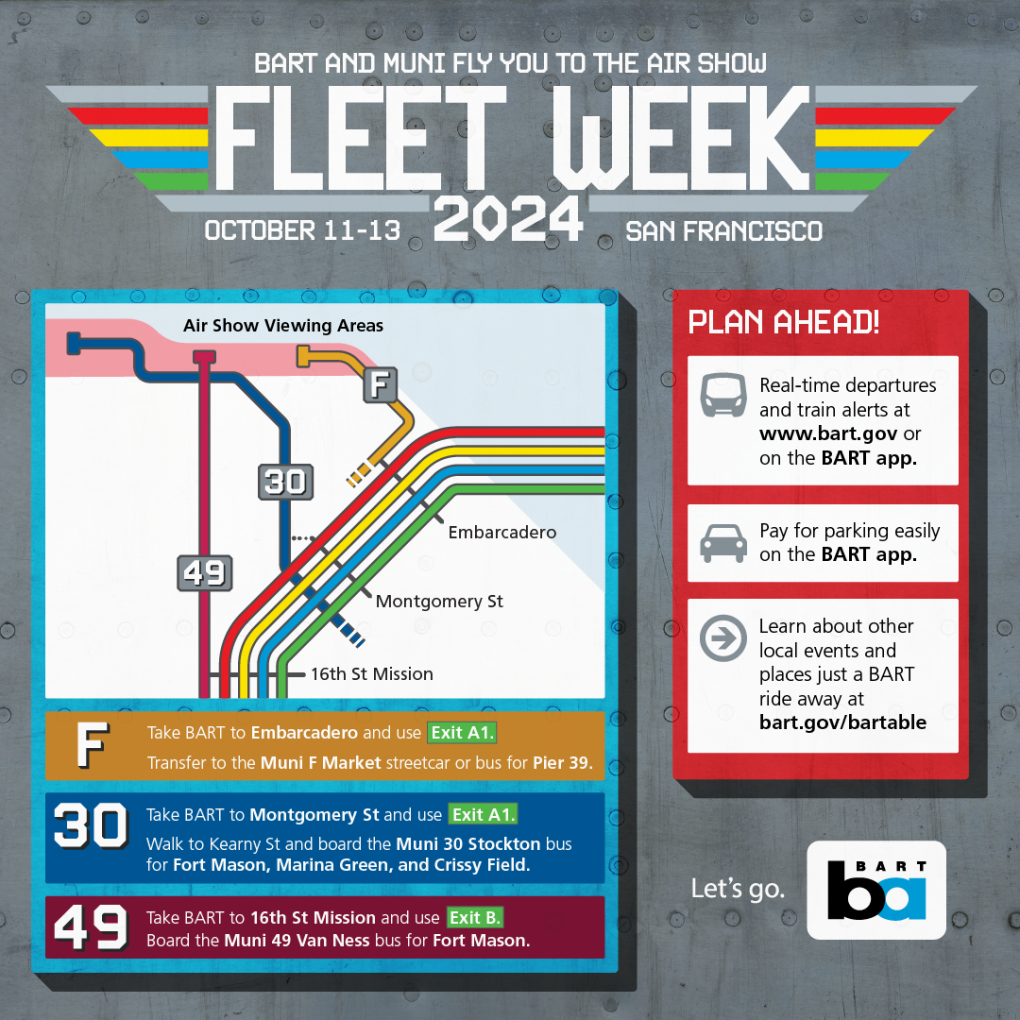
San Francisco Fleet Week 2024 begins Monday, Oct. 7, and culminates on Monday, Oct. 14, and transit is the best way to get there as thousands of people flood the city for air shows and other special events.
To accomodate the predicted crowds, BART will be running longer trains that weekend: Saturday, Oct. 12, and Sunday, Oct. 13.
Here's how to reach the various air show viewing areas with BART + Muni:
- Pier 39: Take BART to Embarcadero Station and use Exit A1 to transfer to the Muni F Market streetcar or bus.
- Fort Mason, Marina Green, and Crissy Field: Take BART to Montgomery St and use Exit A1. Walk to Kearny St and board the Muni 30 Stockton bus.
- Fort Mason (option 2): Take BART to 16th St Mission and use Exit B to board the Muni 49 Van Ness bus.
Rider Tips
Parking is free at all BART stations except Milpitas and Berryessa/North San Jose (which are operated by VTA) on the weekends. Pay for parking easily on the BART app.
Before you leave home, put Clipper card on your cellphone through either Apple Pay or Google Pay. Please ensure you have sufficient funds for a round trip. Plan at the cost of your trip in advance.
Real-time departures and train alerts can be found at bart.gov/eta or on the BART app.
Discover more fun events happening this weekend on BARTable.
BART provides more details about computer equipment problem preventing the start of service on 9/5/25
Update 9/11/25
BART General Manager Bob Powers, Deputy General Manager Michael Jones, Assistant GM of Operations Shane Edwards, and Assistant GM for Infrastructure Delivery Sylvia Lamb provided an update (video above) of two recent service disruptions. On September 5, a computer equipment problem following overnight network upgrade work prevented the on-time start of Friday morning BART service. East Bay service was started at 9:30am and full service was available at 11:45am. On August 29, a report of smoke in the Transbay Tube impacted BART service between Oakland and San Francisco for several hours during the Friday evening commute.
Update 9/6/25
BART is providing more details about Friday's disruption in this memo to our Board of Directors. It will be discussed at Thursday's (9/11/25) Board of Directors meeting that starts at 9am during the General Manager's Report.
Update 09/05/25, 11:45am:
Regular BART service has resumed throughout the system. All stations are now open.
East Bay service was restored at 9:30am and full service was restored at 11:45am.
This service disruption occurred due to a computer equipment problem following overnight network upgrade work. The work is part of an ongoing multi-year project to replace the communications and computer systems, including hardware such as switches and routers, that support BART operations.
This is not a new project and BART has been doing this work during the hours we are not running without issues previously.
Something related to the upgrade work last night triggered a problem preventing all of our communication systems to function properly. Crews were able to isolate where the problem was coming from and they stabilized the system. We are investigating exactly what went wrong.
Update 09/05/25, 9:15am:
Limited East Bay service will start at approximately 9:30am. There is currently no service through the Transbay Tube and no service at any San Francisco stations or on the Peninsula.
Yellow Line will service will resume from Antioch to 12th Street Oakland. Blue Line service will resume from Dublin to MacArthur. Orange line service will resume from Berryessa to Richmond. BART to Antioch service is resuming now.
A computer equipment problem following network upgrade work is preventing the start of service this morning. Seek alternative means of transportation. bart.gov/alternatives provides options without BART service.
BART successfully completes installation of Next Generation Fare Gates at all stations months ahead of schedule
BART has completed the installation work on a milestone project that is already making the system safer. Next Generation Fare Gates are now in place at all 50 BART stations. BART promised to complete installation by the end of 2025 but beat that deadline by four months with the final gates being installed in August.
“This is the latest in a string of victories for riders that are transforming the daily BART experience,” said BART General Manager Bob Powers. “Since last year we have boosted our visible safety presence in the system, increased cleaning, gone to running only Fleet of the Future trains, became the first transit agency in the Bay Area to offer riders Tap and Ride, and now we have installed state-of-the-art fare gates that are already deterring unwanted behavior. Our riders say they want a system that is safe, clean, and user friendly, and we are responding with decisive actions.”
The number of riders who say they’ve witnessed someone fare evade on their trip has dropped by more than 50% in just the last year. In the latest Quarterly Performance Report, only 10% of riders said they saw someone fare evade. That’s down from 22% in the first quarter of Fiscal Year 2025. Reports of fare evasion have been dwindling as Next Generation Fare Gates have been installed at more stations.
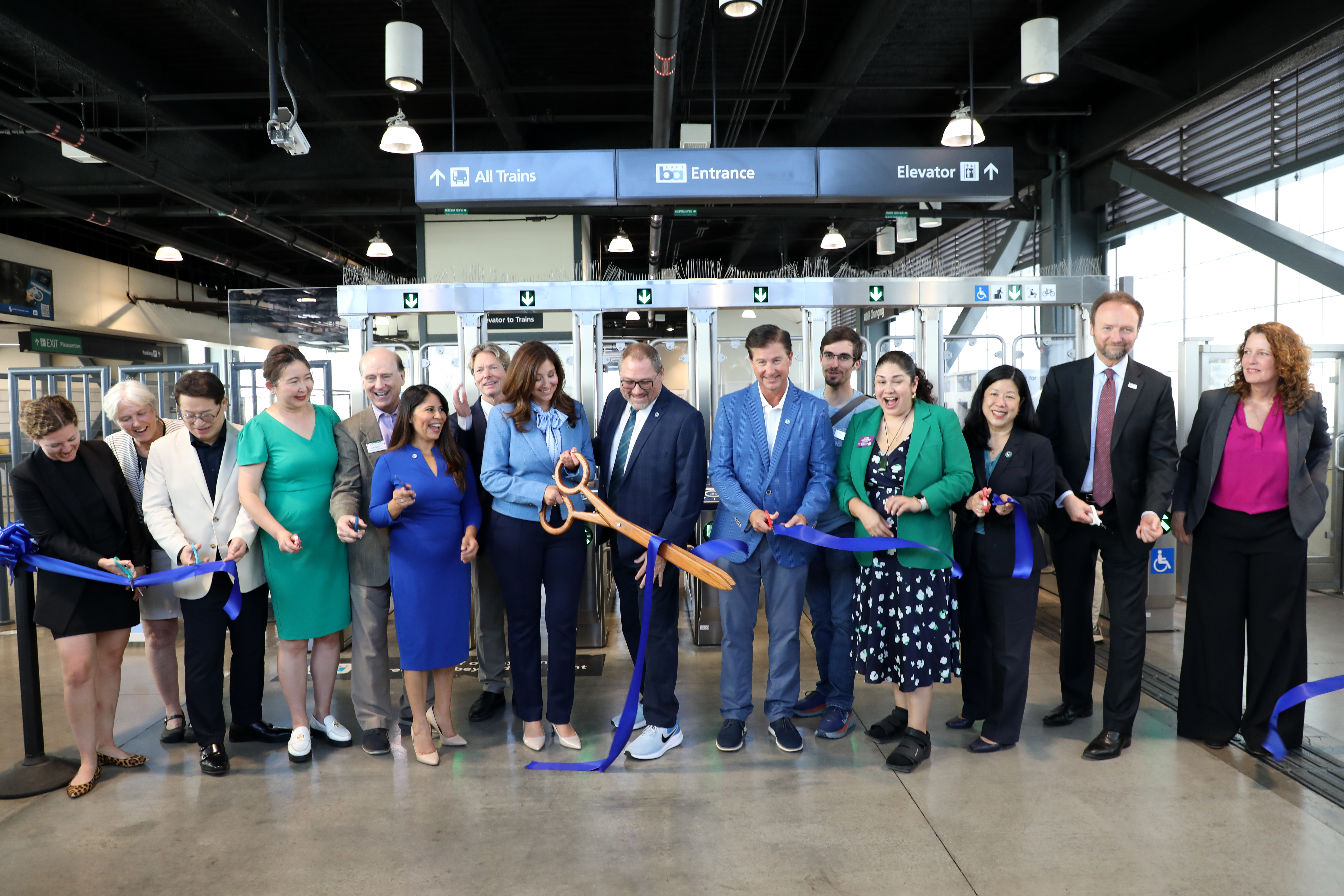
“The completion of the Next Generation Fare Gates project marks a major step forward in modernizing our system and enhancing the rider experience,” said BART Board Vice President Melissa Hernandez. “These new gates improve accessibility, safety, and efficiency, and reflect BART’s commitment to investing in the future of public transit across the Bay Area.”
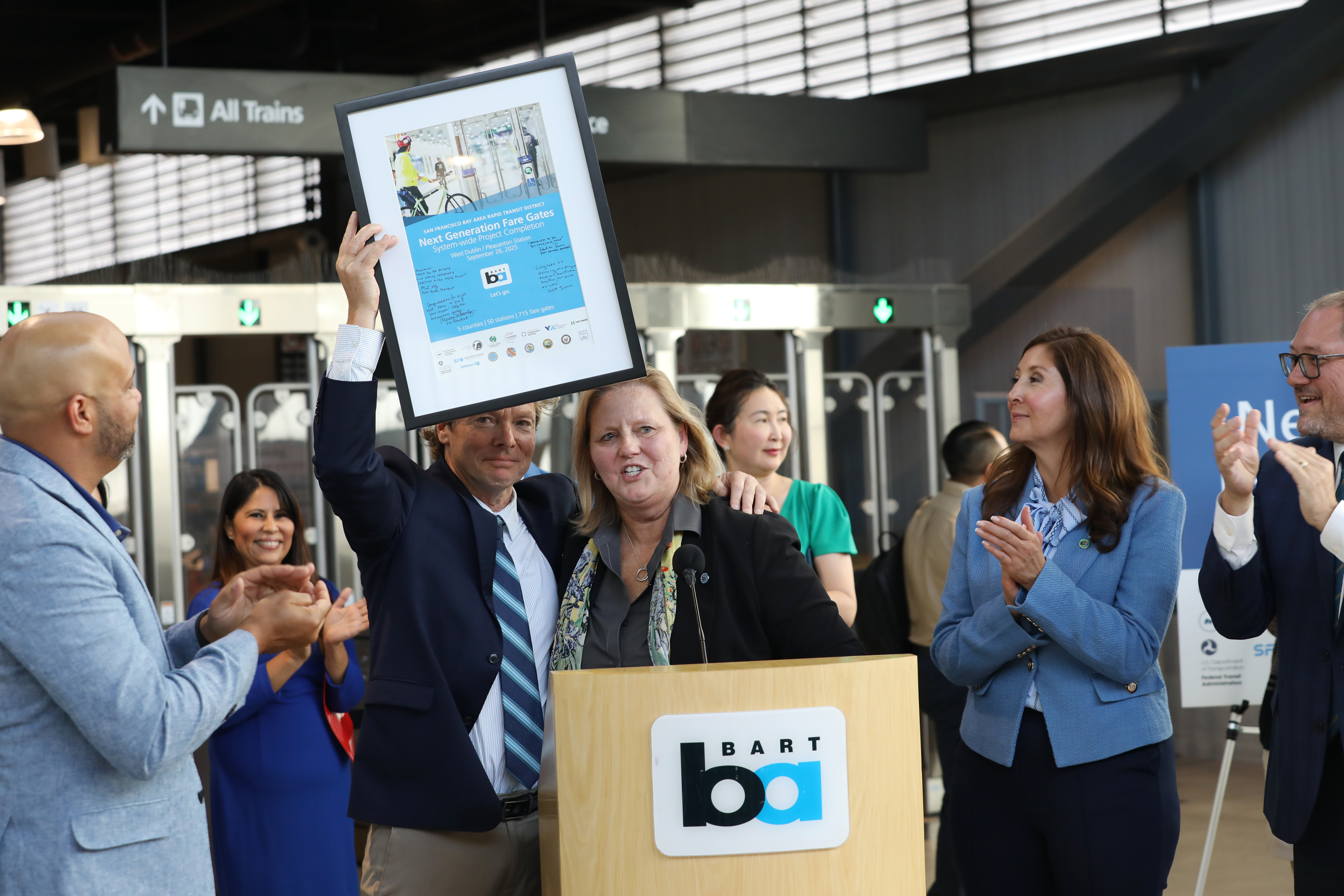
The gates feature a unique door locking mechanism that makes their swing barriers very hard to push through, jump over, or maneuver under. The overall fare gate array height (gate, console, integrated barrier) forms a barrier of 72 inches minimum to deter fare evasion.
“The gates deployed by BART are the only ones of their kind in the world,” said Sylvia Lamb, BART Assistant General Manager for Infrastructure Delivery and head of the fare gates project “Our team did incredible work to beat the installation deadline by several months. Now we will benefit from lesson learned over the last year through the experiences of hundreds of thousands of riders to focus on making these gates even more resilient.”
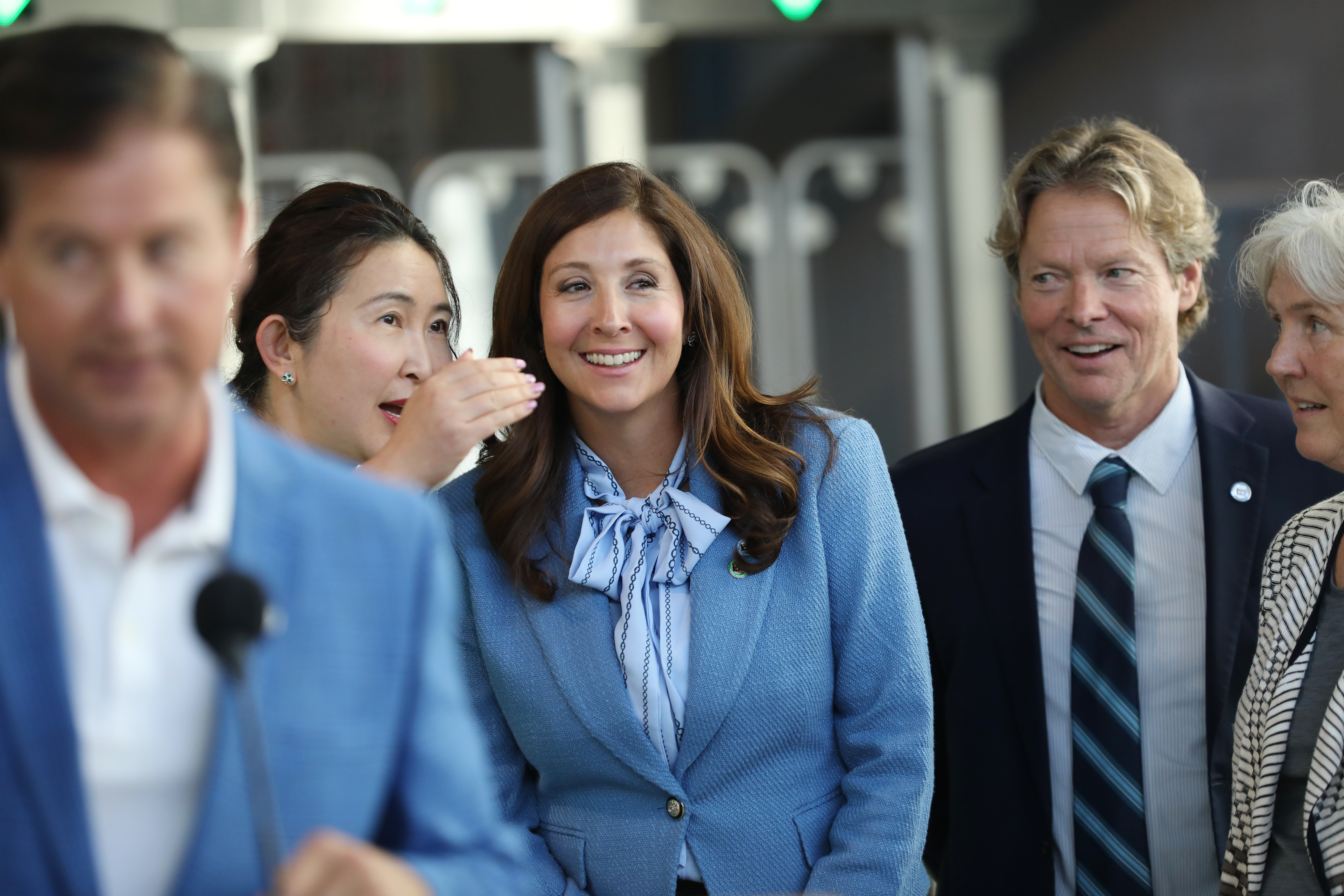
Upcoming work will focus on the full utilization of advanced sensors to make it harder for those who want to “piggyback” into the system by closely following behind paying riders.
BART replaced 715 fare gates across a system that spans five counties.
Happy Halloween! Download our BART-themed stencils to have the best pumpkin on the block
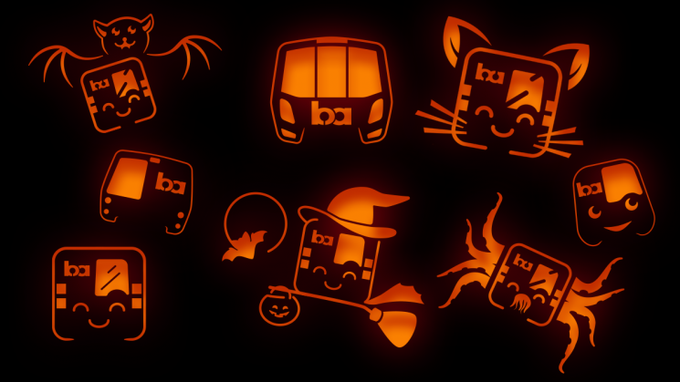
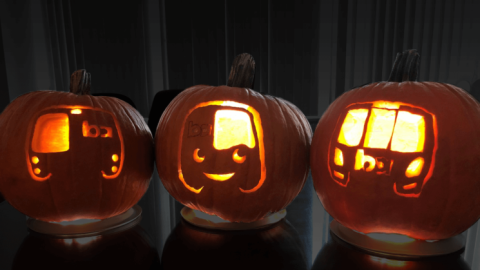
This year, give your pumpkin a BARTy twist! We created eight BART-themed pumpkin carving stencils (from easy peasy to challenging) that you can download at this link.
Print 'em out and get carving!
If you post a pic of your pumpkin, give us a tag on Twitter (@sfbart) or Instagram (@sfbayarearapidtransit) so we can show it off.
Happy Halloween!
BART Board to discuss and adopt an Alternative Service Plan if new transit funding not identified
Feb 26, 2026 Update
On Thursday, Feb. 26, the BART Board of Directors adopted an Alternative Service Plan outlining specific budget balancing details to solve a $376M deficit for the next fiscal year if no new funds become available to BART. BART is facing a structural deficit of $350M to $400M because ridership is still down 50% compared to pre-pandemic levels and BART’s current funding model relies heavily on passenger fares. Get more details here.
Feb 17, 2026 Update
In response to feedback from some board members at the February 12 Board Workshop, staff will amend the budget balancing proposal for the scenario a November ballot measure fails and no new revenue becomes available to BART. The change includes moving the BART station closures from occurring during the second half of FY27 (January 2027) to instead take place in FY28 (July 2027 through June 2028). BART will use reserve funds to push the station closures six months. The other cuts, cost savings, fare increases, and layoffs outlined in the original proposal remain the same. The Alternative Service Plan the board will be asked to adopt as soon as February 26, will also make clear the Board will ultimately decide which stations to close, not staff.
Below is a summary of the latest version of the Alternative Service Plan. It will be included on the February 26 agenda as "for information and possible action."
Alternative Service Plan (Second-half of FY27: January 2027 through June 2027)
January 2027 - Immediate Cost Reduction:
- 3-line service, two trains per hour on each line, 9 PM close (Reduce train hours by an estimated 63%)
- Increase fares and parking fees 30% (minimum full adult fare: $3.35, estimated average fare $6.38)
- Target approximately $30M of savings over 6 months from non-service budget reductions to fleet and non-fleet maintenance, police, cleaning, and administrative support functions
- Continue deferrals of Priority Capital allocations and retiree medical contributions
- Balance remainder of FY27 with one-time resources and financial deferrals
- Assess ridership and revenue impacts and the performance of all District functions to determine if further reductions can be safely and legally implemented
- Continue public discussions with the BART Board and public regarding potential station closures and impacts (prep work for FY 28)
FY28 (July 2027 through June 2028) - Budget Balancing (if feasible):
- Target over $175M in annual cost reductions through a cumulative 70% reduction in service hours:
- Maintain 3-line service, two trains per hour on each line, 9 PM close
- Close up to 15 stations and/or up to 25% of system track miles
- The BART Board will be responsible for all decisions on station or line (segment) closures
- Increase fares and parking fees up to a cumulative 50% (min adult fare: $3.85, estimated average fare $7.26)
- Target annual operating expense savings of more than a cumulative $130M from non-service budget reductions to fleet and non-fleet maintenance, police, cleaning, and administrative support functions
- Continue to defer retiree health contributions; defer most remaining capital allocations
Contingency (if required):
- If determined BART can’t safely or legally operate with available resources, stop passenger service
- Use existing District tax revenues to secure system assets
- Work to determine system’s future
This plan includes approximately 1,200 employee layoffs.
Feb 12, 2026 Workshop Update
Today the BART Board of Directors held their annual board workshop where they primarily discussed staff's recommended "Alternative Service Framework" if a November 2026 ballot measure fails and no other operating revenue source is identified. No action was taken, but staff heard feedback from board members about the framework and the proposed phases of service cuts, station closures, layoffs, fare increases, and other deficit reducing solutions. BART staff made it clear it is a policy decision of the Board to ultimately decide which stations to close. The proposed framework and resolution the board will be asked to adopt does not name which 10-15 stations would close, though staff provided recommendations based on the 10 lowest ridership stations and five others stations that would reduce the size of the BART network (view the presentation for details on staff's proposal).
The board discussed potential modifications to the framework they will be asked to vote on as soon as February 26, such as increasing the proposed Phase I fare increase from 30% to 50% while moving all station closures to Phase 2 (July 2027 instead of 10 stations in January 2027, and 5 more in July 2027).
The board asked staff to do additional budget outreach with stakeholders and to conduct more analysis. This discussion will continue at the next board meeting on February 26 with potential action on the Proposed Alternative Service Framework. Though some board members said they may not be prepared to vote until the March 12 meeting.
You can read the full workshop presentation here.
At the annual BART Board Workshop on Thursday, February 12, BART staff will present Directors with detailed plans for an alternative service framework if a November 2026 ballot measure fails and no other operating revenue source is identified. You can read the full presentation here.
During the workshop, staff will outline the risks and tradeoffs for service and non-service reductions. Because rail has high fixed costs and low marginal savings, it is impossible to close the projected FY27 $376M deficit with service cuts and fare increases alone.
BART staff evaluated multiple aspects of service including routes, stations, headways, peak, evening, and weekend service and hours of operation. The proposed framework outlines, for the very first time, specific details including which stations would need to be closed due to a lack of operating funds and the recommended phased approach to triggering further cuts. The plan retains as many riders as possible, while still cutting service to realize savings. System support services would need to be reduced by 40% as cost savings from cutting service would be largely offset by the resulting lost fare revenue.
There will not be a Board vote at the workshop on February 12. After receiving feedback from Directors at the workshop, staff plans to return to the Board on Thursday, February 26, with a resolution to adopt a finalized alternative service framework that would be implemented if new funding is not secured.
You can participate in the workshop. You may join in person (2150 Webster Street, Oakland, CA 94612) or via Zoom videoconferencing (https://us06web.zoom.us/j/89025424156).
Written comments may be addressed to the BART Board in advance via email to [email protected], using “public comment” as the subject line, before 3:00 p.m. on Wednesday, February 11th.
On Jan. 1, BART fares to increase 5.5%, low-income fare discount to increase to 50%
A modest fare increase and a deeper discount on fares for qualifying lower-income riders will both go into effect on Monday, January 1, 2024.
The Clipper START means-based fare discount for BART will increase from 20% to 50%, meaning low-income riders will pay half the regular fare. The Metropolitan Transportation Commission pilot program offers discounts for Bay Area residents aged 19-64 earning under 200% of the federal poverty level. Clipper START is accepted by more than 20 regional transit operators in addition to BART.
Fares will increase by 5.5% beginning January 1, raising the average fare by 23 cents to $4.43. A 12-mile trip from Downtown Berkeley to Embarcadero, for example, will increase by 25 cents to $4.75. For a 45-mile trip from Antioch to Montgomery Street, the fare will increase by 40 cents to $8.60.
The fare increase was approved by BART’s Board of Directors during the June 8, 2023, budget vote. The Board decided to deviate from its policy of approving a fare increase every two years. BART’s Inflation-Based Fare Increase Program, which has been in place since 2003, would have required an 11% fare increase in January 2024. To cushion the economic impact on riders, the Board directed staff to instead raise fares 5.5% in January 2024 and again at the same rate in January 2025.
BART’s Trip Planner and online Fare Calculator have been updated with the new fares. Riders can look up their new fare by selecting a date of January 1, 2024, or beyond. New fare chart decals will be posted at vending machines.
Fares Fund Operations
The fare increases are expected to bring in an additional $26 million in operating funds through FY25.
Historically, BART relies on rider fares to fund safe, reliable, and clean service – more so than most other transit systems. This requires small but frequent fare increases to keep up with the cost of inflation.
New Fare Gates Being Deployed
Because our riders are directly responsible for funding our operations, BART is rolling out new fare gates in 2024 to protect against fare evasion and self-enforce fare payments.
Low-Income Riders Will Pay Less in 2024
Even with the fare increase, low-income riders will pay less for BART because the Clipper START discount is being increased to 50%.
BART Discounts
- Youth 5-18 years old get 50% off with a Youth Clipper card.
- Seniors 65 and over get 62.5% off with a Senior Clipper card.
- Low-income riders get 50% off starting Jan. 1, 2024, through the regional Clipper START program, available to adult riders earning 200% or less of the federal poverty level.
- The RTC Clipper card is a version of Clipper created for passengers under 65 with qualifying disabilities for 62.5% off fares.
- BART offers a “High-Value Discount.” Adult Clipper cards get a 6.25% discount on cash value rides by buying $48 worth of value for $45 or $64 worth of value for $60 when autoload is set up.