
Search Results
BART’s customer satisfaction rate has hit its highest mark in ten years, rising six percentage points in two years
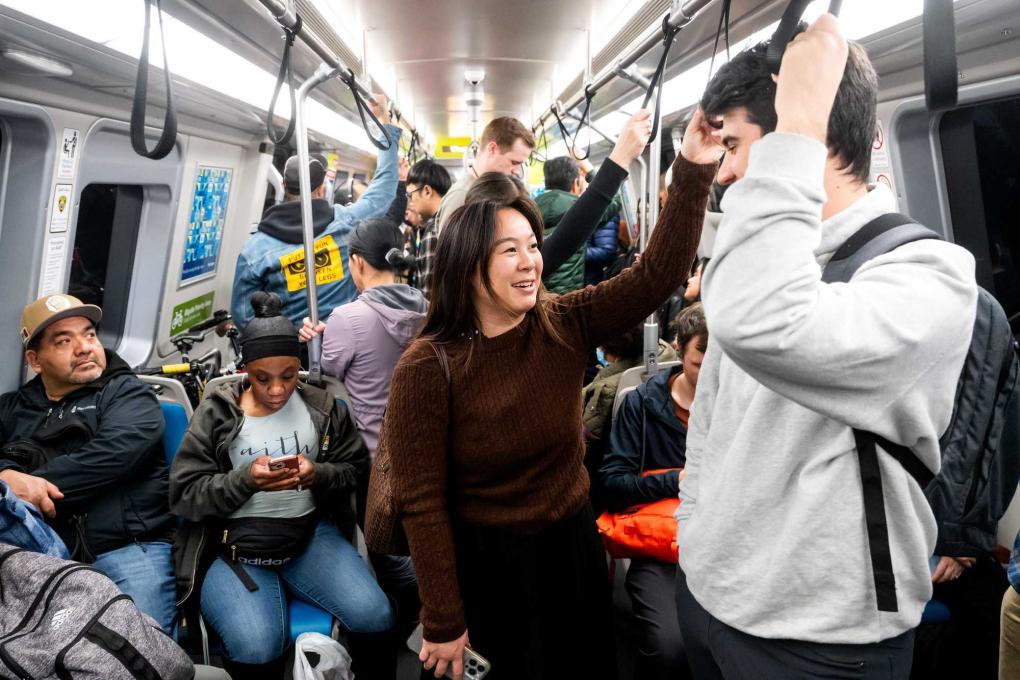
BART’s customer satisfaction rate has hit its highest mark in ten years and surged six percentage points in two years according to the latest comprehensive biannual survey of BART riders.
The 2024 BART Customer Satisfaction Survey found that 73 percent of respondents are “very or somewhat satisfied with BART” compared to 67 percent of those questioned in 2022, the last time BART conducted the survey.
In addition to general questions, respondents were also asked to rate 24 service attributes on a scale of one to seven. Ratings for 17 of the 24 metrics improved in 2024. Cleanliness of trains and stations, on-time performance, presence of BART police, personal security, enforcement against fare evasion, and addressing homelessness all showed improvement.
“These results confirm our Safe and Clean Plan is transforming the BART experience and making our system cleaner and safer,” said BART Board President Mark Foley. “We recognize there is still room for improvement; however, our focus on enhancing the customer experience is yielding positive results. It’s encouraging to see the survey responses that echo what I’m hearing from riders as I travel through the system.”
Some other findings:
- 80 percent of those surveyed said they would recommend BART to a friend or out-of-town guest, up four percentage points from 2022.
- 67 percent agree that BART is a good value for the money, up three percentage points.
- The average rating for train interior cleanliness increased by a whopping 14 percent.
- The average rating for station cleanliness increased by eight percent.
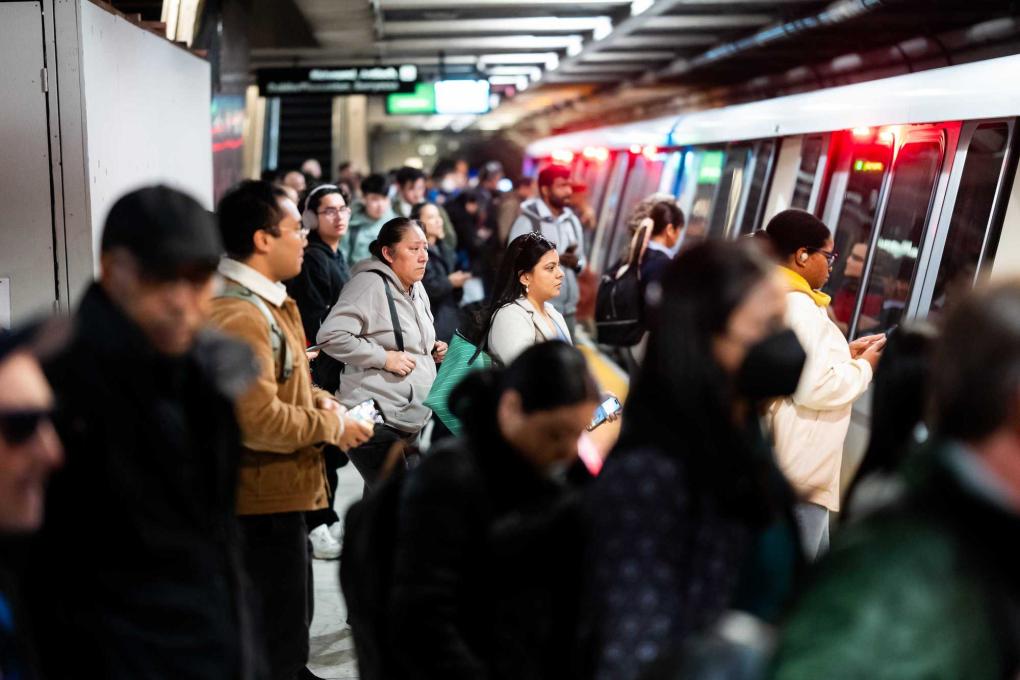
Only the availability of space on trains for luggage, bicycles and strollers and availability of seats on trains declined, unsurprising given the increase in overall ridership since 2022 and BART’s move to run shorter trains to enhance safety and save on energy costs.
BART has surveyed its riders every two years since 1996. More than 4,600 questionnaires in English, Spanish and Chinese were distributed onboard a representative sample of train runs last autumn.
The survey results were presented to the BART Board of Directors at its annual Board Workshop, Thursday, February 27, 2025. View the full presentation here.
BART also asks about customer satisfaction in its ongoing Passenger Environment Survey. That survey is about a rider’s specific trip. The latest customer satisfaction rate from that survey is 83%.
Holiday schedule: BART will run extended late-night service on NYE, Sunday service (8am-midnight) on New Years
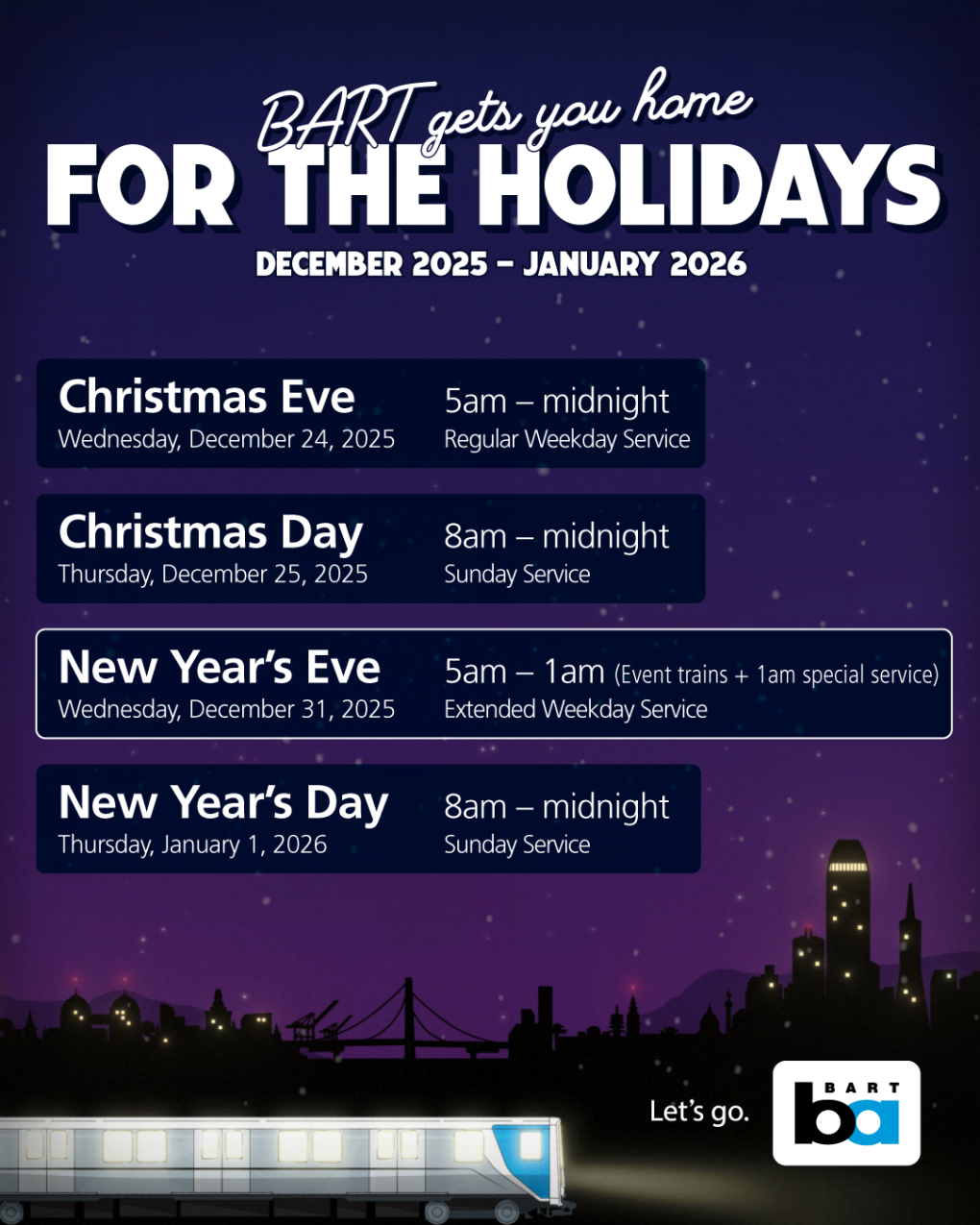
BART will be running special service on New Year's Eve and New Year's Day.
You no longer need a Clipper card to ride BART and other Clipper agencies in the Bay Area! Try out Tap and Ride for the holidays. Tap and Ride gives you the option to pay for BART at the fare gates using contactless credit and debit cards, as well as Apple Pay and Google Pay. It's an immense timesaver as you head out for holiday fun as for zero registration or setup is required (though you can still use Clipper, if preferred). Find more info on Tap and Ride below.
BART Holiday Schedule
Christmas Eve, Wednesday, December 24: Regular weekday service (5am-midnight)
Christmas Day, Thursday, December 25: Sunday service (8am-midnight)
Day after Christmas, Friday, December 26: Regular weekday service (5am-midnight)
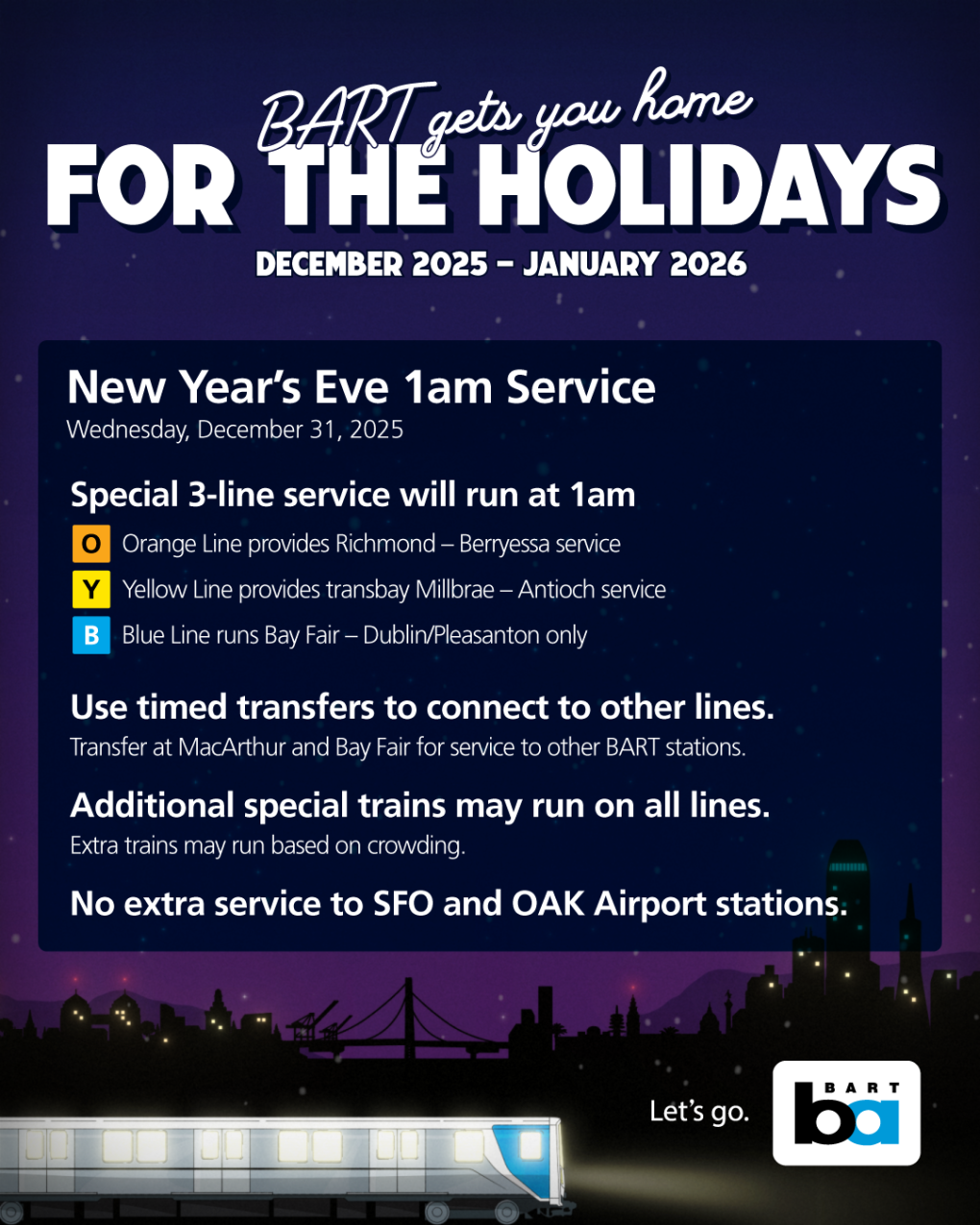
New Year's Eve, Wednesday, December 31: Regular weekday service (5am opening) with extended late-night service, extra staffing, and additional event trains. BART will be providing extended service until 1am for late-night riders coming back from fireworks shows and celebrations. More on this below.
New Year's Day, Thursday, January 1: Sunday service (8am-midnight)
Day after New Year’s Day, Friday, January 2: Regular weekday service (5am-midnight)
Looking for something to do? We've got a list of BARTable NYE celebrations.

New Year's Eve 1am Extended Service - More Info
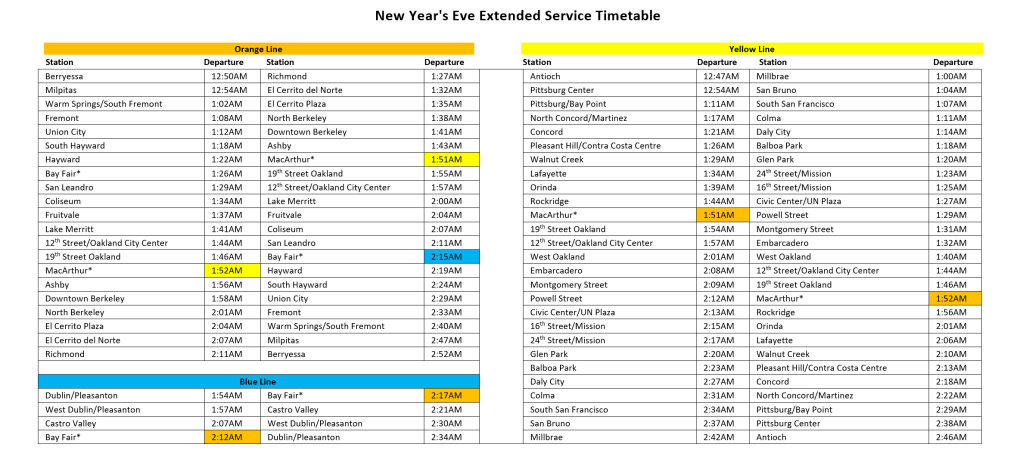
Our 1am extended service will be as follows:
Three-line special service (Yellow, Blue, and Orange only in both directions, for total of six trains for 1am extended service).
Yellow Line will be the only line running in San Francisco and Peninsula. Blue Line will run between Bay Fair and Dublin/Pleasanton.
Trains will be waiting at MacArthur and Bay Fair to complete timed transfers.
Yellow Line and Orange Line trains in all directions will be timed to meet at MacArthur Station at 1:51am in a "grand meet." This is the transfer point for riders coming from San Francisco heading toward Richmond or Berryessa or riders coming from the East Bay heading toward San Francisco.
Orange Line and Blue Line trains will be timed to meet at Bay Fair Station at 2:15am. Dublin-bound riders can take the Berryessa-bound Orange Line train and transfer at Bay Fair Station.
SFO and OAK airport stations will NOT be served.
Last East Bay-bound train running through downtown San Francisco will be at around 1:30am.
Last southbound train heading toward Millbrae will run through downtown San Francisco at around 2:10am.
The regular last trains of the evening (Yellow, Blue, and Orange lines) will be dispatched from the end of their lines at midnight and then at 1:00am. We will run another set of last trains of the evening to serve 48 out of our 50 stations. The 1am trains will not serve SFO and OAK airport stations.
Pay with Tap and Ride
BART riders now have the option to pay for BART at the fare gates using contactless credit and debit cards, as well as Apple Pay and Google Pay.
Tap and Ride is an immense timesaver for riders because zero registration or setup process is required, and riders will no longer need to add fare to their Clipper cards. All Bay Area transit agencies now offer Tap and Ride as of December 10, 2025.
If you want to continue using a Clipper card, take it out of your wallet or purse when you pay. To continue using Clipper on your Apple Wallet, make sure Express Mode is turned on for Clipper card. Android devices will automatically present the digital Clipper card if the user has one in Google Wallet.
Find Tap and Ride FAQs at bart.gov/tapandride.
Parking at BART on holidays
Parking is always free after 3pm and on weekends. Parking will also be free on Christmas Day and New Year's Day. This applies to all BART stations except for Milpitas and Berryessa/North San Jose, which are operated by VTA.
All other parking rules will be enforced.
Parking at BART for Holiday Travel
Airport parking can be a hassle and is always expensive, except at BART stations. We offer inexpensive multi-day parking (see options below) at most stations with easy online reservations. Purchase parking on the Official BART App or pay by website.
Single/Multi-Day Reserved parking is for consecutive overnight stays of up to 20 weekdays at a time. You will need to provide the license plate of the car you plan to drive and a phone number. Please purchase in advance to ensure availability. Reference our guide for paying for Single/Multi-Day Reserved parking here.
Monthly Reserved parking is for stays of up to 24 hours at a time, charged on a recurring monthly basis, and provides a guaranteed space until 10am. This is not to be used while travelling for several days in a row.
During the holidays we experience a higher demand in Reserved Parking at stations near the airport. To accommodate, Reserved Parking is allowed in any Reserved or Daily Fee spot at Millbrae Station and San Bruno Station. Reserved parking signs are blue + white or yellow. Daily Fee parking is only allowed in the Daily Fee area.
Find an overview of parking at BART at bart.gov/parking.
Taking BART to SFO or OAK
Traveling by plane for the holiday? It’s easy to ride BART to the airport. You can take the train directly to San Francisco International Airport (SFO) and Oakland International Airport (OAK). Plan your trip and find fares by using BART’s online Trip Planner and read our comprehensive guide on riding BART to the airport.
Another option for travel to SFO via BART is to purchase Multi-Day Reserved parking on the Official BART App or website and drive to Millbrae Station or San Bruno Station, then take a quick ride to SFO Airport.
Stay Safe
Save these numbers in your phone:
510-200-0992 to text BART Police dispatch to discreetly report criminal activity
510-464-7000 to call BART Police in an emergency (It’s faster than calling 911)
We also offer the BART Watch App--a free mobile app available on the App Store and Google Play that allows you to quickly and discreetly report criminal or suspicious activity directly to BART Police.
You can reach the Train Operator using the emergency call button in each car located by the side doors on the new trains.
Note your train car number when contacting police or the Train Operator. The train number is located above the doors on the inside of each end of the train car.
BART will have extra safety staff working on New Year’s Eve.
Holiday Fun
BART releases body camera video of the November 18 officer-involved shooting at Union City Station, announces independent investigation
BART is releasing video of the officer-involved shooting that took place on Monday, November 18, 2024, in the Union City Station parking lot at around 9pm. Two BART Police officers stopped a vehicle driven by 32-year-old Jasmine Gao after receiving a report of reckless driving. Before contacting Ms. Gao, officers learned the vehicle’s registration was expired. During the stop, Ms. Gao displayed erratic behavior. When the officers asked her multiple times to exit her vehicle she did not comply. While an officer was reaching inside the car, Ms. Gao rolled up the window and accelerated forward. An officer fired three shots, striking Ms. Gao in the upper torso. Ms. Gao received immediate first aid and was transported to a nearby hospital, where she was treated and later discharged.
The case has been referred to the Alameda County District Attorney’s Office.
The officer who discharged his weapon is Nicholas Poblete. He has 6.5 years of service for BART Police and is assigned to the Operations Bureau. He has been placed on administrative leave.
BART’s Chief of Police Kevin Franklin made the following statement about the video and the investigation:
“BART is releasing the full, unedited body camera video from both responding officers, with only statutorily mandated redactions to provide full transparency and accountability in this unfortunate incident. I want to assure the public that all aspects of this incident will be thoroughly investigated. Due to the seriousness of this incident, we have retained an experienced third-party investigator to conduct the internal administrative investigation to ensure an unbiased and objective review. BART remains committed to continuous improvement and ensuring the actions of our police officers meet the highest of standards.”
BART’s Civilian Oversight Model
BART’s Civilian Oversight Model, adopted by the BART Board of Directors, offers additional layers of independent oversight of the BART Police Department. The Office of the Independent Police Auditor (OIPA) may accept and investigate any complaint of misconduct and may monitor and review investigations.
The biggest BART fan in Japan flew to the Bay for a day to ride a legacy train one last time
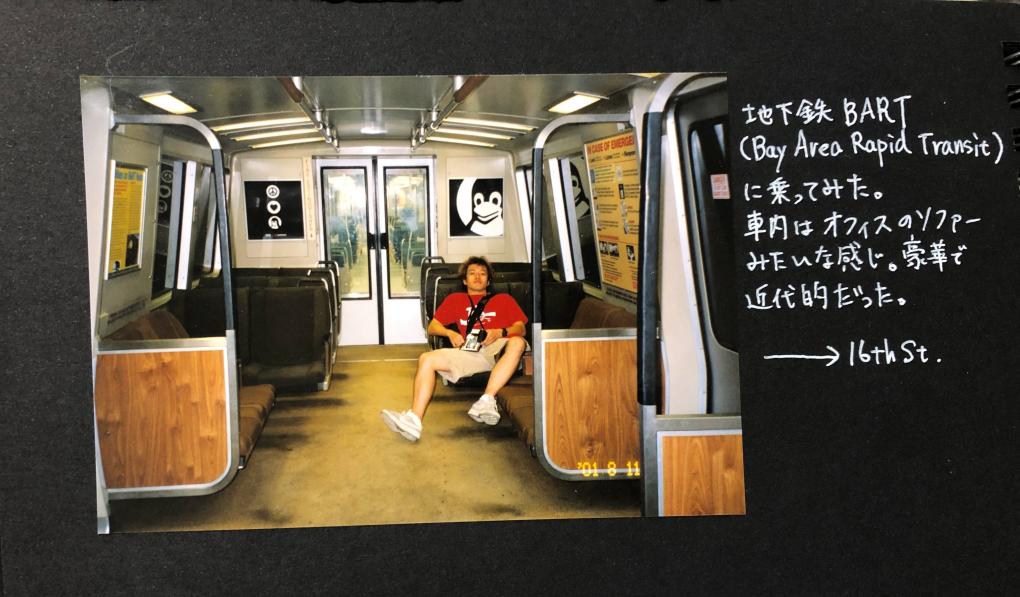
A photo of a scrapbook showing Atsushi Goto on a BART train in 2001. The text reads, "Me riding the BART subway. The vibe inside the cars reminded me of an office with sofa chairs." Photos courtesy of Atsushi Goto.
On Friday, April 19, at 3pm, Atsushi Goto’s plane touched down at San Francisco International Airport. He hastily collected his carry on, went through customs, and dashed toward the SFO BART station. A train was waiting for him on the platform.
The last time Atsushi rode BART, the trains still had yellow carpets and fabric seats. The Fleet of the Future trains were just an idea, and the legacy fleet didn’t have that adjective attached to its name yet. Actually, at the time, the legacy fleet was only a few years older than Atsushi, then a 21-year-old university student in Japan touring the U.S.
That was 2001. This past April marked 23 years since Atsushi last set foot on a BART train. And the trains that met him at SFO in April were not the ones he knew.
The 24 hours that followed his touchdown were a whirlwind of a trains, buses, cable cars, and one big party for a bunch of old trains at MacArthur Station – BART’s retirement celebration for the legacy trains. On the night of Saturday, April 20, just over a day after arriving, Atsushi was on a plane again, headed back home to Japan. Atsushi is an automobile designer, and on Monday, he had work.
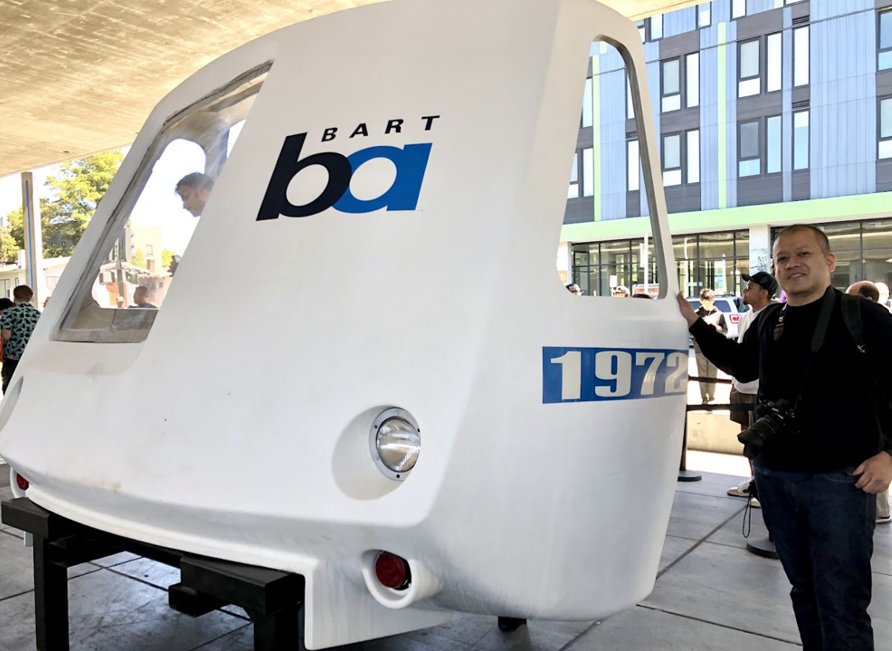
Atsushi poses with the train cab cutout at the legacy retirement ceremony on Saturday, April, 20, 2024. Photo courtesy of Atsushi Goto.
“I feared this was my last chance to see these trains. I could not wait any longer,” Atsushi said, speaking on a videocall from Japan. He’d never intended for his return to the Bay Area to take so many years, but between work and his other adult responsibilities, it just happened that way.
Atsushi had heard rumblings of a BART legacy fleet retirement party and final ride from rail fans online, so every single day, he checked BART’s X account to see if the event information had been posted. He immediately started looking for plane tickets. A few weeks before, it finally appeared on his feed. Just a few days later Atsushi booked his ticket. Due to his work schedule, he could only get away for the weekend.
He has no regrets. His final ride on the legacy fleet was everything he dreamed it would be.
“It was unforgettable, a wish come true,” he said.
On his last ride, Atsushi took tons of photos, celebrated with fellow rail fans, and reflected on the 23-year-long ride that took him from his first spin on an original BART train to his final one that day. Before the train returned to the yard from Fremont Station, Atsushi said, “I touched the train to thank it for its many years of service.”
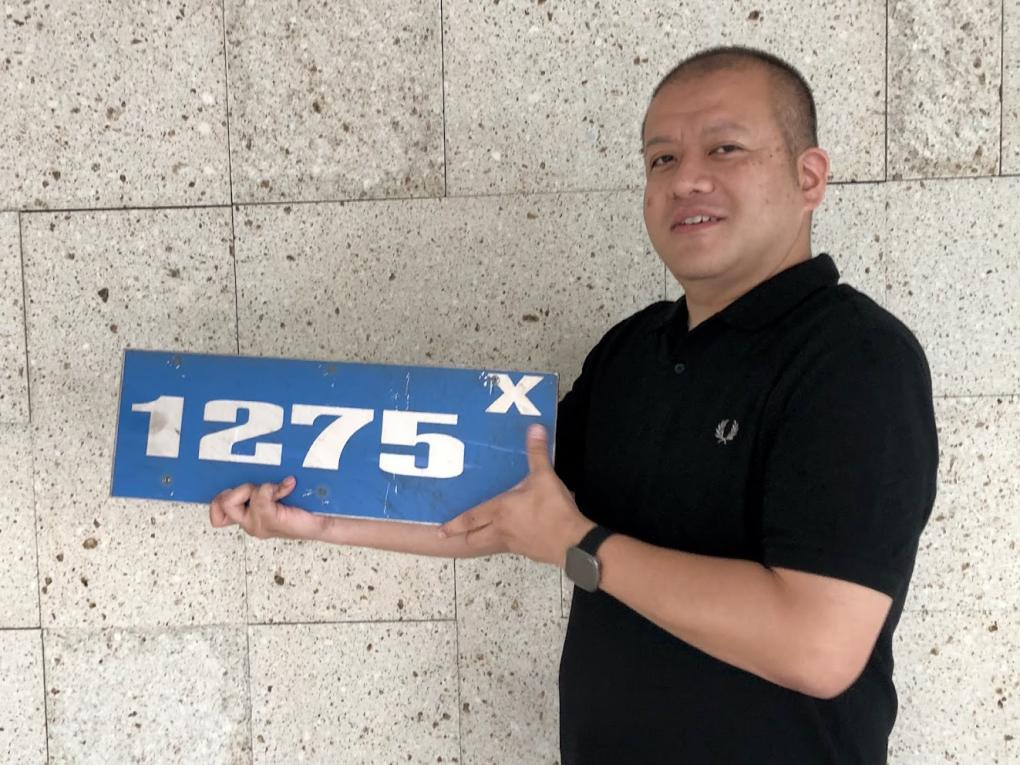
Atsushi Goto pictured with one of his legacy car number plates back home in Japan. Photo courtesy of Atsushi Goto.
BART Communications learned about Atsushi and his love of BART from Customer Services Assistant Nathan Nguyen. Nathan’s the kind of guy who’ll go out of his way to help a customer, even if that customer lives in a different time zone halfway around the world.
Before he learned about the legacy retirement event, Atsushi was desperate to get his hands on some legacy car number plates. There’s no international shipping option on Railgoods.com, where you purchase the quick-to-sellout plates, but Nathan made it happen just for him. The cost of shipping was as much as the plates themselves, but Atsushi wanted them nonetheless.
“As I got to know Atsushi communicating through email and learning the love he has for BART, I made it my mission to get these plates to him in Japan," said Nathan. "Atsushi is a very genuine guy, and the love he has for BART is overwhelming!”
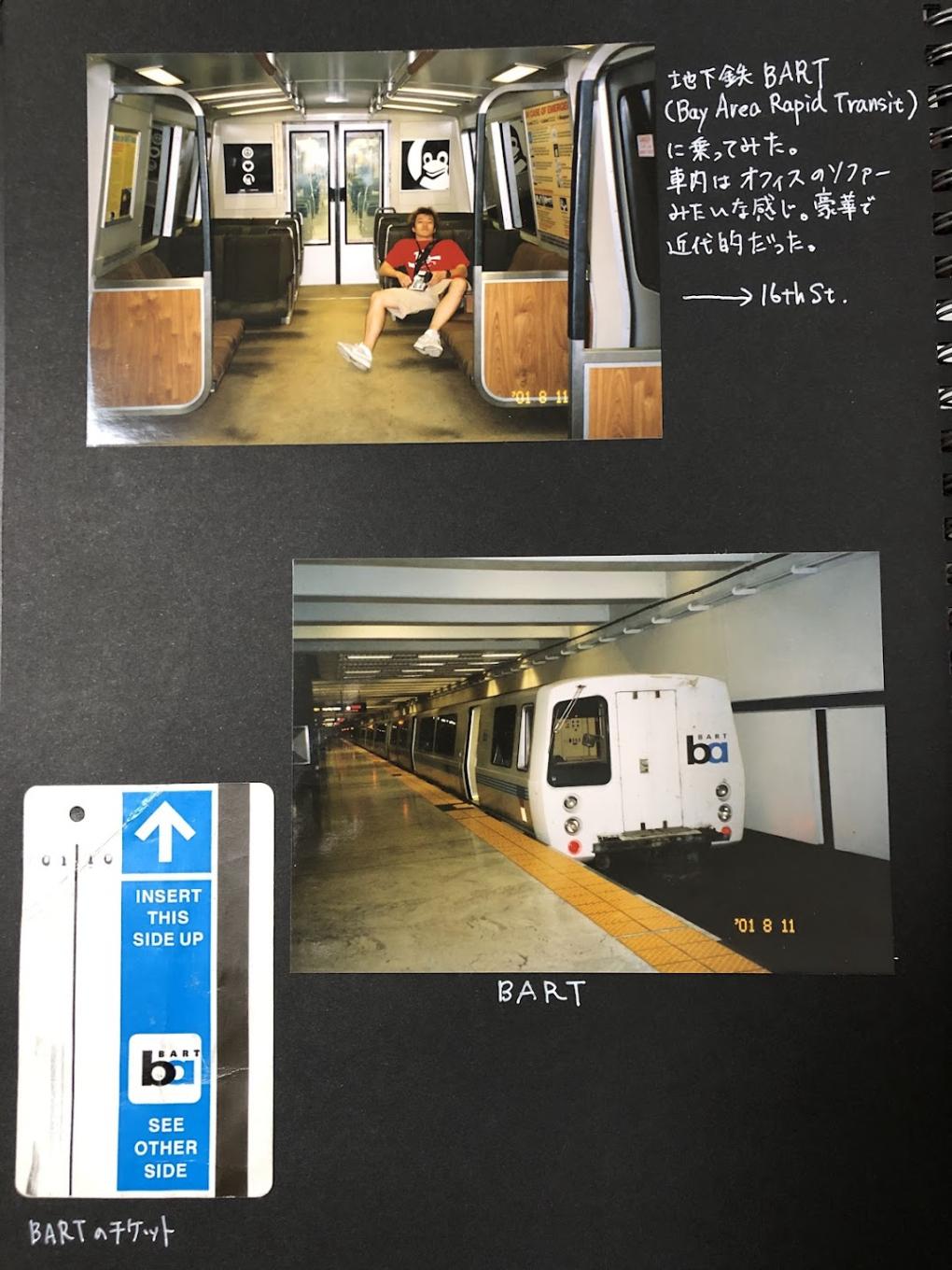
A photo of the full scrapbook page with photos Atsushi took in 2001 and the BART ticket he used. Courtesy Atsushi Goto.
Atsushi has a page in an old scrapbook commemorating his first BART ride. There’s a photo of himself at 16th St. Mission Station. He’s 21, and the ends of his hair are bleached like a true 90s kid. Below the photo, Atsushi pasted his first BART ticket. The text reads on the page reads: “I took the BART (Bay Area Rapid Transit). The interior of the train felt like an office sofa. It was luxurious and modern.”
Atsushi had wanted to visit San Francisco since he was a child. His mother used to read to him from the 1950s-era children’s book “Maybelle the Cable Car” by Virginia Lee Burton, translated into Japanese from the original English.
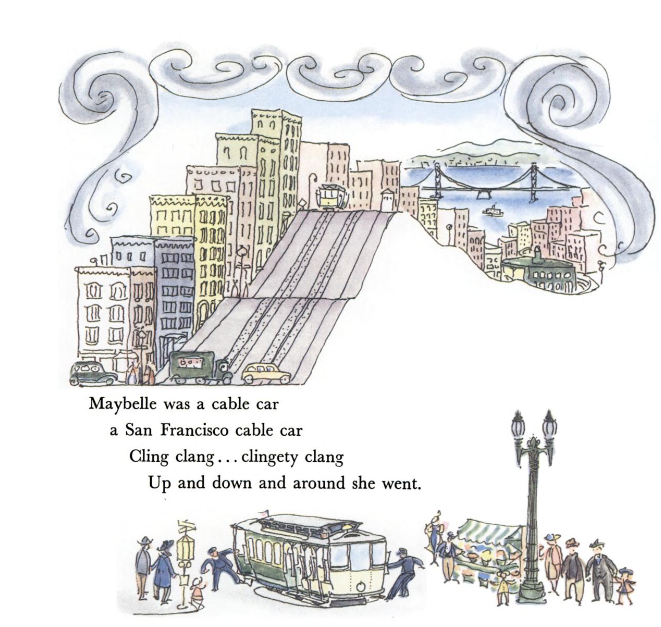
A snapshot of the opening lines of “Maybelle the Cable Car” (Copyright Houghton Mifflin).
“Maybelle was a cable car / a San Francisco cable car / Cling clang . . . clingety clang / Up and down and around she went,” the the classic story begins.
“I was really surprised by the angle of that hill,” Atsushi said.
When he finally made it to the U.S. in 2001, Atsushi felt like he was on a movie set.
“I really like America because as a child, I’d often see American movies on tv, like “Speed” and “Top Gun” with Tom Cruise,” he said. He’s also a big fan of American hard rock, including Guns N’ Roses and Aerosmith.
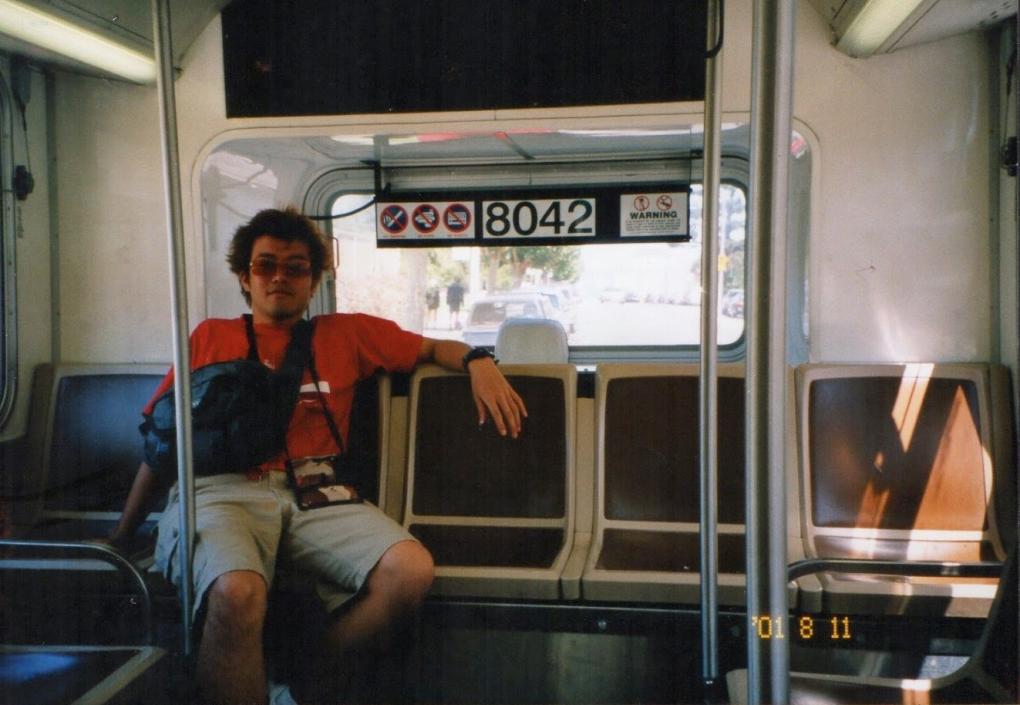
Atsushi on a Muni bus in 2001. The 8042 bus was retired in 2016. Photo courtesy of Atsushi Goto.
During his visit, he traveled west to east, stopping in cities along the way, including Los Angeles, Chicago, Detroit, Washington D.C., New York City, and Dallas. The Bay Area was one of his favorite places, and he spent lots of time riding its many forms of transit.
“The great thing about the Bay Area’s transportation system is that it combines modern and traditional elements and together, they function as a means of daily transportation,” he said. “For example, on the one hand there are advanced systems like BART and Muni, on the other hand, there are cable cars and the Muni F line. It’s fascinating and wonderful.”
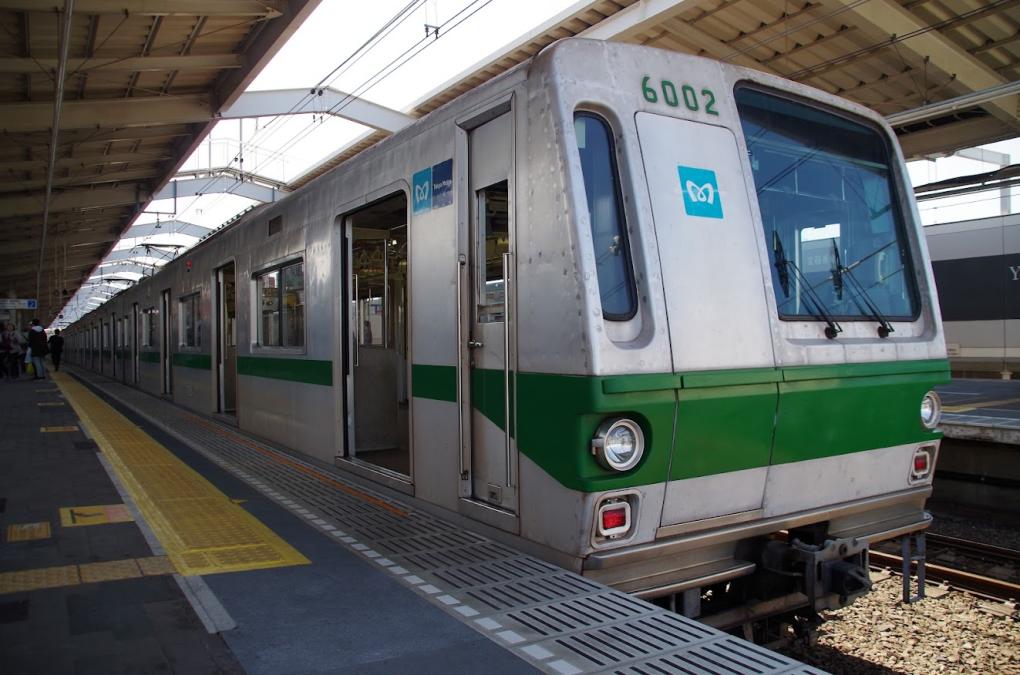
A Tokyo Metro Series 6000 train. Photo by Atsushi Goto.
BART’s “sofa-like spacious seats and seamless exterior” made him feel as if he were riding in a vehicle from the future. The cars’ exterior design was quite unlike the trains in Japan, where most of the trains are square and boxy, Atsushi said. He noted that the BART trains influenced the design of the cab on the Tokyo Metro Series 6000 trains, which he used to ride to get to school in Tokyo. He felt a strong sense of familiarity, communion even, with the BART trains off the bat.
“The legacy train’s design is so simple and iconic a child can easily draw it. With its round headlights and large windows, the design is still fresh even 50 years after its introduction,” he added.
He also thought the stations were cool thanks to their modern architecture, red electronic display boards, and the hip BART logo and color scheme.
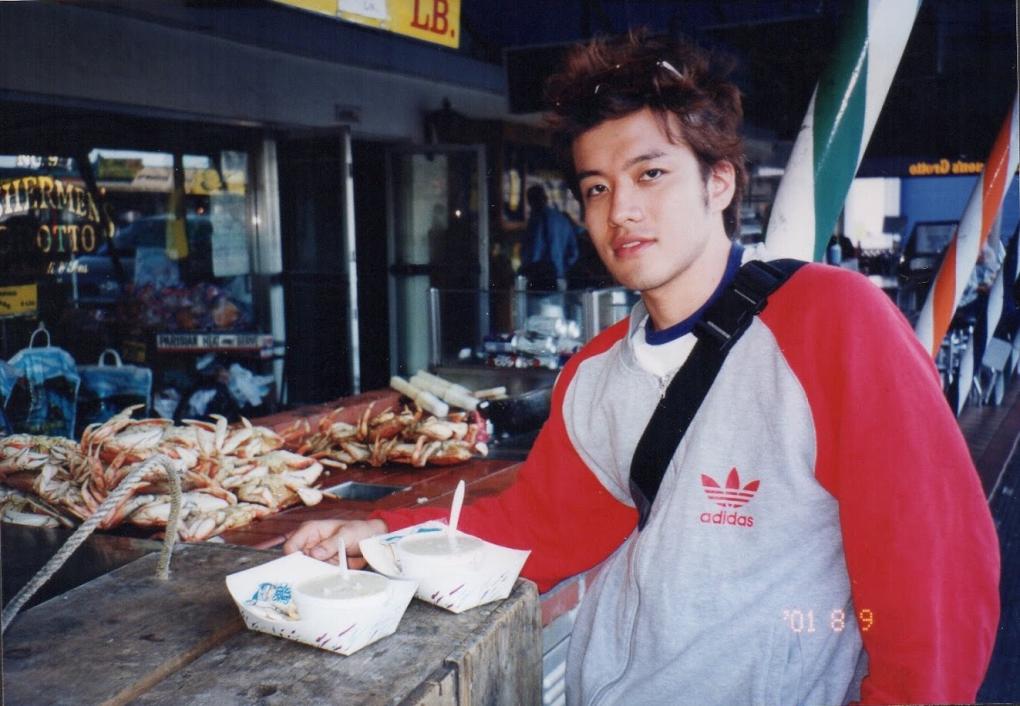
Atsushi eats clam chowder at a stand in San Francisco during his visit in 2001. Photo courtesy Atsushi Goto.
On his second visit to the Bay Area so many years later, Atsushi said his heart leapt when he came face to face with a BART train at SFO Station. He said his first ride on the new trains was “very comfortable,” and he appreciated the “sloping cross section and color scheme of the cars," which reminded him of the original cars. He also liked how the colors of the train “really match the beautiful Bay Area scenery.”
After dropping his bag at his hotel in downtown San Francisco, Atsushi hopped on a cable car on Market Street and rode it to Fisherman’s Wharf. After dining on some clam chowder on the waterfront, Atsushi rode back to his hotel on the F Market and Wharves Line, a heritage streetcar service that uses legacy equipment from retired fleets from San Francisco and abroad.
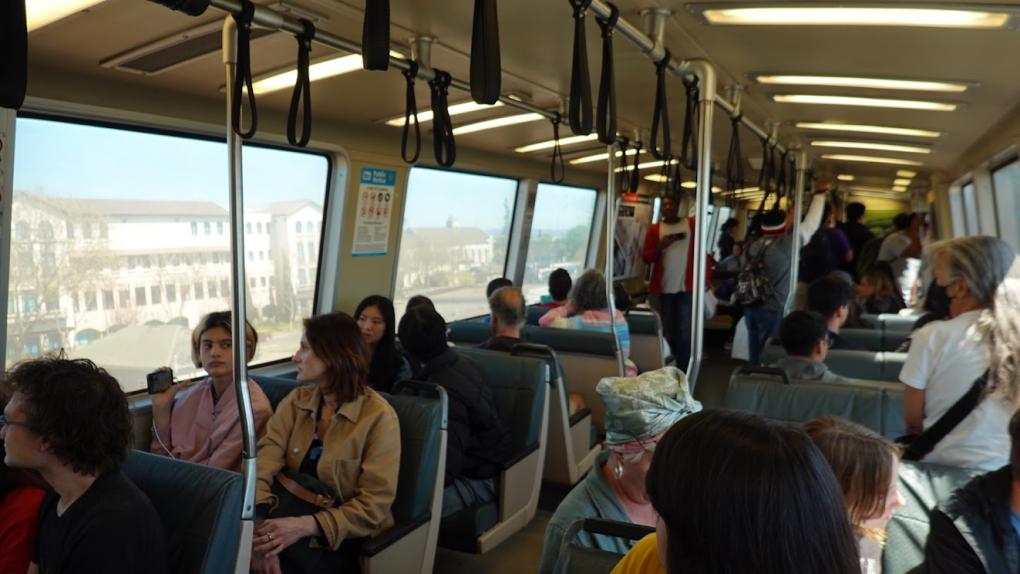
Scenes from the legacy train retirement event on Saturday, April 20, 2024. Photo by Atsushi Goto.
Saturday morning, he rode BART to Fruitvale Station because he got a tip that the legacy trains would be passing through the station on their way to MacArthur for the ceremony. He met another rail fan waiting for the train, too, and so they hung out and chatted while they waited.
Then, at last, he rode to MacArthur and basked in the atmosphere generated by thousands of rail fans celebrating BART and its historic trains.
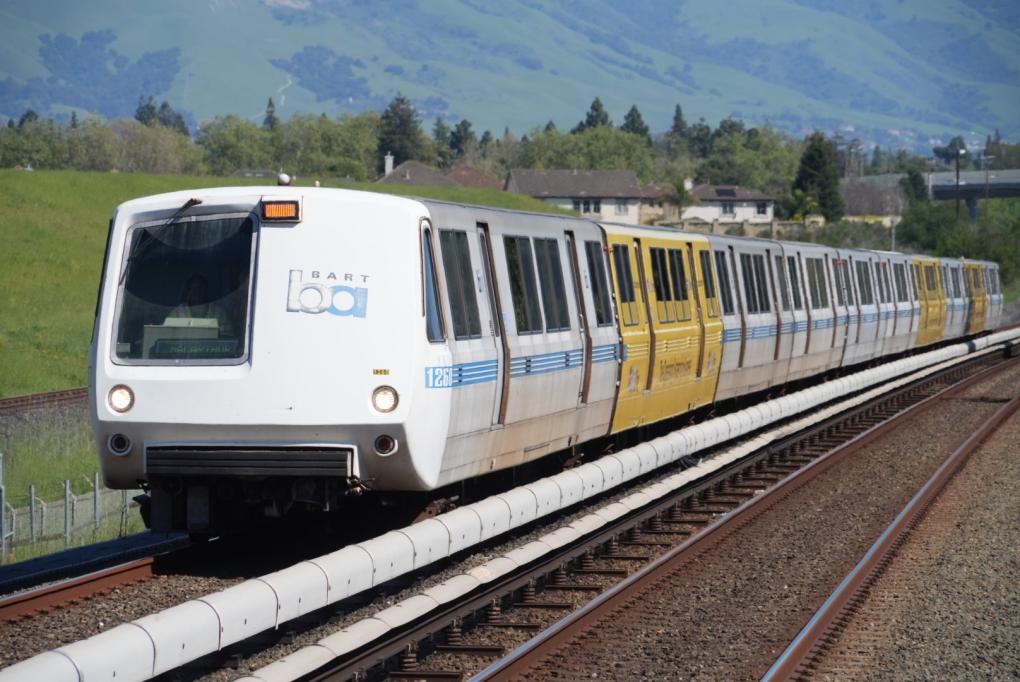
A legacy train on the tracks during the legacy train retirement event on Saturday, April 20, 2024. Photo by Atsushi Goto.
On the train, he said the scene on the train was very lively and fun.
“It was a wonderful experience to sit in a spacious seat and ride while looking out at the Bay Area,” he added.
After the train pulled into its final stop – Fremont Station – Atsushi waited on the platform with dozens of other rail fans to see the trains off to the yard.
Once the train sailed away, Atsushi had one more rail system to ride. His rail fan friend at Fruitvale told him about Caltrain’s Nippon Sharyo cars, which are being retired. So, Atsushi dashed back to San Francisco, caught one of the double-decker, Japanese-made beauties, and rode it a few stops. Then, it was back on BART to SFO and a long plane ride back home.
Atsushi said he won’t let so much time pass between now and his next visit to the Bay. He admits he should have come back sooner, but when he started working after graduation, it became difficult to take long holidays.
“I would definitely like to visit again,” he said. But he’s going to wait until the Western Railway Museum opens it BART museum with its three legacy train cars.
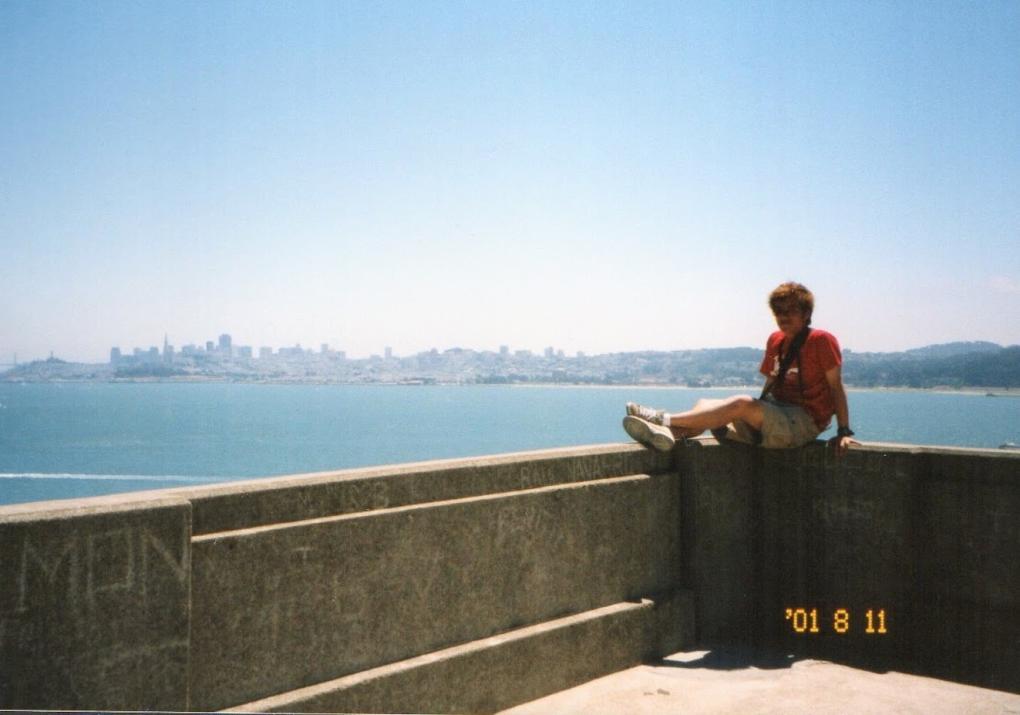
A Timeline of Atsushi’s Whirlwind Visit to the Bay Area
9pm JST, Friday, April 19: Atsushi Goto’s plane departs Narita Airport in Tokyo.
3pm PDT, Friday, April 19: Atsushi touches down at San Francisco International Airport.
5pm PDT, Friday, April 19: Atsushi takes BART from SFO to Downtown San Francisco and walks to his hotel by Civic Center/ UN Plaza.
7pm PDT, Friday, April 19: Atsushi catches the cable car on Market Street to Fisherman’s Wharf.
9pm PDT, Friday, April 19: Atsushi rides the Muni F train back to downtown.
11am PDT, Saturday, April 20: Atsushi photographs a legacy train passing through Fruitvale Station as it heads to MacArthur for the celebration.
1pm PDT, Saturday, April 20: Atsushi attends the legacy train retirement ceremony at MacArthur Station and queues to board the last train.
2pm PDT, Saturday, April 20: Atsushi rides the last legacy train to depart MacArthur, then sees it off as it returns to the yard.
7pm PDT, Saturday, April 20: Atsushi arrives at Caltrain station and boards the Nippon Sharyo double-decker train.
9pm PDT, Saturday, April 20: Atsushi takes BART from Civic Center to SFO.
1am PDT, Sunday, April 22: Atsushi’s flight to Tokyo departs San Francisco.
5am JST, Sunday, April 22: Atsushi’s flight lands at Tokyo Haneda International Airport.
February posts highest ridership week since the pandemic, underlining BART’s critical role during major events like the Super Bowl
BART carried more than a million riders during Super Bowl LX week, the highest ridership week for BART since the pandemic. Thursday, Feb. 5, was also the highest ridership day since the pandemic with 225,832 trips, per BART’s February Ridership Snapshot.
Preliminary ridership numbers for March are strong. Over February and into March, Saturday ridership reached 85% of pre-pandemic levels, and March to date is 14% higher compared to the same period a year ago. Tuesday, March 24, is now the third-highest post-pandemic ridership day with more than 221,000 trips.
The surge in February ridership was driven largely by fans and visitors traveling to destinations across San Francisco for Super Bowl-related events and celebrations. The strong performance highlights BART’s ability to move large crowds quickly and efficiently, connecting the region during moments of peak demand.
With global events like the upcoming 2026 FIFA World Cup on the horizon, BART will continue to play a key role in transporting residents and visitors to major destinations throughout the Bay Area.
February ridership highlights:
• Total trips: 4.5 million (+13% year-over-year)
• Average weekday ridership: 191,099 (+11% year-over-year)
• Average Saturday: 129,183 (+27% year-over-year)
• Average Sunday: 77,296 (+15% year-over-year)
Saturdays saw particularly impressive growth, reflecting increased demand for events, entertainment, and weekend travel across the region.
In February, more than 685,000 trips were taken using Tap and Ride, up 7% compared to the previous month, reflecting continued adoption of contactless payment options that speed up station entry and improve the rider experience.
Ridership alone cannot close the funding gap
Even with continued growth, fare revenue has not returned to pre-pandemic levels and is not enough on its own to fully fund operations. Like transit agencies nationwide, BART faces a structural budget deficit as remote and hybrid work patterns reduce traditional commute trips. Read more about BART’s funding deficit here.
Find comprehensive BART ridership reports here and daily ridership numbers here.
BART Board of Directors elects Melissa Hernandez to serve as Board President and Edward Wright as Board Vice President
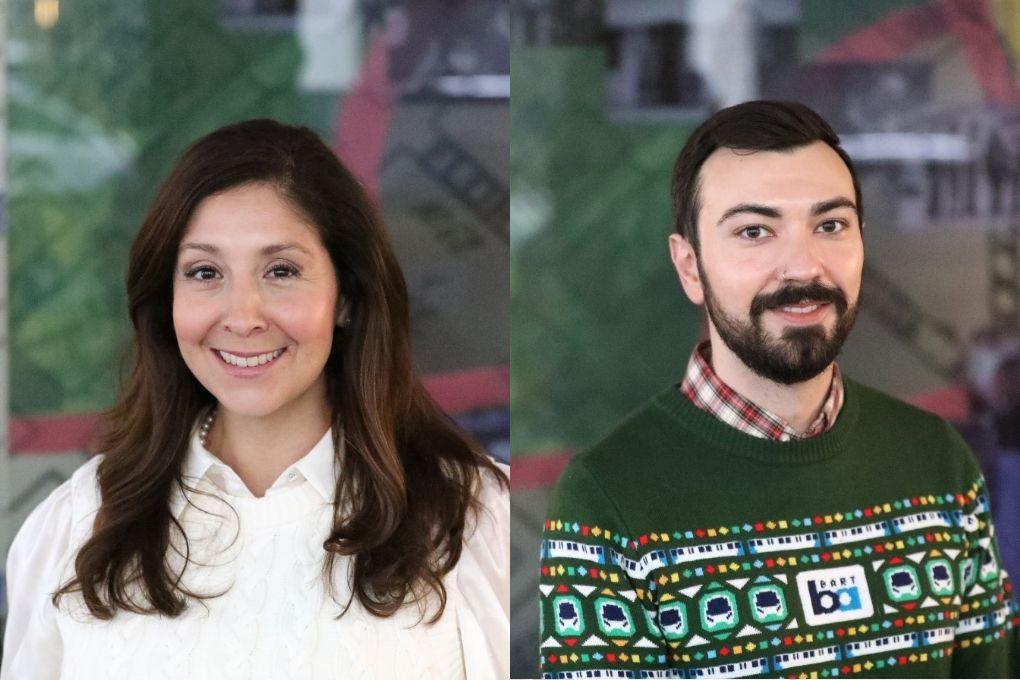
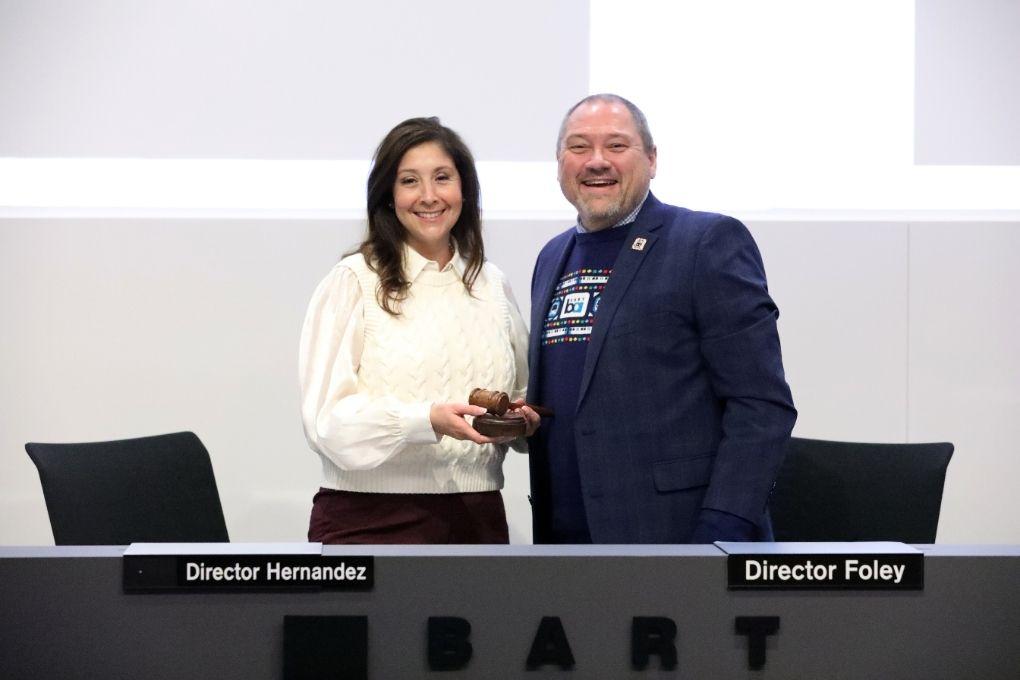
The BART Board of Directors during its meeting today unanimously elected Melissa Hernandez to serve as its president for the 2026 term. Hernandez served as Board Vice President for the 2025 term. She is the first Latina to serve on the BART Board of Directors and now becomes the first Latina to serve as Board President.
Hernandez will lead the BART Board during what’s expected to be a defining year for the future of the agency. BART faces a budget deficit of up to $400 million now that state and federal emergency funds have been exhausted and an uncertain future if a new source of reliable long-term funding can’t be secured.
“Thank you for the opportunity to serve as your president,” President Hernandez said following her election. “I truly believe this year will define BART for decades to come if we continue to put riders first and work together as a team to face the challenges ahead of us. I am confident people will look back on 2026 as the year we secured BART’s future as the essential backbone of the Bay Area transit network.”
First appointed to the Board on May 23, 2024, to fill the vacancy for District 5, Hernandez was elected in November 2024.
District 5 is in Alameda and Contra Costa counties and includes a portion of the City of Hayward, ranging from Castro Valley Station in the north to Hayward Station in the south. It also includes the City of Pleasanton (except for a portion near Kilkare Woods), the City of Livermore, the City of Dublin, the southeastern part of San Ramon, and rural areas in east Alameda County.
Previously, Hernandez served as a City of Dublin councilmember for eight years and also served as the city’s mayor for four years until June 2024. She has chaired three regional transit boards: the Livermore-Amador Valley Transit Authority (LAVTA), Tri Valley/San Joaquin Valley Regional Transportation Authority (Valley Link), and the Finance Committee of the Alameda County Transportation Commission.
Director Edward Wright elected as BART Board Vice President
The Board of Directors also unanimously elected District 9 Director Edward Wright as Board Vice President. Wright was elected to serve on the board in November 2024.
District 9 is in San Francisco and includes the following stations: 16th St Mission, 24th St. Mission, Embarcadero (shared with District 8), Civic Center/UN Plaza, Glen Park (shared with District 8), Montgomery (shared with District 8), and Powell St. (shared with District 8).
Prior to joining the BART Board, Edward led transportation policy and communications for three local legislators; served as a Transit Strategy and Communications Advisor for the SFMTA and as President of the Harvey Milk LGBTQ Democratic Club; and organized a range of political campaigns, civic and community events, marches, and direct actions.
“I believe this will be the most consequential year since BART was created, and I take this role and the responsibility that comes with it very seriously,” Vice President Wright said during the board meeting. “I came here to try to do something and will do so by working together collaboratively with my colleagues. Let’s go!”
“Our systems are more aligned now than ever”: Local transit CEOs take BART, buses, and even an electric trolley during Earth Day ride-along event
Ride-along attendees and transit riders fill a County Connection Route 14 bus. On Friday, April 21, ten transit CEOs from across the Bay Area gathered for a multimodal, three-hour-long voyage that carried them from the green hills of Orinda to the dry heat of Pittsburg. The “All Aboard with Transit CEOs”
BART Train Operator Dewayne Deams on the lessons he learned from his great-grandfather, transit trailblazer Curtis E. Green
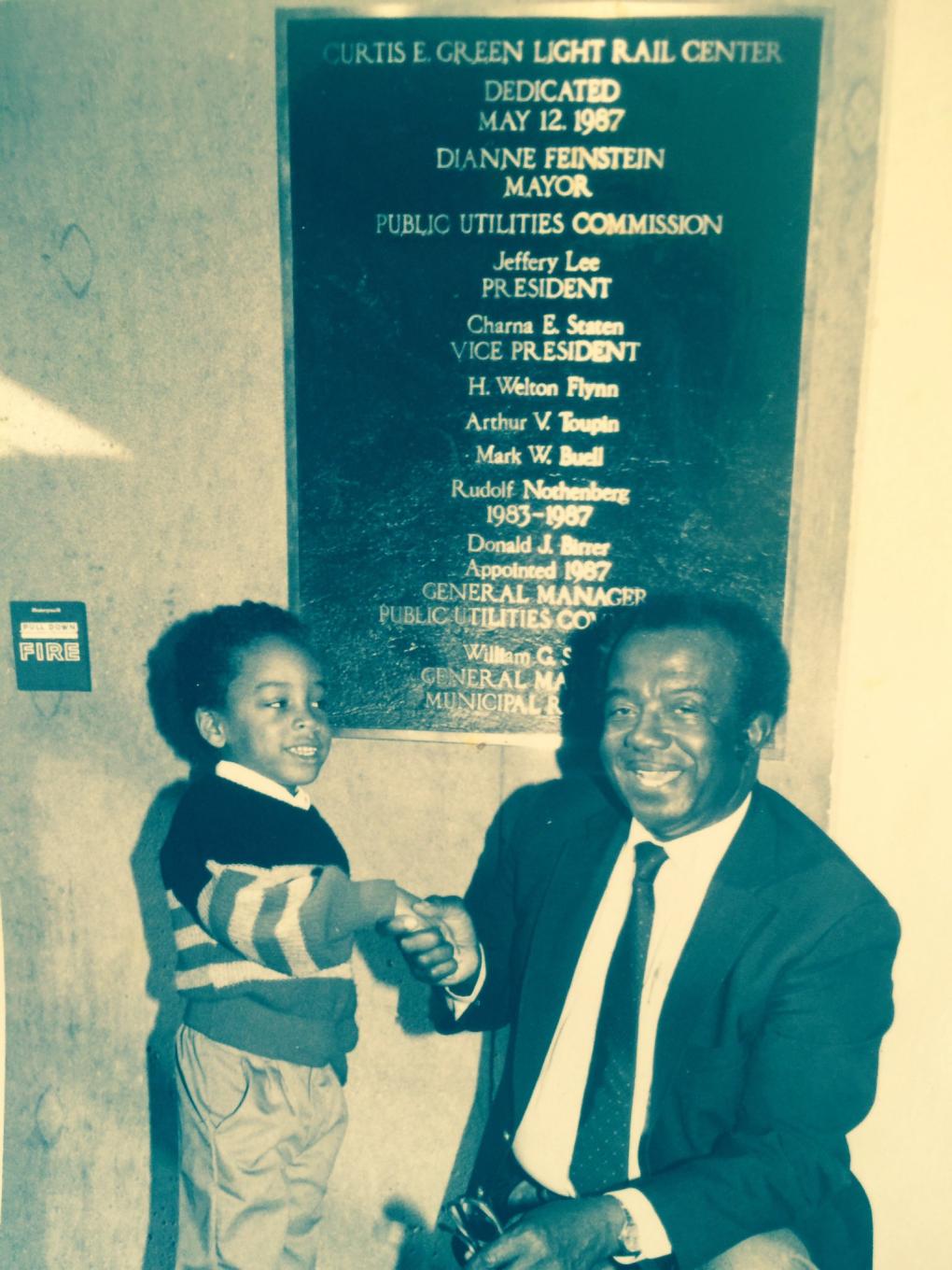
Dewayne Deams (left) with his great-grandfather Curtis E. Green at the dedication ceremony for the Curtis E. Green Light Rail Center on May 12, 1987. Photo courtesy of SFMTA Photo | SFMTA.com/Photo
BART Train Operator Dewayne Deams has digital version of an old photo stashed on his phone. The grainy, sepia-toned image shows a boy, smiling and shaking hands with a gentleman in a suit and tie. There's a plaque behind them that reads: “Curtis E. Green Light Rail Center, Dedicated May 12, 1987."
The boy is Deams as a five-year-old. The gentleman is Curtis E. Green, Deams’ great-grandfather and the first Black person to lead a big-city transit agency in the U.S. Green’s impact on public transportation is immeasurable. For Deams, its personal.
“I don’t have a vocabulary big enough to describe how much his legacy means to me,” Deams said of his great-grandfather. “He’s a trailblazer. In my time with him, I never saw him that way. I didn’t realize he's literally in the history books until I was older.”
Deams started asking questions about the man he knew simply as “granddaddy” after his funeral, at which Willie Brown spoke and a letter by Dianne Feinstein was read. Green died in 2002 at 78 after a long illness. Deams, then 21, had seen Brown and Feinstein on tv. He knew they were famous, but why were they speaking at great-grandpa’s memorial service?
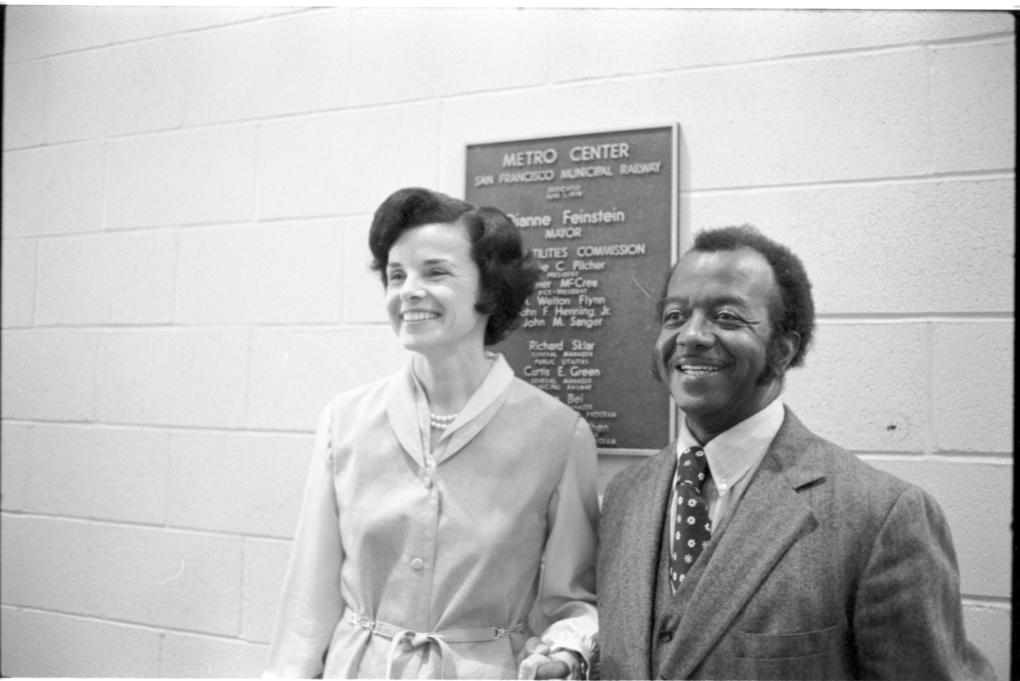
Dianne Feinstein, then the Mayor of San Francisco, and Curtis E. Green at the dedication of the Muni Metro Light Rail System on July 11, 1979. Photo courtesy of SFMTA Photo | SFMTA.com/Photo
Deams said his great-grandfather wasn’t the name-dropping type, and he certainly didn’t know him as “the Muni guy.” Rather, he remembers Green as gregarious and easygoing with a hearty laugh. The two talked about football a lot.
After Green died, Deams started researching, and he quickly came to realize his great-granddaddy was a “big deal.” At the African American Museum and Library at Oakland, Deams found a section all about Green and his legacy.
“I had him for a good while,” Deams said. “But when you’re a kid, you don’t always understand the magnitude of things. It’s like, okay, grandpa, whatever you say. I’m grateful I eventually came to learn the importance of what he accomplished.”
Before he fully understood his great-grandfather’s legacy, Deams said he would sometimes brag to friends and classmates when passing the Curtis E. Green Light Rail Center in Balboa Park.
“I’d say, ‘Look at that name! That’s my grandfather,’” Deams remembers. “That was always a claim to fame for me.”
Transit obviously runs in Deams’ blood, and not only on behalf his great-grandfather. Both of Deams' parents drove buses and light rail for Muni. His mother, Denise Green, is now a supervisor at the agency, where she’s worked for more than 30 years. Twice she’s won the distinguished Driver of the Month award, including when she worked in Green’s namesake division. He attended every one of her awards ceremonies.
“The second time she won, while she was working in the Green Division, he came and spoke about how proud he was,” Deams said. “I get choked up thinking about it. That was one of the last times I saw him before he died.”
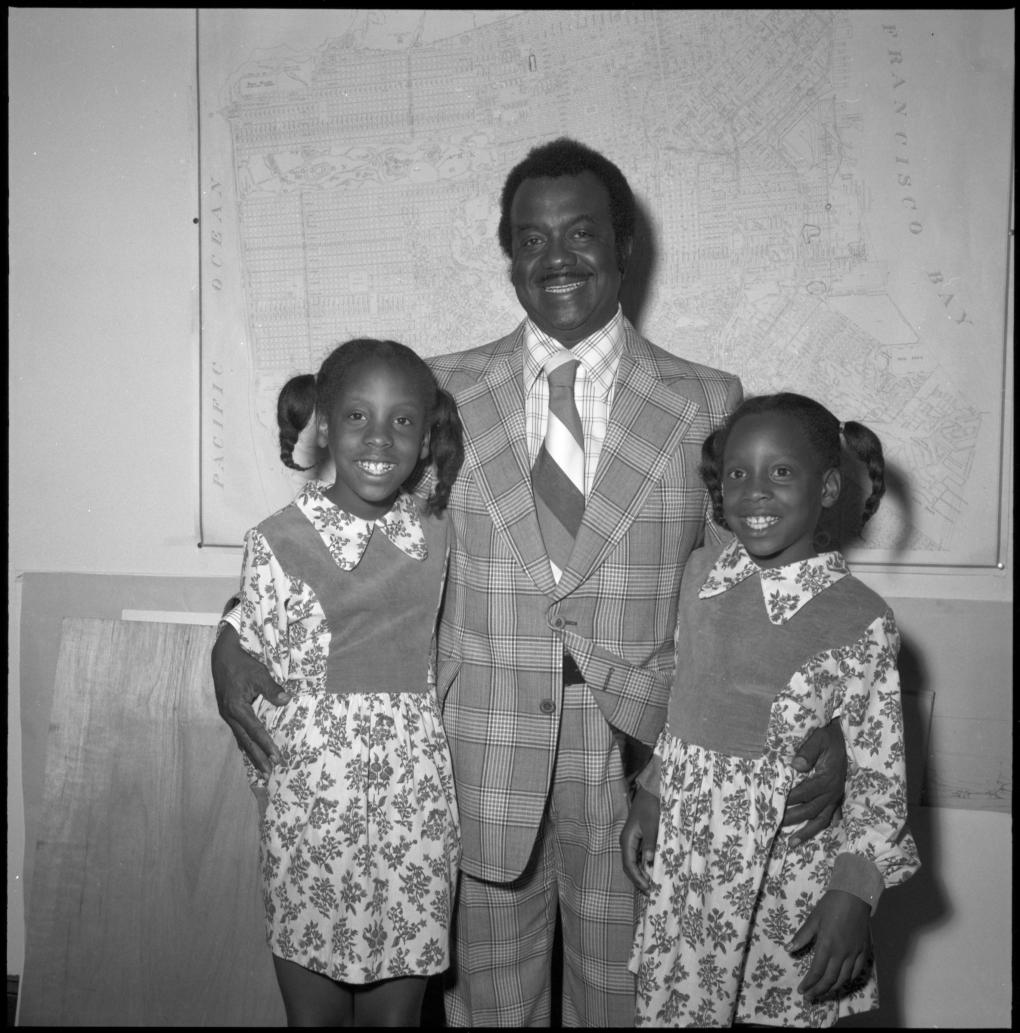
Curtis E. Green pictured with his family on July 23, 1974. Photo courtesy of SFMTA Photo | SFMTA.com/Photo
Green settled in San Francisco after serving in the Marines during WWII. Before the war, it could be challenging to find a job if you were Black -- hiring practices were often blatantly discriminatory. The war opened things up a bit, and in 1945, when Green was seeking a job in San Francisco, many employers suddenly had a shortage of workers on their hands. That year, Green was hired as a bus driver, making 90 cents an hour.
Over his 37-year career at Muni, Green slowly rose in the ranks. He knew he wanted to pursue management, and so he did, earning his degree after years of night classes. In 1974, he became deputy general manager of Muni. A year later, he was promoted to the top spot.
Things were not always easy for Green, his great-grandson said. Back in the day, drivers carried change – riders didn’t have to give exact fare – which sometimes made them targets. Green was once robbed and beat up for his change purse.
He faced challenges because of his race, too, especially as he moved up in the ranks. “’You’re affirmative action. You’re only getting this because they needed to hire a Black guy,’” Deams said, parroting colleagues’ racist remarks. Those words stung his great-grandfather, Deams said, but he always rose above it, touting the importance of hard work above all else.
Green loved his job, the city, working with people, Deams said. When he reached the top of Muni's ranks, he treated everyone the same, whether a janitor or mayor of San Francisco.
Deams carries on his great-grandfather’s legacy in his own way, waking up each morning, hopping in his cab, and striving to give BART riders the best service possible. He describes himself as “a major transit nerd” -- one of the lucky few whose passion is also his job.
Deams said his conduct at work is influenced by his great-grandfather and the example he set. Green believed in killing ‘em with kindness and told his great-grandson that there was nothing wrong with being nice. Deams took that to heart, applying it in scenarios as basic as “seeing someone running to the train doors when I’m operating.”
“I could just take off, but I’m a sucker and hold the doors most of the time,” he said. “People appreciate it. You don’t have to be cutthroat. You can be kind and still get the job done.”
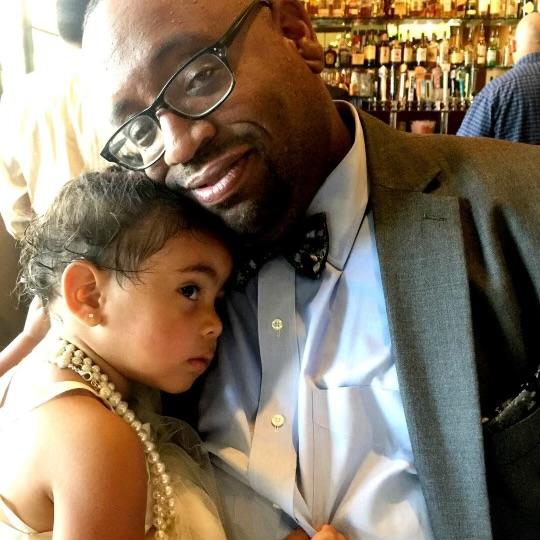
A recent photo of Dewayne Deams with his daughter.
One of his favorite parts of the job, like his great-grandfather, is interacting with people. Deams currently works on the Yellow Line, and he loves “walking the platform to my train, answering questions as I go, and seeing people ride from all over the world.” Typical topics of conversation include baseball and how to get to Fisherman’s Wharf. Once, Deams met a woman boarding the train with her father, who had helped build BART back in the 1960s. Deams was honored to take them for a ride.
Having grown up as a “latchkey kid” in the Bayview District of San Francisco, Deams said public transit was a lifeline for him and his little brother. They took it to school, to baseball practice, to appointments. His favorite spot to take the train growing up was Blondie’s Pizza at Powell Street Station. He and his friends would grab a slice and try to scarf it down before the pigeons beat them to it.
As a teenager one evening, while spending the night at his grandmother’s house, Deams remembered convincing her to give him a $20 bill. He grabbed the cash, took the bus to Colma Station, and rode BART to the Coliseum to watch a Warriors game.
“For $20 at the time – it was the 90s – I was able to get there and back, buy a ticket to the game, and get some nachos,” he said. “My mom was pretty furious when I got back though.”
Now, Deams takes his three daughters around the Bay Area on BART, including to sports games. They’re proud of their dad and his career. BART trains aren’t just BART trains to them, Deams said, but Daddy’s BART trains. Just like his great-grandfather did for him so many years before, Deams is now sharing the joys of transit with his children, teaching them how to use it and why it matters.
“They’re in love with trains,” he said. “Especially BART trains.” Nothing could make him prouder.
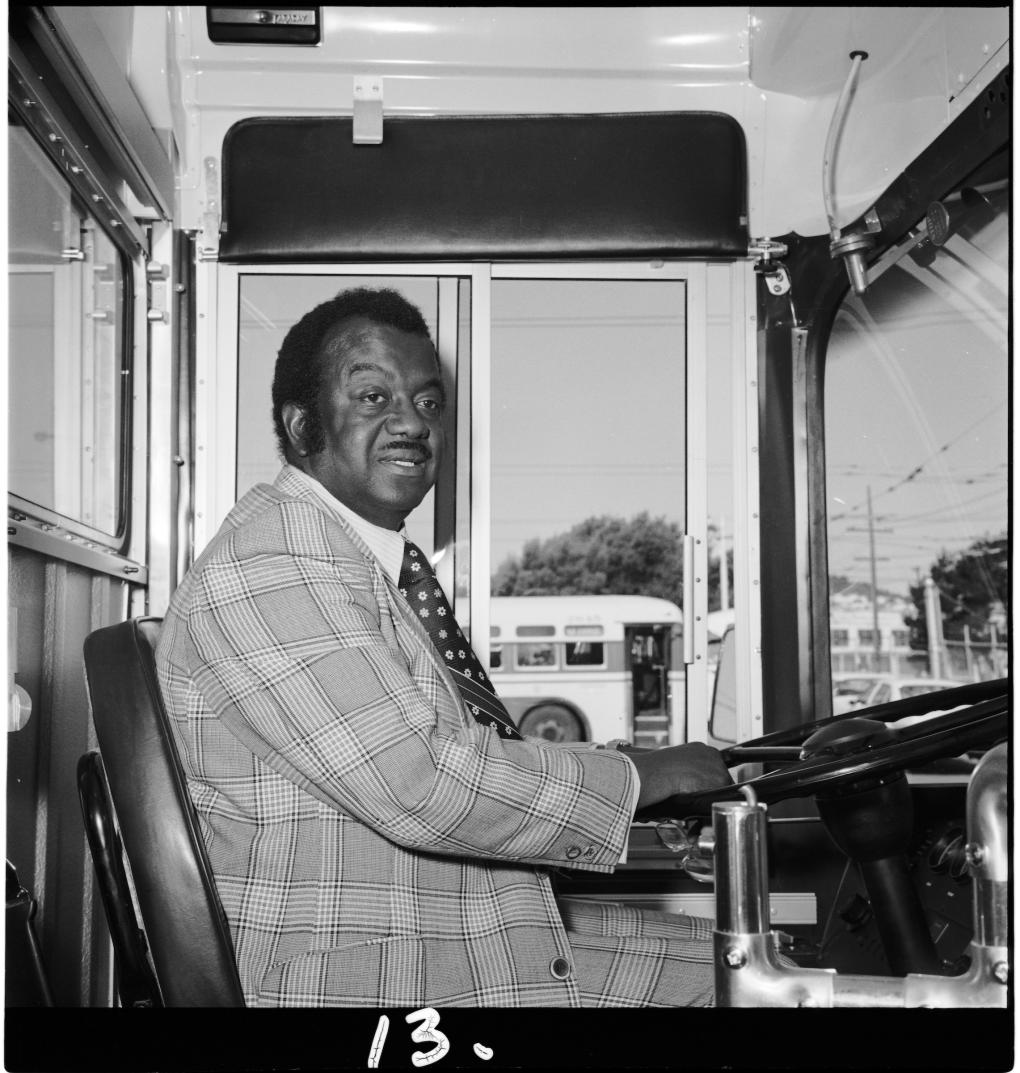
Curtis E. Green at the wheel of a new AM General diesel coach on May 5, 1975. Photo courtesy of SFMTA Photo | SFMTA.com/Photo
New data shows crimes against riders plummeted as BART celebrates one year since the arrival of Next Generation Fare Gates
The number of crimes against riders per million trips has fallen 67% from the end of 2024 to the latest quarter. The crime rate is falling even as more people are riding BART. Over that same period the number of BART PD and safety-related delays fell 47% as police had to respond to fewer reported incidents.
“We knew updated, modern gates would improve the rider experience. They have been a real game changer,” said BART General Manager Bob Powers. “The new fare gates are at the core of what I call the ‘New BART.’ We are offering our riders a safer, cleaner, and more reliable experience than even just a year ago.”
"The data speaks loud and clear: BART's new fare gates prove without a doubt that investing to improve and modernize our public transit infrastructure pays off big time," said Libby Schaaf, President and CEO of the Bay Area Council. "BART riders want and deserve nothing less than a safe, convenient and clean system and BART has delivered. The Bay Area Council is proud of our advocacy in support of these new fare gates and our partnership with BART to help get this done.”
September marks one year since BART completed the successful installation of Next Generation Fare Gates at all 50 stations. The work was completed several months ahead of BART’s deadline to have new gates fully installed by the end of 2025.
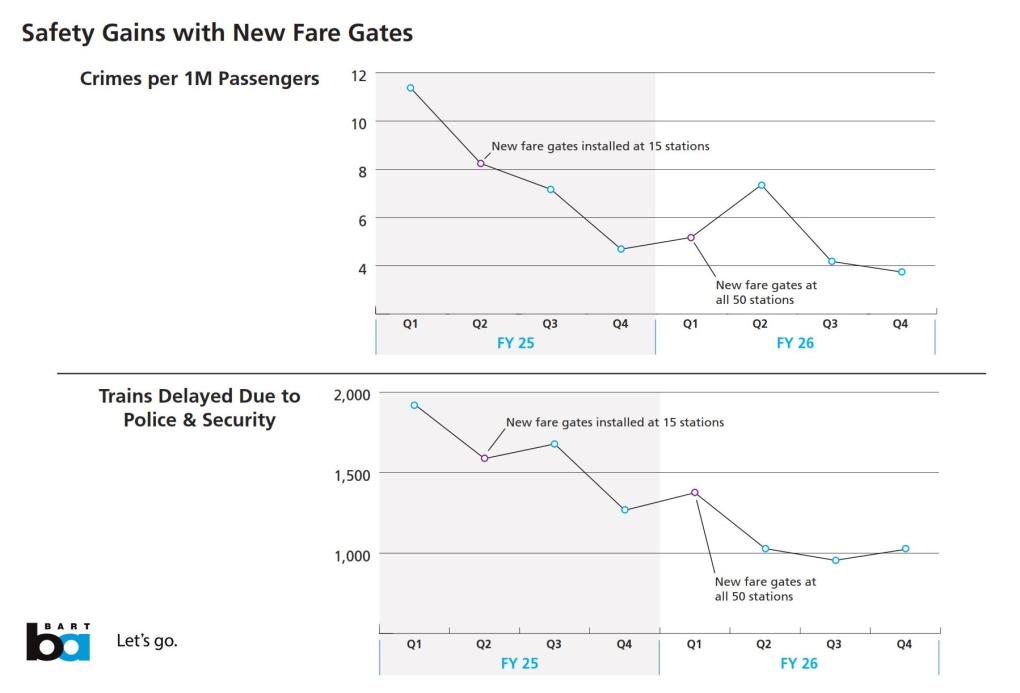
Riders report seeing fewer instances of fare evasion. The percentage of riders who say they witnessed fare evasion during their trip is down 60%. Early indications are the gates are responsible for BART revenue growing by about $10 million annually through reduced fare evasion.
“New gates and our high-visibility patrols on trains and in stations are providing layers of security for our riders,” said BART Police Chief Kevin Franklin. “As reports of fare evasion drop, it frees up members of my team to respond more rapidly to emergencies in the system.”
The new gates have clear swing barriers that are very difficult to be pushed through, jumped over, or crawled under. The overall fare gate array forms a tall barrier of a minimum of 72 inches to deter fare evasion.
Making already highly effective gates even stronger
BART is doing ongoing work to make the new gates even more resilient against fare evaders and those who try to damage them. BART is piloting an advanced motor gear system which is designed to strengthen the gates’ resistance to repeated impacts. Gates outfitted with the new motors have been able to withstand 10,000 repeated impacts of around 926 pounds. The new motors are being tested right now at Coliseum and Pittsburg Center stations.
BART hosts inaugural Girls in Motion Fall 2023 Summit to inspire young people to explore careers in the transportation industry
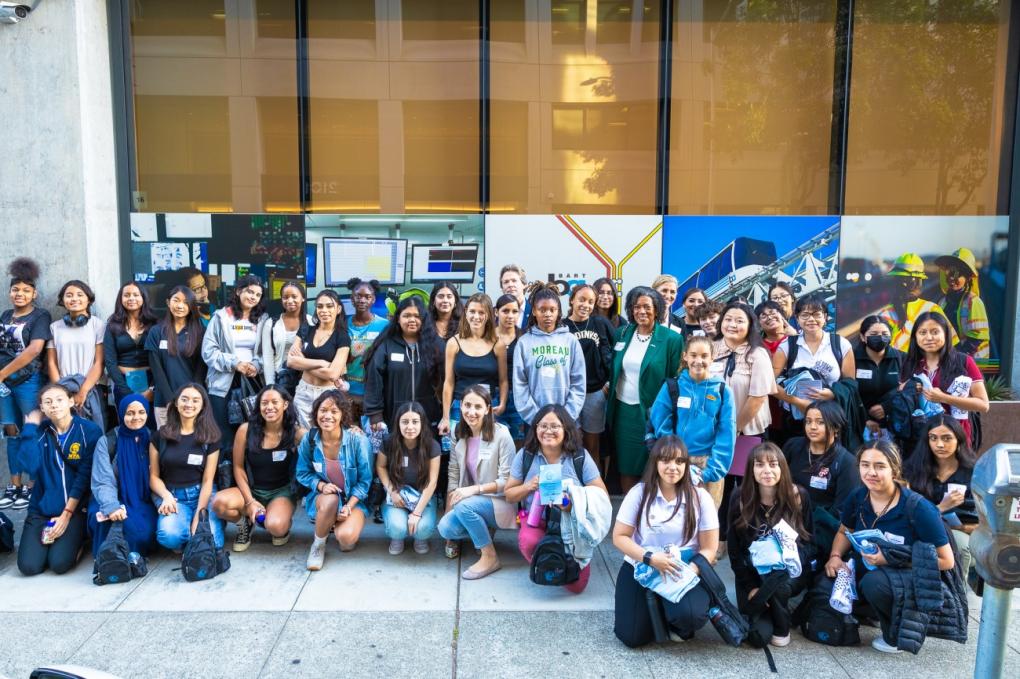
A photo of the attendees who participated in the Girls in Motion Fall 2023 Summit, hosted at BART Headquarters on Thursday, Oct. 19, 2023. Photo courtesy of Conner L’Hommedieu of Kimley-Horn.
Transportation leaders from across the Bay Area came together recently to share their passion for transit and inspire young people to explore the industry as a potential career.
On Thursday, Oct. 19, BART hosted the inaugural Girls in Motion Fall 2023 Summit, organized by the American Council of Engineering Companies (ACEC), California, Bay Bridge Chapter, and WTS San Fransico Bay Area Chapter, an international organization for women in transportation.
“The summit was a great opportunity to collaborate with our external partners and provide a platform of exposure for high school girls and specifically those from marginalized communities,” said Cynthia Fields, Supervisor of Workforce Development at BART and a member of the summit planning committee. “We want Gen Z to have this level of awareness as they consider their futures. It’s important for our girls to see people who look like them in the workplace, especially powerful women.”
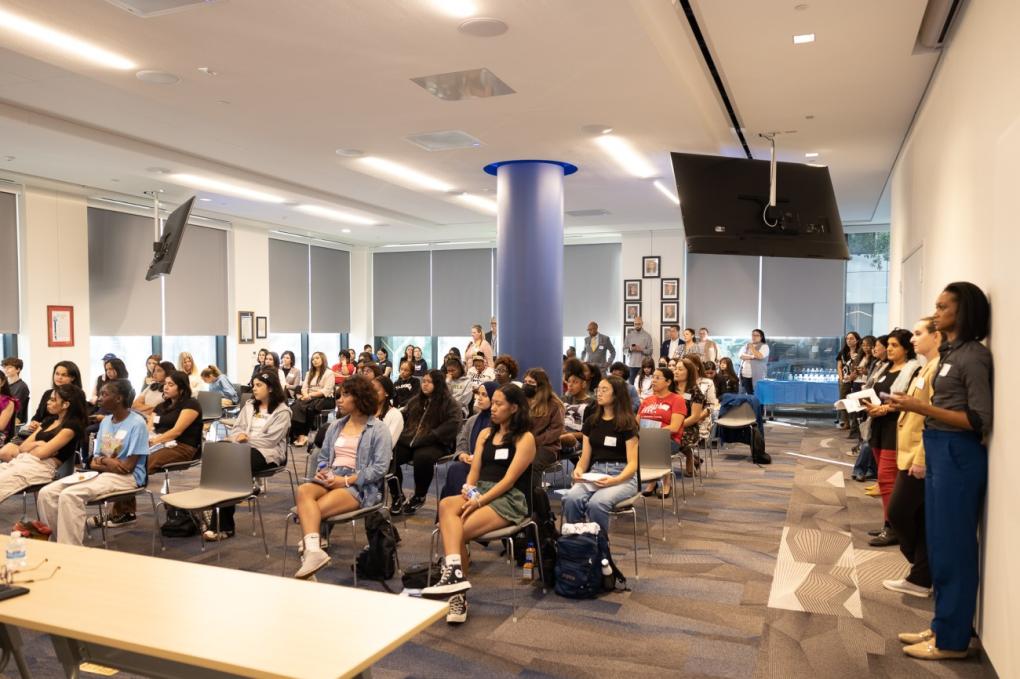
The standing-room only audience during the Girls in Motion Fall 2023 Summit, hosted at BART Headquarters on Thursday, Oct. 19, 2023. Photo courtesy of Conner L’Hommedieu of Kimley-Horn.
Dozens of young women, mostly high school students, attended the rousing summit in BART’s boardroom. Many attendees are participants of Girls Inc of Alameda County, located just a few blocks down the street from BART HQ. Girls Inc. previously visited BART in March of this year to learn about engineering on International Women’s Day.
The focus for this event was even broader in scope, and many of the transportation leaders who spoke noted the expansiveness of the transit industry and how its workers come from a surprising diversity of professional backgrounds.
“There are so many different fields in transportation,” said Tess Lengyel, Executive Director of the Alameda County Transportation Commission. “Transportation is not just one thing; there are attorneys, communications professionals, planners. The list goes on.”
Lengyel spoke during the opening session, a panel with fellow transit executives Bob Powers, the General Manager of BART, and Beverly Greene, Executive Director of External Affairs, Marketing and Communications at AC Transit. Michele DiFrancia, President of ACEC-CA, Bay Bridge Chapter, moderated the inspiring conversation.
Each executive espoused their passion for transit and some of the surprising delights of working in the industry.
At the opening of the session, Powers cited some data points to get the girls fired up. Thirty-four percent of BART staff are eligible to retire, he said, stressing the need for more young people with fresh perspectives and ideas to join the industry. He also noted that 25% of the BART workforce are women or nonbinary.
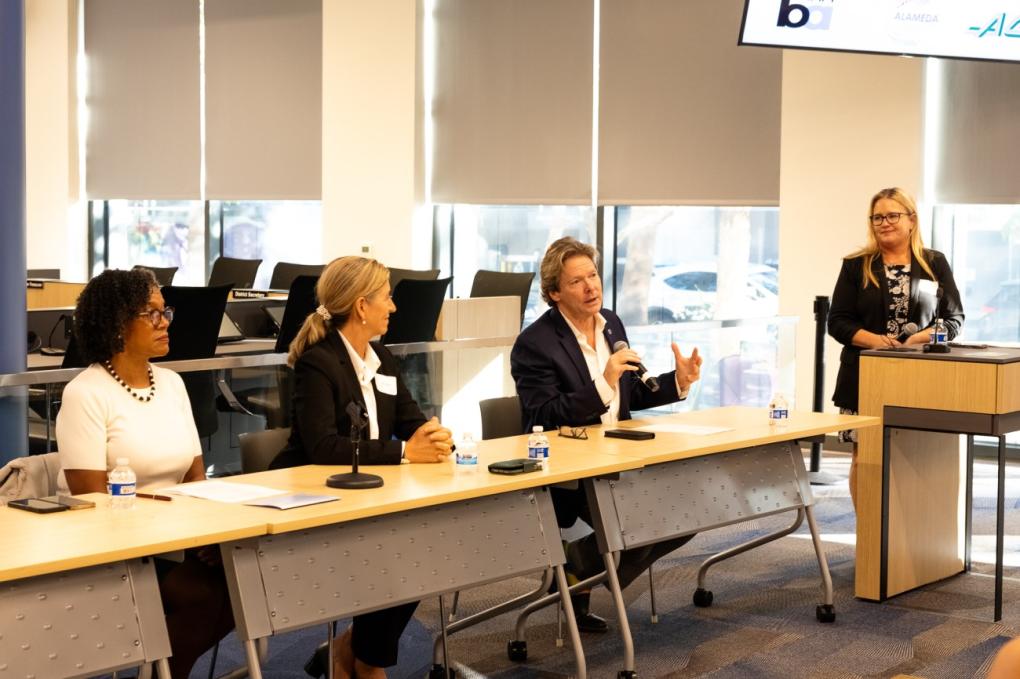
(From left to right): Beverly Greene, Executive Director of External Affairs, Marketing and Communications at AC Transit, Tess Lengyel, Executive Director of the Alameda County Transportation Commission, Bob Powers, General Manager of BART, and Michele DiFrancia, President of ACEC-CA, Bay Bridge Chapter, photographed during the Girls in Motion Fall 2023 Summit, hosted at BART Headquarters on Thursday, Oct. 19, 2023. Photo courtesy of Conner L’Hommedieu of Kimley-Horn.
“We have to do better as an agency to get that number up,” he said. “A job in transit pays well, has good benefits, and means something to the community. There’s so much opportunity in transit.”
He also stressed the stability of the industry, which is often insulated from fluctuations in the economy. Layoffs, he pointed out, are rare in transportation compared to many other industries.
Greene said she wasn’t even aware of transit as a career when she was in high school. Her advice to aspiring transit professionals was practical: Meet with your college counselor at least every other week and get involved with extracurriculars. She also shouted out the many women she’s had the opportunity to work with and learn from throughout her career. “And these women are running the agencies!” she said.
A career tracks panel followed the discussion, featuring transportation professionals from a mix of fields, including, from BART, Alicia Trost (Chief Communications Officer), Sadie Graham (Director of Link21), Phoebe Cheng (Group Manager for Civil, Structural, and Track Engineering), and Ni Lee (Group Manager for Integration Engineering). Sarah Hersom, Vice President of HNTB and Jon Porterfield, Executive Vice President of Anser Advisory, also joined the discussion.
“Working at BART is so exciting,” said Cheng. “You see it all, and it takes all kind of skillsets.
Graham shared her unique background – she studied landscape architecture in college – and how her diverse experiences have served her in career. She also pointed out that after ten years of public service, your college loans are taken away. Graham herself said her loans were recently erased.
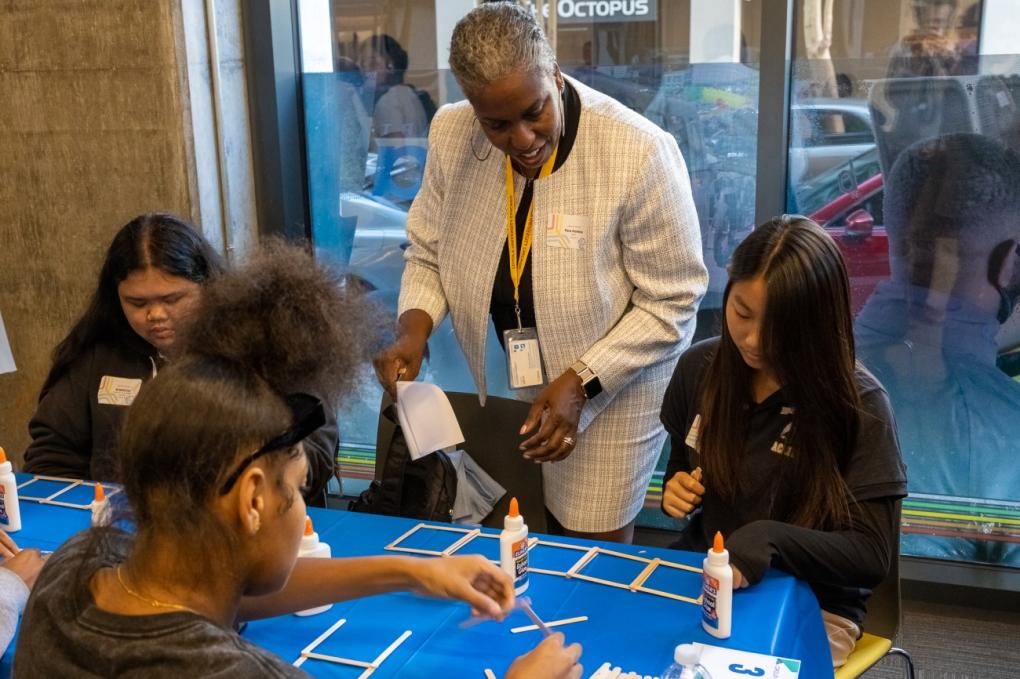
Tera Stokes-Hankins, Chief Transportation Officer at BART, assists attendees in building popsicle stick bridges during the Girls in Motion Fall 2023 Summit, hosted at BART Headquarters on Thursday, Oct. 19, 2023. Photo courtesy of Conner L’Hommedieu of Kimley-Horn.
At the end of the discussion, the young women engaged in a team STEM bridge-building activity with popsicle sticks that put their science, technology, engineering, and math skills to the test.
Arden Sorensen-Waod, a tenth grader at Piedmont High School, said she learned a lot of surprising facts at the summit.
“I’m interested in urban planning and community service. Maybe transit, too?” she said. Her biggest takeaway was realizing that “you can start in one field and end up in another one.” She was also excited that so many efforts were being made in the industry to connect with a younger audience.
As Powers noted during the panel: “Youth are the future of public transit. We want to hear your ideas – and we are listening and implementing them.”
BART has many opportunities for young people to learn about the transportation industry, including a robust Summer Internship Program (info flyer here) and youth tours, a program that is slated to relaunch in the late fall of this year. For more information, email [email protected].