
Search Results
Compassion in crisis: BART worker’s quick thinking, empathy help save a life
Senior operations foreworker Curtis Zedd Jr. photographed on July 9, 2021
By MELISSA JORDAN
BART Senior Web Producer
Curtis Zedd Jr., a born-and-bred Oaklander, does hard, physical work as a BART senior operations foreworker, troubleshooting problems on trains, his 6-foot-1 stature giving him a strong and commanding presence when emergencies arise.
And yet, it was his empathetic, compassionate, sensitive side that kicked in recently when he was credited with saving the life of a man having a mental health crisis, for which he received a commendation for outstanding service.
It was June 23 and Zedd had just checked in to start a shift at Millbrae Station. He noticed that two station agents were trying to talk to a man who was standing in the trackway between the running rails (the tracks the train runs on) and the electrified third rail, which powers the train and can be deadly if touched.
Zedd’s quick thinking kicked in and he got on the phone to the Operations Control Center, asking for the rail to the powered down, then he sat down on the edge of the platform, made direct eye contact with the man, and locked in his gaze.
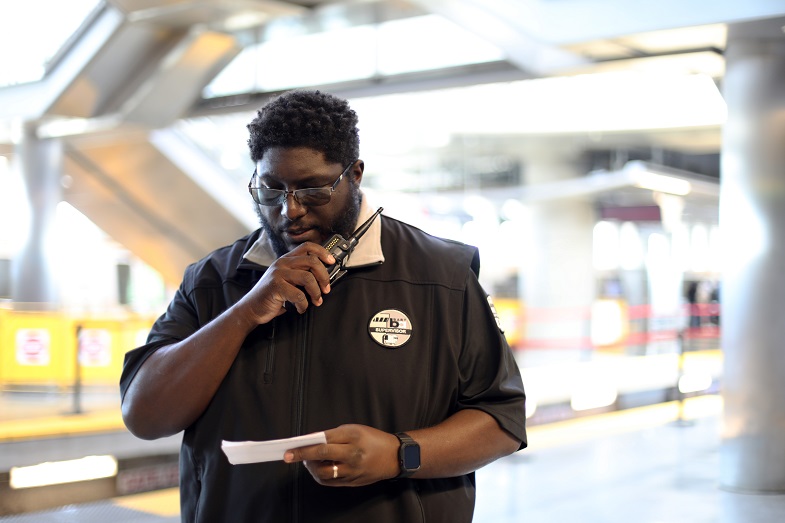
Curtis Zedd Jr. photographed using his radio during a shift at SFO Station on July 9, 2021
“The first thing I said to him was, ‘Is everything OK?’ “ Zedd recalled. “And he said, ‘No, I’m just tired. I’m tired of everything,’ And I asked him to tell me about what was going on with him. He said he’d already told it, that he’d told his whole story. And I said, ‘Well, you haven’t told it to me. Tell me what’s going on.’ “
The man, whom Zedd estimated to be in his late 50s, said he was a homeless veteran. He said he had nowhere to go, no hope, and just wanted “to end it all.”
“I told him that tomorrow would be another day. That he was able to wake up today, and now he would be able to wake up tomorrow and there would be another chance.”
“I just sat with him, and kept listening to his story,” Zedd said. “I told him, ‘This is not the way to go. We can get somebody out here to take you to a place to stay, to get you some help. I told him that he mattered, and also that his actions would affect a lot of people, people who would be hurt, who would be traumatized, by what he was trying to do.”
What’s especially remarkable is that Zedd stepped up even after having seen such traumatic situations already in his career. Many years ago, when he was working as a train operator at BART and just a few months out of training, a woman threw herself in front of his train at Montgomery Station; she survived. In another case a couple of years back on the Warm Springs line, he coaxed another person in crisis off the edge of the platform to safety.
Zedd doesn’t want to be called a hero, and said it was just instinct that kicked in. He went down into the trackway to be closer to the man at Millbrae after the third rail had been de-energized and trains were being held back.
“I told him, ‘Talk to me. You can vent. I’ll listen to whatever you have to say. Let’s just get out of the trackway. And in the end he calmed down.”
BART Police arrived soon and took the man to receive a mental health assessment.
“I’ve been in transit for 20 years, before BART at VTA, and unfortunately you see this in the rail industry, you see people at the end of their rope sometimes,” Zedd said. He has some close friends who were on site at the VTA yard the day of the recent mass shooting. He grieves for them, and for all who have been touched by such tragedies.
“These things affect a lot of us transportation workers,” he said. “It’s something that station agents deal with every day; they’re usually the first people to come into contact with anybody having a mental health crisis.”
“When we see people who are in trouble, who need help, we try to help them. We sympathize with them,” he said.
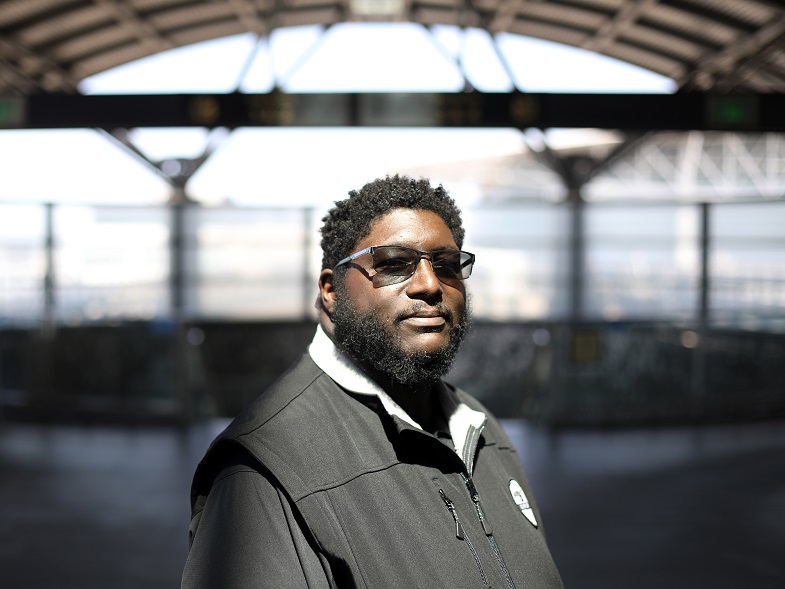
Curtis Zedd Jr. received a commendation for his outstanding work on June 23, 2021
The job of a BART operations foreworker involves supervising train operators and station agents, in addition to troubleshooting and attending to emergencies. It’s an incredibly stressful job, but Zedd said he loves his work.
“When I clock in, for the 8, or 10, or 12 hours I’m here, I try to have a good attitude,” he said. “I come in and do my job to the best of my ability. We all have a lot of respect back and forth.”
Zedd calls himself a “transit junkie” who has been riding BART all of his 41 years. His earliest BART memory is taking the train as a young boy from Coliseum Station in Oakland to 12th Street/City Center Station for the Christmas parade.
Operations Control Center Manager Shanon Matthews, who put Zedd in for the commendation, said he truly went above and beyond the call of duty. “We got a call from Curtis to de-energize the rail,” she said. “This person was very erratic, and Curtis kept the individual engaged in conversation. He kept him distracted and got him to turn away from the third rail. And he actually talked the guy back up on the platform and calmed the guy down. He was a strong, compassionate presence.”
BART Police Chief Ed Alvarez has recently created a Bureau of Progressive Policing and Community Engagement, which includes social-work-trained Crisis Intervention Specialists; you can find job listings for those positions at www.bart.gov/jobs. Because these crisis-focused workers can’t be in all places at all times, work like that of Curtis Zedd, the station agents who first interacted with the man in crisis at Millbrae, and others like them, are essential to BART, and to the wellbeing of all who use the BART system.
BART Board President responds to Regional Measure 3 results
BART Board President Robert Raburn issued the following statement on voter approval of Regional Measure 3: "I want to thank Bay Area voters for this investment in public transit that supports keeping the region mobile. I also want to thank the Metropolitan Transportation Commission for its leadership in
New BART and Uber in-app integration launches with discounts to get to and from BART
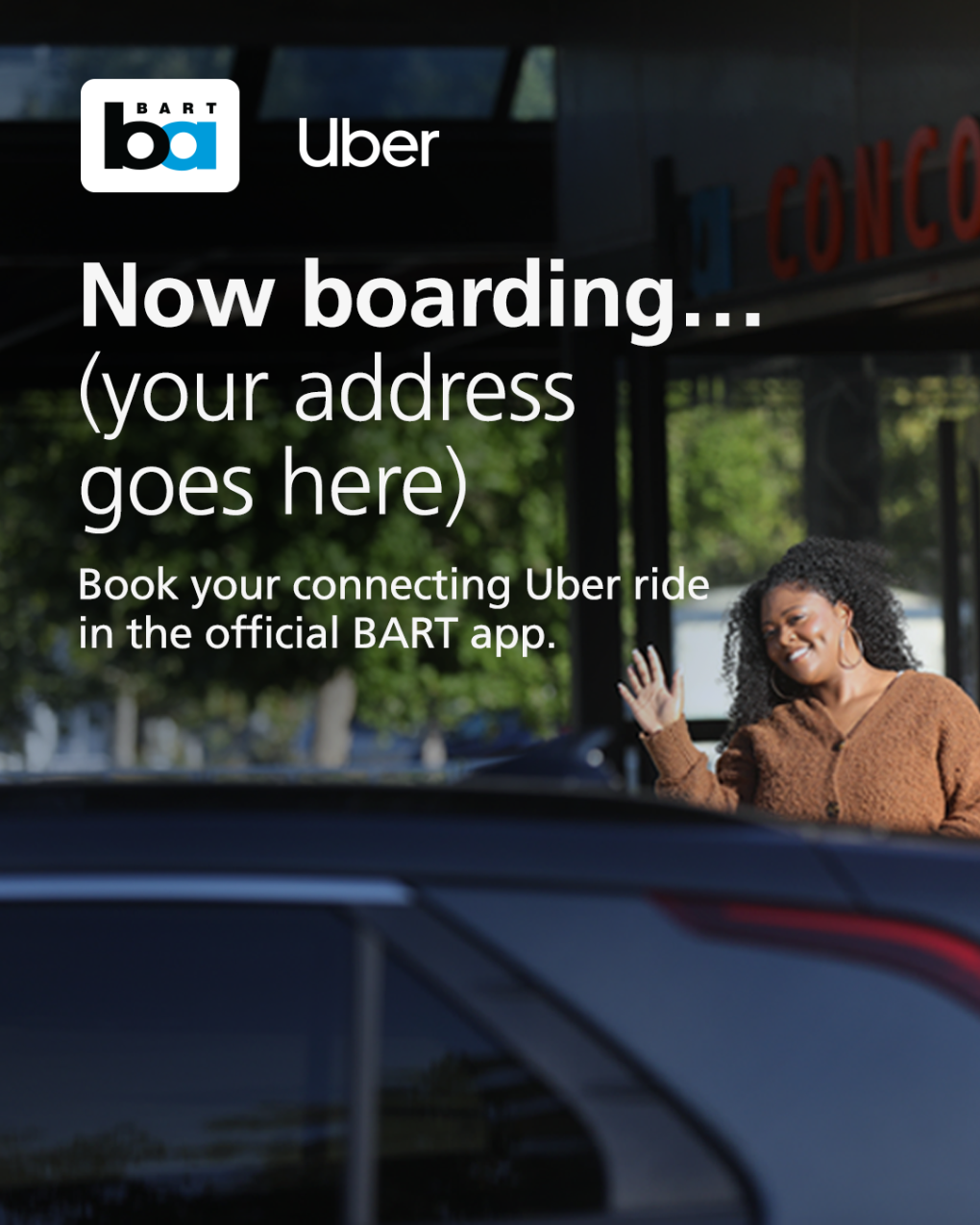
Bay Area riders can now plan and book short Uber trips — ranging from two to seven miles — to and from BART stations directly within the Official BART App. This exciting partnership between BART and Uber Transit is part of BART’s ongoing commitment to enhance the customer experience by expanding and modernizing technology solutions that offer riders more flexible, convenient ways to get where they need to go.
BART is partnering with Uber Transit to fully integrate seamless end-to-end journey planning and payment all within the BART app. Riders will no longer need to use multiple apps to plan their BART trip and plan and pay for an Uber ride. Everything can be done without leaving the BART app, and the total trip time will be displayed, making things faster and easier for users.
Uber Transit is focused nationwide on supporting transit agencies to provide low-cost paratransit trips and to solve first/last mile challenges. This new partnership addresses a key challenge within the Bay Area’s transit network: providing reliable connections for people whose starting location or destination is too far to comfortably walk to a station or bus stop or is underserved by frequent bus or rail service.
Read BART + Uber Integration FAQs here
“Embracing technology to help people leave their cars at home and reduce congestion is a shared value within the Bay Area,” said Bob Powers, BART’s General Manager. “Collaborating with Uber will help attract new riders and will simplify the process for those who take Uber to and from BART stations. This partnership will also expand access options as we build more housing in place of parking lots at stations.”
“Uber Transit is proud to partner with BART to bridge the crucial first/last mile challenge, helping transit agencies close gaps that too often keep people from getting where they need to go,” said Chris Margaronis, Head of Transit Partnerships at Uber. “By integrating Uber rides directly into the BART app, we’re simplifying travel, expanding access, and making public transit a more flexible, reliable option for everyone — especially those in underserved areas. Together, we’re reimagining how people move across the Bay Area.”
“No longer having to use multiple platforms to plan, book, and pay for a trip involving BART and Uber is a game changer for our riders,” said Ravi Misra, BART’s Chief Information Officer. “Providing this simple option on the BART app shows how innovation can improve access to BART and increase ridership.”
The BART and Uber partnership includes a special, limited time $5 Uber trip discount at the launch of the program for trips starting or ending at the following ten selected BART stations:
- Antioch
- Bay Fair
- Concord
- Daly City
- Fruitvale
- Lake Merritt
- MacArthur
- Richmond
- Walnut Creek
- West Oakland
Riders can take advantage of the special $5 discount up to six times over seven calendar days.
These stations were selected based on locations where people may not live on a bus line and in a way to ensure bus ridership is not significantly impacted. Great care has been taken to ensure sustainable and active modes of transportation remain featured in BART’s Trip Planner.
In addition to Uber trips, BART’s popular multimodal Trip Planner continues to include walking and biking options as well as other transit, bike-share, and scooter-share options for getting to and from BART stations. Riders can also customize preferences such as walking and biking speeds for planning their trips. To enhance regional transit coordination, BART’s Trip Planner includes the schedules for regional rail service, such as Caltrain, Capitol Corridor, and ACE, as well as buses, ferries, and cable cars. During times when BART is experiencing major service disruptions, transit riders can plan itineraries that don’t include BART as an option to help them get around.
Essential workers on BART: Meet the San Francisco SPCA's Daniel Malin
In the city of San Francisco, named for the patron saint of animals, the SF SPCA is providing essential services to animals for sick, urgent and emergency care visits during the coronavirus pandemic, and still helping animals find forever homes (by individual appointment).
To do so, the SF SPCA needs its workers, and those workers need a safe and reliable way to get to work. That's where BART comes in.
Daniel Malin takes BART from Oakland to his job at the SF SPCA's Mission Campus. He works in customer service so he might help intake an injured dog for emergency surgery, arrange for a foster pickup, or schedule a telemedicine appointment. (The SF SPCA is currently closed other than for emergencies or by appointment for adoptions or fosters, to allow for safe social distancing.) Malin also makes the rounds giving out belly rubs and chin scritches to the animals.
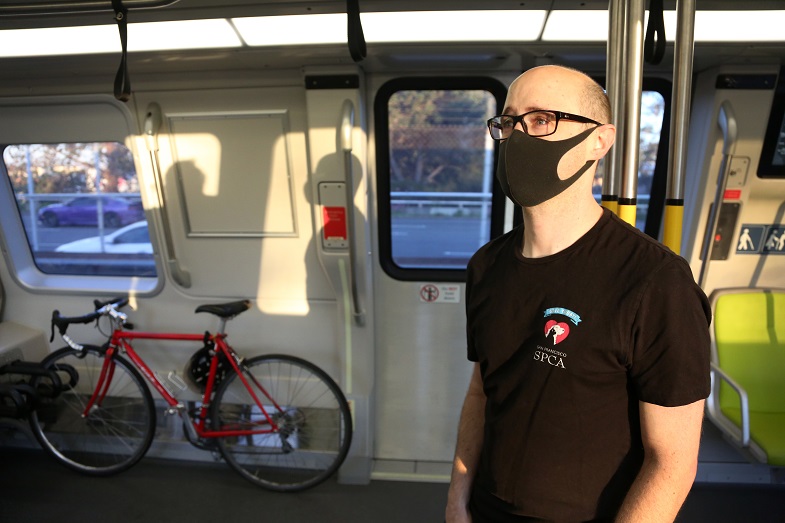
"BART takes me from MacArthur to 16th St./Mission, where I help people and their animals every day," he said. "BART is the cheapest and most reliable way I have to get to work," said Malin, who doesn't own a car. He takes the first train of the morning and works 10-hour days, so both ends of his commute have mostly had plenty of room for safe social distancing, he said.
"When I get off BART, the dogs and cats of San Francisco are counting on me to come to work," he said. "Because without people like myself who use BART, we couldn't run our services to help people and their animals in need."
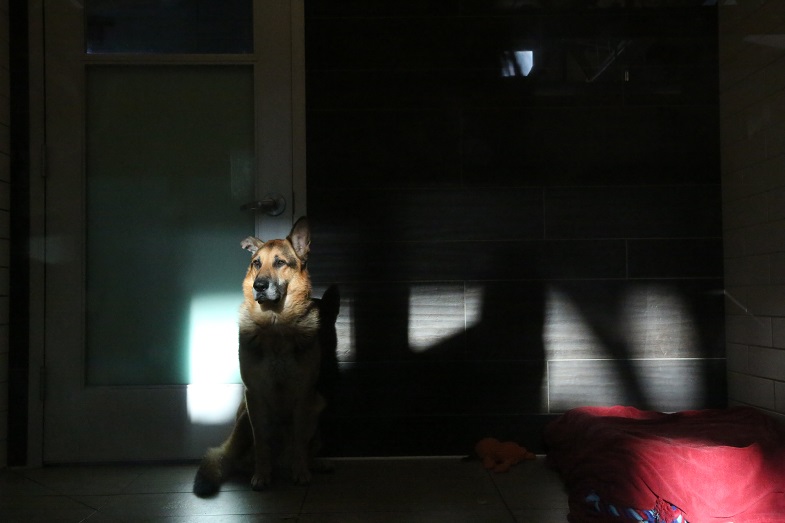 A very good pup enjoys sitting in the sunlight in one of the SF SPCA’s spacious rooms
The COVID-19 shelter-in-place order for the Bay Area classifies veterinarians as essential service providers. The SF SPCA is setting up telemedicine appointments for things that don't fall under sick, urgent or emergency care.
"COVID-19 has dramatically impacted our operations," said Krista Maloney, Communications and Community Engagement Manager for the SF SPCA. "Our adoption center has been closed since the shelter-in-place order went into effect, and most of our shelter animals are now in foster homes."
"Pets can be a great source of comfort during difficult and stressful times," Maloney said. "Studies suggest that spending time with an animal has many health benefits, like lowering anxiety levels. Having pets or a foster animal during shelter-in-place is often a win-win for both the animal and guardian."
Currently, foster pets are being placed with volunteers who have already completed training. If you would like to get on the list for training in the future, visit www.sfspca.org/foster and fill out the foster interest form.
"We’re still figuring out how best to move forward with adoptions while prioritizing health and safety, Maloney said. "If you’re interested in adopting a specific animal, email [email protected] to inquire about the current adoption process."
The SF SPCA is an independent nonprofit that is 152 years old. It is not associated with any national organization and does not receive any government funding. "We rely on community support, and we need it now more than ever. If you’d like to make a donation, please visit www.sfspca.org/get-involved/donate," she said.
Malin said every donation is appreciated for the SF SPCA's work helping keep people and pets together, safe and healthy. During a break between phone calls, he walked around interacting with the animals.
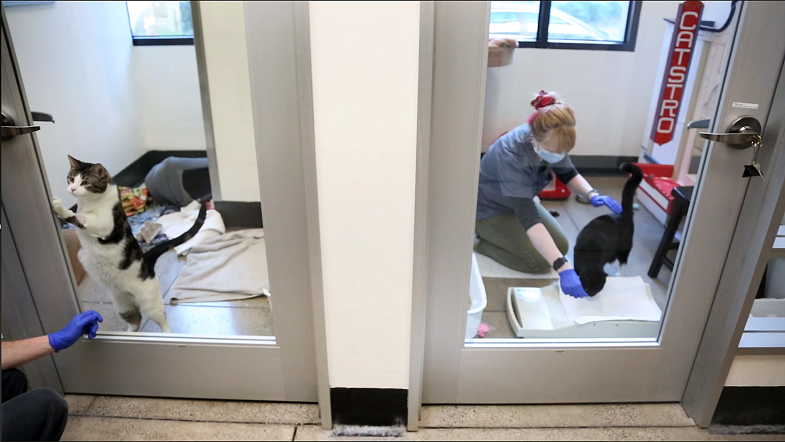
Romeo, a tabby mix adjusting on three legs after an amputation, followed Malin's finger as he traced it on the outside of the glass. In the next room over, another SF SPCA worker stroked and weighed a tuxedo cat.
"I've seen a lot of people help animals, and a lot of animals help people," Malin said.
Dr. Jena Valdez, Director of Community Medicine at SF SPCA, had a few tips for folks sheltering in place with their pets:
- Don't overdo it with walks; just because you have more time on your hands, your pet still needs rest time. "Exercise is great for everyone, but always in moderation," she said.
- The season for foxtails, which can lodge in pets' fur, paws or noses, is upon us, as is flea and tick season. Use preventatives and check your pet's coat after a walk.
- If your pet has behavioral issues, shelter-in-place may be a perfect time for concentrated focus on those. You can schedule a televisit with an animal behavioral expert.
- Always wash your hands before and after interacting with your pet.
- Always spay or neuter pets to prevent overpopulation.
- If you or someone you know cannot safely care for a pet, please contact an animal welfare agency so that another guardian may be found. Pets are sensitive creatures and should never be dumped or left behind.
- Don't shop, adopt. There are many healthy animals in animal protection agencies and shelters waiting for a home.
Do you know of an essential worker taking BART who is interested in telling their story? Tweet to us @sfbart and we may reach out to show the important jobs of essential workers and how BART helps them do their work.
BART Connects: A young woman from East Oakland says she "wouldn't be where I am today" without BART
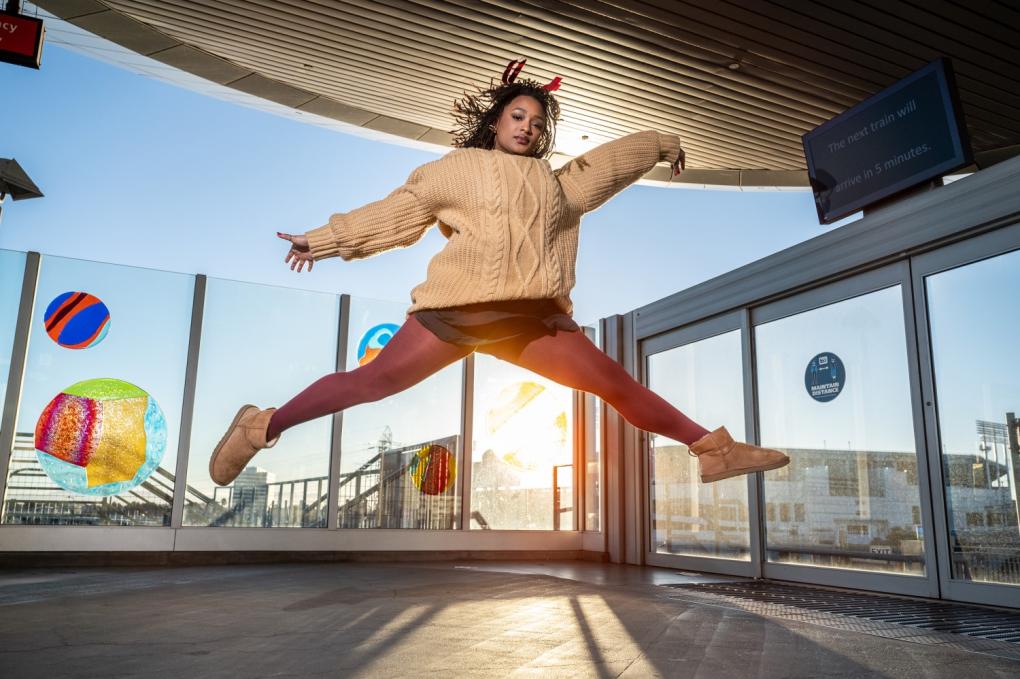
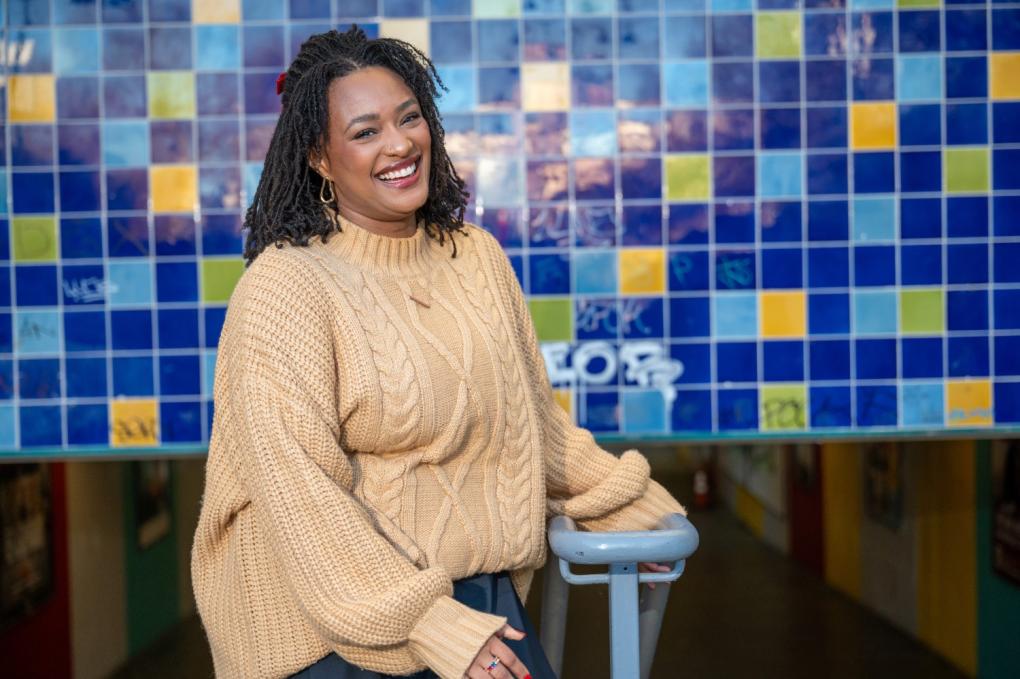
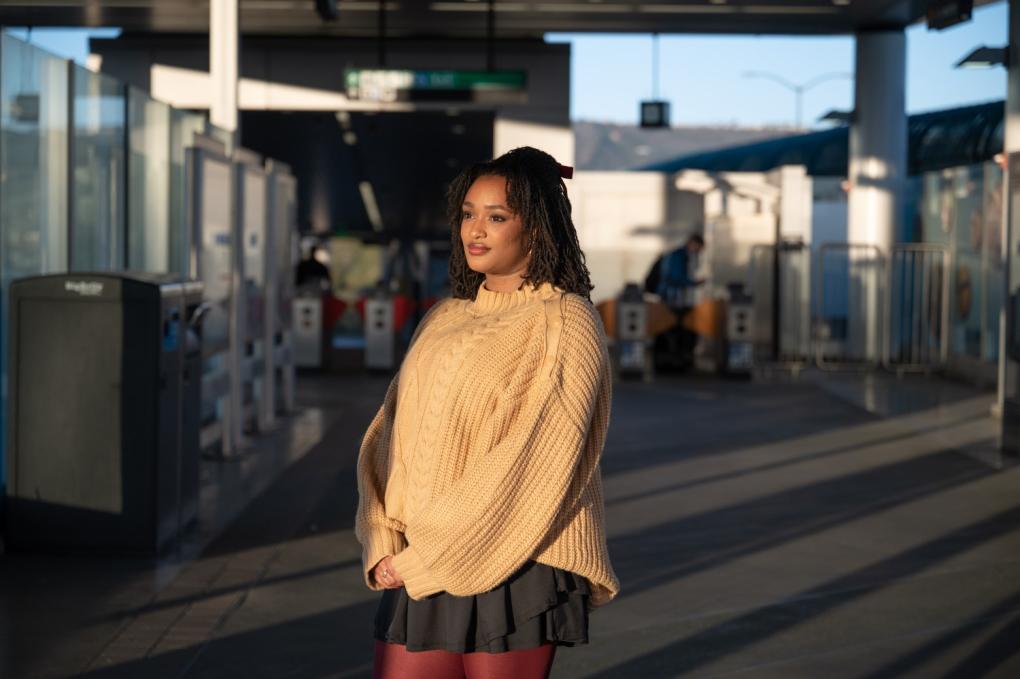
Erica Mitchell pictured at Coliseum Station.
BART runs like a thread through every stage of Erica Mitchell’s existence. You might say the system map is a tapestry of her life, woven with memories that stretch from childhood to maturity.
Mitchell grew up in East Oakland near Coliseum Station. The trains that departed every which way from the station were “lifelines,” she said, that carried her to novel places, experiences, and possibilities.
“At different points in my life, BART has meant different things to me,” said Mitchell, now 27 and living in San Francisco. “I wouldn’t have been as independent as I was as a kid without BART; I wouldn’t have been able to survive here; and I wouldn’t be where I am today."
In high school, Mitchell said BART was a symbol of freedom and autonomy. Her school was located in Portola Valley, and every morning, Mitchell would ride to Fremont Station then catch a bus to campus. It was a schlep, but during the ride, she found time to think and dream about the life she wanted to have.
Then, as a student at Laney College, Mitchell would travel from her apartment in San Francisco to Lake Merritt Station and walk to campus. On these trips, she timed her makeup routine with the ride; if she hadn't finished applying mascara when the train reached West Oakland Station, she was behind schedule. When she wasn't doing her makeup, she'd stare out the windows and draw the scenes on the other side of the glass.
Before she graduated, Mitchell started working for the Oakland Mayor’s Office. To get to City Hall, she sometimes had to empty a water jug filled with coins in the hopes that she could scrape together enough change to buy her fare to 12th Street/Oakland Station.
Mitchell still takes BART to work. But she also uses it for fun: to get to dance class in the Mission District, to hit the town with friends, or to catch up with her mom back in East Oakland. Mitchell is a self-described “night owl,” and on late nights with pals, she frequently finds herself racing to catch the last BART train. “It’s very Cinderella and her carriage,” she said laughing.
Mitchell has long understood the importance of public transit to the Bay Area, thanks largely to her late father. Before she was born, Mitchell's dad retrieved the cash and coins deposited in BART fare machines. Later, he operated buses for AC Transit. His bus route drove past Mitchell's childhood home, and some days, she and her mom would meet him at the closest stop to give him snacks and hugs.
Those early exposures to public transportation left an impression on Mitchell. Among friends, she is known as the “#1 BART fan,” but she prefers to call herself a “BART babe.”
BART has also connected her to love, she revealed, squirming slightly. The story goes something like this: During her BART rides to Laney College, Mitchell began to notice the same person on her train each morning. Later, she started seeing him in some of her classes.
“I was excited to see him on BART every morning. When else are you going to have uninterrupted time with your crush?” she said. Eventually, Mitchell and her BART crush started dating – “It was a good time while it lasted,” she said with a laugh.
As Mitchell described the BART meet cute, a lightbulb went off in her head. “There should be a dating car – singles only,” she joked. “You could call it Trainder, like the train version of Tinder."
One cannot deny that BART facilitates meaningful connections, she continued in a more serious tone. When public transportation is at its best, she said, it lays the groundwork for an interconnected region, and “that’s conducive to love, to community, to relationships.”
“Transit teaches you how to be in community with others," she said. “And from those interactions, you can learn to be more accepting and curious.”
About the BART Connects Storytelling Series
The BART Connects storytelling series was launched in 2023 to showcase the real people who ride and rely on BART and illustrate the manifold ways the system affects their lives. You can follow the ongoing series at bart.gov/news.
The series grew out of BART's Role in the Region Study, which demonstrates BART’s importance to the Bay Area’s mobility, cultural diversity, environmental and economic sustainability. We conducted a call for stories to hear from our riders and understand what BART means to them. The call was publicized on our website, social media, email blasts, and flyering at stations. More than 300 riders responded, and a selection of respondents who opted-in were interviewed for the BART Connects series.
Serial entrepreneur turned Station Agent reflects on his journey to BART
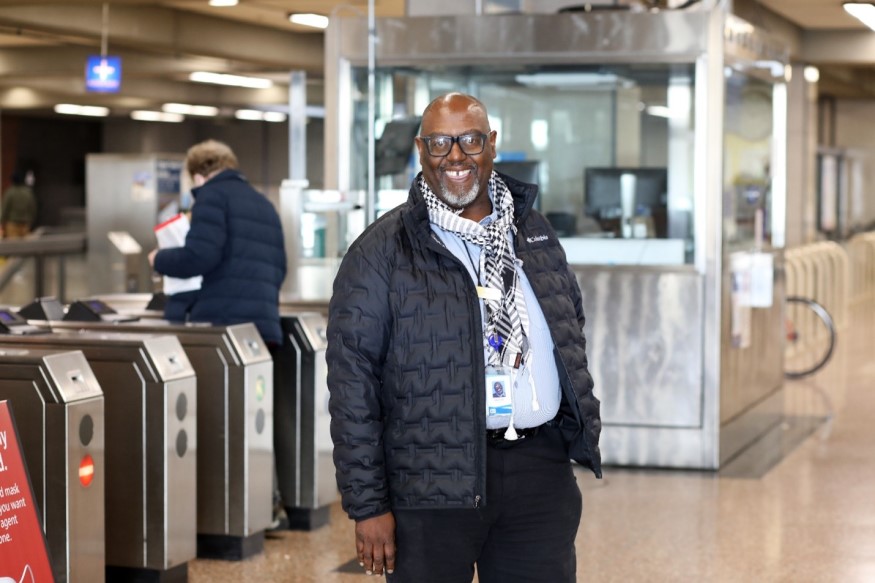
Update: Marcus is now a full-fledged Station Agent!
Marcus Dyer had been working at San Leandro Station as a Station Agent trainee for only a week when he noticed something happening. The same six people, every time they stepped inside the station, would wave and stop to chat with him.
“I wanted to become a Station Agent because it gives you the ability to be a part of a community,” Dyer said recently, speaking on a break from on-the-job training at Lake Merritt Station. “You see the same people every day, and sometimes you see them on their worst days. As a Station Agent, you have the opportunity to turn their day around and make it better.”
Dyer is one of 31 individuals training to become station agents at BART. Due to hiring needs, BART is currently running two certification classes concurrently of about 15 trainees each. During the 18-week course, which is held three to four times a year depending on hiring needs, the budding station agents learn about every aspect of the transit agency, including:
- District Operations Rules & Procedures
- Customer Service
- Administrative & Operational Procedures
- Station Facilities and Communications
- Automatic Fare Collection
- Ticket & Clipper Card Analysis
- Reports and Forms
- ADA
- Safety & Emergencies
- Opening and Closing Procedures
The course, which includes on-the-job training as well as classroom-based curriculum, culminates in a rigorous certification test. The current group of trainees is slated to take the test in May.
Dyer, a former student at San Francisco State University, has welcomed his return to the classroom.
“I’m the oldest kid in my class,” he said. “To be able to go back into a school environment and turn my learning skills back on…it makes me feel awesome.”
With age, Dyer said, comes wisdom.
“I’ve had a lot of life experiences and been in a lot of different situations, which helps put things into perspective,” he said. “I tell the younger folks in my class: You’ve been in harder situations than Station Agent training. Relax and try to enjoy it!”
Before embarking on his BART journey, Dyer was a “serial entrepreneur.” In his time, he’s owned a limousine company, an upholstery shop, and a catering business. During the first year of the pandemic, he made and sold more than 2,000 masks when he noticed they weren’t widely available in his community. He donated a mask for each one purchased.
Recently, Dyer felt it was time to make a change and find “more stable” work, especially work that provided benefits such as healthcare and retirement. His road to Station Agent was 20 years in the making, he said.
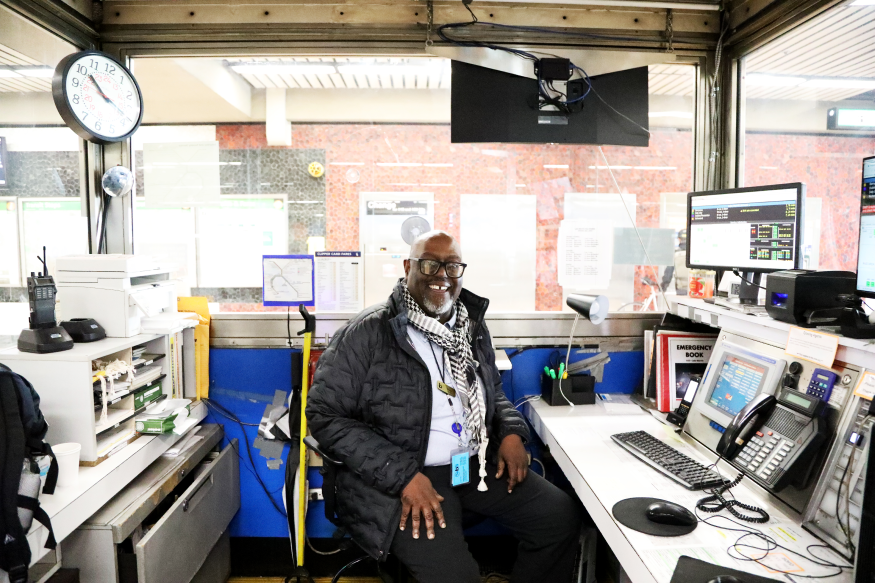
In the early 2000s, Dyer filed an application to become a BART Station Agent. He made it through the first two stages, but never took the final test.
“I don’t really remember why I didn’t take it. It probably had something to do with my job at the time,” he said. “But it’s always been in the back of my mind that I should have been working at BART 20 years ago.”
Dyer said he was drawn to the role of Station Agent because of his “love for people.”
“To be able to help people while making a living that allows me to take care of myself and my family…it’s a beautiful thing,” he said. At home, he has an eight-month-old Dogo Argentino named Taylor – “She already weighs 75 pounds!” he said with a laugh.
According to Dyer, the Station Agent role “is the hardest job at BART.” That’s why he’s trying to “learn everything” he can about the system – a system he’s been using since he was a child growing up in Oakland.
BART has played a large role in Dyer’s life, and many of his formative memories circle around a station. His church sits right across from MacArthur Station, for example, and he grew up looking at the station and its trappings from the pews. In college, he took BART every day to San Francisco for class. His heart, however, will always reside at Coliseum Station.
“I’m a big A’s, Warriors, and Raiders fan, so I’ve been using that station since I was six years old,” Dyer said. “I’ve probably done hundreds of tailgates in the parking lot.”
Ahead of the final test in May, Dyer is optimistic about what his future at BART might hold. He said the transit agency is “one of the greatest places in the world” for folks looking to embark on a second career.
“If you put your effort into it, you will have the opportunity to succeed,” he said. “I truly don’t know any other place like this, where you can interact with people all day and also make a great living.”
Take BART to Oakland Pride Sat. 8/31
Join BART this Sunday, August 31, for Oakland Pride parade and festival. The parade begins at 10:30 am at 14th and Broadway and ends at Broadway and 20th. The festival opens at 11 am. Look for the BART booth and BARTmobile. We'll have extra personnel at our downtown Oakland stations and the first trains on
BART Director Melissa Hernandez, BART’s first Latina board member, brings a wealth of expertise to her leadership
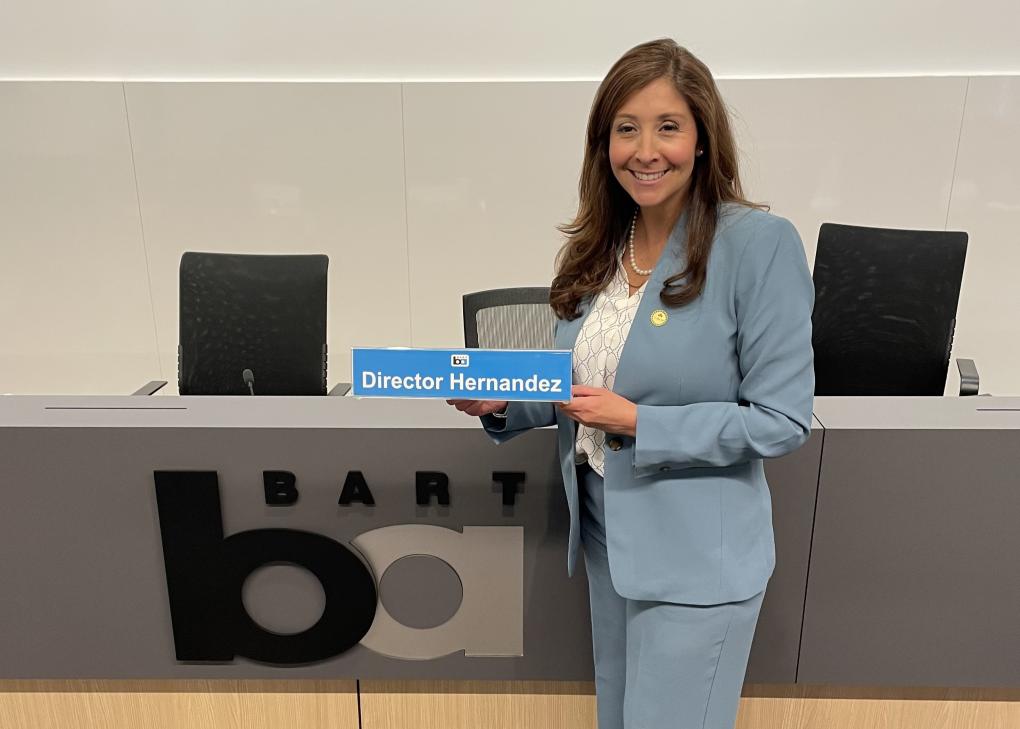
BART Director Melissa Hernandez in the BART boardroom after her appointment to the BART Board of Directors.
This Hispanic Heritage Month, BART is proud to celebrate members of the BART District of Hispanic and Latino heritage, who enrich our organization and the community at large. Over 15% of BART's workforce identifies as Hispanic and Latino, and we have been celebrating them throughout the month with stories, gatherings, and acknowledgements.
Read a profile of BART's new Director of the Office of Civil Rights Rudy Garza here and a profile of Aileen Hernandez, BART Interim Manager for Grants & Funding Advocacy Division here.
Director Melissa Hernandez is becoming accustomed to being “the first.”
She was not only the first Latina to be elected Mayor of Dublin, making her the first Latina mayor in the history of the Tri-Valley, she is also the first Latina to serve on the BART Board of Directors following her appointment as BART Director of District 5 this spring.
“Wow, BART, it took fifty years,” Hernandez said with a laugh. It was five decades too many, but Hernandez, a working mom from an immigrant, working-class background, is already bringing her unique experiences to make BART more responsive and accessible to every one of its riders.
“It makes me emotional. Neither one of my parents graduated high school,” she said. “To have gotten where I am now is really important for my family, for the girls who feel they will not get anywhere because they’re struggling in school and don’t have the right resources. I want to continue to uplift the future generations of women leaders and make certain that all of our institutions are meeting the needs of our region’s many constituencies.”
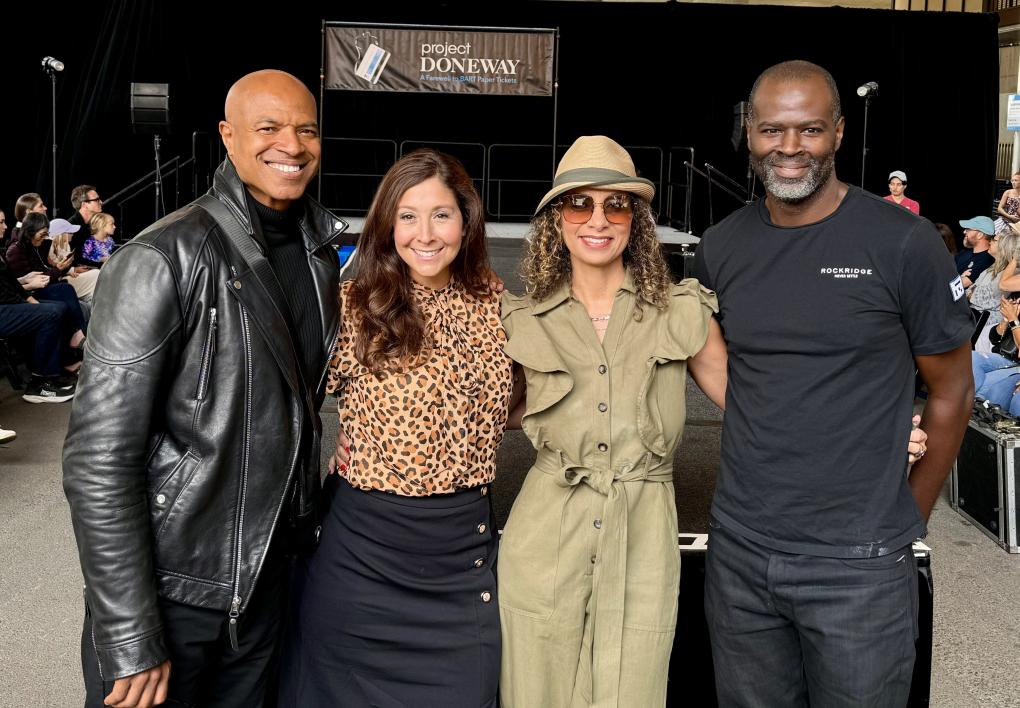
Director Hernandez (second from left) is pictured at BART’s Project Doneway fashion show with the judges Charleston Pierce, Mary Campbell, and Randy Wells.
Hernandez grew up in a large, loving family with solid working-class roots. She still remembers her parents waking before the sun rose to work in the fields and them returning in the afternoon to take care of the children.
“That is where I get my work ethic and drive for leadership,” said Hernandez.
She continued: “As someone from the immigrant tradition and a working mom myself, these early experiences drove me to support our public schools, improve our communities, and make certain that all working families have access to jobs. And part of that access means being able to get to a job on time, through a reliable, affordable transportation system!”
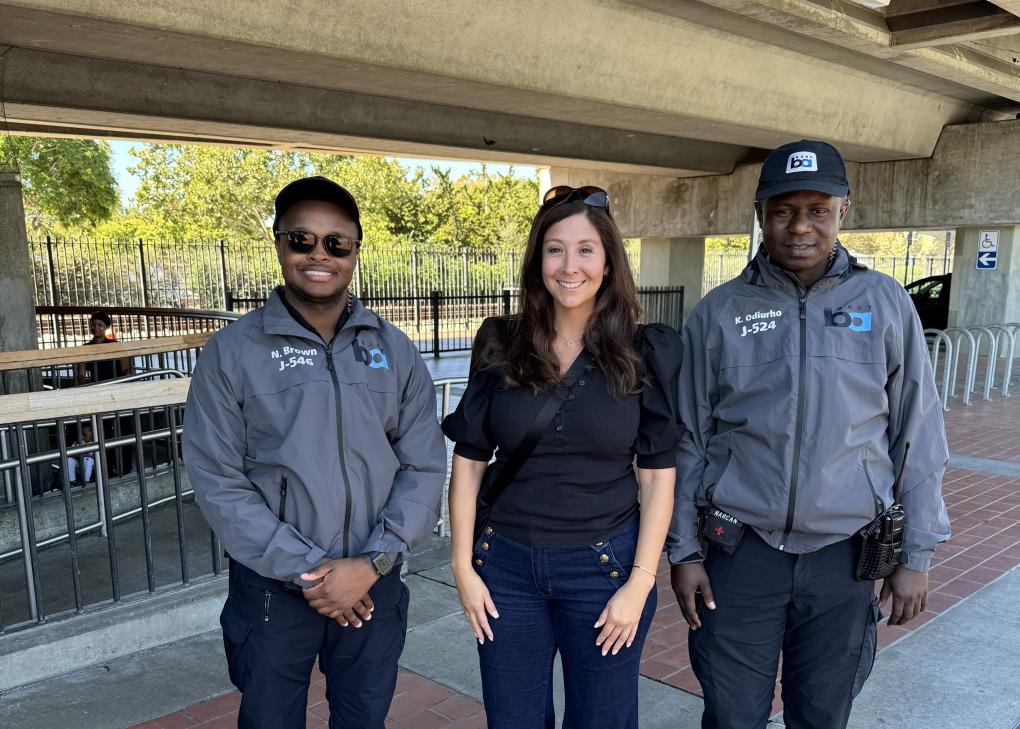
Director Hernandez with Transit Ambassadors Nequavis Brown and Kingsley Odiurho at Hayward Station.
Hernandez has made championing public transportation the core of her professional life. She has served on numerous transit boards, including as the chair of the Tri-Valley Regional Transportation Authority and the Tri-Valley/San Joaquin Valley Regional Authority.
You might say transportation runs in Hernandez’s blood. For the majority of his life, Hernandez’s father worked as a truck driver. In fact, at 74 years old, he is still at it, though he's driving small hauls now.
“My father has the strongest work ethic I know,” Hernandez said. She remembers taking her dad’s old 18-wheeler for a spin – a memory that has stuck with her now that she’s embedded in the transportation industry.
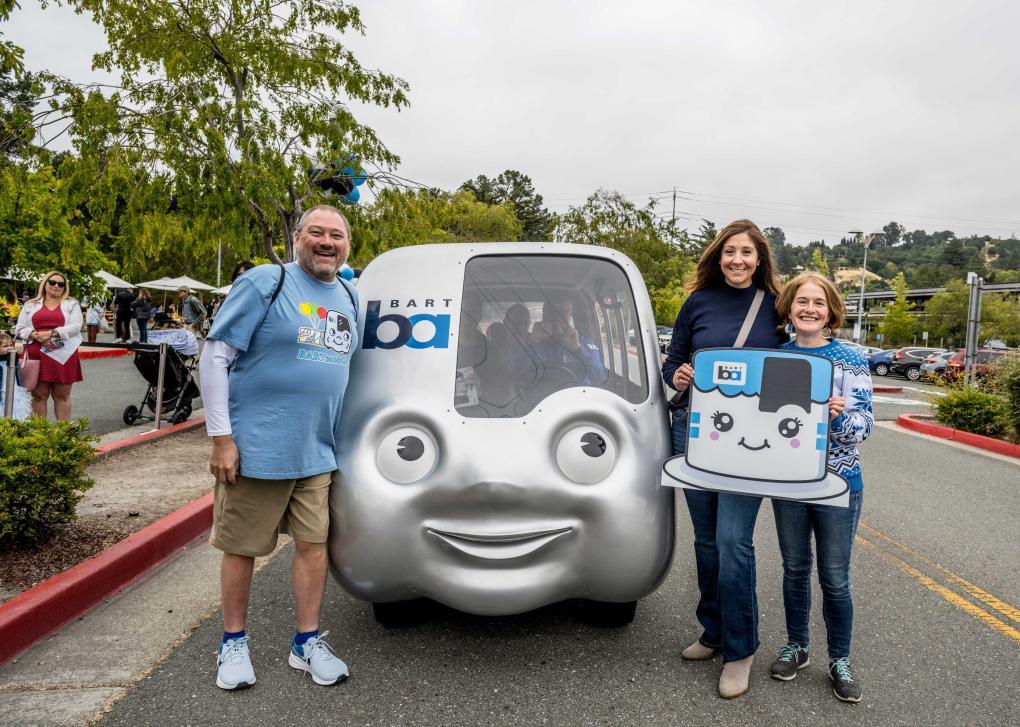
From left to right: BART board members Mark Foley, Melissa Hernandez, and Rebecca Saltzman are pictured at the BARTmobile's 20th Birthday Party at Orinda Station.
“It is so difficult to drive those things,” she said. “It takes a ton of practice. The same goes for driving those big city buses and BART trains!”
Much like her father’s ever-shifting truck routes, Hernandez’s life has had its twists and turns.
In her teens, she worked at small businesses, including scooping ice cream and working as an office manager at a dental office. Those early work experiences at small local businesses drive her philosophy as a BART board director.
“COVID was a wake-up call for BART,” she said. “It gave the organization time to get back to the basics of quality service, safety, and cleanliness for our customers.”
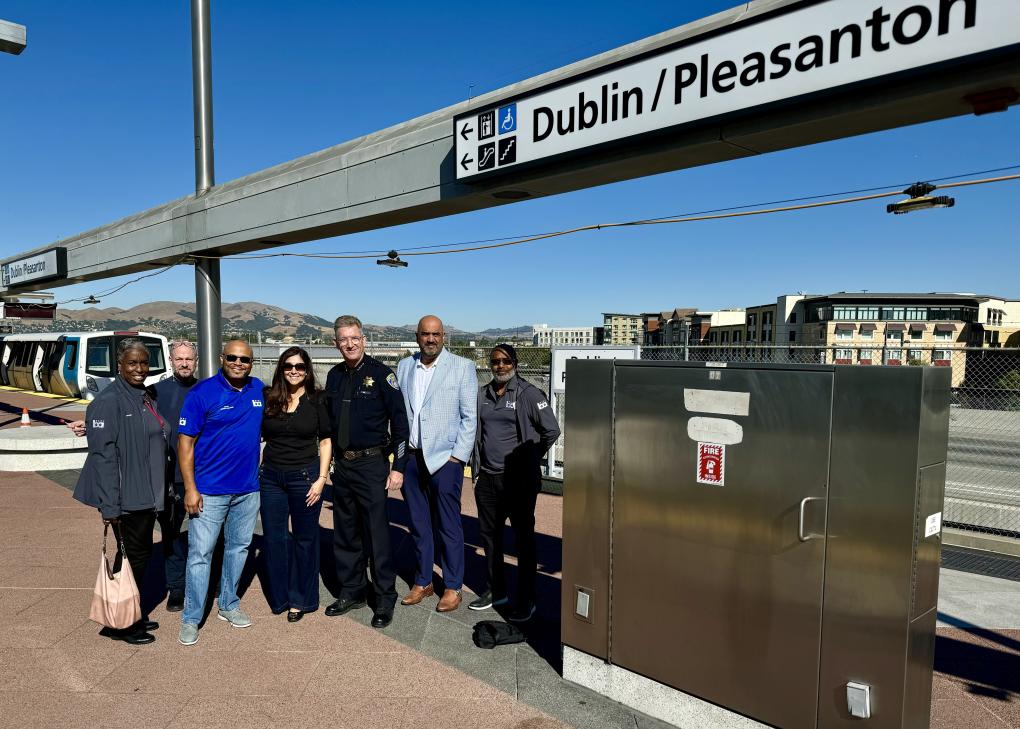
From left to right: BART Chief Transportation Officer Tera Stokes-Hankins, Assistant Chief Maintenance Officer Greg Lombardi, Deputy General Manager Michael Jones, Director Melissa Hernandez, BART Police Chief Kevin Franklin, BART Police Lieutenant Jaswant Sekhon, Assistant Chief Transportation Officer Eric Matthews.
Being a Latina in a position of power has not always been easy. As Hernandez wrote in her application for the BART Board: “I am well acquainted with being the only person who looks like me, or who has my experiences, in any room I enter.”
Rather than shrinking when she walks into those rooms, Hernandez is focused on elevating her unique experiences and building common ground in these polarized times.
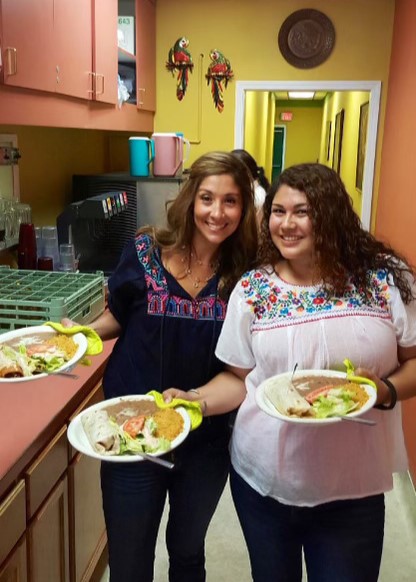
Director Hernandez with Alameda County Supervisor Elisa Marquez at Marquez’s family’s restaurant in Hayward.
“It is important to have many diverse groups of people at the table – and not just different genders, orientations, and ethnicities, but people from different upbringings,” she said. “Much of who we are stems from our childhoods and how we were raised. I am always trying to bring forward the values my parents imparted.”
One such value is mentorship.
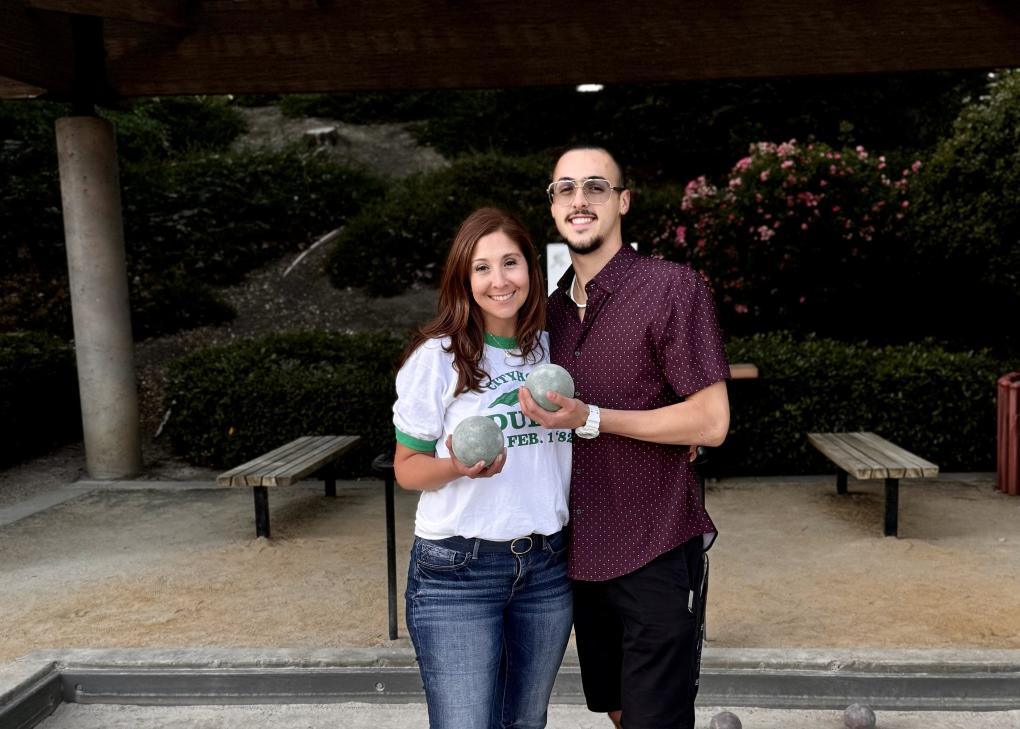
Director Melissa Hernandez with her son.
At the dental office where Hernandez began working as a teenager, she learned the impact a consistently supportive role model can have on your life.
“The solo dental practitioner really took me under his wing, and it spurred my first career in the health services,” she explained.
“Really, it was the folks—whether my parents, small business owners, and other women in leadership— who helped me along the way and made me the person I am. And now that I am here, I want to give back to the communities I serve and most importantly, allow my daughter and other little girls to dream about all that they can accomplish and contribute.”
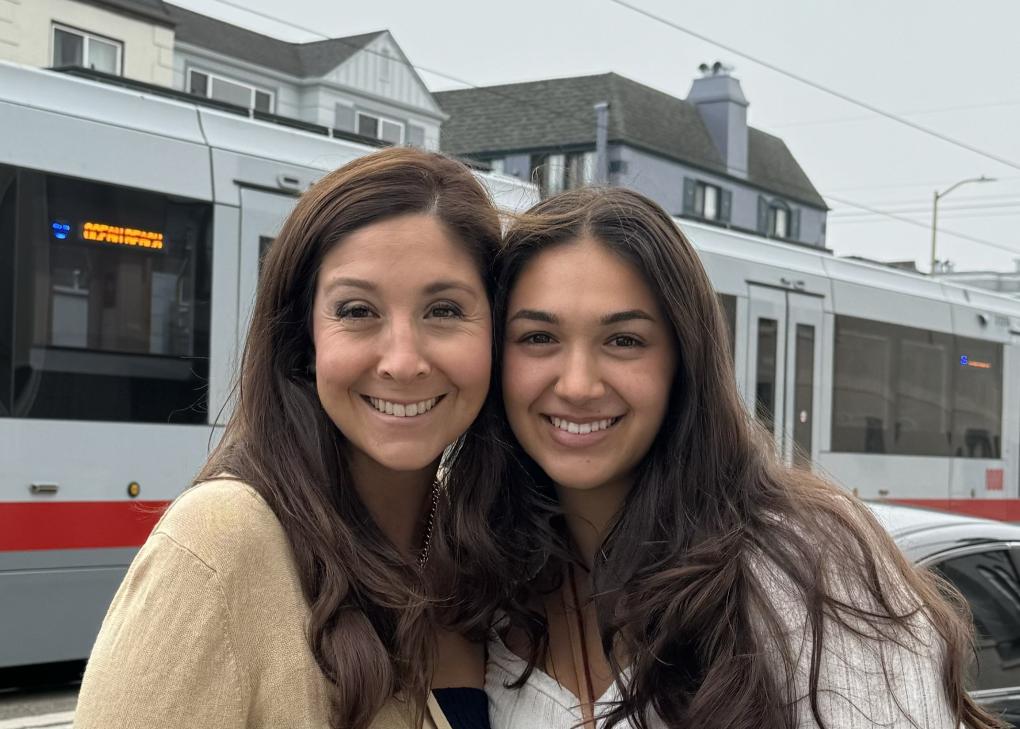
Director Hernandez with her daughter in San Francisco.
BART year to date crime stats through June
Click here to view year-to-date crime stats through June 2018. Overall crime at BART has remained flat this year with 1662 Part 1 crimes year-to-date in 2017 and now at 1,659 year-to-date in 2018. BART Police has been making steady progress with its officer recruitment campaign. Under Chief Rojas, our officer